
A fast, dynamic, playful and chatty game
AIM: To create a fun, engaging, and creative game to reveal and capture how tweens use and imagine spaces (in Trumbull Hall Park or other Chicago Housing Project).
what is scribbly situation?
Scribble a situation in 60 seconds, then find what’s similar and what’s unique in everyone’s drawings. You all decide what counts — just make sure your explanation impresses the Mayor! So think fast, draw bold! Most points wins.
where?
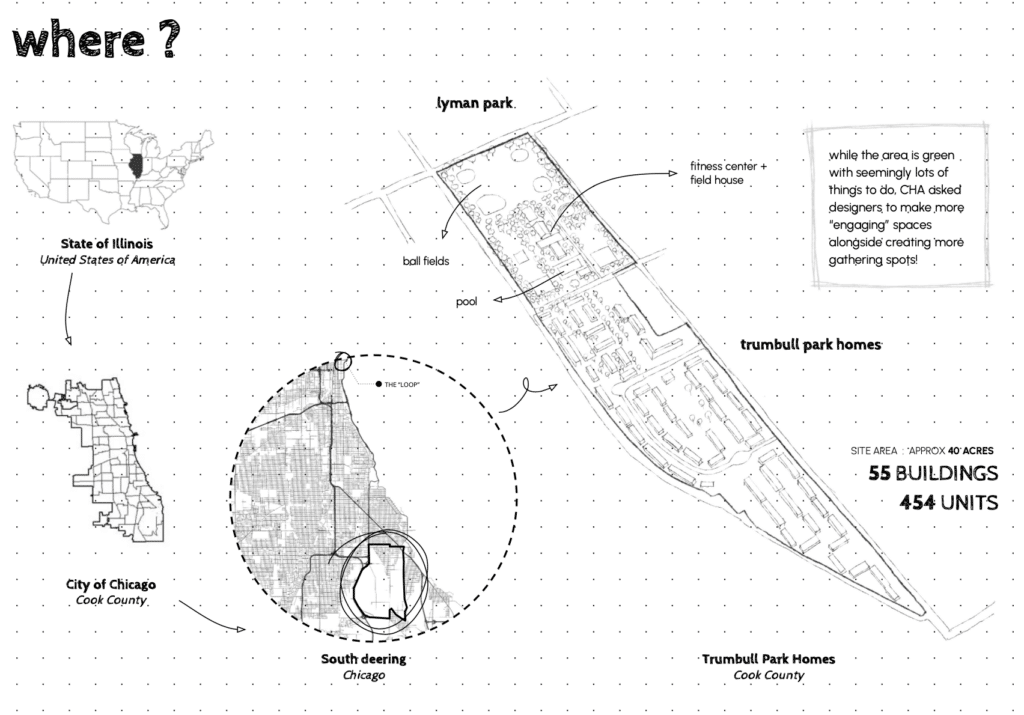
why?
a day-to-day data gap
We have lots of data about Chicago, the South Deering, and Trumbull Hall on a macro-scale
City Planning documentation and studies, scientific reports, historical accounts and records
We lack data on the day-to-day realities of who lives there
A lack of formal and informal information of events, activities, non-historically important stories
our goal
To create a game that allows us to see how the residents and users of Trumbull Park experience and use the spaces around them.
why tweens?
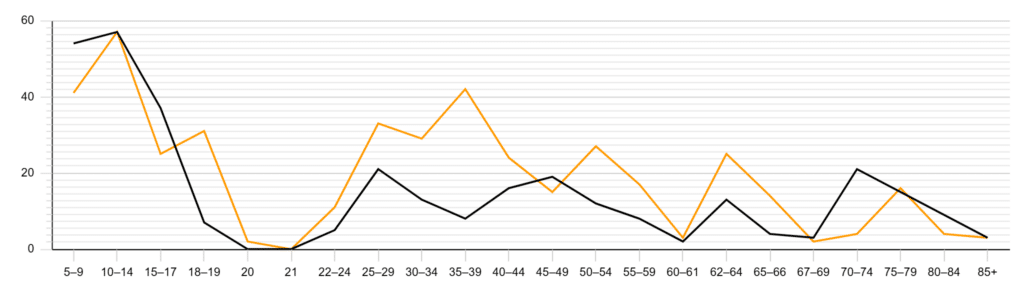
Focusing on tweens (roughly ages 9–12) in Trumbull Park is strategically important for our urban design research The reasoning sits at three levels: demographic reality of the site, participatory design gaps, and long-term community transformation.
- Are old enough to move independently through the neighbourhood
- Use parks, paths, courts, and open spaces without constant parental supervision
- Are the primary users of informal outdoor space (playgrounds, sidewalks, lawns, courts)
- A “unifying” user group to design for – activating spaces for all ages as the “social hinge” of the park!
AIM: To create a fun, engaging, and creative game to reveal and capture how tweens use and imagine spaces (in Trumbull Hall Park or other Chicago Housing Project).
HOW TO PLAY
Scribbly Situation
A fast, dynamic, playful and chatty game
AGE 8+ PLAYERS 4 – 6 MINUTES 30+
AIM
Scribble a situation in 60 seconds, then find what’s similar and what’s unique in everyone’s drawings. You all decide what counts — just make sure your explanation impresses the Mayor! So think fast, draw bold! Most points wins.
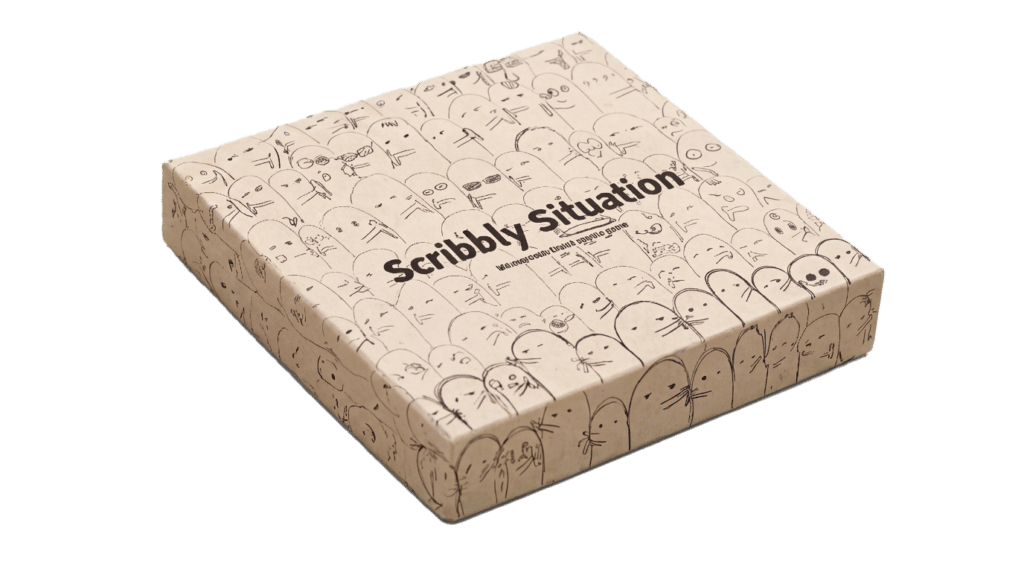
WHAT DO YOU GET IN THE GAME BOX?
2 Decks of Situation Cards — a Reality Situation deck and a Fantasy Situation deck with questions that tell you what to scribble
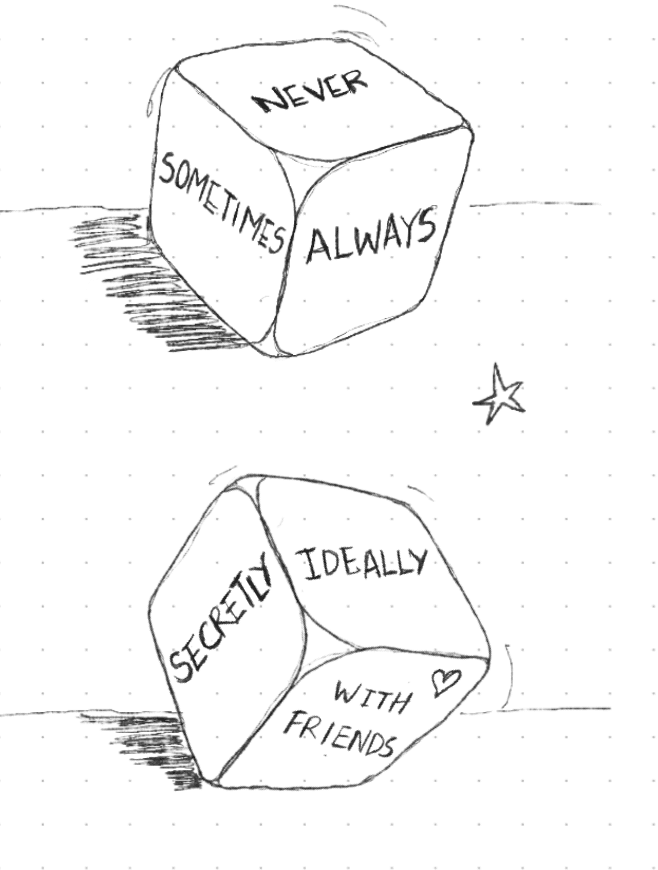
A Vibe Dice — 6 faces that each add a different twist to the situation: Always, Never, Sometimes, Secretly, With Friends, Ideally
2 Decks of Location Cards — a Reality Location deck and a Fantasy Location deck, which tell you where the situation happens
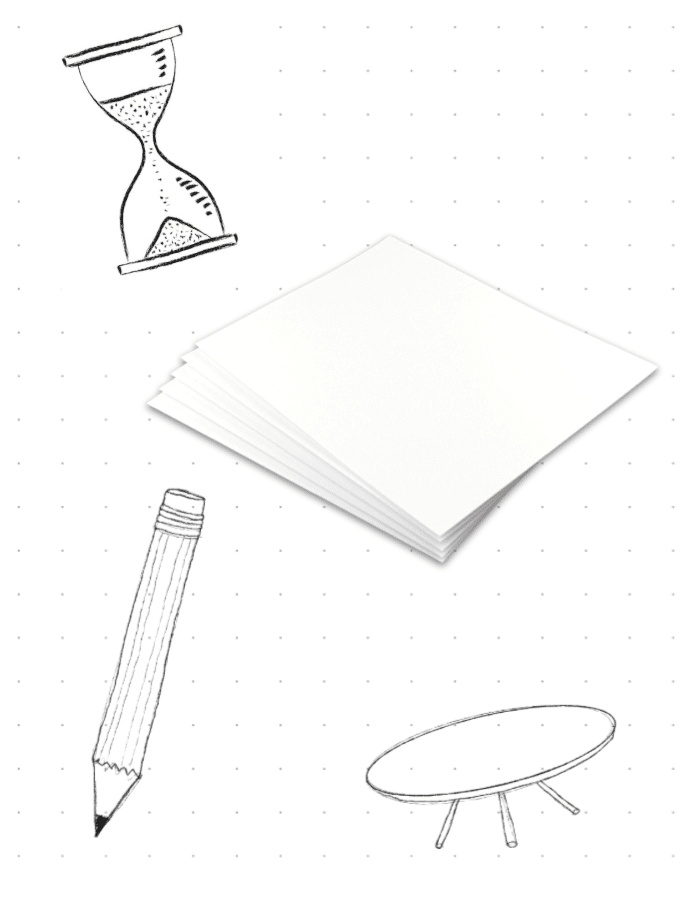
A Score Pad — one sheet per round to log everyone’s points
A Scribbling Pad — paper to draw on. Don’t forget to use both sides!
A Box of Pencils — for scribbling
A Sandglass — 60 seconds. That’s all you get!
TWO WAYS TO PLAY!
For fun — use both the Reality and Fantasy Cards together for wilder, more unpredictable situations.
For understanding your neighbourhood — use only the Reality Cards. This version helps adults and community researchers learn how people actually experience and imagine the spaces around them.
BEFORE YOU START
Take a piece of paper and pencil from the box. The youngest player starts the round by becoming the Mayor.
GET READY TO SCRIBBLE !!
01
PICK A SITUATION CARD — The Mayor picks one Situation Card, which reveals a question with two blanks.
Example:: “In _____, where would you _______ hang out after school?”
02
VIBE DICE and LOCATION CARD — The Mayor rolls the Vibe Dice and picks a Location Card to fill in the blanks of the Situation Card.
03
SCRIBBLE! — The Mayor turns the Sandglass to start the timer and everyone (including the Mayor) begins scribbling! You now have 60 seconds to draw the situation.
04
EXPLAIN — Starting from the person on the right of the Mayor, each player explains what they drew and why. The Mayor goes last!
05
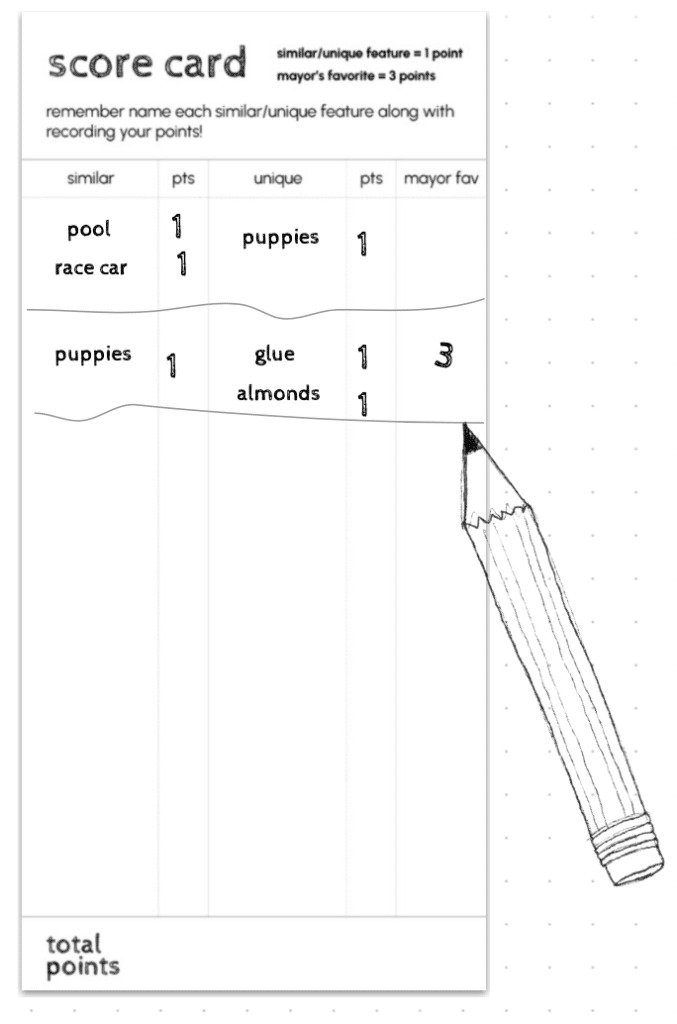
IDENTIFY and SCORE — Identify what’s similar and what’s unique in each other’s drawings. Each player gets one point for every identified similar and unique thing in the drawing.
Example:
If it’s the same kind of thing — like a drawing of a basketball hoop or a park bench — it counts as similar.
If only one person drew it and nobody else did — like a trampoline or a treehouse — it counts as unique.
It can get a little crazy — but remember, you all validate what’s similar and what’s unique!
06
MAYOR POINTS — Time to use your power, Mayor! Pick your favourite explanation of the drawing, which will receive 3 extra points. The only rule? You can’t pick yourself. Being Mayor means being fair!
07
CONTINUE —The person on the right of the Mayor becomes the New Mayor and the game continues.
A Round of Scribbly Situation is completed when every player has become the Mayor once.
WINNING
After one round, the player with the highest points WINS! If there’s a tie, the tied players get 60 seconds to draw their favourite character from a fantasy world, it could be Harry Potter or Tom and Jerry. The youngest person chooses their favourite to find the winner.
Play Test
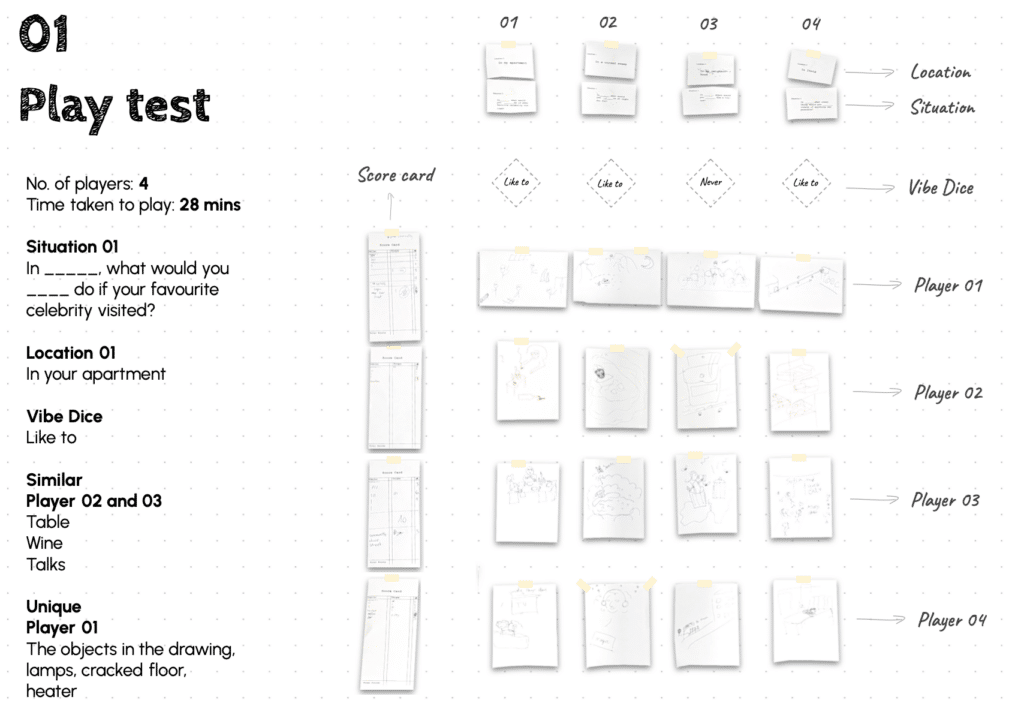
Observation from Test 01
Reflections from Test 01
The playtest confirms that the game produces a chatty, playful atmosphere, and we understand that this is where our data lies, in the conversation.
The game has the potential to reveal socio-spatial insights into participants’ everyday lived realities, habits, and environments in a non-intrusive, playful way.
Player 01: Objects in their home like lamps, heater, crack on the floor
Player 02: Habits or behaviours
Player 03: Activities like cooking food, candle light dinner
Player 04: Activities like watching tv
- Unclear Scoring System: What is unique became a question at times.
- Location Card Confusion: In my apartment, is the apartment of the person reading the prompt?
- Unclear design of the Scorecard.
- Not so fast: Took longer than expected!
- Balance between Fantasy and Reality situations.
Game Play :
how can it be implemented ?
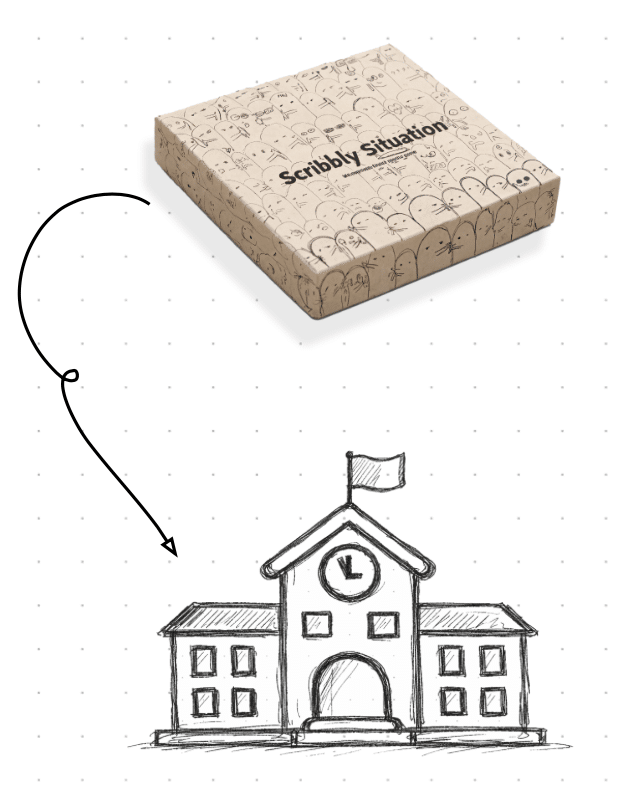
Ideally, the game is facilitated by urban planners, designers, or leadership involved in the project being used to collect data.
In our project, the game would be proposed and sent to the CHA team.
The CHA on-site team would reach out to local elementary/middle schools (Orville T. Bright Elementary) about running short workshops to play Situational Scribbles.
The CHA on-site team would facilitate the game in classrooms alongside teachers, and teach kids the game alongside recording observations and qualitative data points in conversations/drawings.
how would it be used ?
day-to-day understanding
While the game embraces play, its outcomes reveal how tweens navigate, imagine, and claim space — generating insights that directly inform realistic planning and design interventions.
Generate ideas for real design implementation
Navigate and claim local spaces
Envision futures for their environment
Perceive and interact with place
Sources:
Ask Lisa: The Psychology of Parenting. (2024). The new edition of Untangled by Dr. Lisa Damour | Episode 205 [Video]. YouTube. https://www.youtube.com/watch?v=VEXoUQJY2nw
Chicago Housing Authority. (2025, December 15). Our House: Let’s talk about CHA’s FamilyWorks services program! [Podcast episode]. CHA News. https://www.thecha.org/news/our-house-lets-talk-about-chas-familyworks-services-program
Chicago Housing Authority. (2025, November 10). Our House: Let’s talk about CHA’s youth opportunities program! [Podcast episode]. CHA News. https://www.thecha.org/news/lets-talk-about-chas-youth-opportunities-program
Damour, L. (2016). Untangled: Guiding teenage girls through the seven transitions into adulthood. Random House.
Hutton, D., Herrington, S., & Brussoni, M. (2022). Seven cs for tweens: Design principles for children aged 10-13 in the urban landscape. Children, Youth and Environments, 32(2), 1-34. http://www.jstor.org/action/showPublication?journalCode=chilyoutenvi
Sousa, M. (2022, March 18). https://ludogogy.professorgame.com/co-creative-experiences-serious-games-for-spatial-planning/
Statistical Atlas. (n.d.). Age and sex in Trumbull Park, Chicago, Illinois. Statistical Atlas. https://statisticalatlas.com/neighborhood/Illinois/Chicago/Trumbull-Park/Age-and-Sex
