
The Gaudi Tower : Podium
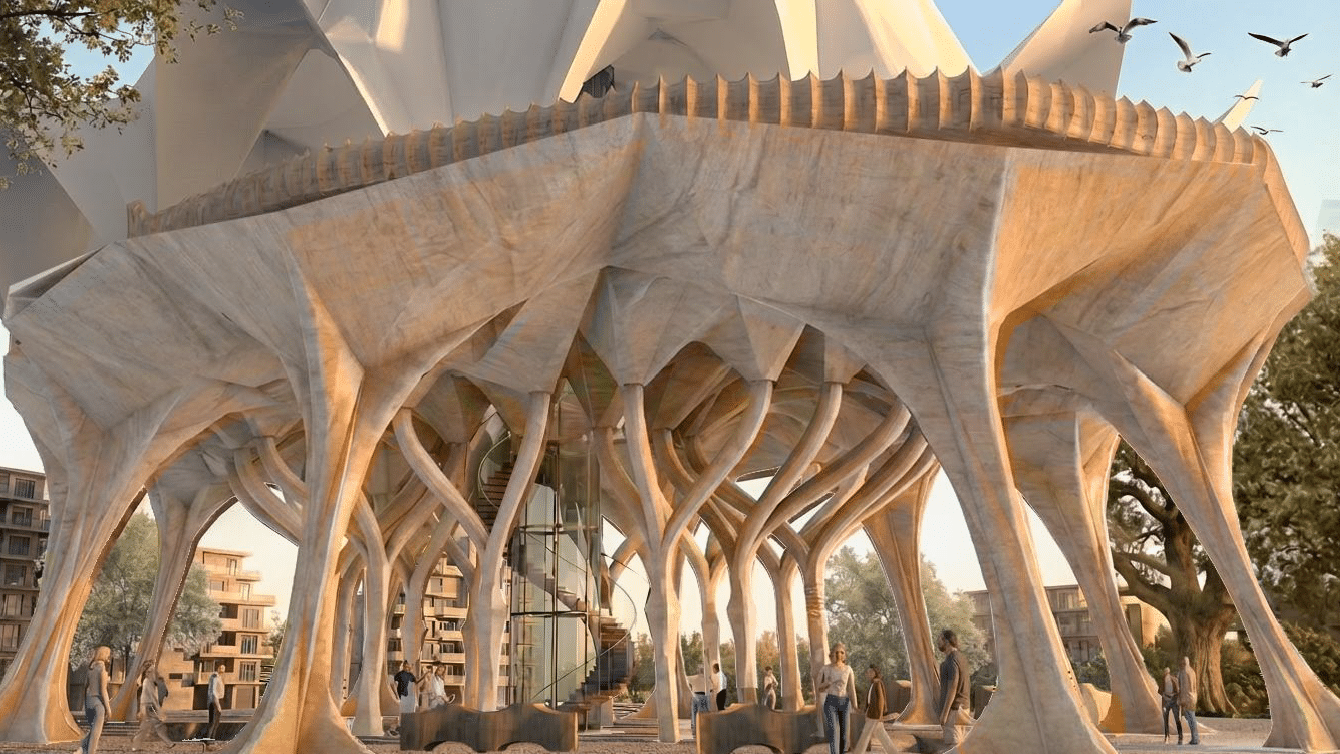
COLUMN LOGIC CEILING DESIGN DEVELOPMENT FLOOR DESIGN LOGIC FABRICATION PROCESS

Deep diving into Gaudi’s Algorithmic Legacy
After Gaudí: From Computation to Composition examines how Antoni Gaudí’s structurally equilibrated design strategies, developed for the Sagrada Família Basilica, anticipate contemporary computational approaches to architectural form-making. The seminar explores how geometric systems such as hyperboloids, helices, bifurcations, perforations, and perturbations enable complex yet explicable architectural compositions that balance structural logic, material efficiency, and spatial expression. Through parametric thinking and controlled variation, students investigate how small changes in geometric variables can generate rich formal, structural, and environmental outcomes, continuing Gaudí’s legacy through computation-driven design.

Bifurcation: A division into two forks or branches; the point of such division; either or both of two such forks or branches
Perforation: A hole made by boring, punching, or piercing; an aperture passing through or into anything.
Perturbation: The deviation of a system, process, etc., from its regular or normal state or path, caused by an outside influence;
Learning from his design for the unfinished Colònia Güell chapel (1898-1914) Antoni Gaudí wanted the structure for the Sagrada Família Basilica (1882 – ongoing) to be ‘equilibrated’, and calculated accordingly. By equilibrated, we mean that the gravity forces for the whole basilica are directed axially through the columns: each column, for instance, is therefore aligned to meet these forces as efficiently as possible through their axes. As a calculated optimised solution, every column is positioned slanted rather than vertically, which is atypical compared with what we are used to seeing in most buildings. Therefore, the Sagrada Família Basilica is a visual representation of the accommodation of gravity loading at work.
Columns alone will not efficiently accommodate all the forces being grounded unless they are subdivided through branching up to meet the masses they are required to support. The lyricism of Gaudí’s expression of worship beneath the canopy of a petrified forest is therefore matched by a lyrical structural solution.
Poetic in its simplicity, such a solution nevertheless introduces formal complexity: how do we make branching columns, and what is the nature of the joint between trunks and branches? And what of the surfaces to the ceiling mass the columns support, and the perforations made to them as windows and rooflights?

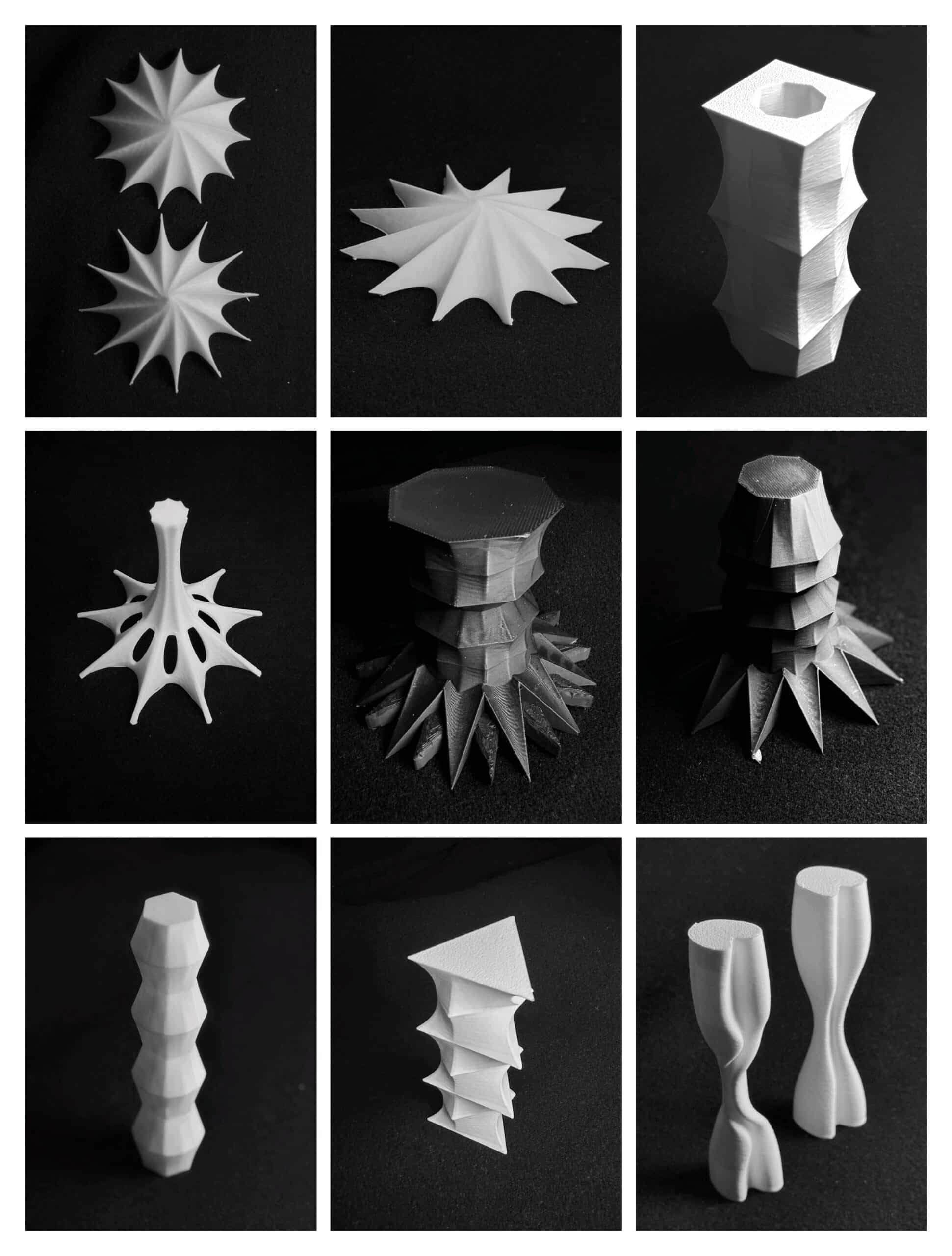
This workshop will look at the following challenge: Gaudí bequeathed a fascinating paramorph – an infinitely parametric archetype for all the towers that sit atop and surround the basilica void below. This is his 1:10 model for the sacristies, one of which has been built today. How might he have designed this archetype differently had he had full access to contemporary digital design and fabrication tools? In the seminar, we will explore alternative options using hyperboloid perforations and helical columns and perturbating their assembly using hyperbolic paraboloids. The description and representation of columns, creating a potentially underlying geometrical guide to how we branch columns and join them elegantly to the trunk. We will also seek alternative strategies for perforating the ceiling and walls to optimise heat and light gain with extraordinary aesthetic sensitivity. To do so, our journey will focus on generating and putting into practice a workflow that goes from design computation to composition and composition to fabrication, all based on parametric design software and a blend of analogue and digital fabrication tools.

Throughout this course, participants will be introduced to the subtleties of Gaudi’s parametric design and reveal the richness of his use of hyperbolic geometry. Using the provided digital workbench, participants will develop tools for sculpting a building façade, roof and ceiling, and supporting columns applied to an architectural system. We will do this while simultaneously adapting hands-on techniques to experiment with intersecting hyperboloids, hyperbolic paraboloids, and helicoids (and planes when required). Furthermore, an additional layer of optimisation will be introduced and adapted to craft the facade parametrically with maximum environmental performance criteria. The aim is to develop a system that provides sufficient light to the interior while illuminating it with the beauty and subtlety of the Sagrada Família Basilica itself to which they are attached.
Finally, with the aid of analogue and digital fabrication, robotic manufacturing and 3D printing, participants will produce a series of scale stereotomic modules to test the effectiveness of the simulation software with respect to the environmental performance and aesthetic outcome.
At course completion the student will:
COLUMN LOGIC CEILING DESIGN DEVELOPMENT FLOOR DESIGN LOGIC FABRICATION PROCESS
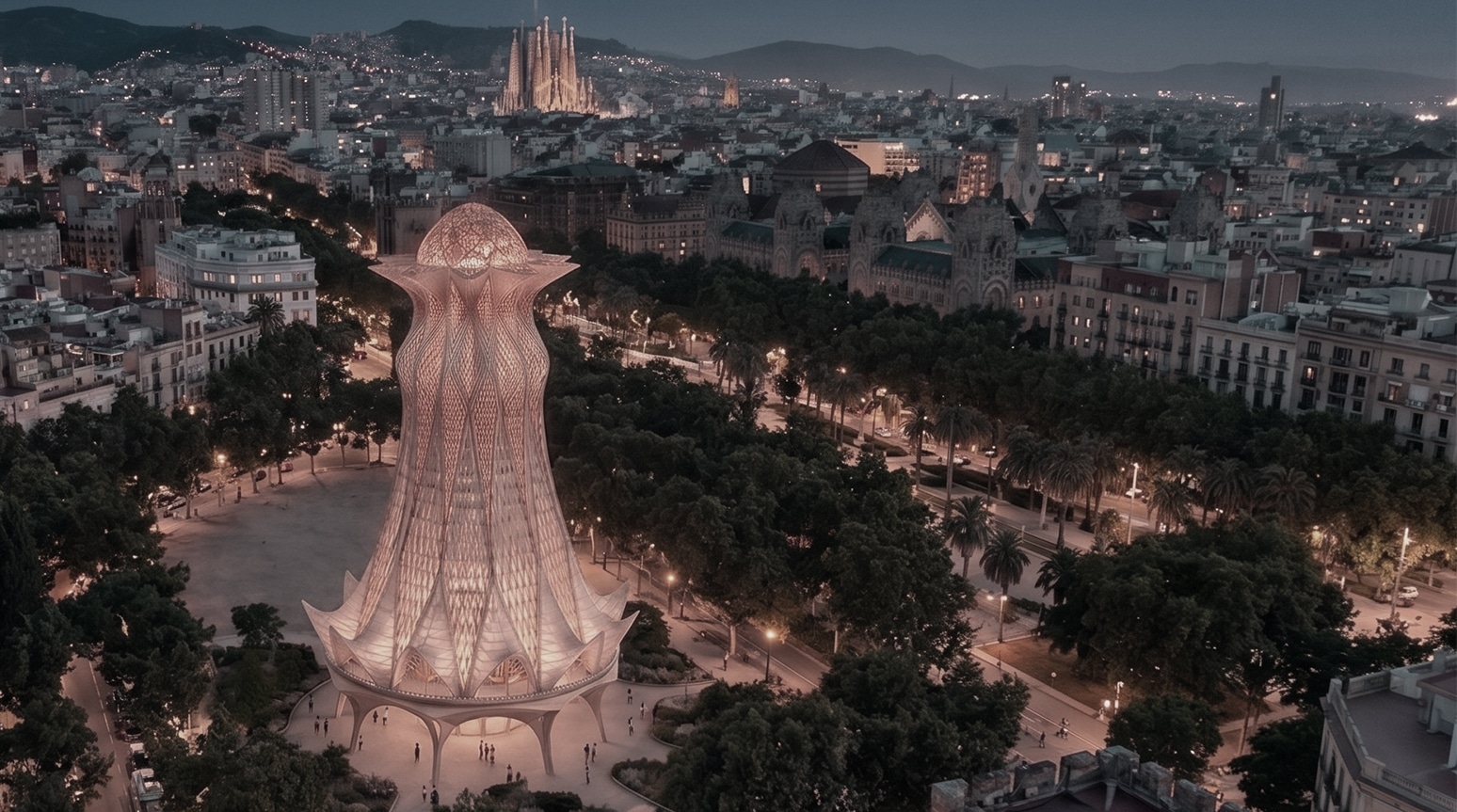
Site and Key Viewpoint Site and Key Viewpoint Core Project Keywords References FORM FINDING Final Form – Sketch Form Logic Variations and Catalog – Side Profile Form Finding Catalog Base Variation Catalog Convex concave Variation Catalogue Final Form – Levels OPENING & PLANTERS Opening’s Logic – Diamond Shape Opening’s Logics Catalog of Opening Opening Logic … Read more
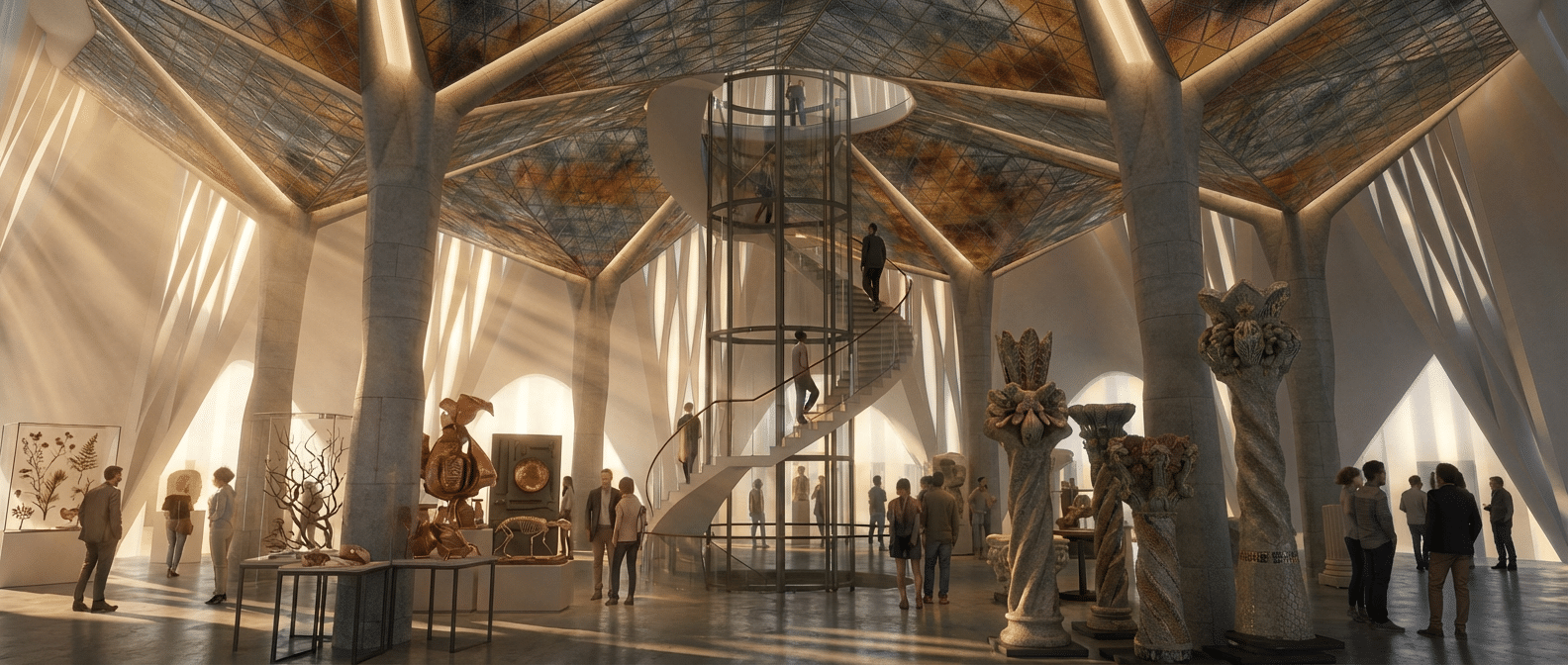
The After Gaudí vision is explored through the lens of an Interpretation Center, not by simply copying forms, but by deeply understanding his geometry and structural logic. Project Framing: A 2026 Centenary Monument in the Born District. The monument site is strategically located in the Born District, deeply connected to the urban fabric between the … Read more
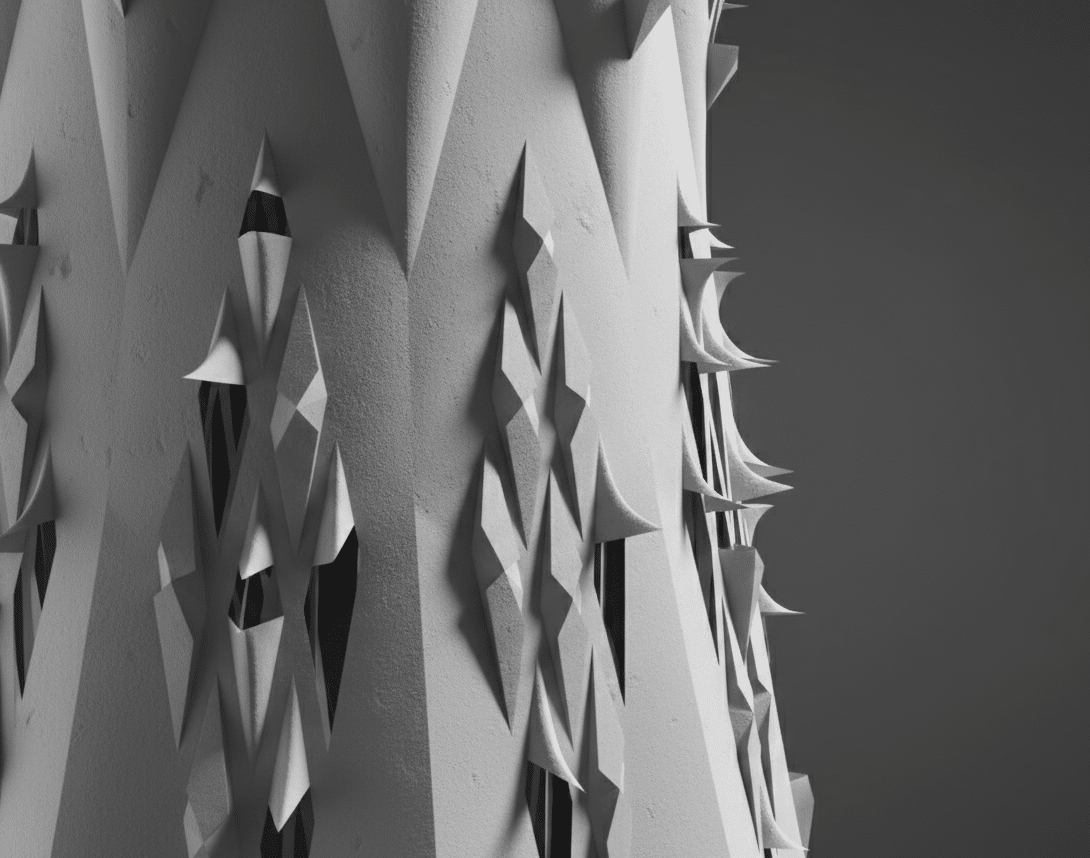
This project develops a parametric façade system inspired by the geometric logic of the Sagrada Família sacristy, translating Gaudí’s generative principles into a contemporary computational workflow. The tower form emerges from iterative transformations of a radial geometry using ruled surfaces and rotational operations, producing a continuous structure defined by gradual variation. A diamond-based grid organizes … Read more
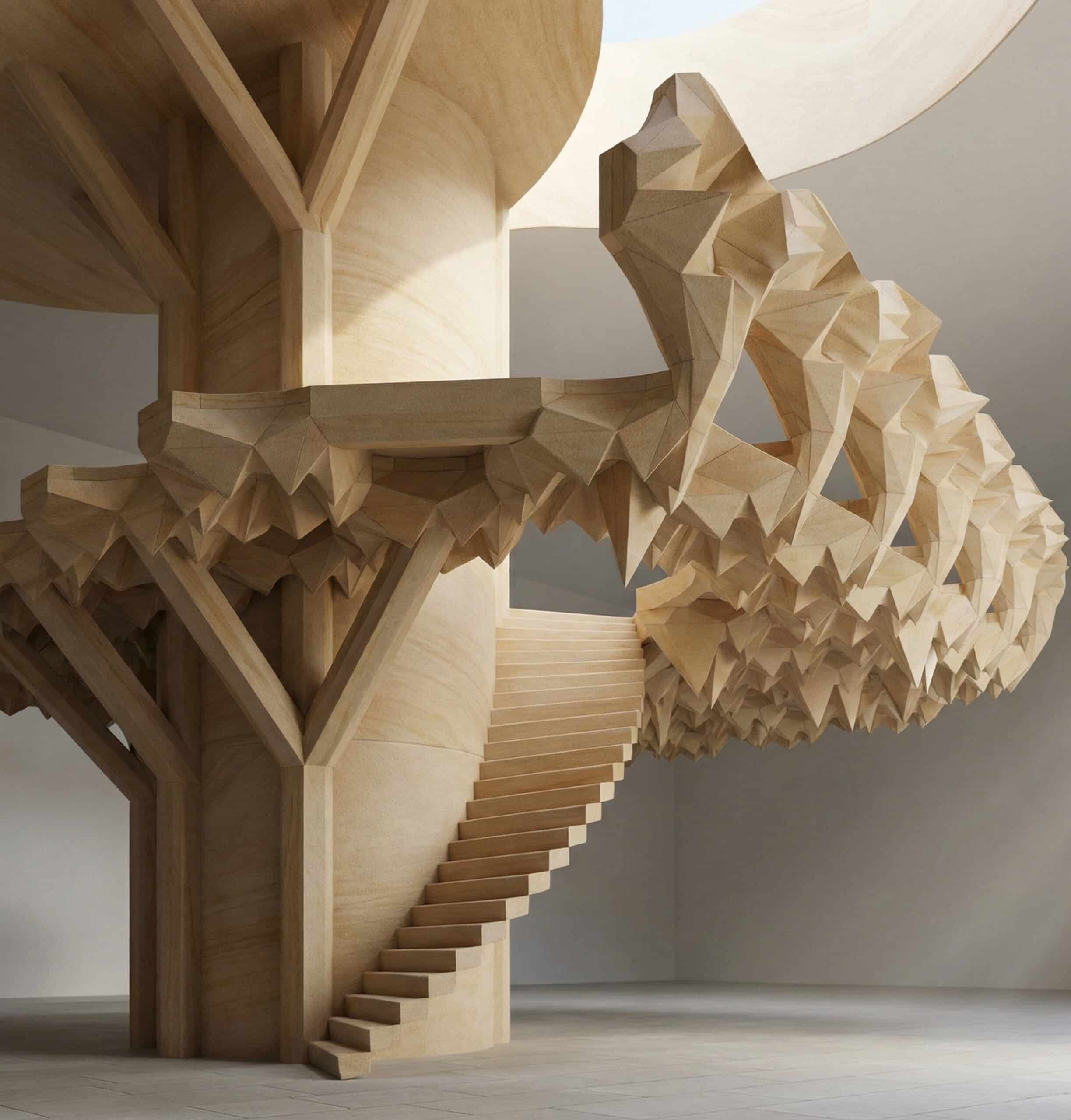
Our project explores the After Gaudí vision through the lens of an Interpretation Center—not by simply copying forms, but by deeply understanding his geometry and structural logic. Project Framing: A 2026 Centenary Monument in the Born District. The Interpretation Center: Defining the Cultural Program An Interpretation Center is not just an exhibition space; it is … Read more