




It seems we can’t find what you’re looking for. Perhaps searching can help.
Computational Design: Exploring the Possibilities of Parametric Thinking
How can computational design transform the way architects explore, develop, and evaluate design ideas? In this seminar, students learn the fundamentals of visual scripting with Grasshopper, developing algorithmic thinking and parametric workflows to generate geometry, manage complex data, and explore multiple design variations. Through hands-on exercises in data manipulation, animation, and visualization, students discover how computational tools can expand the design process and support more informed, performance-driven architectural decisions.
Syllabus
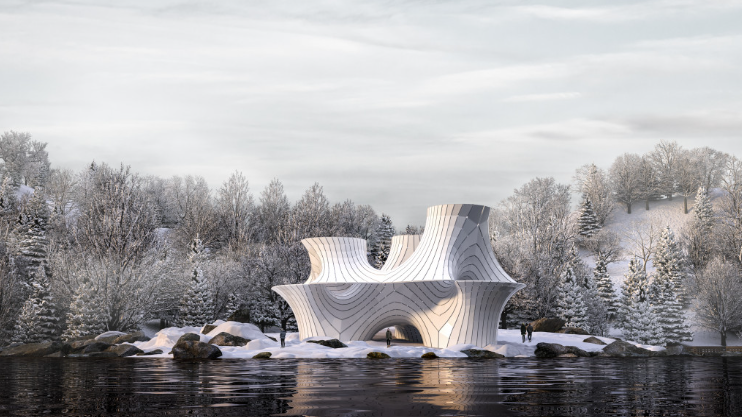
Credits: Minimal Surface. B.Freitas, I.Kukner, F.Polvi, D,Savicevic, A.Sharma. Complex Forming Seminar, 2019/20
Computational design lies at the core of innovation in the realm of design. The tools that we now use to design have augmented iterative processes, allowing for the holistic integration of performance and complexity. This allows designers to extend beyond the three dimensional space into a virtually limitless parametric realm of design intent variations in which to choose from.
By effectively building parametric models, navigating the range of alternatives, and evaluating them with analytical tools that are embedded in the design process, designers are able to take better informed decisions in order to create projects that are performative and complex by whichever metrics the designer wishes to challenge them with.
For this purpose, Grasshopper has significantly become the standard for computational design, not only within academia but across many trades and disciplines that encompass the creating process. This provides easy access to algorithmic thinking and a large ecosystem of plugins that provide a broad range of tools for advanced design.
This seminar focuses on teaching the fundamentals of visual scripting through Grasshopper while exploring the most basic concepts of computational design. From the generation of geometry as data into how to manage multiple geometrical information algorithmically and procedurally, students will become proficient in algorithmic thinking in order to navigate the complexity of multi-criteria geometry.
Learning Objectives
At course completion the student will:
- Understand the fundamental concepts of computational design
- Develop strategies for building algorithms
- Gain knowledge of the basic principles of generative design
- Generate parametrized processes
- Apply data-driven design logics
- Learn how to create dynamic models
- Acquire deeper knowledge of algorithmic design concepts and geometry parametrization
- Gain advanced understanding of complex geometries
- Explore the most recent workflows for complex modeling
- Understand the conceptual and practical applications of computational design tools
Faculty
Faculty Assistants
Projects from this course
Nothing Found