
It seems we can’t find what you’re looking for. Perhaps searching can help.
Ecological Interactions: Observing Place and Designing Regenerative Systems
How can a deeper understanding of ecological processes, human traditions, and technological systems inspire architecture that actively regenerates its environment? In Ecological Interactions, students investigate landscapes as interconnected living systems, using field observation, environmental monitoring, digital technologies, and biological indicators to understand the relationships between organisms, human activities, and their surroundings. Through this research, students develop architectural and landscape interventions that respond to ecological change, restore habitats, and establish new relationships between nature, technology, and human livelihoods.
Syllabus
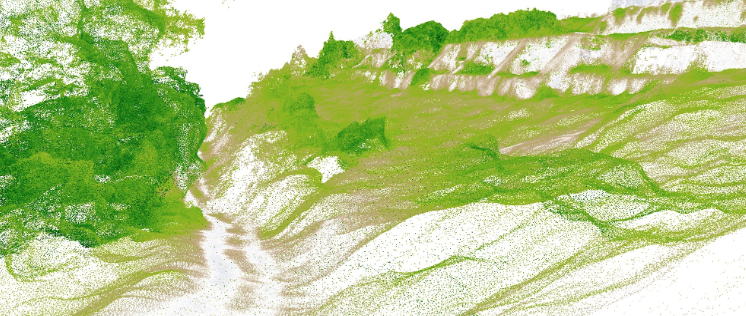
Credits: Valldaura NDVI Scan / Jonathan Minchin Noumena ROMI
The Introductory Studio G2 investigates the relationship between observation, place, production and design and will explore how landscapes can be read as dynamic systems that encompass ecological processes, human occupations, material flows and technologies. These forms of knowledge and information will be woven together to provide the foundations for new architectural, urban and industrial interventions, to propose innovative relationships between organisms, landscapes and human livelihoods. How can designers move beyond the building as an isolated object and instead consider design as the organisation of relationships between ecology, culture, technology. to inform new forms of regenerative architecture and industry?
The studio begins with surveilling nature and examines contemporary monitoring technologies and biological information strategies. Organisms perceive and embody worlds of information and new instruments and techniques are transforming our ability to observe living systems. Satellite Earth observation can reveal vegetation, climate and land-use change across entire regions; drones and computer vision expose patterns within landscapes; environmental sensors record changing soil, water and atmospheric and DNA-based techniques expose biological communities that might otherwise remain invisible. These instruments, at different scales, extend the senses of the designer from the territorial to the molecular and from Below to above ground and inform practices within ‘Critical Zones’ and ‘Bioregions’.
Yet ecological data and models alone cannot describe a place, Landscapes are also shaped by generations of human occupation: infrastructures, industries and cultural traditions. These activities contain accumulated knowledge about materials, seasons, migrations and environmental limits, while simultaneously producing ecological pressures, dependencies and opportunities for transformation. The seminar therefore investigates a territory through three interconnected lenses: ecological signals, human traditions, and technological systems. Rather than analysing these domains independently, we will learn to synthesise them. In this sense, the territory itself becomes a design brief. The objective is not simply to document existing systems, but to identify gaps, unrealised relationships and possibilities for regenerative intervention. Moving from surveillance to synthesis and from synthesis to intervention, the seminar asks a central design question: How can understanding the ecological and cultural intelligence of a place reveal what should be made there—and how making it might help that place regenerate?
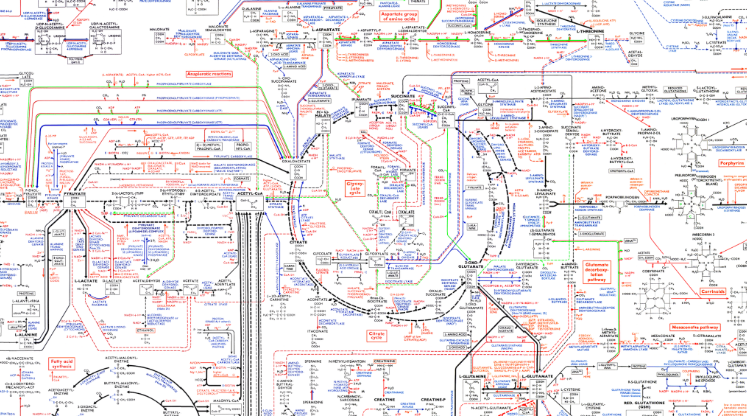
Credits: Boehringer poster representing the whole metabolic network. Researchgate: https://tinyurl.com/349aezba
Learning Objectives
At course completion the student will:
- Acquire an understanding of various historical and changing land use paradigms, as well as their underlying philosophies and theories relating to human settlements.
- Gain an experiential and tacit understanding of biology research activities and site Investigations.
- Identify Indicator and model species as ways to read environmental health, finding the potential problems that ecosystems face through plant traits and species behaviours.
- Build an understanding of ecological linkages Monitor, map and record, both through direct observation and the use of digital surveillance and monitoring.
- Make hypotheses for design interventions and propose new and restorative metabolic pathways focusing on particular habitats.
- Form creative land use proposals that make use of designed observation strategies to inform a responsive design.
Faculty
Faculty Assistants
Projects from this course
Nothing Found