

It seems we can’t find what you’re looking for. Perhaps searching can help.
Ecosystemic Morphologies: Designing Productive Urban Ecosystems
How can architecture move beyond providing space to become an active participant in the ecological and productive systems that sustain our cities? In Ecosystemic Morphologies, students explore how computational design, environmental analysis, parametric systems, and emerging AI tools can shape adaptive architectural forms that integrate urban food production and water management. Using Barcelona as a testing ground, students design a productive urban tower that combines architecture, infrastructure, and landscape to create new ecological, social, and productive value for the surrounding community.
Syllabus
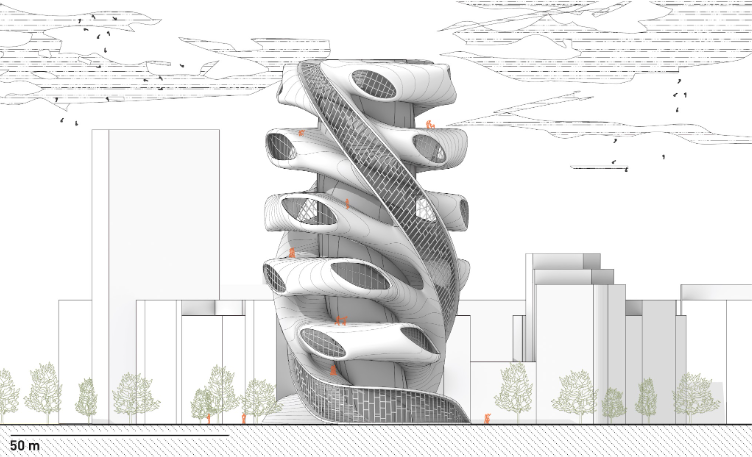
Credits: The living factory. Introductory Studio G2, IAAC 2021/22
Course framework
The Ecosystemic Morphologies design studio explores the future of architecture by forging new paradigms that merge computational design, environmental systems, and productive processes to tackle pressing urban and environmental challenges. Focused on redefining architecture as an adaptive system integrated within larger ecological and productive networks, the course framework seeks to transform urban spaces into productive, multipurpose infrastructures. These structures will integrate programmes that benefit the surrounding community while generating ecological, social, and productive value within the city.
At the centre of this investigation is the question of whether cities can host productive ecosystems through architecture and intelligent design tools.
Research Objective
A central objective of the studio is to investigate the relationship between architecture and production, exploring how productive systems can become drivers of spatial design. Cities depend on extensive infrastructures for food, water, energy, and materials, while buildings generally act as consumers within these systems. The studio will explore how architecture can instead participate actively in these cycles, transforming production into new spatial relationships, programmes, and forms of occupation.
Design Approach and Methodology
At its core, Ecosystemic Morphologies refers to a design approach in which environmental systems, productive processes, computational methods, and emerging AI tools converge to generate performative architectural forms and spatial organisations. By exploring the relationship between form, function, productive systems, and environmental conditions, the studio develops morphologies shaped by multiple interacting forces. The aim is to create architecture that is deeply embedded within its ecosystem and capable of generating ecological, spatial, and social value.
Students will analyse relevant ecological and productive systems, identify their relationships, and translate them into design parameters and rules. Through parametric design, generative processes, environmental analysis, simulation, and state-of-the-art AI tools, students will learn to explore architectural configurations, organise research, and test design decisions throughout the process. The studio will move between diagrams, digital models, data, architectural drawings, simulations, physical models, and prototypes, introducing students to a design process in which computation becomes a tool to connect ideas, evaluate alternatives, and develop architectural proposals.
Project Output
The design output of the studio will be architectural proposals that explore the integration of food production and water management systems within productive urban infrastructures. Barcelona will serve as a testing ground, where students will design a small urban tower conceived as a productive ecosystem. These systems will become fundamental drivers of the building’s programme, spatial organisation, environmental behaviour, and morphology.
Projects will investigate processes such as water collection, storage, treatment, and reuse, together with forms of urban food production, while developing relationships between users, architecture, productive systems, and the surrounding neighbourhood. The tower will operate simultaneously as architecture, infrastructure, and productive landscape, demonstrating how these approaches can create productive and resilient urban habitats.
Studio Vision
In Ecosystemic Morphologies, architecture becomes an active system that interacts with its environment, integrates productive processes, and creates new relationships between users, space, and resources. Through the combination of computational design, environmental thinking, and emerging design tools, the studio aims to rethink urban architecture as both productive and adaptive, while contributing to more resilient and ecologically responsive cities.
Learning Objectives
At course completion the student will:
- Relate architecture and design to allied disciplines, environmental systems, and emerging technological contexts.
- Understand and apply fundamental concepts of computational design as part of an architectural design process.
- Develop digital design tools and parametric systems to explore complex geometries, topological relationships, and form-finding strategies.
- Integrate productive and ecological systems into architectural proposals, considering relationships between resources, environment, program, and spatial organization.
- Use environmental analysis, simulation, and data-informed design methods to evaluate and refine architectural strategies.
Faculty
Faculty Assistants
Projects from this course
Nothing Found