Within the ACESD Theory course, students will engage with both foundational theory and emerging debates.


Syllabus

Advanced Computation for Environmental and Structural Design (ACESD) THEORY


ACESD Theory Faculties courtesy

This course explores the intersections of computational design, sustainability and artificial intelligence in architectural practice. It introduces students to the theoretical underpinnings of computational design and critically examines how AI-driven tools—from generative algorithms to data-driven optimization—are transforming the way architects conceptualize, design, and deliver projects. While sustainability is addressed as a recurring theme, the focus lies on understanding the broader social, cultural, and professional implications of AI in design.

Within the course students will engage with both foundational theory and emerging debates. Early sessions cover the history and principles of computational design, followed by an introduction to machine learning and AI applications in architecture. Midway, invited experts present on topics such as generative design, ethical considerations of automation, and the environmental impacts of data-intensive tools. Later sessions shift toward case studies, critical readings, and group discussions where students debate issues like authorship, bias in algorithms, and the shifting role of the architect in an AI-augmented profession.

The course emphasises active participation through debates, critiques, and discussions. Students are encouraged to question assumptions, challenge trends, and develop informed perspectives on how AI shapes architectural culture and labor. By the end, participants will not only gain an understanding of current computational and AI-driven approaches but also be able to articulate critical positions on their opportunities and risks, especially in relation to sustainability and the future of architectural practice.

Learning Objectives

During the course students will:

  • Develop critical thinking on the adoption of AI in design practice
  • Develop critical thinking on sustainable and environmental design in architecture 
  • Apply knowledge in innovative architectural and computational design approaches to address environmental challenges and AI workflows


Faculty


Projects from this course

Rethinking AI’s Role in the AEC Industry

From automation to infrastructure Before starting this course, I primarily understood Artificial Intelligence in the AEC industry as a productivity tool—something used to automate repetitive tasks, accelerate modeling, or optimize isolated steps within the design workflow. AI was, in my mind, an add-on: powerful, useful, but largely standalone. Over the duration of the course and … Read more

Beyond Efficiency

The Purpose of AI in the Age of Resource Scarcity Introduction: Redefining the Question The question “What is the purpose of AI in AEC?” often elicits a predictable response focused on speed. For years the industry has viewed Artificial Intelligence primarily as a mechanism for automation. It is seen as a faster way to produce … Read more

The Future of AI in the AEC Industry

Artificial Intelligence (AI) is changing the Architecture, Engineering and Construction (AEC) industry in ways we’re only beginning to understand. As computational design and software advances and is tasked to handle more complex and data-intensive forms, AI offers real potential to optimize workflows and improve design team collaboration from initial concepts on Schematic Design (SD) to … Read more

AI in AEC: Decision Support Across the Lifecycle

AI in AEC is often pitched as a design generator or a shortcut to faster output. We pushed a more real definition: AI’s purpose is decision support, helping teams see risk earlier and choose better options, while humans remain accountable. AEC is a chain of high-stakes decisions made under pressure: feasibility, coordination, procurement, construction risk, … Read more

AI and the future of intelligent architecture

AI in intelligent architecture enhances design efficiency, sustainability, and user‑centric spaces. Key benefits include automation, data‑driven insights, and optimized building performance. Challenges involve data privacy, high implementation costs, and skill gaps. The future promises adaptive buildings, predictive systems, and seamless human‑AI collaboration shaping more resilient, responsive, and sustainable built environments. 1. AI-Driven Design Innovation Generative … Read more

WHEN DESIGN~MEETS DATA

In the early stages of learning, artificial intelligence was perceived primarily as a digital aid tools created to improve efficiency, accuracy, and coordination across different stages of a project. AI was largely understood as a decision-support system, particularly valuable during the early design phases, yet always positioned as secondary to human expertise and judgment. However, … Read more

Beyond Speed: Redefining the Purpose of AI in the AEC Industry

Initial Perspective: AI as an Efficiency Tool At the beginning of the course, I viewed AI primarily as a means to enhance productivity. It appeared to be a practical instrument for automating routine tasks, such as refining designs or performing structural calculations. By minimizing errors, reducing time requirements, and lowering costs, AI could expedite project … Read more

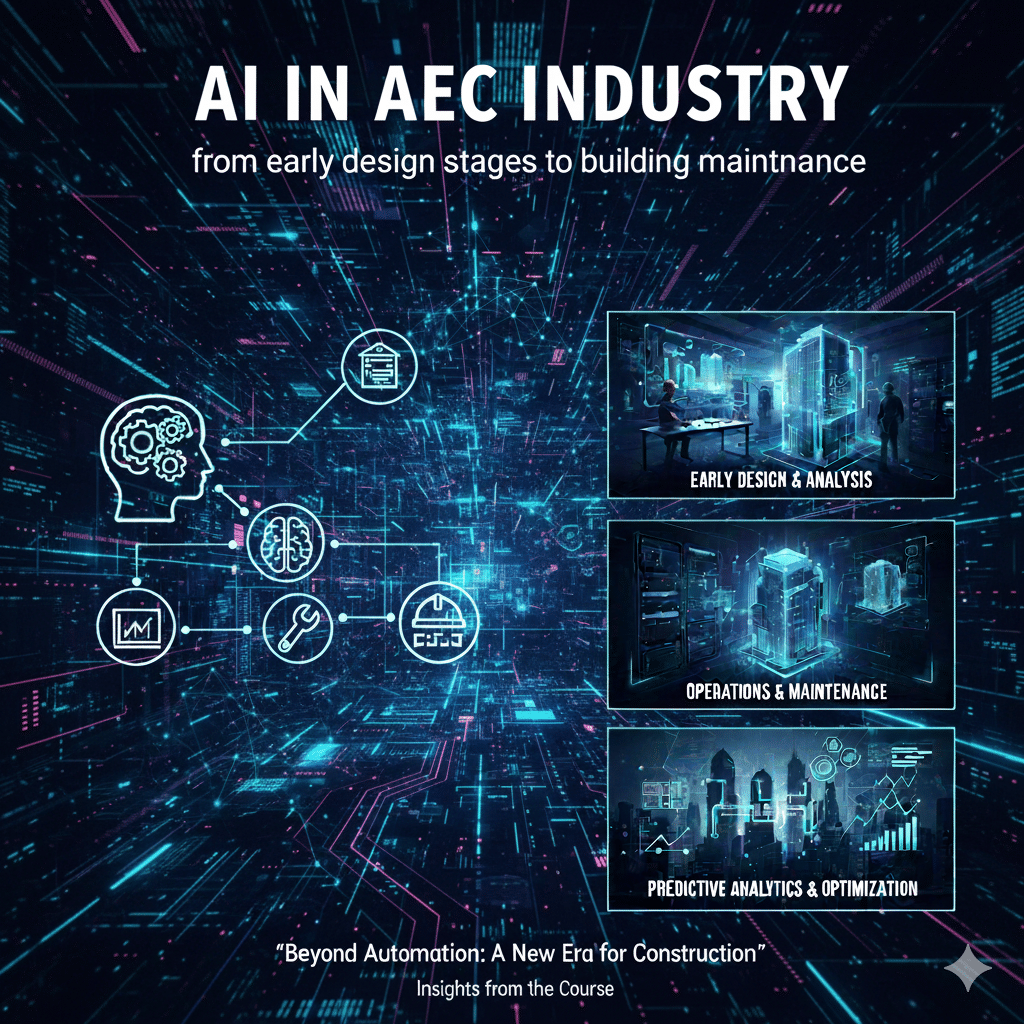
AI in the AEC industry: from early design stage to building maintenance

What Is the Purpose of AI in the AEC Industry? Artificial intelligence is not only a technology aimed at automating tasks; insights shared during this course demonstrate that AI plays a far broader and more strategic role in the Architecture, Engineering, and Construction (AEC) industry. Through real-world applications and practical case studies, AI emerges as … Read more

AI Won’t Save Architecture by Making It Faster: Only by Making It Responsible

Introduction: The Wrong Question We Were Asking For years, the question sounded simple: What is the purpose of AI in AEC? The answers were predictable speed, automation, productivity. Faster drawings. Fewer errors. Leaner workflows. That definition collapsed the moment we confronted Jakarta. Through our studio project Floating Grounds, developed in the flood-prone Penjaringan District, and … Read more

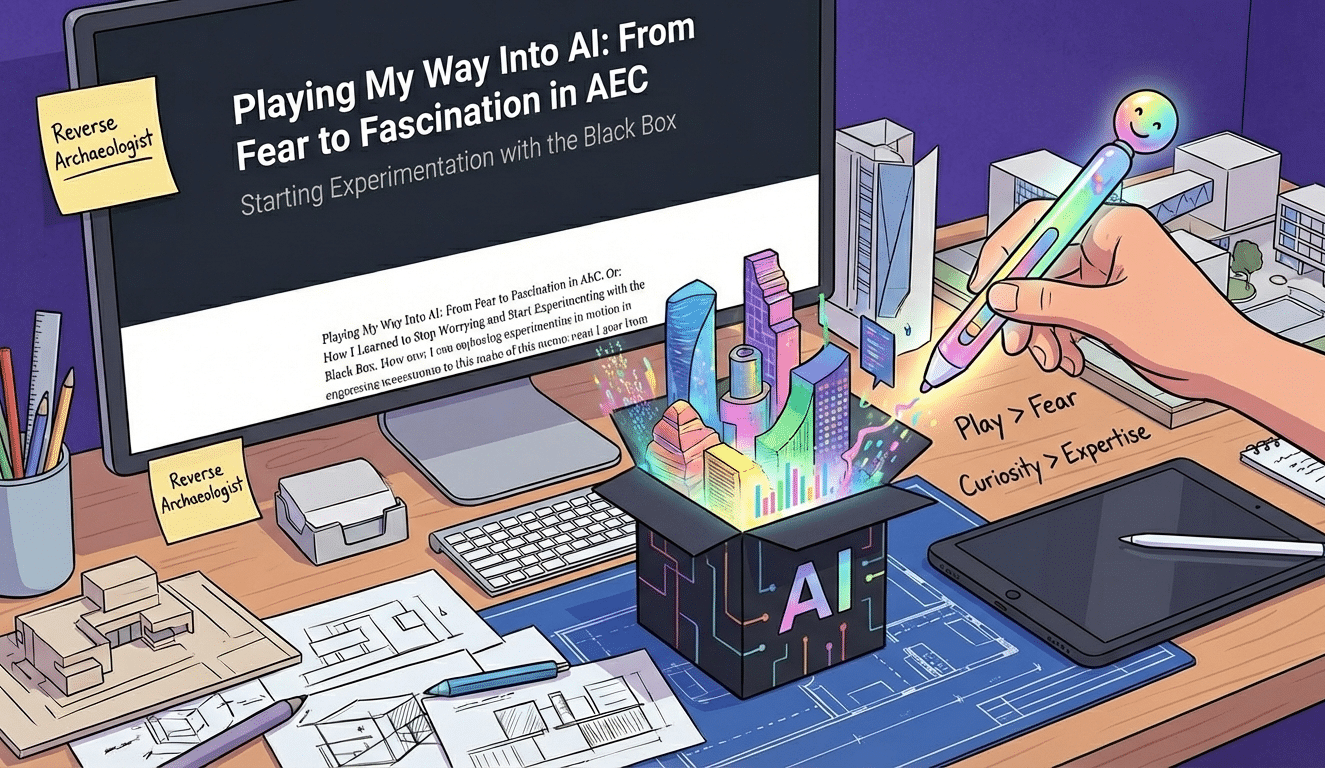
Playing My Way Into AI: From Fear to Fascination in AEC

Design via Experimentation with the Black Box When I started my MaCAD program this semester, AI felt like a threat. As an industrial designer, I saw it as this incomprehensible pattern-finding machine that could somehow analyze thousands of products simultaneously, finding relationships I’d spend years trying to notice. The black-box nature terrified me—I couldn’t trace … Read more

AI in AEC: Supporting Better Decisions

The purpose of artificial intelligence in architecture, engineering, and construction (AEC) is not to replace architects or engineers, but to support better decisions in an increasingly complex field. Today, the built environment is shaped by overlapping layers of constraints and ambitions: environmental performance, structural behavior, material systems, costs, timelines, regulations, and social impact. Managing this … Read more

Beyond Speed: Redefining the Purpose of AI in the AEC Industry

The conversation around Artificial Intelligence in Architecture, Engineering, and Construction (AEC) often begins and ends with the concept of “efficiency”. We discuss doing things faster, reducing man-hours, and automating mundane tasks. But as the industry faces unprecedented challenges, the true purpose of AI is shifting. It is no longer just about speed; it is about … Read more

What would have Bucky said?

Middle east, 1067 AC scene 1: Long before the word algorithm existed, a woman draws lines in the send. She is not an architect. The word does not exist yet either. She is simply someone who must decide where people sleep when the river floods. She draws, erases, redraws.She listens to the wind.While She remembers … Read more