Site Specification
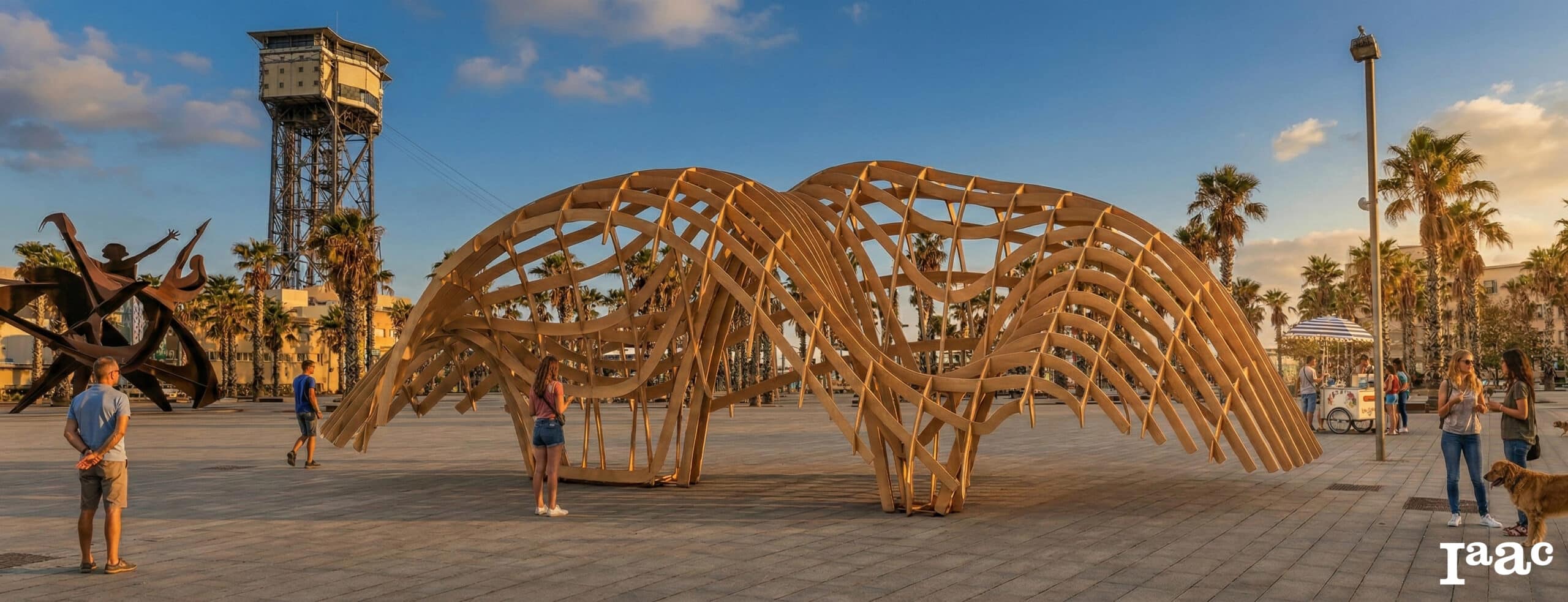
The pavilion, located in Plaza del Mar, Barceloneta, features a design adaptable to coastal winds and connected to the sea, primarily constructed from polywood marine 3mm thickness fabricated in CNC machine to withstand its beach environment.
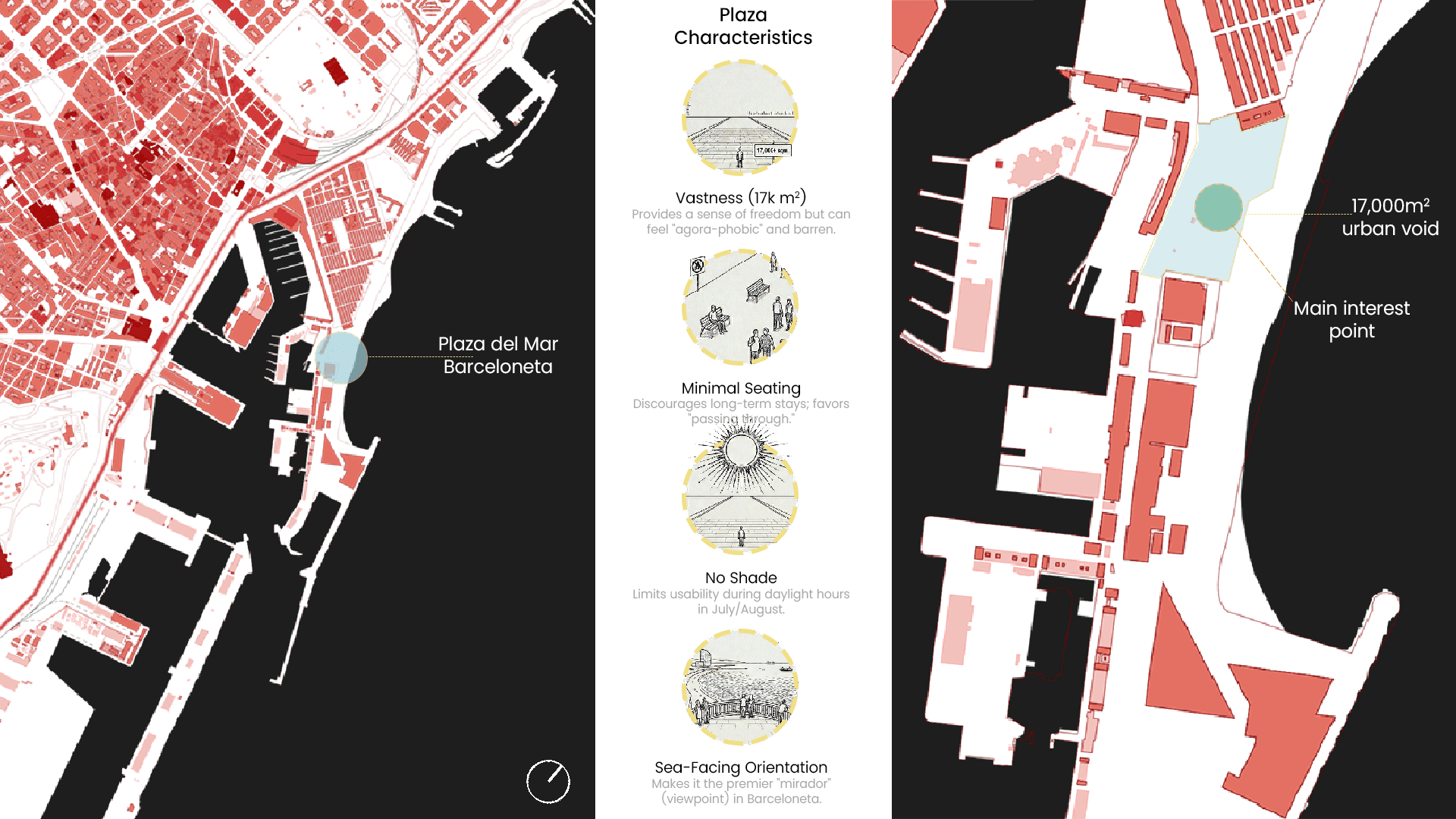
Plaza del Mar is a vast, 17,000-square-meter urban “void” that serves as Barceloneta’s primary window to the Mediterranean. While its scale offers impressive, unobstructed sea views, the space is defined by a lack of shade and seating, often making it feel like a harsh “heat island” rather than a comfortable park. Consequently, it functions primarily as a high-traffic pedestrian thoroughfare—vibrant and crowded on weekends—where the main draw is the horizon rather than the plaza’s own amenities.
Referential work’s logics
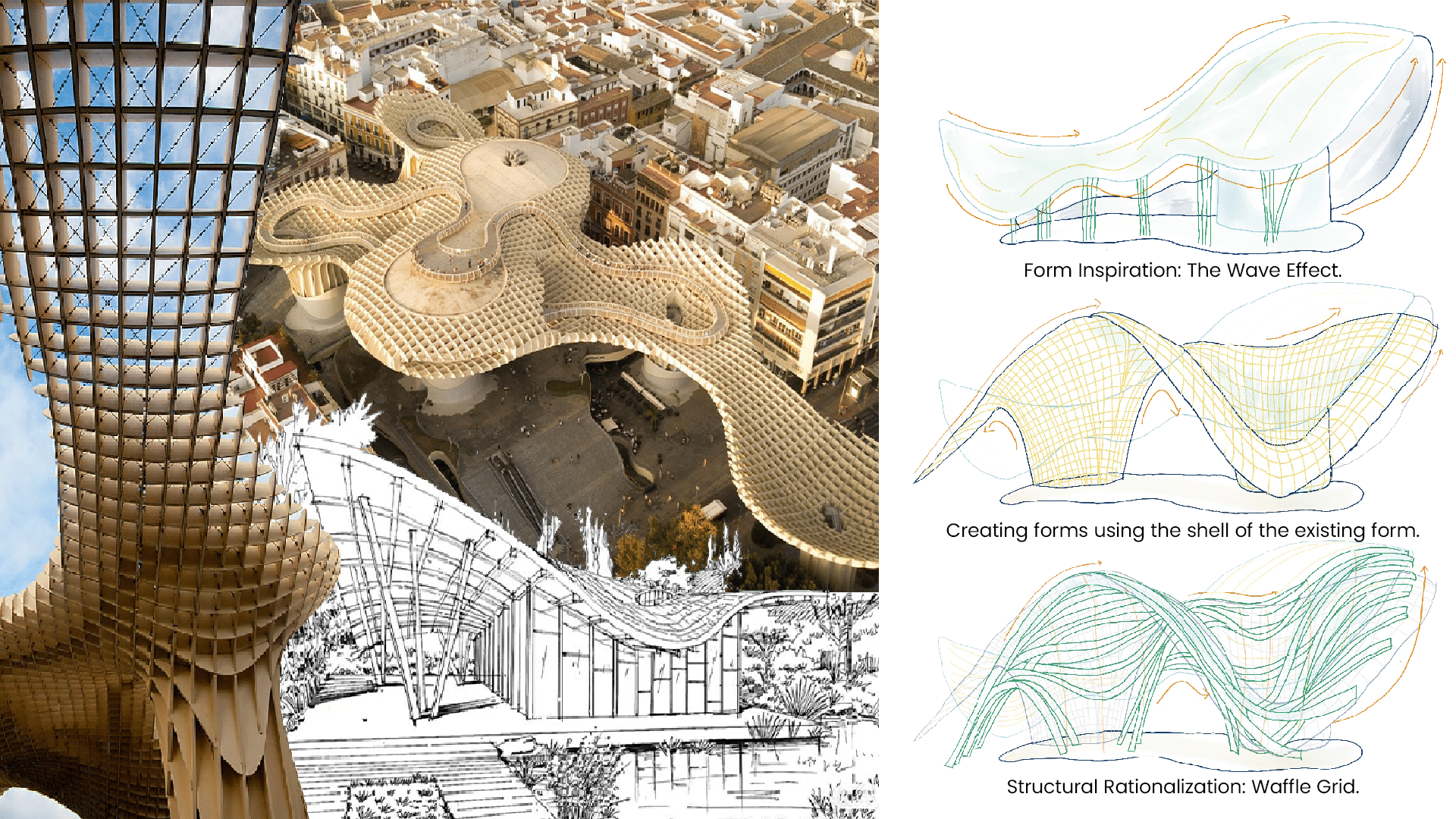
The Wave (Conceptual): The primary form is driven by a hand-drawn sketch mimicking a breaking wave. This translates into a dynamic, asymmetrical roofline with varying heights, creating sweeping spatial compressions and expansions underneath.
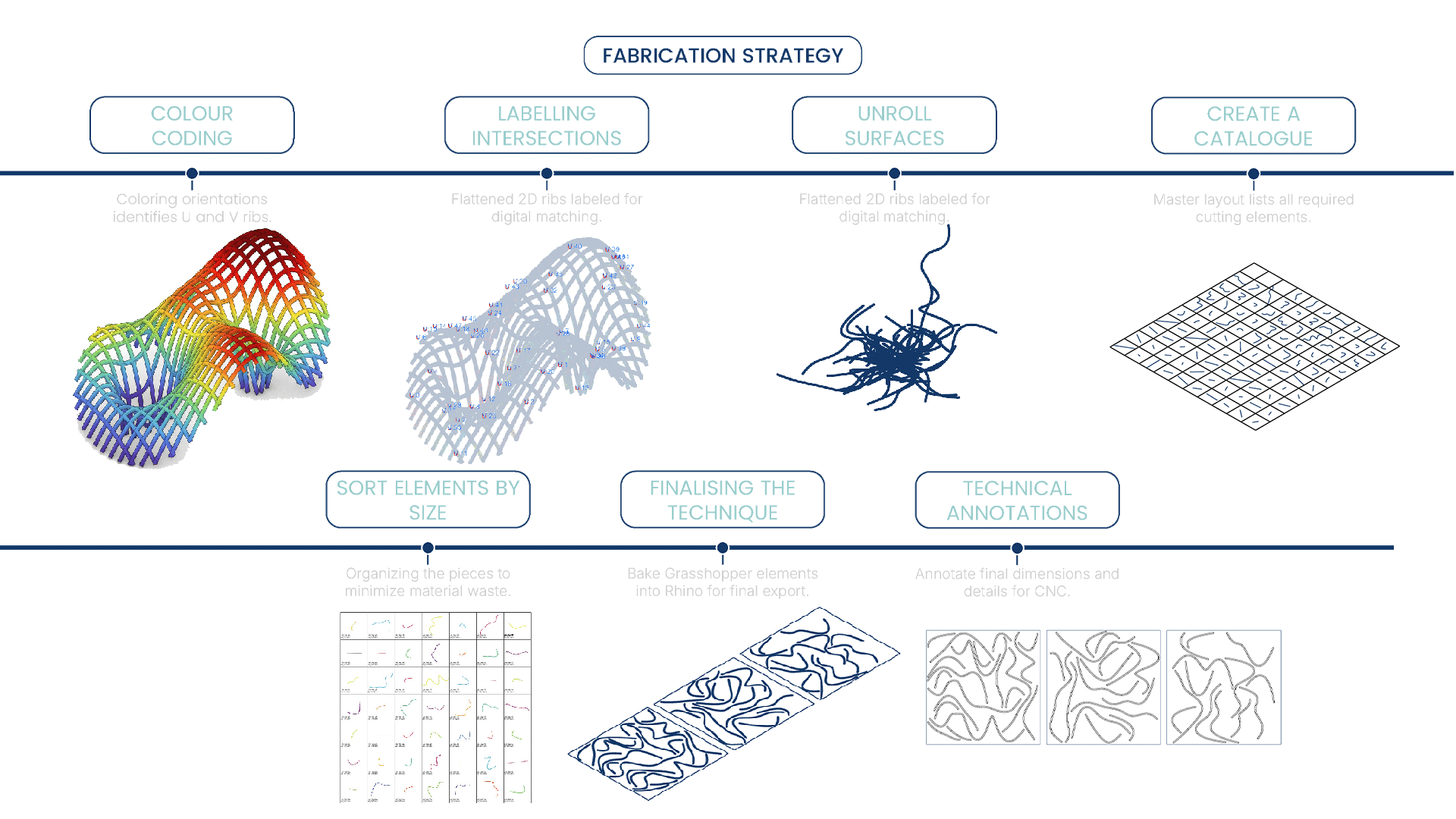
Metropol Parasol (Structural/Fabrication): Designed by Jürgen Mayer H. in Seville, this is the ultimate reference for translating a complex, undulating 3D surface into a buildable system. We are adopting its logic of a bi-directional grid (waffle structure) made of planar elements (like timber or plywood) that interlock to form a self-supporting, rigid canopy.
System deconstruction
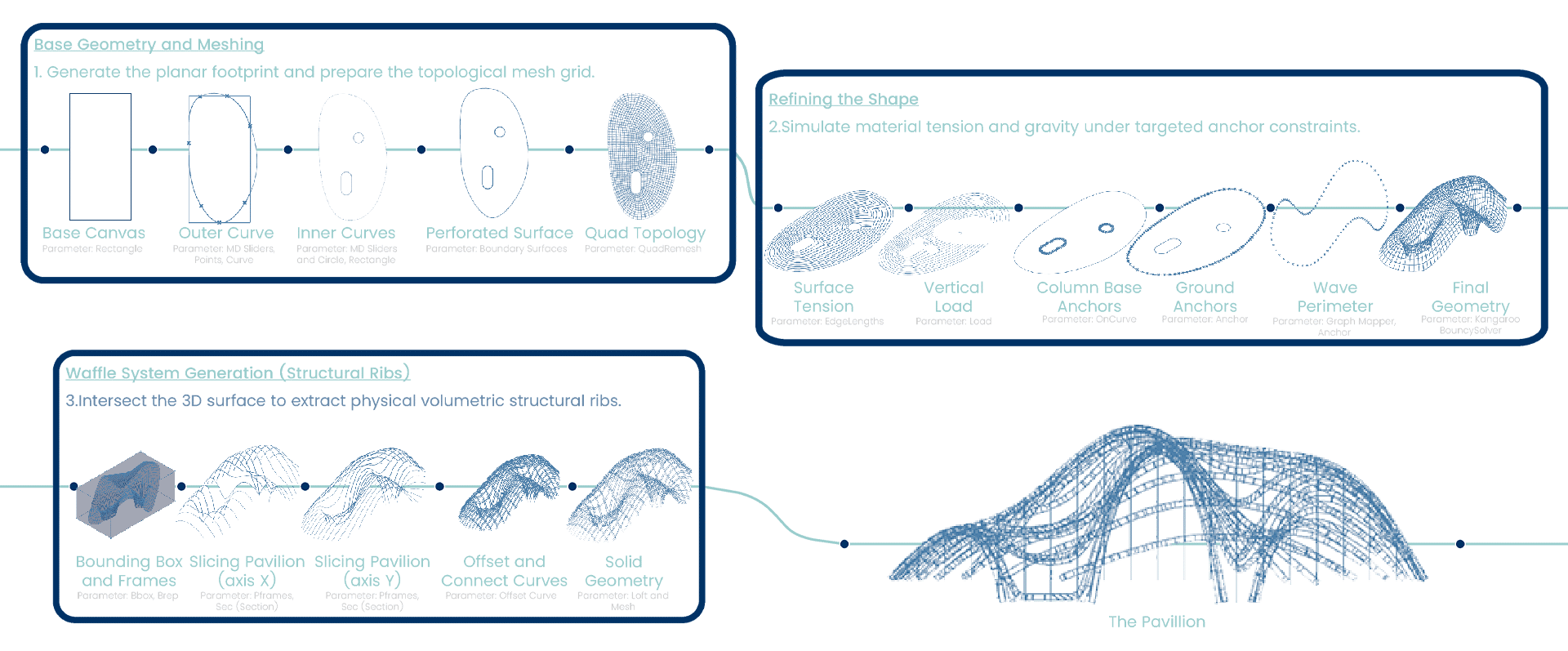
The pavilion’s geometry is driven by a continuous parametric workflow. The system is deconstructed into three main components, each controlled by specific numerical parameters.
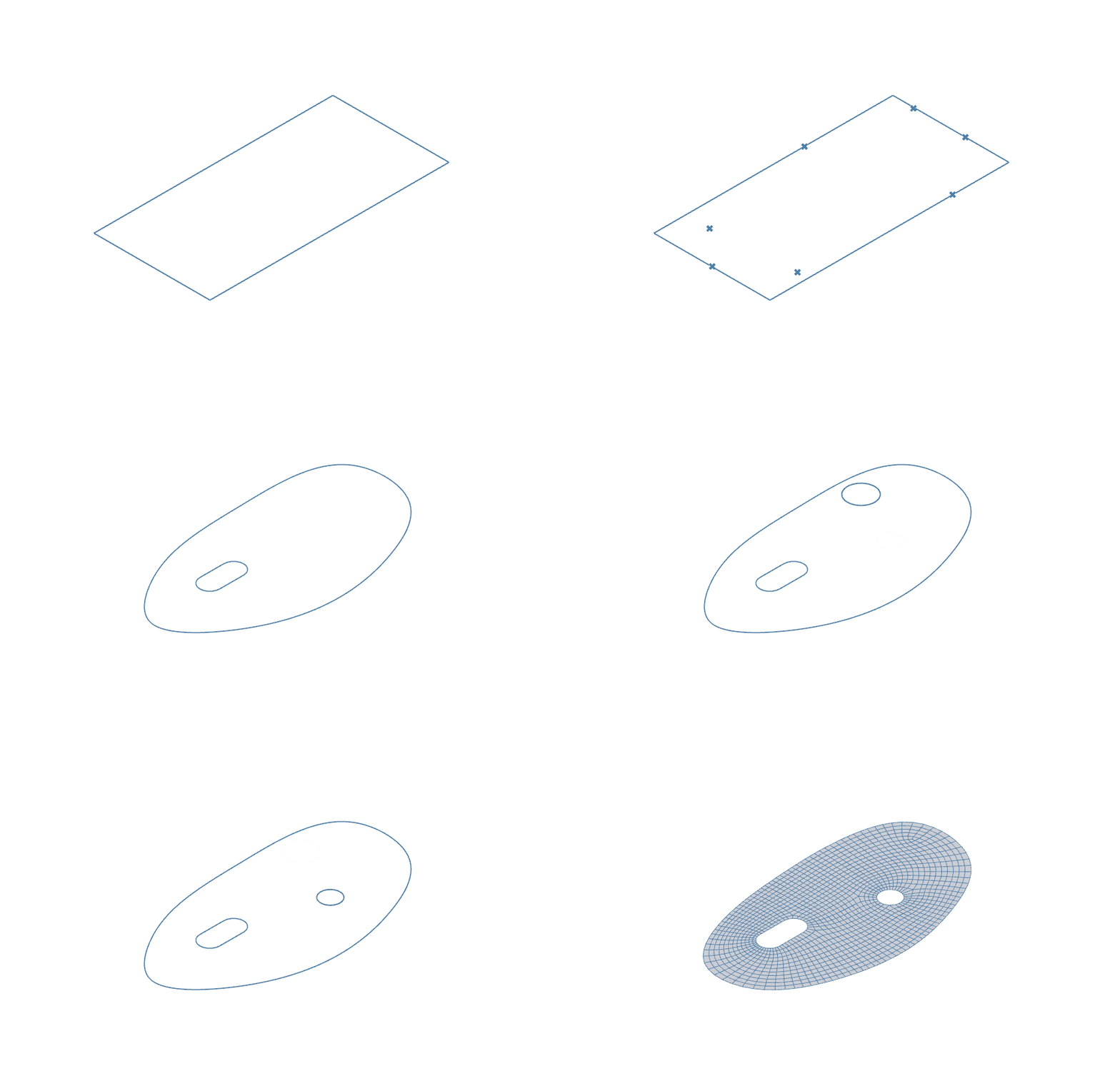
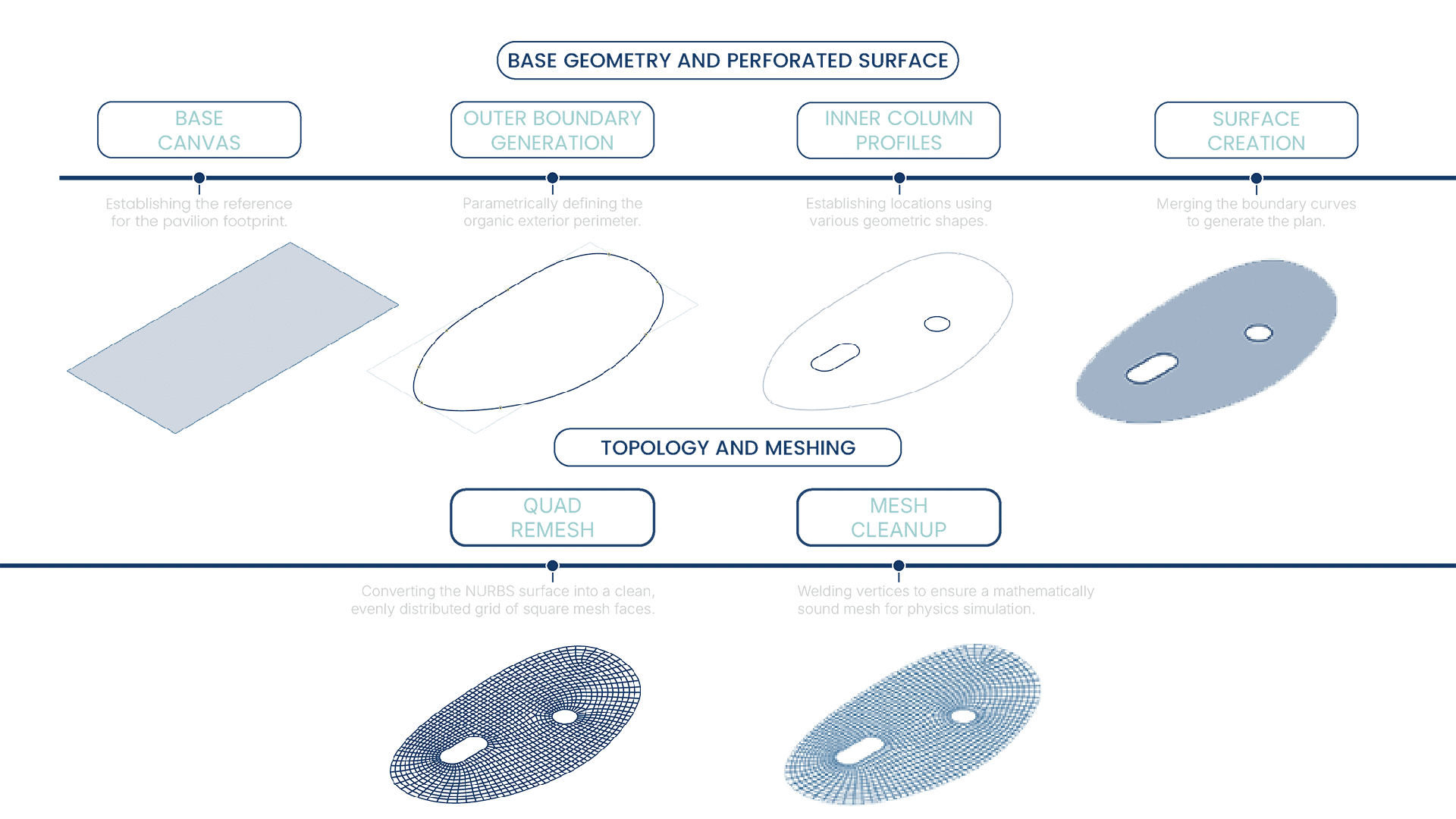
The geometry generation process involves converting flat 2D shapes into a workable mesh, guided by MD Sliders that determine UV coordinates on a base canvas for the pavilion’s organic outer perimeter and interior column placement. Inner support dimensions are adjusted with number sliders for circular column radii (1.0 and 0.708) and rectangular column bounds (3.2 x 1.45). A QuadRemesh component then creates the topological grid with a Target Count of 1500, essential for maintaining mesh density, ensuring sufficient vertices for smooth physics simulation while avoiding computational overload.
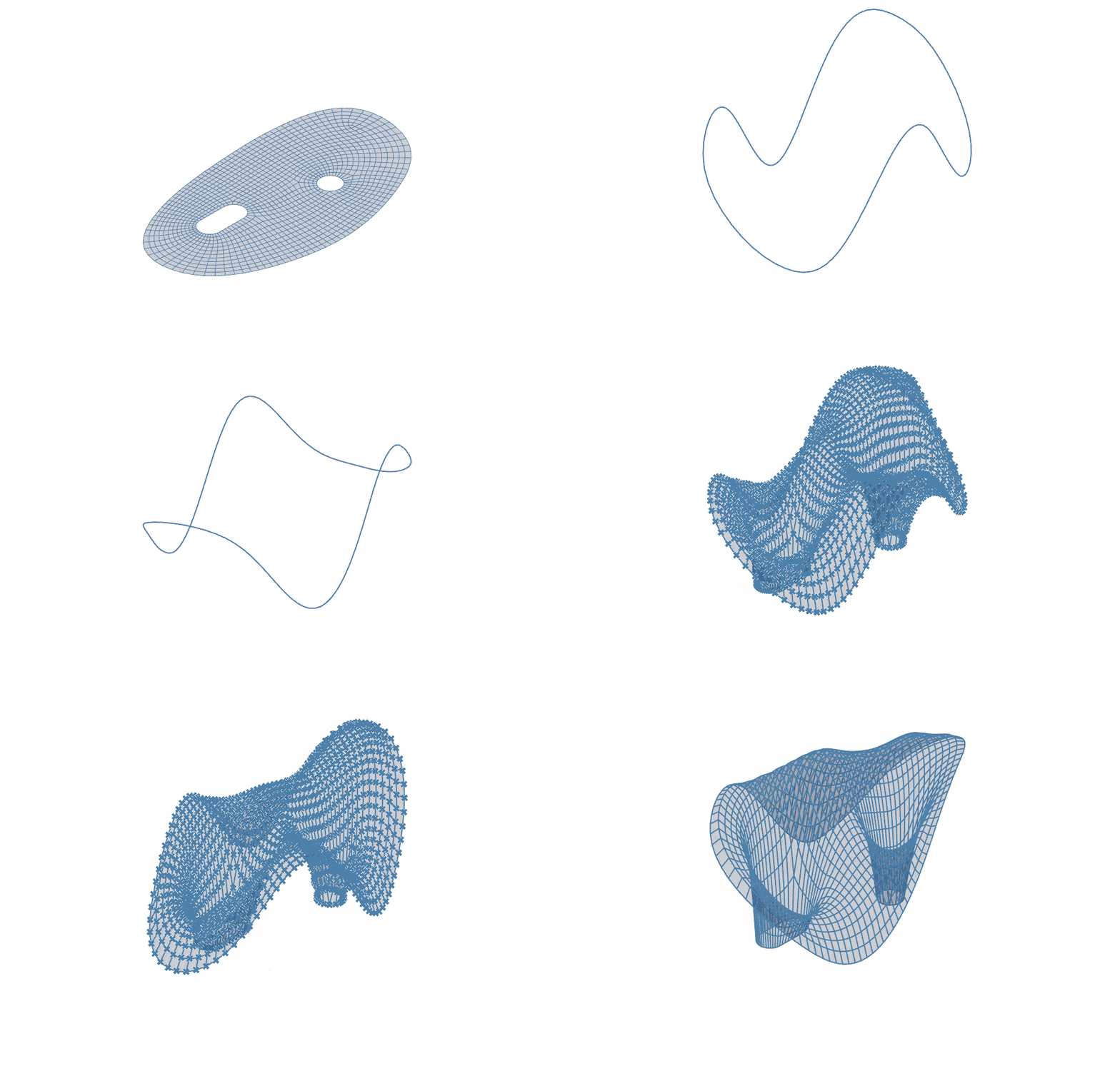
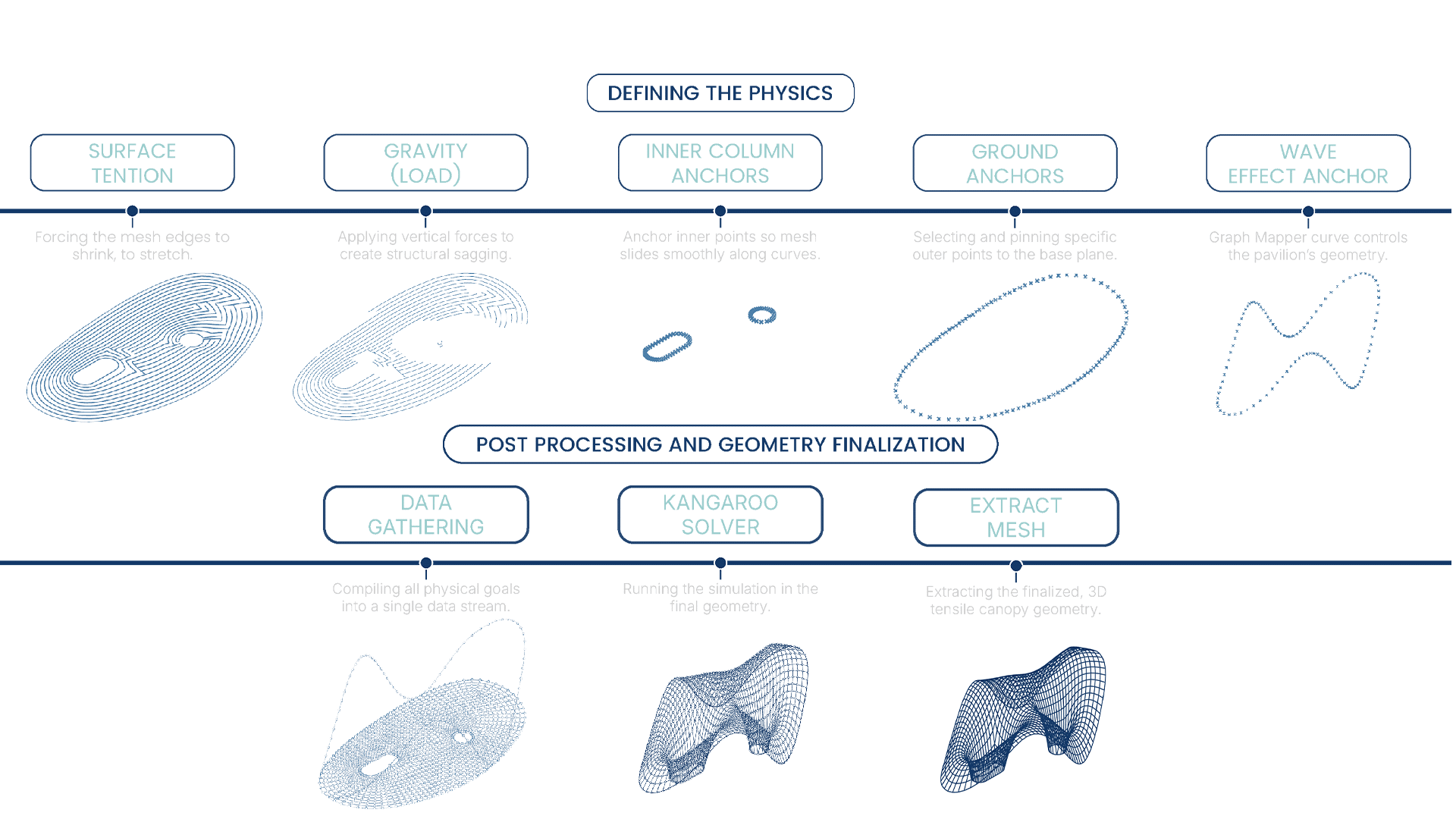
The script’s mathematical engine revolves around the form-finding process involving Kangaroo physics and a Graph Mapper to shape the pavilion in 3D. The pavilion’s outer edge rhythm is influenced by Wave Frequency, controlled by adjusting a Sine wave in the Graph Mapper, affecting the number of arches or entrances. A Remap component translates the wave into height, with its Target slider at 6.95 representing the Wave Amplitude for maximum Z-axis elevation. The physics solver manages geometry through Membrane Tension (with an EdgeLengths factor of 0.42 for fabric tightness) and Gravity (using a Load factor of -0.081 to create structural valleys).
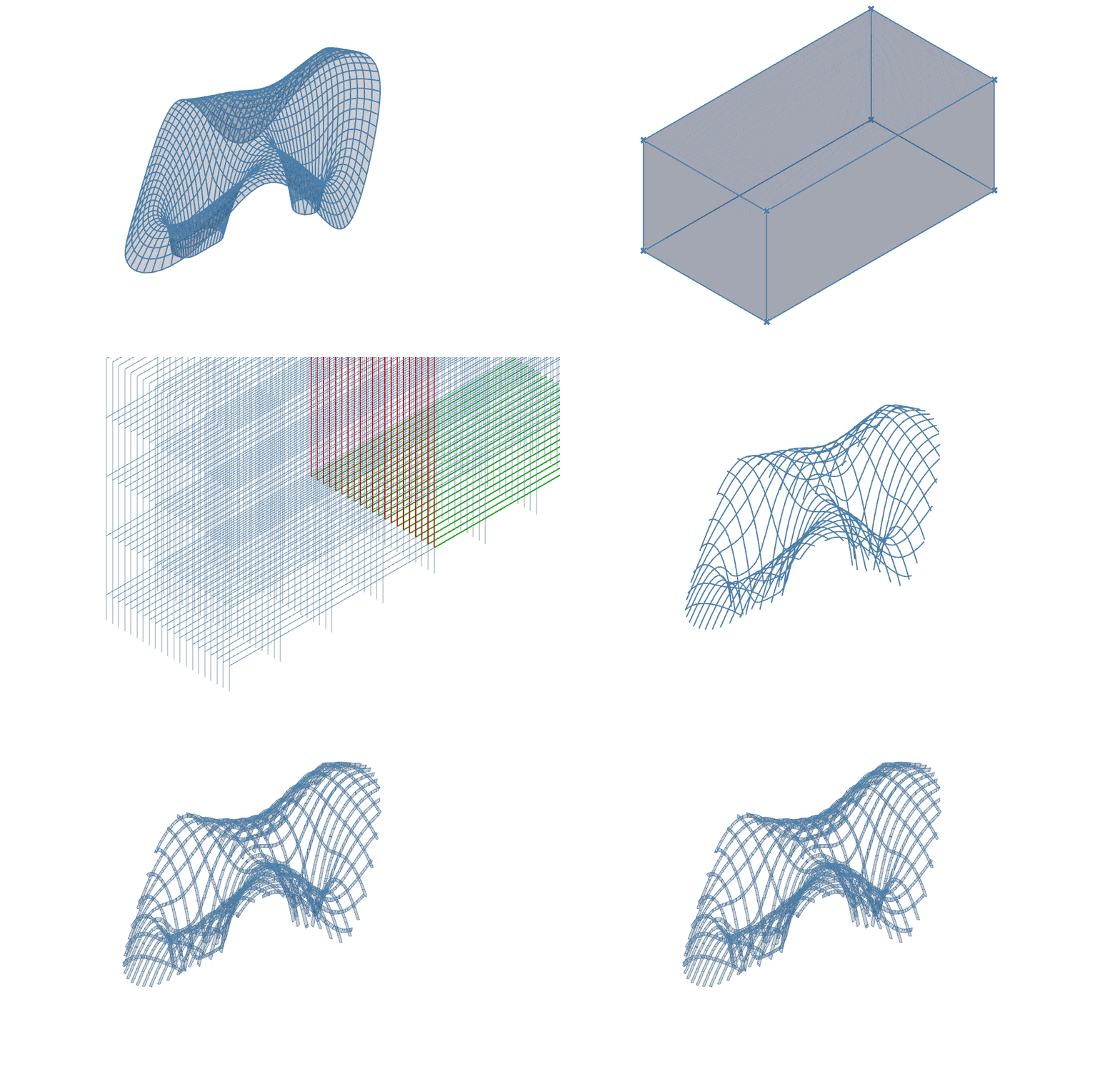
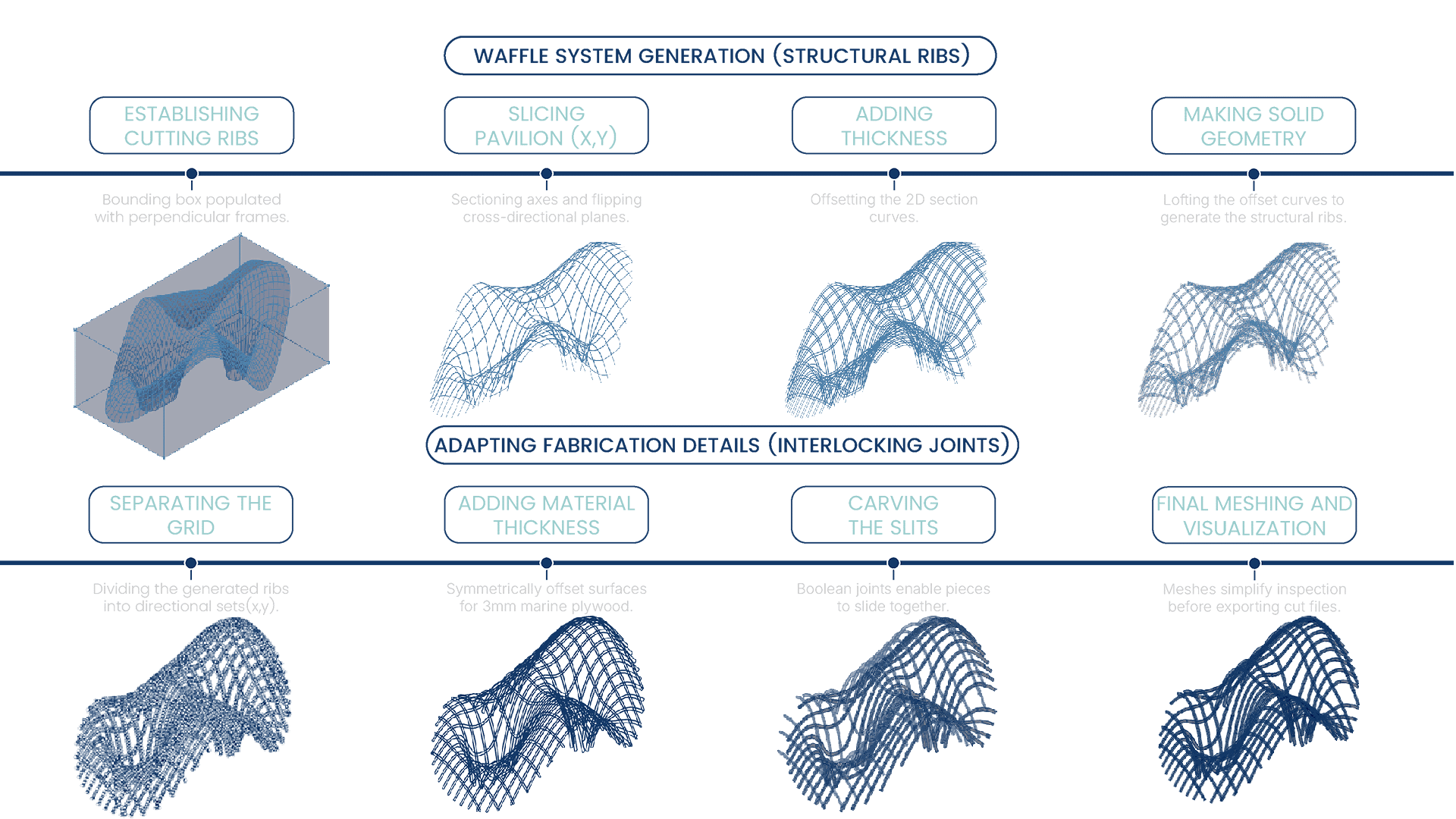
The final defining parameters control the conversion of a thin simulated mesh into a physical waffle structure. The grid’s density is influenced by the PFrames Count slider, set to 20, which determines the number of structural ribs along the U and V axes. The structural planks’ width is defined by an Offset Distance parameter of 0.20. Material Thickness is established during the boolean difference operation, utilizing a symmetric offset of 0.050 in both directions to align with the 0.10 physical thickness of the fabrication material, ensuring seamless interlocking slits.
Workflow diagram (pseudo code)
Design process (form finding)
Iteration Catalog
Fabrication Sequence and Assembly Methology
Video Animation
Fabrication Documents
Render