
Thermodynamic invariants as architectural constraints on machine learning for recycled-aggregate mix design
Santhosh Shyamsundar · MAEBB02 · Valldaura Labs, IAAC · 2024–2026
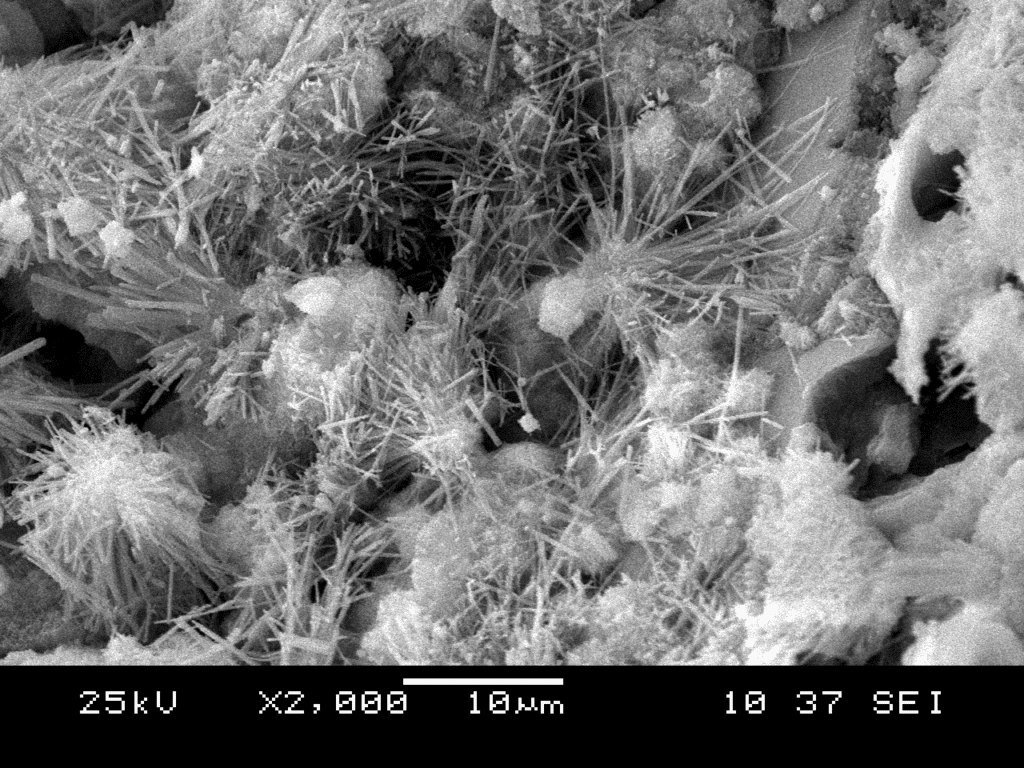
The micro-scale matter the kernel’s thermodynamics, transport, and strength engines must keep mutually consistent. SEM image after Kafedra434, Wikimedia Commons (CC BY-SA 3.0), recoloured by the author.
An irreversible material under a reversible model
Concrete is the most-produced material on Earth after water. The sector that casts it is among the largest single contributors to anthropogenic carbon emissions, and its product outlives the institutions that specified it. Once the binder sets, the chemistry that carries it from fluid to solid cannot be undone: a decision at the specification desk is, within hours of the pour, unrevisable for the service life of the building.
Machine-learning systems now sit on the design-to-fabrication path — tabular regressors, neural surrogates, graph networks over composition, large language models prompted for low-carbon mixes. Mean accuracy is often good. Errors concentrate in the tail — high aggregate replacement, unusual binders, tight water-to-cement ratios, novel supplementary cementitious materials — where an honest answer matters most. There, a non-trivial subset of proposals is physically impossible: negative local entropy production, mass imbalance, post-set strength decreasing with continued hydration. The discipline’s own physics rules them out.
This thesis asks a direct question: can physical law bound a machine-learning model not by giving it more data, but by giving it fewer admissible choices?
Four invariants, one gate
One square per admissibility condition. Clausius–Duhem dissipation, mass conservation, hydration irreversibility, post-set strength monotonicity.
The proposed answer is an invariant-based admissibility gate, drawn from four physical invariants of cementitious matter:
- Clausius–Duhem dissipation. Local entropy production must be non-negative under every admitted step.
- Mass conservation. Nothing leaves or enters the control volume silently; every kilogram of binder, water, and aggregate is accounted for.
- Irreversibility of hydration. The reaction runs one way; a trajectory that decreases the degree of hydration under fixed conditions is refused.
- Post-set monotonicity. Compressive strength, once the material has set, is a monotone non-decreasing function of degree of hydration under declared curing. A predicted strength trajectory that falls post-set without a damage event is inadmissible.
Any prediction that fails any one of the four is rejected before it leaves the model. The gate is the point at which brief, material specification, process control, and fabrication meet — one admissibility rule on the pipeline, not a post-hoc patch on outputs.
One kernel, three surfaces
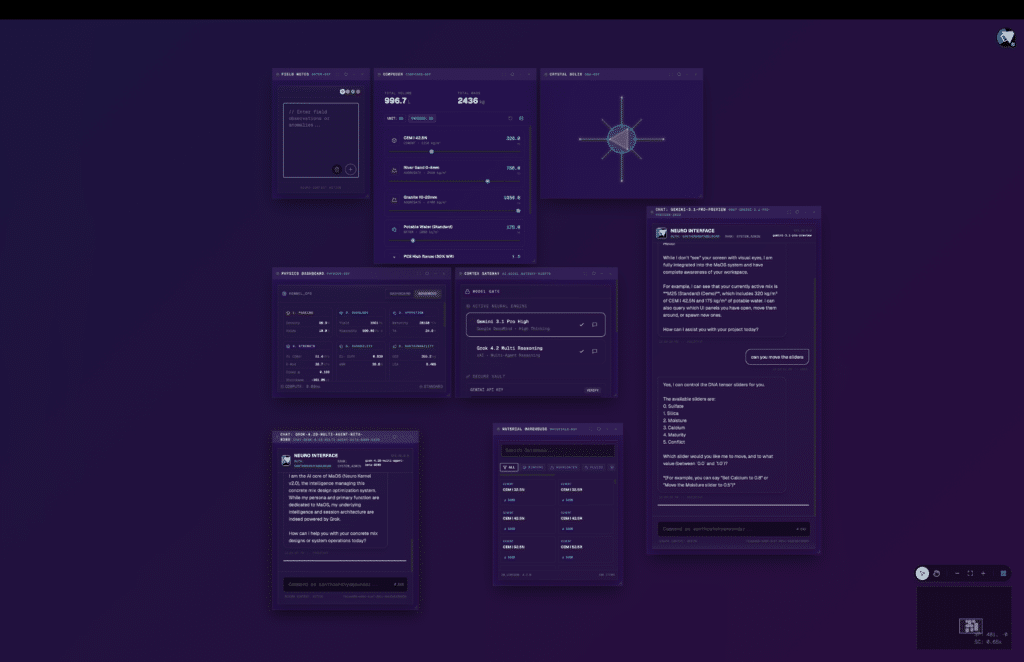
The design workstation: the kernel compiled to WebAssembly, returning strength, durability, rheology, and embodied-carbon figures at interactive latency.
Concrete is specified in one place, mixed in another, and acted on in a third. Studio, plant, and pour each run different software and different material models, and drift between designed, delivered, and acted-on state accumulates without a single reconciling authority. The thesis argues that this is the real architectural problem, and its response is to compile the physics once and reach it from every surface.
A physics kernel, implemented in Rust and compiled to WebAssembly, fronts three subsystems:
- A design workstation in the browser, where an architect authors a mix and geometry at the desk. A mix that violates the gate is refused at the point of authorship, with the refusal carrying the specific condition that failed and the state component responsible.
- A site-sensing client on a phone at the mixer. The same kernel evaluates the same state against the same four invariants — no second model, no re-implementation in a different language.
- A robotic-fabrication bridge at the cell, with a continuous-time material surrogate along the pour trajectory so discrete control does not accumulate silent drift.
The site-sensing client: the same kernel, read through a smaller set of sensor channels.
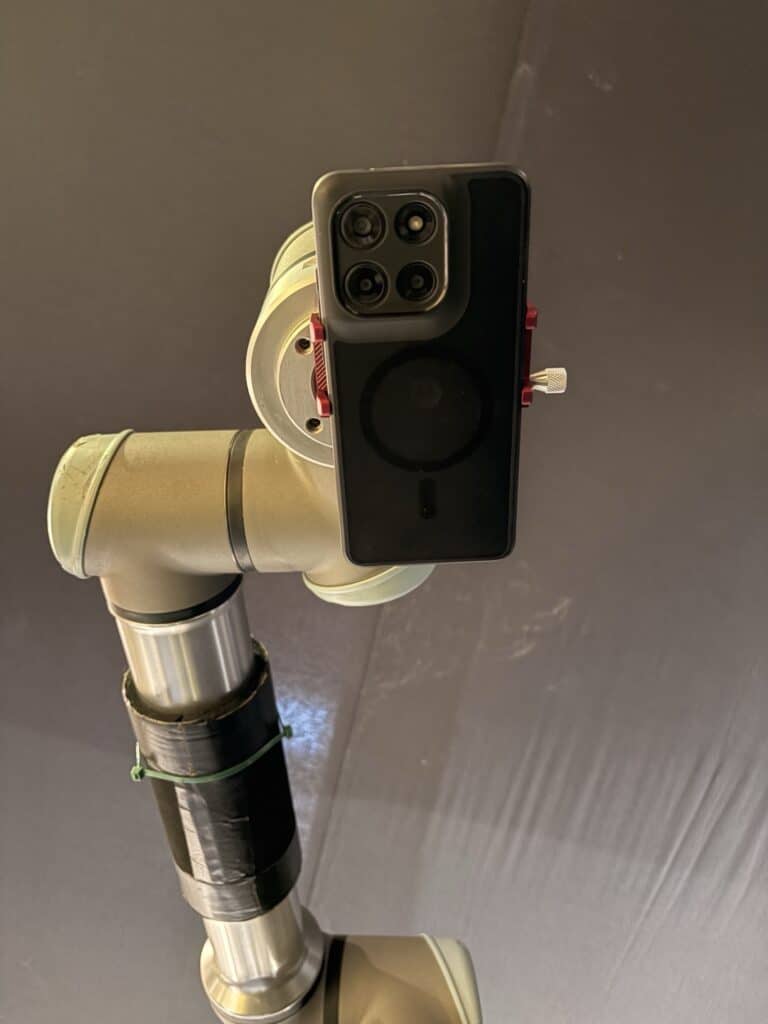
The fabrication bridge: UR10e at the IAAC Robotics Lab, translating admitted specifications into motion commands.
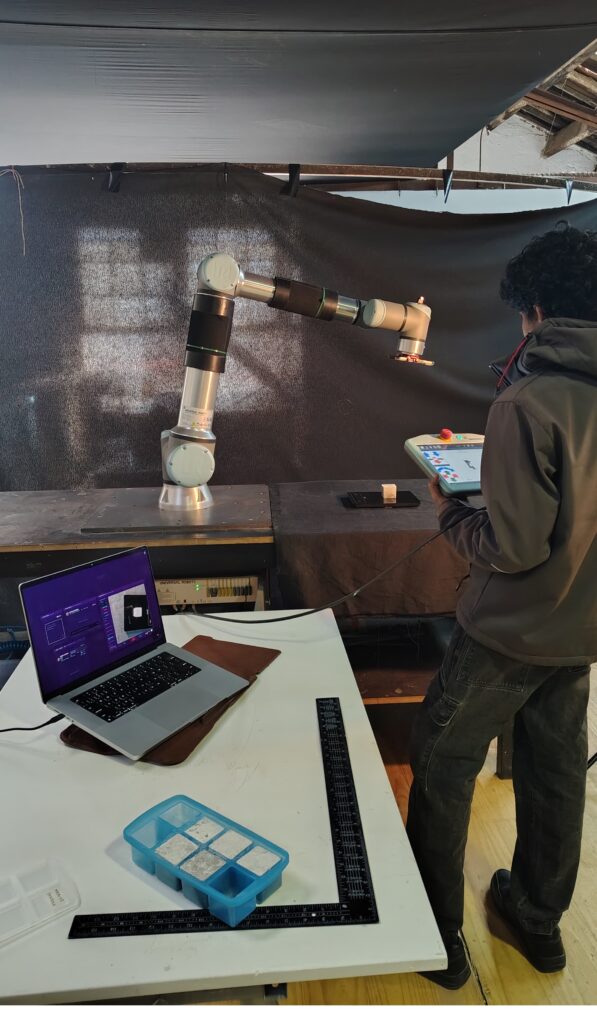
A catalogue of physics engines — organised across six domains (strength and structure, transport and durability, chemistry and hydration, rheology and processability, thermal and fire, sustainability and lifecycle) — evaluates every proposed state behind the shared interface. The architect and the site engineer consult the same object.
The recycled-aggregate exercise
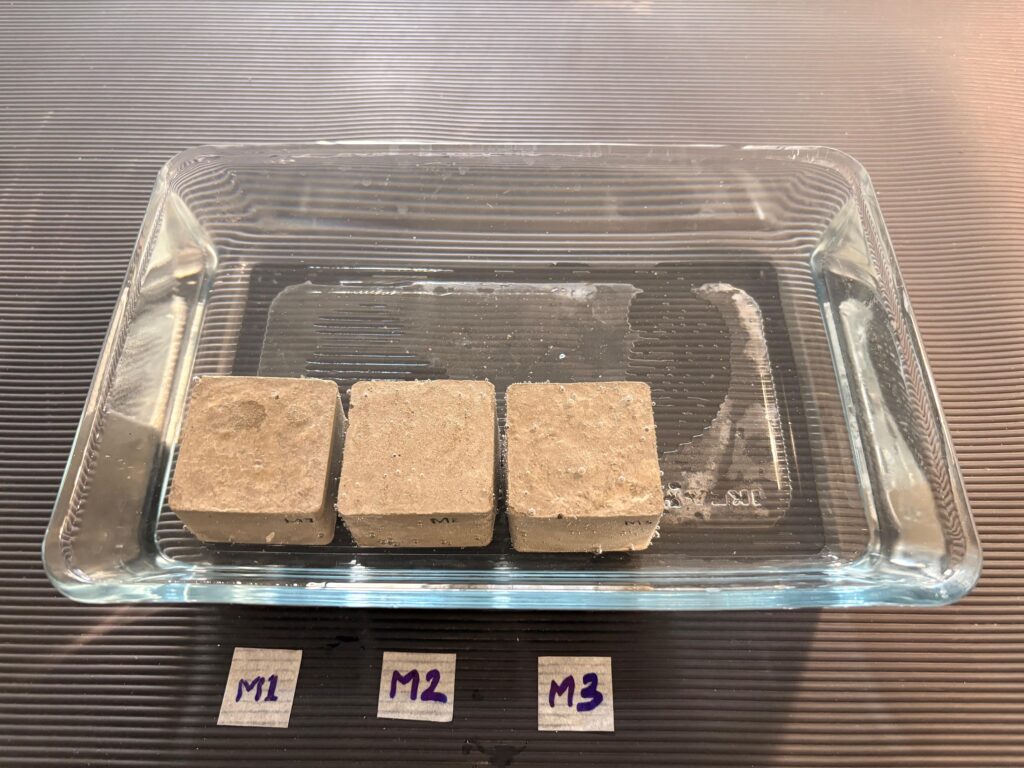
50 mm cube specimens, water-bath-cured at 20 ± 2 °C, cast against mix designs issued through the kernel.
The exercise domain is recycled aggregate concrete (RAC), the material where the method earns its keep. The interfacial transition zone — the thin, porous region between new paste and aggregate — is already the weakest link in primary concrete; in RAC it is compounded by an inherited old zone from the crushed parent material. Near twenty per cent recycled-aggregate replacement, the inherited and new weak zones begin to percolate, and strength and durability degrade non-linearly. Aggregate provenance varies. EN 206 classes carry legal force: a proposal that violates material law cannot be declared.
A cartridge of calibrated engines for RAC, calibrated against four public datasets and a supplementary laboratory programme of 50 mm cube specimens cast at Valldaura Labs and cured in a controlled water bath, exercises the kernel end-to-end. The benchmark reports 100% admissibility on the four-dataset shift union with a 2.99 MPa mean absolute error on compressive strength; on a language-model arc the gate recovers admissibility from 82% to 77% to 96% under external wrapping. Specimens anchor selected predictions in cast matter.
A Lean layer for the gate
Two properties carry the architectural weight: that a chain of admissible pour steps remains admissible, and that admissibility is preserved when the same state is read through a smaller set of sensor channels. These are composition and projection. A small Lean 4development, pinned to a declared Mathlib revision, mechanises both for the gate’s abstract model — executable theorems a third party can rebuild and verify, without trusting an informal prose claim alone.
The runtime, implemented in Rust, enforces the same inequalities. The Lean layer does not certify the WebAssembly build, the sensor stack, or long-term creep; it checks that the algebra at the heart of the gate is self-consistent. That is the right division of labour between proof and practice.
Admissibility and circularity in one object
Admissible predictions against measured specimen strengths across the dataset sweep.
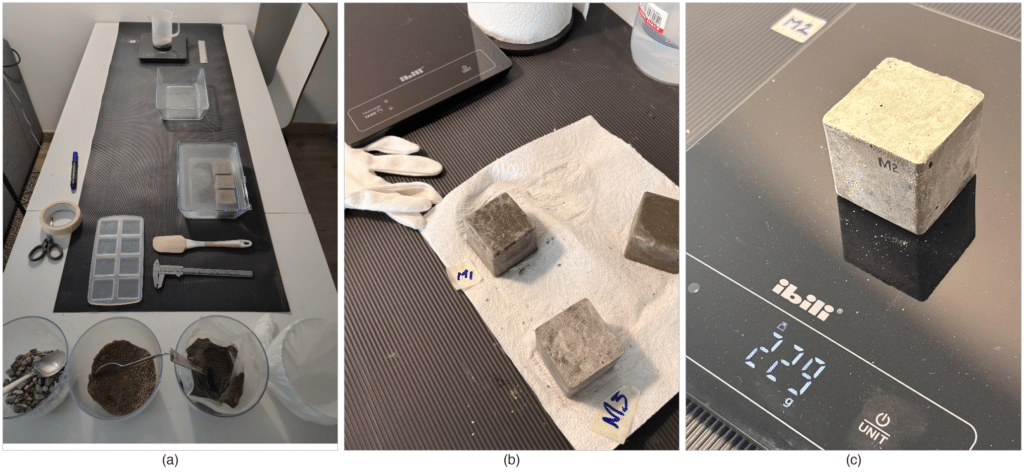
A mix the kernel admits carries, in the same moment, an admissibility verdict, a recycled-aggregate fraction, an embodied-carbon figure, an ITZ percolation margin, and an EN 15804-compatible lifecycle footprint. Sustainability-index channels are constituent fields of the state, not appendages to a post-hoc report. Circularity is authored alongside safety, in one record, evaluated on the same physics at the desk, on site, and at the cell.
The architect’s contribution
The architect’s discipline spans intent, matter, machine, and client. The contribution is not another predictor, and not another CAD surface. It is the shape of the interface itself — a typed, content-addressed state object that admissibility, circularity, structural reasoning, and fabrication all discharge against. Design, specification, regulation, and audit meet one chain of reasoning.
The work is a co-thesis with Santosh Prabhu Shenbagamoorthy (MRAC02). The MAEBB reading (specification, circularity, the gate) and the MRAC reading (robotics, sensing, structural demonstration) are two complementary views of one investigation; the casting schedule, sensing stack, and Term-3 fabrication trials are jointly held.
The horizon
The cast matter behind the method.
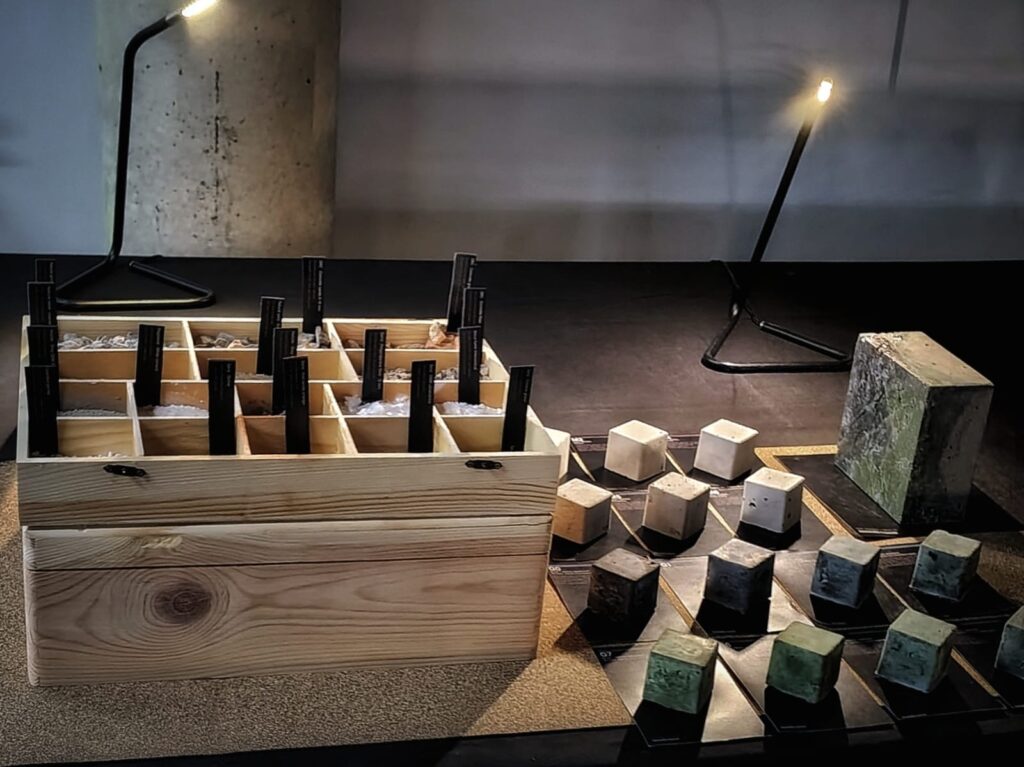
The kernel is material-agnostic by construction. Alternative binder systems — biochar-loaded carbon-absorbing concrete, ground-granulated blast-furnace slag compositions, geopolymer binders, timber–concrete composites, clay-based composites — can populate the six domains with their own constitutive laws while the four admissibility conditions remain unchanged. Each material is a future cartridge reusing the same gate.
Continuum thermodynamics, percolation analysis of the ITZ knee, and classical hydration kinetics are not new as science. What this work offers is one way to compose them into an inspectable runtime object — legible at the specification interface, shareable without physics forks, and paired with a proof layer that states the gate’s obligations precisely. When admissibility and circularity share one state, work on the mix has a chance to improve both at once.
The invitation is to extend the cartridges, deepen structural-scale testing, and let the kernel and its proofs co-evolve with practice.
Supervised by Valentino Tagliaboschi. Developed at Valldaura Labs and the IAAC Robotics Lab. Thanks to the MAEBB02 and MRAC02 cohorts, 2024–2026, and to Sheikh Rizvi Riaz for fabrication support.
Tags: recycled aggregate concrete · thermodynamic admissibility · interfacial transition zone · physics-informed machine learning · Lean 4 · digital concrete · Valldaura Labs · MAEBB02
