
Is the concept of utopia fading as we gain more forecasting power yet face even greater uncertainty?
CHARACTERS
Governor
Journalist
Fisherman
Fish Seller
Governor’s P.A
Media
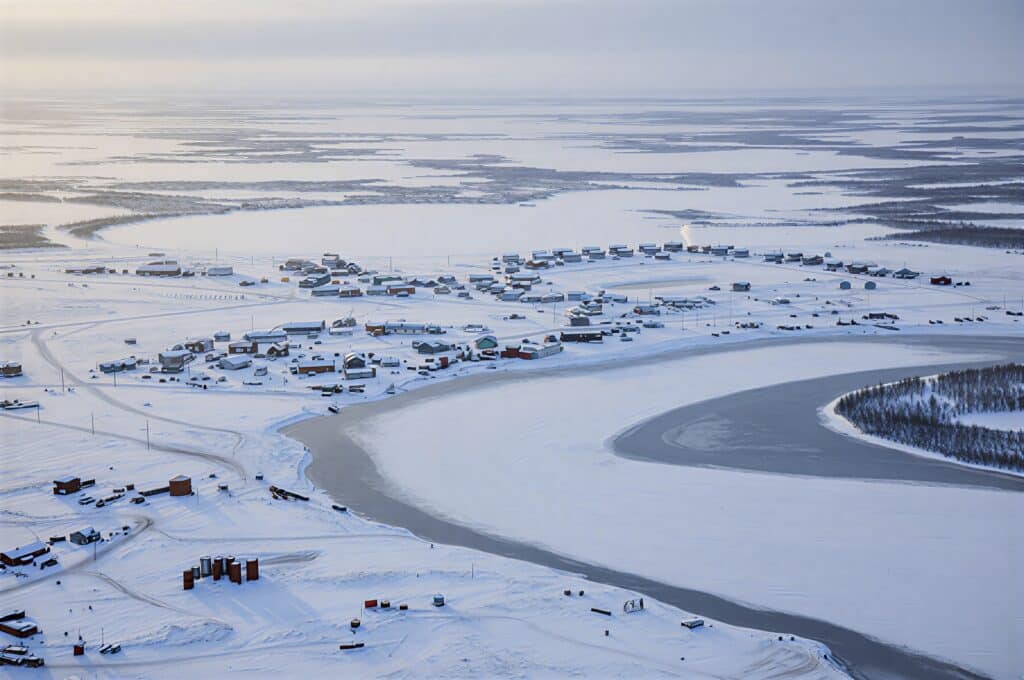
– FIRST ACT –
GOVERNOR IN THE CAR
(OVERLOOKING RUINS)
(The Governor receives a call.)
Governor: Everything is falling into place… right where we want it. We’ll move when it’s time.
(He cuts the call, eyes fixed on the ruins. People are being evacuated to higher lands)
Governor’s PA: Sir… the evacuation routes are holding. People are scared. They don’t know what comes next.
Governor: In times like these, the future splits into more paths than people realize. “Possibility is content, potency is energy, and power is form.”
Governor’s PA: I… I’m not sure I understand.
Governor: “Potency is the energy that transforms the possibilities into actualities.” Someone has to act, or nothing will change. Move them out. All of them.
ACT II: Path to the Tent
The Governor steps out. Reporters rush forward.)
Media: Governor! What’s happening here? How will you revive Kipnuk?
Governor: Let me speak to the people first.
Evacuee: Politicians show up when it’s already too late.
Fish Seller: Yeah. They come after the water takes everything. What good is a governor now?
Governor: Kipnuk doesn’t need to return to what it was. This moment… it’s a fork in the road. “Possibility is content, potency is energy, and power is form.”
Fish Seller: Here we go. Speaking in riddles while people drown.
Governor: Someone has to decide which path we take… but who should that be? Who has the right to turn one possibility into the future for everyone else?
Fish Seller: Whoever still has a bed to sleep in. Definitely not us.
Governor: We’re trying to rebuild, not abandon you. “In order to shift from virtuality to actuality, a possibility has to be embodied in a subject and this subject needs potency.”
Fish Seller: People don’t need potency they need ground that doesn’t collapse under their feet.
Governor: If we can’t act, nothing shifts. It’s our ability to move that turns a collapsing world into a new one.
Fish Seller: (Laughing bitterly) And what about us? We’re the ones who always get transformed. What it tells me is that your future sounds dangerously utopian. “Discussing different futures of our working lives reveals so much about our present attitudes toward work.”
Governor: Someone has to push forward… Futures don’t rise out of thin air they come through those strong enough to carry them into the world.
Fish Seller: Maybe liberation exists somewhere out there… just not for people like us, not in a place that keeps sinking.
Governor: Let’s keep talking inside the tent. Maybe we can find one possibility you still believe in.
ACT III & IV: Inside the Tent / The Debate
(Inside the tent, Ideologies collide)
Journalist: You’ve lived here your whole life. Did it ever feel like this… this uncertain?
Fisherman: Storms used to come and go. Now the world forgets the ‘go’ part.
Journalist: Before we get into anything else… what future are we actually heading toward? Who decides what Kipnuk becomes now?
Fisherman: Out here, you survive by following the signs—tides, winds, small things that guide you when nothing else does. “We navigate by guiding lights.”
Journalist: Like sailors used the North Star. Utopia works the same: a direction we follow, even if we never arrive.
Fish Seller: Direction? Look outside. Nothing feels possible now.
Governor: “Sometimes we don’t have that potency.” But we must act. It’s the idea of a different future that gives politics its force. Without that pull, there’s no direction—no change.
Journalist: Kipnuk isn’t finished. It still has openings. “Futurability is a layer of possibility that may or may not become actual.”
Fisherman: “Possibility is not one; it is plural.”
Governor: When people are scared and exhausted, they can’t see any possibilities at all. They can’t imagine anything. “If the emerging subjectivity has potency… it can bring invisible possibilities into visibility.”
Journalist: But when one person holds that potency, the North Star becomes a command, not a direction. Look at THE LINE in Saudi Arabia… a single, total future drawn before anyone could imagine their own. A straight path for millions, decided by a handful. That’s not futurability, Governor. That’s a prison made of promises.
Fish Seller: You can’t force people to feel hope. When exhaustion takes over, no amount of will can lift it. “Sad passions cannot be cancelled by force of will.”
Governor: Every time we hit a major crossroads, some futures disappear and others appear—and it’s power that determines which way things go. And right now… we’re at one.
Journalist: We don’t need domination. We need interpretation. Imagination matters. “Reason overflows into the stormy seas of speculation…”
Fisherman: When you think in utopian terms, you don’t cut reality away from imagination. They flow together, the way tides and wind do. Even the land speaks if you know how to listen.
Fish Seller: That’s where everyone is.
Governor: “The social mind is devoured by panic and impotence.” It’s our ability to act that lets us transform things—that’s where freedom begins.
Journalist: Transform who? We all know the present holds many futures, but you’re the one deciding which future survives.
Fish Seller: “Utopian’ is an accusation.” And today… it fits.
ACT V: The Decision
(The storm has calmed. They stand at the edge of the destroyed town.)
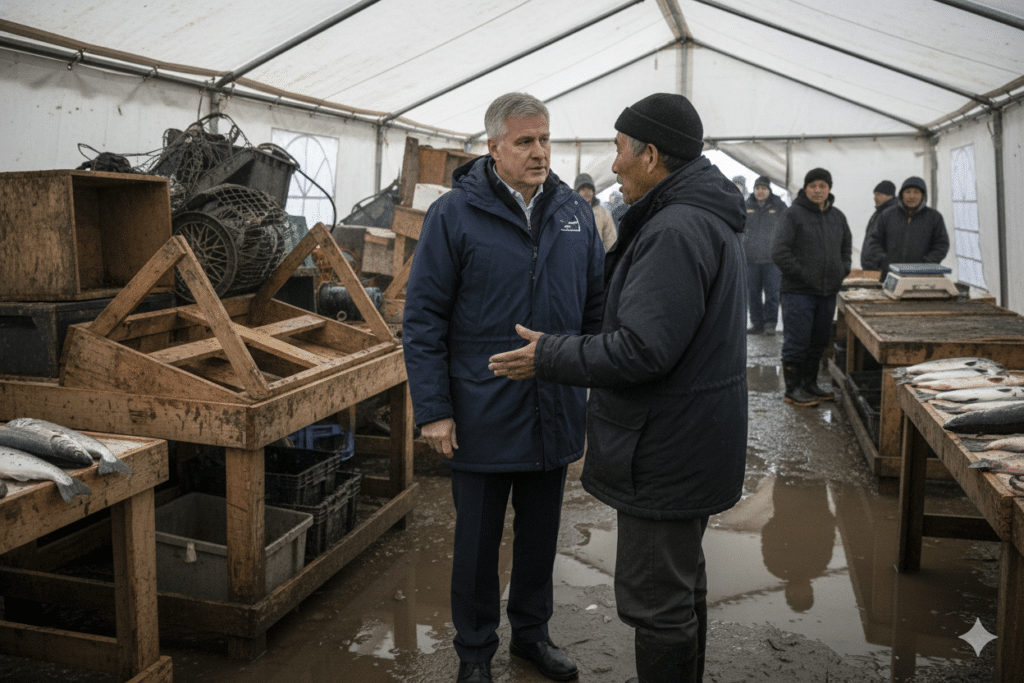
Fish Seller: Feels like you’ve already made your choice. “Selecting one possibility among many.”
Journalist: We needed a horizon not a ruler. “Without the breakage that utopian visions offer us, we risk being stuck… seduced by constrained ideas of what’s possible.”
Fisherman: “The future is not prescribed.” But it always arrives.
Governor: You think I’m closing futures. I’m trying to keep at least one alive. Utopia isn’t a picture—it’s a direction. And directions mean nothing unless someone walks first… even if the ground is breaking. If we wait for everyone to agree, Kipnuk will disappear before the debate ends. Someone has to choose a path—not for power… but because time won’t wait.
Fish Seller: (Murmuring) When one man holds the potency… utopia stops being a star to follow and becomes the road he forces us onto.
Governor: Look around you—Kipnuk can’t hold us anymore. If we stay here arguing about futures, we won’t survive long enough to have one.
Journalist: So this is the choice? Leave everything behind because you say it’s the only path forward?
Fisherman: He’s right. The tide’s shifting again. If we don’t move, it’ll take what’s left of us.
Fish Seller: (Quiet, defeated) Fine… let’s go.
Governor: (Lowers voice, making a call) They’ve agreed.
ACT VI: Final Curtain
(The Governor returns to the car)
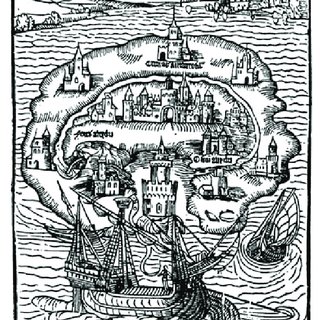
Governor’s PA: Sir… is this really the right thing to do?
Governor: There is no “right” anymore. There are only possibilities—and someone has to choose one.
Governor’s PA: But why you?
Governor: Because the future isn’t predetermined. It only becomes real when someone acts. If we hesitate, the worst future wins. If we move, at least we shape it. This is futurability: many paths, one choice. And I’m the one who has to make it.
“When collective potency collapses, individual potency fills the vacuum.” — Franco “Bifo” Berardi
BIBLIOGRAPHY
Berardi, Franco “Bifo.” Futurability: The Age of Impotence and the Horizon of Possibility. 2017.
Grosz, Elizabeth. Architecture from the Outside: Essays on Virtual and Real Space. Cambridge, MA: MIT Press, 2001.
Mbembé, Achille. The Earthly Community. 2017.
Hester, Helen. Post-Work: What It Is, Why It Matters, and How We Get There. 2021.
Beech, Amanda, Robin Mackay, and James Wiltgen, eds. Construction Site for Possible Worlds. Kindle ed. Falmouth: Urbanomic, August 11, 2020.
CREDITS
S. Thulasiram
Vijeeth Rao Mandala
Revanth Munivenkatappa Satish
Prathamesh Prakash Jadhav
