
What economies of attention do augmented environments trigger?
CHARACTERS
Étienne
Ashley
Akshay
Lukas
Emily
Fig. 1
“When the Festival Begins” (2016)
– FIRST ACT –
(Inside the Saint‑Jean Cathedral, Lyon. Étienne sits in quiet contemplation. Sound tests begin for the Fête des Lumières. Outside, Ashley Summers arrives, phone in hand, preparing to livestream.
Darkness falls. The cathedral glows faintly. Étienne rises, disturbed by bursts of light and sound. Ashley steps out of a taxi, adjusting her phone camera, speaking to her followers.)
(1)
Benjamin, The Work of Art in the Age of Mechanical Reproduction(1935), 6.
(2)
Han, Saving Beauty (2015), 1-2.
(3)
Bishop, Disordered Attention How We Look at Art and Performance Today (2024), 24.
(4)
Bishop, Disordered Attention How We Look at Art and Performance Today (2024), 41.
(5)
Han, Saving Beauty (2015), 3.
(6)
Kornbluh, Immediacy or,The Style of Too Late Capitalism, (2024), 9.
(7)
Bishop, Disordered Attention How We Look at Art and Performance Today (2024), 33.
(8)
Bishop, Disordered Attention How We Look at Art and Performance Today (2024), 35. “The mode of attention that results is skimming and sampling, reading quickly to get the gist, or sampling two or three parts of the installation rather than the whole.”
(9)
Bishop, Disordered Attention How We Look at Art and Performance Today (2024), 159.
(10)
Hyperattention is characterized as “switching focus rapidly among different tasks, preferring multiple information streams, seeking a high level of stimulation, and having a low tolerance for boredom”.
(11)
Benjamin, The Work of Art in the Age of Mechanical Reproduction(1935), 6.
(12)
Bishop, Disordered Attention How We Look at Art and Performance Today (2024), 41
(13)
Bishop, Disordered Attention How We Look at Art and Performance Today (2024), 45
ÉTIENNE:
ASHLEY:
ÉTIENNE:
ASHLEY:
ÉTIENNE:
ASHLEY:
ÉTIENNE:
ASHLEY:
ÉTIENNE:
ASHLEY:
ETIENNE:
“The unique value of the ‘authentic’ work of art has its basis in ritual.” (1) This place was built for contemplation, not for being viewed as spectacle. “The smoothness of the beautiful today avoids any confrontation. It is the affirmative form of the positive.” (2) But now the form is drowned in noise, fractured by bursts of light.
“Absorption in a single object, usually via a single information stream, for a long period of time.” is gonna waste my energy (3) because for me every sunset, every cathedral, every vibe is content. “Beauty is no longer contemplative; it is optimized for instant affect.” (4) Beauty is what hits instantly, what trends.
Beauty cannot be reduced to a dopamine surge. “The smoothness of beauty today is the violence of positivity.”(5) It erases pain, it erases truth.
(excited, almost breathless) I don’t think that’s true at all, because for me beauty is immediate, it’s shareable, it’s now. “Immediacy’s pulsing effulgence purveys itself as spontaneous and free, pure vibe..” (6)
(shaking his head from side to side) Tsk tsk tsk
You are just overthinking this, the truth is pretty simple. If it doesn’t trend or get attention, it doesn’t exist “This perpetual oscillation between here and elsewhere, consuming and commenting, is central to how we look at art and performance today.” (7)
“Spectatorship today is characterized less by immersion than by distraction, skimming, and sampling.” (8)
(grinning, to her livestream) What? Sorry I got distracted, what were you saying?
But “The digital equivalent of art is scrolling. As a way of looking, scrolling implies a flatness of affect: the boredom of repetition (next, next, next)…”(9) That’s not distraction — that’s the new way of life. Hyperattention is how we live now.(10)
But if you live only to capture, will you ever truly witness? “For the first time in world history, mechanical reproduction emancipates the work of art from its parasitical dependence on ritual.”(11) And with that, the possibility of true beauty slips away.
“Beauty is no longer contemplative; it is optimized for instant affect.”(12) and that’s just how everyone operates these days, “Modern spectatorship, premised on fully focused presence and deep attention, no longer seems appropriate or necessary.” (13)
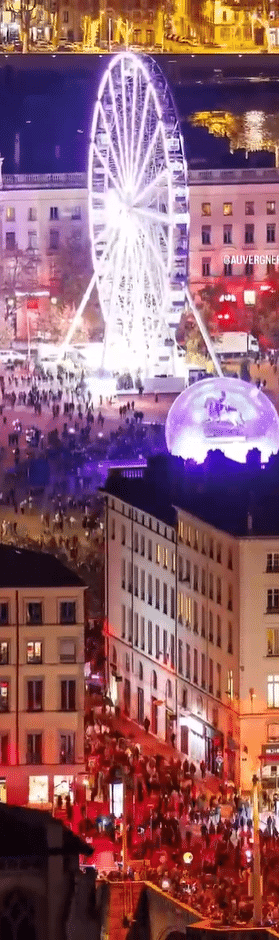
Fig. 2
“Festival Ongoing” (2024)
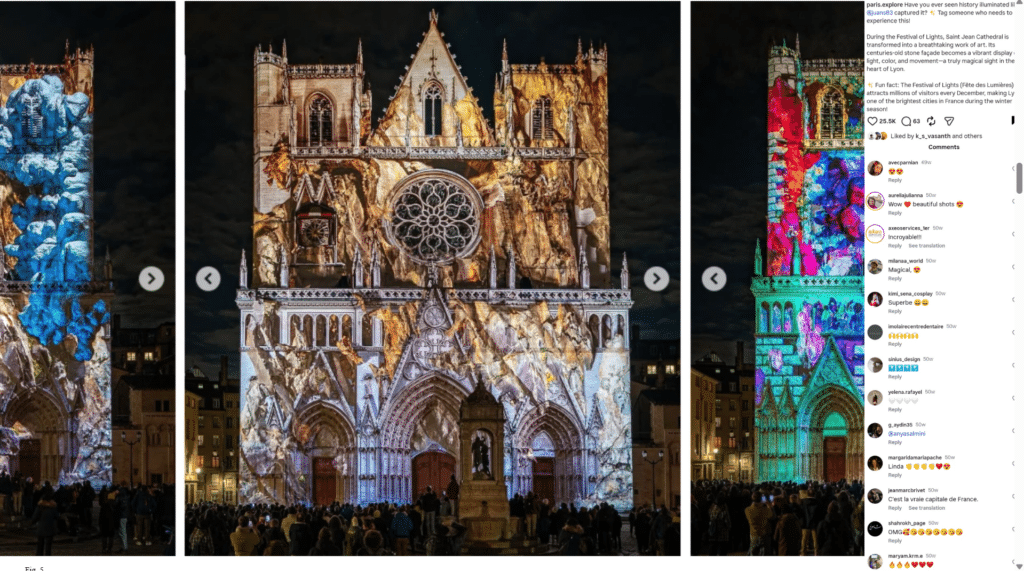
Fig. 3
“Someone following the Fesvival on the Metro”

Fig. 4
“Crowd filming” (2024)
– SECOND ACT –
(The plaza outside Saint‑Jean Cathedral. The light projections intensify. Ashley streams live. Étienne grows restless. Lukas sits alone in his study, screen glowing. He watches Ashley’s livestream not for spectacle, but for patterns.
Akshay scrolls impatiently on his phone while riding the metro, waiting for Ashley’s stream.)
(14)
Han. The Crisis of Narration (2024), 11.
(15)
Bishop, Disordered Attention How We Look at Art and Performance Today (2024), 62
(16)
Han, Saving Beauty (2015), 29
(17)
Zuboff, The Age of Surveillance Capitalism: The Fight for a Human Future at the New Frontier of Power(2019), 220
AKSHAY:
ASHLEY:
ÉTIENNE
ASHLEY:
“I have already run out of patience.” (comments) “But we increasingly lack the patience for attentive listening, even the patience for narrative.” (14), that’s just not me.. I need more, I need fragments, I need streams.
Hold on, this art is worth the wait. (to herself) “What’s scarce is the limited reserve of human attention.”(15) And I’m here to capture it.
“They call this art? It’s just debris. It’s ‘trash washed onto the beaches of digital economies.” “The beautiful is being flattened into the agreeable.” (16) and here, it is consumed, traded, emptied.
This is my job! “Every click, every search, every like is a behavioral surplus.”(17)

Lukas hears this conversation, writes a note for himself and comments in the live stream.
(18)
Zuboff, The Age of Surveillance Capitalism: The Fight for a Human Future at the New Frontier of Power(2019), 8
(19)
Bishop, Disordered Attention How We Look at Art and Performance Today (2024), 23
(20)
Han, Saving Beauty (2015), 32
(21)
Kornbluh, Immediacy or,The Style of Too Late Capitalism,(2024), 16
(22)
Han, Saving Beauty (2015), 3
(23)
Benjamin, The Work of Art in the Age of Mechanical Reproduction(1935), 5
(24)
The aura of a work of art is the element that is lost in the age of mechanical reproduction, which can be defined as “its presence in time and space, its unique existence at the place where it happens to be”. This unique existence determined the history of the work, including physical changes and changes in ownership. Walter Benjamin suggests subsuming this eliminated element under the term “aura,” stating: “that which withers in the age of mechanical reproduction is the aura of the work of art”.
(25)
Kornbluh, Immediacy or,The Style of Too Late Capitalism,(2024), 2
(26)
Benjamin, The Work of Art in the Age of Mechanical Reproduction(1935), 7
(27)
Buildings are taken in through both use and perception—through touch and sight. This is not the tourist’s focused contemplation, but something shaped by habit. In architecture, we perceive far more through casual, incidental noticing than through full attention. This habitual, tactile mode of reception becomes essential in moments of historical change, when perception cannot rely on contemplation alone but must adapt through lived, bodily familiarity.
(28)
Han, Saving Beauty (2015), 11.
LUKAS:
AKSHAY:
ASHLEY:
ÉTIENNE:
ASHLEY:
ÉTIENNE:
AKSHAY:
(writes a note on his Miro board) “Surveillance capitalism unilaterally claims human experience as free raw material for translation into behavioral data.”(18) “Attention was ideally poised to fill a gap in business theory”(19) “The more data there are about a person, the better that person can be surveilled, controlled and economically exploited.” (20) people are “performing exhaustive unwaged digital labor as data producers. “(21)
(comments in live stream) Can you keep your phone steady for a moment, please? I am trying to watch the projection
(comments in the live stream) Steady? “Narrative is being replaced by information.”(22) And information dissolves before you can hold it.
(shifting her phone frame replying to Lukas) Oh, come on…. look at this, isn’t this frame so much better! Don’t get attached to things so quickly.
It doesn’t matter “Even the most perfect reproduction of a work of art is lacking in one element: its presence in time and space.” (23) It’s Aura. (24)
Aura? Aura depends on beauty and its capacity to attract attention.“Immediacy is the style of too late capitalism.” (25) If it doesn’t trend, it doesn’t exist.
“The authenticity of a thing is the essence of all that is transmissible from its beginning.”(26) But this authenticity is lost. What remains is a copy, a spectacle. (27)
“Narrating presupposes close listening and deep attention.” (28)
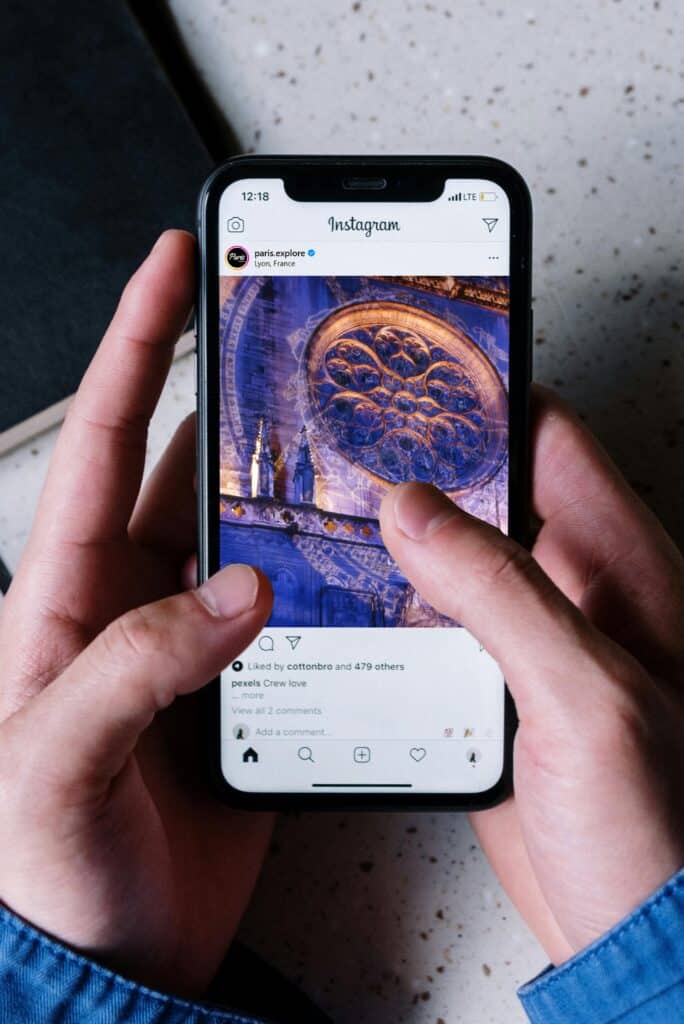
Fig. 8
“Someone Scrolling Down The Feed”

Fig. 9
“The moment when projection goes off: Ashley’s Phone”
All of a sudden, everyone is engulfed in total darkness. The projections die. The audio cuts out.
Curtain
(Act II ends with all characters reflecting on the fragility of attention.)
– THIRD ACT –
(Silence drops over the square as the projections die. The city’s glow returns, revealing the cathedral bare and unfiltered. Ashley watches her audience vanish; Akshay stares, unsure how to read the raw façade. Etienne looks pleased — the glitch suits him. Lukas observes quietly. Enters Emily, the lighting technician, steps out with a smoking connector, more annoyed than surprised. Each character is left with the same question: What does it mean to look?
(Silence drops over the square as the projections die. The city’s glow returns, revealing the cathedral bare and unfiltered. Ashley watches her audience vanish; Akshay stares, unsure how to read the raw façade. Etienne looks pleased — the glitch suits him. Lukas observes quietly. Enters Emily, the lighting technician, steps out with a smoking connector, more annoyed than surprised. Each character is left with the same question: What does it mean to look?)
ASHLEY:
EMILY:
(Ashley (pointing her phone at the bare stone): No, no, no! I’m gonna lose all my followers! Where is the technician, someone fix this ASAP!
(holding a scorched cable) Yeah, well, right now what “deserves attention” is this junction box that’s cooked. Someone pushed it past tolerances.
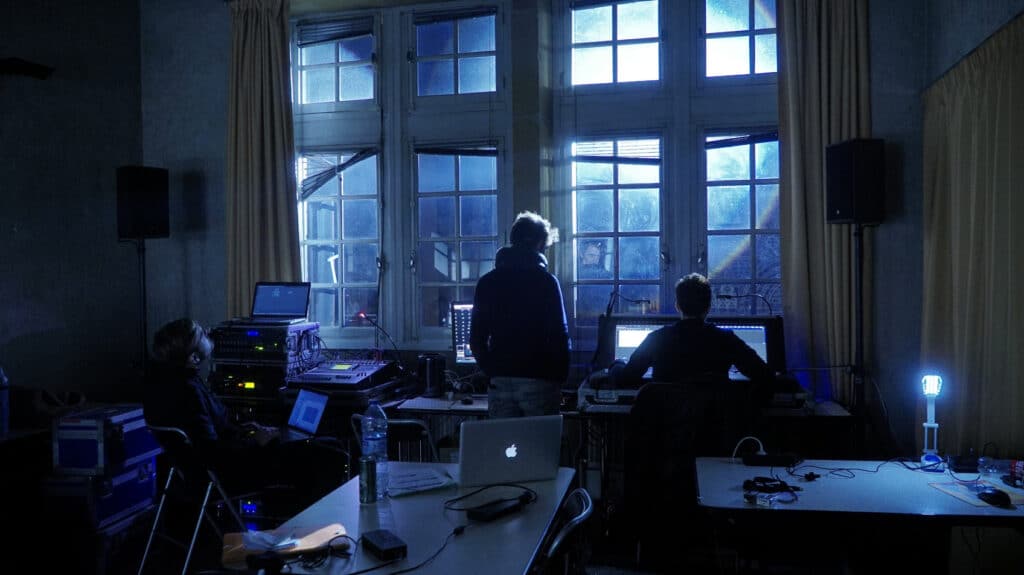
Fig. 11
“Technical Staff Trying to Solve The Problem” (year)
(29)
A “perpetual oscillation between here and elsewhere, consuming and commenting”.
(30)
Bishop, Disordered Attention How We Look at Art and Performance Today (2024), 6
(31)
Weber, Economy and Society (1921), 301.
(32)
Unlike traditional projections onto flat screens, augmented projection mapping uses specialized software to accurately align and warp video, animations, and graphics with the precise contours and features of the real-world object.
(33)
Bishop, Disordered Attention How We Look at Art and Performance Today (2024), 2-3
(34)
Kornbluh, Immediacy or,The Style of Too Late Capitalism,(2024),12
(35)
Bishop, Disordered Attention How We Look at Art and Performance Today (2024), 4
(36)
Bishop, Disordered Attention How We Look at Art and Performance Today (2024), 22
(37)
Simondon, “Techno-Aesthetics,” in International Lexicon of Aesthetics, 2025)
(38)
Benjamin, The Work of Art in the Age of Mechanical Reproduction(1935), 21
(39)
Benjamin, The Work of Art in the Age of Mechanical Reproduction(1935), 16
(40)
[Benjamin, The Work of Art in the Age of Mechanical Reproduction(1935), 15
(41)
Benjamin, The Work of Art in the Age of Mechanical Reproduction(1935), 26
(42)
Bishop, Disordered Attention How We Look at Art and Performance Today (2024), 119
(43)
Benjamin, The Work of Art in the Age of Mechanical Reproduction(1935), 6.
ASHLEY:
EMILY:
AKSHAY:
LUKAS:
ÉTIENNE:
ASHLEY:
LUKAS:
EMILY:
LUKAS:
ASHLEY:
ÉTIENNE:
EMILY:
But the projection! Can’t you just fix it? People were watching it! It was the whole point of the livestream! Ugh, this is so bland. The visuals made it alive, without them, it’s nothing. “modern spectatorship… is incessantly hybrid:(29) both present and mediated, live and online, fleeting and profound, individual and collective.”(30) If it’s not on my screen, it doesn’t exist.
The point? The current limit, not your dopamine spikes. ‘Rationalization renders process independent of charisma or beauty’(31). If the projection fails, nobody sees your point anyway.
Hello?? Projection’s dead.(32) This is… weird. Can’t look at the stone for so long.
What you’re all living right now is the condition. “Our conversations and observations took place in and alongside the work, as did our photography.” (33) When the work vanishes, so does the scaffolding of your attention.
So the Aura of the Cathedral is restored again!
Aura doesn’t pay rent. Urgency does. “The colloquial connotation of immediacy as ‘urgency’ underlines the temporal dimension of this style, a hurry-hurry that compresses time into a tingling present.” (34) If I don’t move FAST, if they don’t get what they WANT, they LEAVE me.
Ashley. Étienne. Listen. “How has our attention been reorganized?” (35)This blackout is not a failure. It is a revelation.“Digital networks collapse the space between reality, experience, and image.” (36) And here, we are all learning what it means to lose it.
You’re all arguing philosophy. I don’t philosophize. I maintain the system. “Techno-aesthetics reminds us that technical objects are never neutral tools — their operations, tolerances, and failures actively shape what we can perceive and experience.” (37)
(writes analogy on Miro board) “Mechanical reproduction is inherent in the very technique of film production. This technique not only permits in the most direct way but virtually causes mass distribution.”(38) “The camera introduces us to unconscious optics.” (39) “By close-ups of the things around us, by focusing on hidden details of familiar objects… the film, on the one hand, extends our comprehension of the necessities which rule our lives; on the other hand, it manages to assure us of an immense and unexpected field of action.”(40) Nowadays “The film is the art form that is in keeping with the increased threat to his life which modern man has to face.”(41)
(furious, to her dead livestream) Why are they leaving?? Guys, stay—hellooo?? Ugh, this is the problem. “The second I stop entertaining you, you engage in this peak-and-decay model of viral attention”.(42)
Hmmm, now that i realise maybe “The adjustment of reality to the masses and of the masses to reality is a process of unlimited scope.” (43) You’re not causing this disorientation— you’re living inside it.
(Emily enters again) Okay. Emotional breakthrough aside, does anyone have ANY idea from where this blackout mess came from?
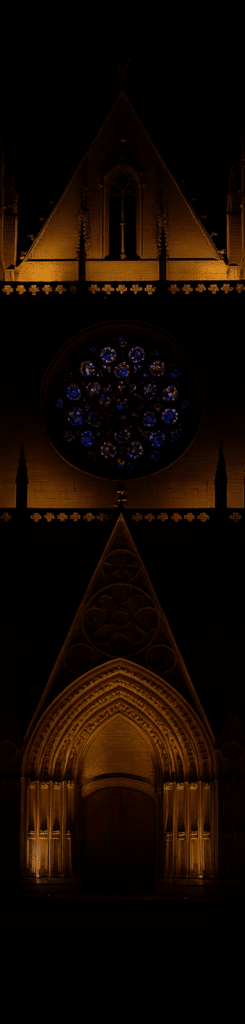
Fig. 12
“After the Projections Goes Off: The Facade only with ambient lighting”
(Meanwhile, Akshay gets bored and leaves frustrated.)
(44)
Zuboff, The Age of Surveillance Capitalism: The Fight for a Human Future at the New Frontier of Power(2019), 274
(45)
Benjamin, The Work of Art in the Age of Mechanical Reproduction(1935), 26
(46)
Bishop, Disordered Attention How We Look at Art and Performance Today (2024), 25
(47)
Kornbluh, Immediacy or,The Style of Too Late Capitalism,(2024),3
(48)
Kornbluh, Immediacy or,The Style of Too Late Capitalism,(2024),15
ÉTIENNE:
EMILY:
ASHLEY:
ÉTIENNE:
LUKAS:
Emily, there!
Ah, great! I’m all done here, power will reboot in a moment. Whether you actually see something this time…that’s up to you, not the projection.
“Today’s means of behavioral modification are aimed unabashedly at ‘us.’ Everyone is swept up in this new market dragnet.”(44), so maybe I also unknowingly became a pawn, reshaped by what I consume.
“The conventional is uncritically enjoyed, and the truly new is criticized with aversion.”(45). Maybe I am one of those narrow minded people who just resist.
(writes on his Miro board) Attention is a “cultural construct” “transindividual, relational, and collective phenomenon” (46) “The big business of ‘disintermediation’ accompanies the aesthetic happenings we’re observing: flexibility and fluidity, emanation and connectivity, directness and instantaneity are economic premiums as much as they are artistic ones.” (47)
(comments on Ashley’s stream) “Of course, omnicrisis devours us.” (48) Don’t lose hope, maybe you are the new artist.
