
In what ways do multi-intelligence design processes unravel the entanglement between authorship, authority and authenticity?
CHARACTERS
RK
WARREN
CHRIS
SRB
KSHITIJA
AMANO
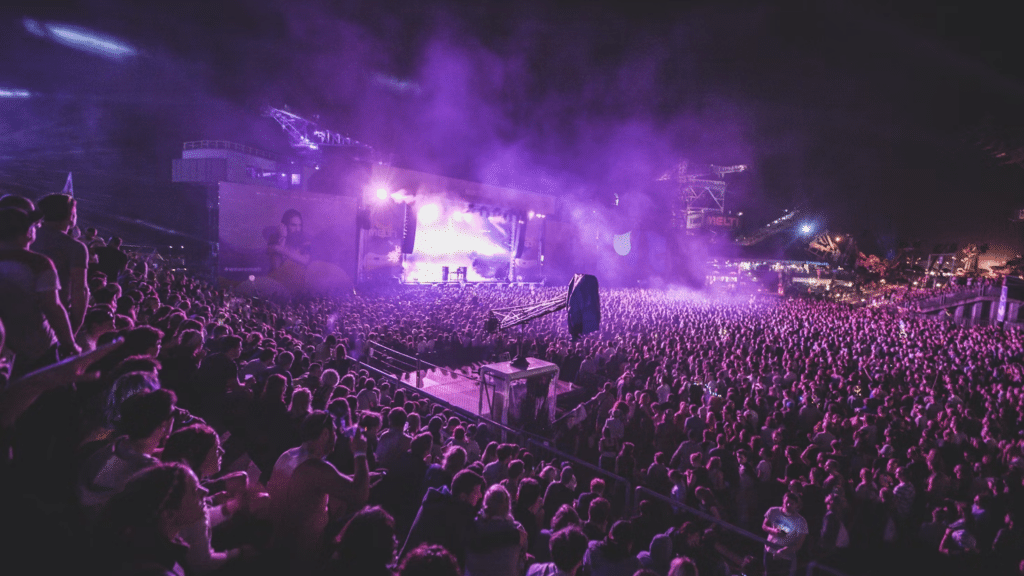
Lollapooza, Chicago, 2025
– FIRST ACT –
(It’s late evening, and the concert grounds of Lollapalooza are alive with sound and motion. RK and Warren step through the gates, the air buzzing with anticipation and the thump of basslines. The crowd ripples ahead of them, drawn toward the main stage where Doechii is mid-performance, her voice cutting sharp over a hauntingly familiar melody.)
RK: (taking it all in) There’s something about this place, man. The chaos. The color. But mostly the music, talking to itself across time.
WARREN: (laughs, nudging him) And I thought you were here to lose your mind to the melody, synths and bass. Already starting with a lecture?
(In the distance, the stage lights erupt. Doechii’s voice cuts through the soundscape – raw, urgent. The track is “Anxiety”. The chopped-up skeleton of Gotye’s Somebody That I Used to Know floats underneath, warped and anxious.)
(RK nods along the beat waits for the start of Somebody that I Used to Know)
RK: … Now and then, I think of when we….(Anxiety by doechii starts) … DAMN IT !!!
WARREN: (grinning, pointing toward the stage) There! That’s the one!
RK: (staring at the stage, half to himself) It’s wild. Life doesn’t move forward by clean breaks, it braids itself together. This track is not just hers or his, it’s what happens when forms merge and keep on evolving.
WARREN: (laughs, nudging him) We need to get past the “Who.” The theory is clear: “Writing is the destruction of every voice, of every point of origin.” (1) That single Author is a myth.
RK: That riff is like a genetic fragment. It’s not “pure Gotye” anymore, but without that inherited piece, the whole system of the song shifts. We’re listening to a little evolutionary jump, not a copy.
WARREN: To give a text an Author is “to impose a limit on that text,”(2) and we refuse limits. The claim to decipher her intent becomes quite futile.
RK: She isn’t standing outside his work; she’s inside it, like one organism living in another. Call it sampling, just like “The origin of cells with nuclei is exactly equal to the evolutionary integration of symbiotic bacterial communities.” (3)
WARREN: “The text is a tissue of quotations drawn from the innumerable centres of culture.” (4) Her only power is to mix those writings. And listen ”this performance is a performative utterance.” That’s not Gotye’s heartbreak anymore.
RK: Not bow. At least acknowledged. “How could random gene mutations lead to the evolution of flowers and eyes?”(5) you see??!!! Sampling is lineage. She’s speaking through him, not around him. Doesn’t that mean anything?
WARREN: She’s not expressing an individual ‘me.’ ”To write is to reach that point where only language acts, not ‘me’”(6). So yeah, music evolves. She’s doing what the Scripter does: pure, instantaneous inscription.”
RK: When she hits the chorus, it’s like the melody remembers a former life. The crowd only feels that punch because the old song is still alive in the new one: two lineages occupying the same body.
(They pause. Doechii screams into the chorus, her voice fractured and fierce. The crowd screams with her. Lights strobe across their faces.)
WARREN: (quietly) Ghost or not, the true meaning lies with us. “A text’s unity lies not in its origin but in its destination.” (7) This isn’t nostalgia. ”This is the Birth of the Reader.” (8)
RK: (watching the stage) Maybe that’s the point. None of this is ‘from scratch’. We are “All, originated through mergers of different types of bacteria in a specific sequence. Joint residence prevailed and proliferated.” (9) Leave it, let’s go for a smoke.
(They stand shoulder to shoulder, surrounded by a crowd that couldn’t care less about the debate. And yet, both of them are moved. Different beliefs, same beat.)
CURTAIN
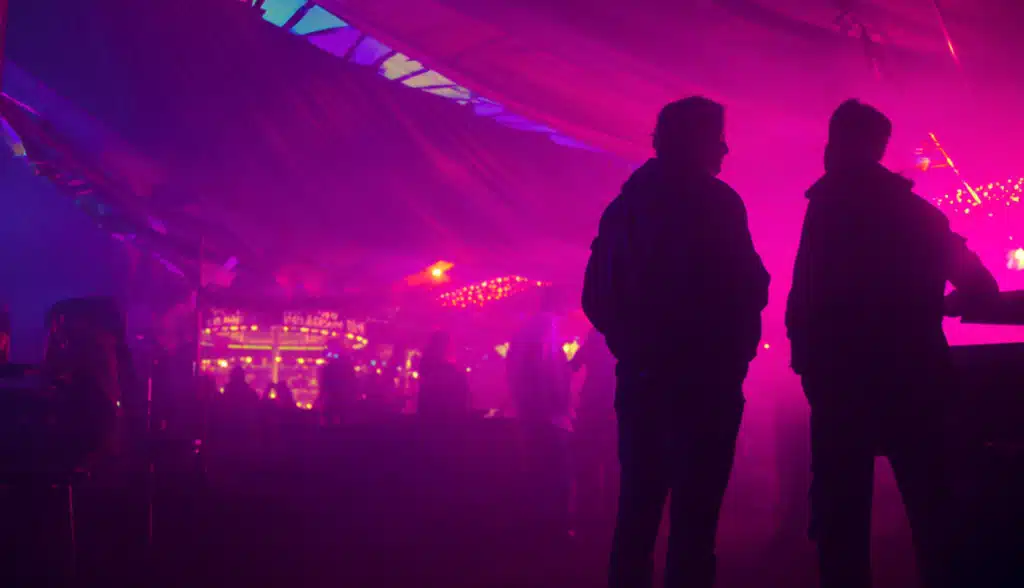
RK and Warren at a corner.
– SECOND ACT –
(In the bask of their own Anxiety, RK and Warren finds a corner by the big logo of Lollapalooza to light a cigarette, and finds himself without a lighter.)
RK: Please tell me you got a light.
WARREN: (laughs) Here I thought you’d have one
(A few feet away stands a man in all white frayed linen shirt, old boots, tangled headphones. A cigarette dangles from his lips, but he’s humming softly to himself, eyes closed, fingers twitching like they’re on invisible guitar strings.)
RK: (gestures towards him) You got a light? (mimics the action of a lighter)
(Chris flicks the lighter. RK leans in. The flame flares between them. As RK exhales, Warren looks across the clearing.)
WARREN: (nods toward him) What’s your story? Let me guess you don’t like this music!
CHRIS: Huh? (takes the headphones off) Yeah, listening to this music would ruin somebody that I used to know, if you know what I mean.
(RK and Warren laugh.)
CHRIS: But, as Gerald Raunig says “the machine”, in this case the song “is not a technical device and apparatus, but a social composition and concatenation.”(10)
(Raj takes a good long drag, glancing at Chris’s headphones.)
RK: You know, “evolution doesn’t really do clean breaks.”(11) It’s more like this festival, tracks bleeding into each other, old hooks folding into new voices.
CHRIS: Well, her song might feel “authentic,” but I wouldn’t call her the author. Listen: “the concatenation of knowledge and technology is not exhausted in fixed capital, but also refers beyond the technical machine, to forms of social cooperation and communication.”(12)
WARREN: (confused) Then who is the author?
CHRIS: Gotye, and at the same time, everyone and everything tangled into the machine. After all, “man becomes a piece with the machine or with other things in order to constitute a machine.”(13)
RK: We keep arguing about who the “real” author is, but listen: “Cell heredity, both nuclear and cytoplasmic, always must be considered for the entire cell, the entire organism.” (14) On a symbiotic planet there is no sealed-off self, everything we call an individual is already a collaboration. “Multicomposition is our nature.” (15) Nobody starts from zero; everyone is inheriting, editing and grafting.
WARREN: (rolls his eyes) here we go again, isn’t he the life of the party (Sarcastically). You’re still trapped in ancient history, grandpa. That obsession with the Author’s person, his life, his vice? That’s the “epitome and culmination of capitalist ideology.” (16) Look around! The Scriptor on that stage “is born simultaneously with the text.”(17) That means she is the true Scriptor, and this moment is authentic. “The birth of the reader must be at the cost of the death of the Author.”(18)
CHRIS: It’s only authentic because it’s in the now. (looks at his cigarette as it goes off)
Much like this, once it’s off, it’s off.
And the track, the sound, the song, it’s part of “the relationship between streams and ruptures of assemblages, in which organic, technical and social machines are concatenated.”(19)
(Chris lights again taking a long puff.)
RK: (watching the smoke curl) Maybe that’s why this whole authenticity thing feels off. If we’re all “walking communities”(20) anyway, then every track is a community too, no lone genius, just a shifting crowd signed under one name.
(Chris doesn’t respond, he has a 50-yard stare, almost like he’s lost in thought, only snapped back by the change in music.)
WARREN: Damn, we lost our spot in the crowd.
CHRIS: Don’t worry. I can arrange access to the VIP section, I know the manager, follow me.
CURTAIN
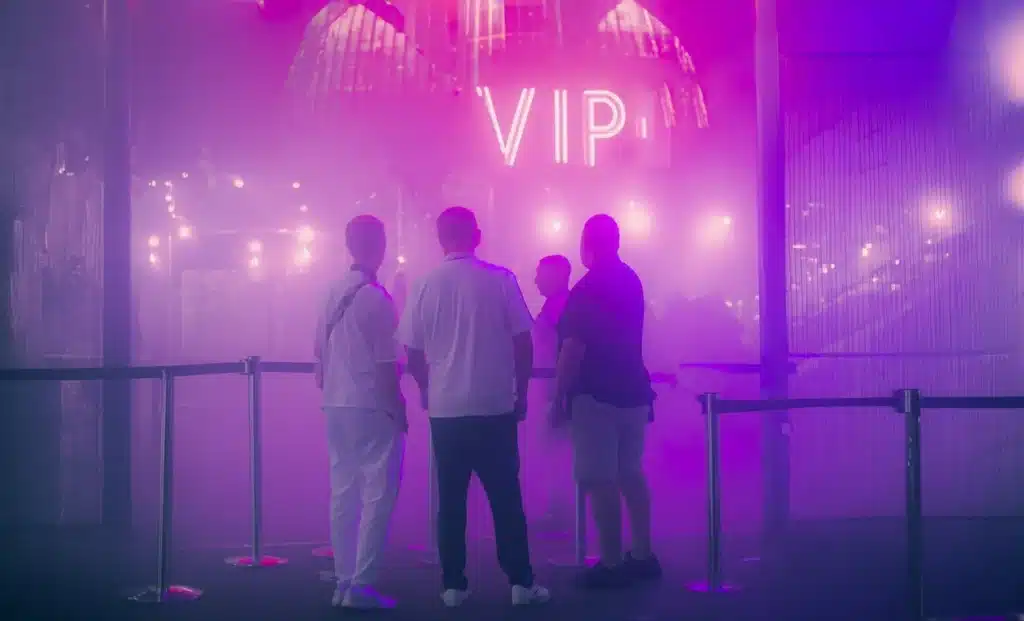
RK, Warren and Chris outside the VIP section.
– THIRD ACT –
(Chris moved through the crowd with surprising urgency, carving a path like he knew exactly where the night was supposed to lead. Behind him, RK and Warren followed a little lost, a little amused, and entirely swept up by the strange magnetism of the moment. They didn’t know where they were going, but they liked the feeling of almost figuring out.
At the barricade, Chris came to a stop and raised a hand towards a towering man on the other side, the kind of presence you notice without needing to know his name. ID badges swung from every strap, and a microphone hung from his collar like a badge of unspoken rank. Even in the middle of a tense exchange with an elegantly dressed woman dripping in accessories, the tall figure broke into a grin at Chris’ interruption. He greeted Chris not with suspicion, but with a familiar dap, the kind that spoke of history, not protocol)
CHRIS: Hey! These are my friends (gestures at RK and Warren). Guys, meet SRB, he’s the head coordinator and with him is the marketing wizard Kshitija. I know they are too kind and have 2 spare VIP bands for us.
RK & WARREN: (Awkwardly) Hi.
(Kshitija listening but focused on her phone and typing.)
KSHITIJA: There’s no way this big guy agrees without a democratic vote. Unc has no idea who he has booked for events too.
SRB: “It is not a dawn of a new world, but a new attitude toward the world, in the line of such a parliament of things.”(21) As long as everyone’s having a good time here, I am all good. Lollapalooza needs to be a success no matter what.
WARREN: You and RK will get along just fine.
CHRIS: (Raises an eyebrow) So that’s what you guys were talking about? You know,”It is not a question of the essence, but of the event, not about is, but about and, about concatenations and connections, compositions and movements (22).” The environment here is that field. It shapes us, the crowd, the music. That’s the author.
KSHITIJA: I beg to differ, in this digital era, “All that is digital is variable, and digital variability goes counter to all the postulates of identicality that have informed the history of Western cultural technologies for the last five centuries.”(23) The now will always change but what won’t change is the algorithm that shapes everything that is the author. “Invisible algorithms have already replaced all visual and physical traces of authenticity.”(24)
CHRIS: You’re forgetting something. “withdrawal of the complementary social component.”(25) a person who is accustomed to everyday rituals “he overlooks the new situation and abruptly falls over with his bicycle”(26) The market isn’t fixed, So what’s popular today dissolves tomorrow.
WARREN: So even you agree, what is relevant today is authentic.
CHRIS: Exactly. And that only makes it more complicated, “mutually supporting one another as one machine’s.”(27) So where do you even locate authenticity in that? I happen to create my own music which, right now, is in the genre of blues. My music comes from my pain, my surroundings. Here, have a listen.
(Amano eavesdrops, and interrupts)
AMANO: Oh wow, can I have a listen?
(Chris gives his walkman and Amano connects it to his phone. He sees Chris’ confused expression)
AMANO: I made an app that uses AI to generate full songs from samples.
CHRIS: (Snatches it back) Excuse me, if you feed my music into another device then suddenly, “the machine is constituted by the multiplicity of functions that are composed in it”(28) It stops being my music the moment your tool transforms it.
AMANO: Why are you offended? “Is the value of the output by the fact that they are not made from a fine tuned guitar or piano audio? Or that the music was not composed by a mammal with opposable thumbs.”(29) Let me demonstrate the power of machine learning by combining your mere intuition!
(Amano does something on his device. Music starts playing.)
KSHITIJA: “The author’s initial intention should always be upheld.”(30) AI removes the Author from the process. “In Alberti’s theory, the design of a building is the original, and the building is its copy, the drawing is not the building, and the building is not the work; the project is.”(31) Much like that Authority belongs to the author but authenticity isn’t derived from it.
SRB: “The beat is nothing without the singer. The king is just a commoner without his crown.” (32) “The goal is not to end up in a world with no objects or subjects, but rather in one where there are only well-constructed objects and subjects, the result of adequate negotiations between all relevant actors involved in the network.” (33) “It is a parliament of quasi-objects, a place where both objects and subjects are represented, but together with their relations, their scientists, and their uncertainties.”(34)
(A familiar music from a forgotten artiste plays.)
WARREN: Oh my god, its been ages since I heard this song! Is Marshmello on the lineup?
CHRIS: Yes he is.
(Music starts playing loud)
Final Curtain
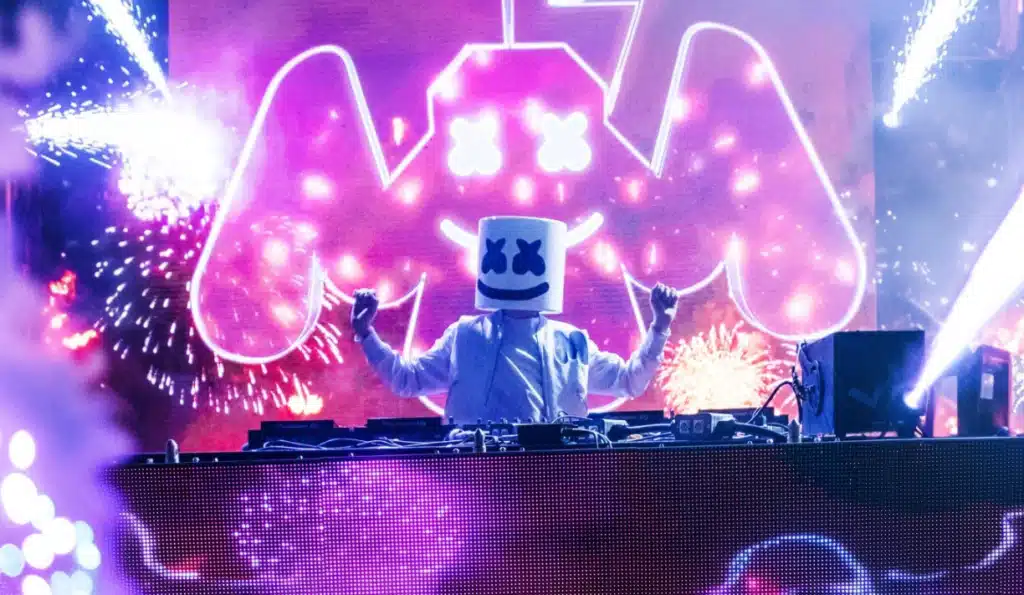
Christopher Comstock aka Marshmello performing live at Lollapalooza.
BIBLIOGRAPHY
Roland Barthes. “The Death of the Author” (1977)
Lynn Margulis, Symbiotic Planet-A New View of Evolution(1998)
Raunig, Gerald. A Thousand Machines: A Concise Philosophy of the Machine as Social Movement. (2010)
Bruno Latour, Parliament of Things (1998)
Mario Carpo. The Alphabet and the Algorithm. (2011)
Matias del Campo. Art Beyond Mechanical Reproduction, (2023)
CREDITS
Aman Arora
Brendon Dlima
Kshitij Shetty
Nisanth Menon
Rajkumar Dindor
Souvik Ray Baruah
Surya Vasudevan
Warren Maugo
