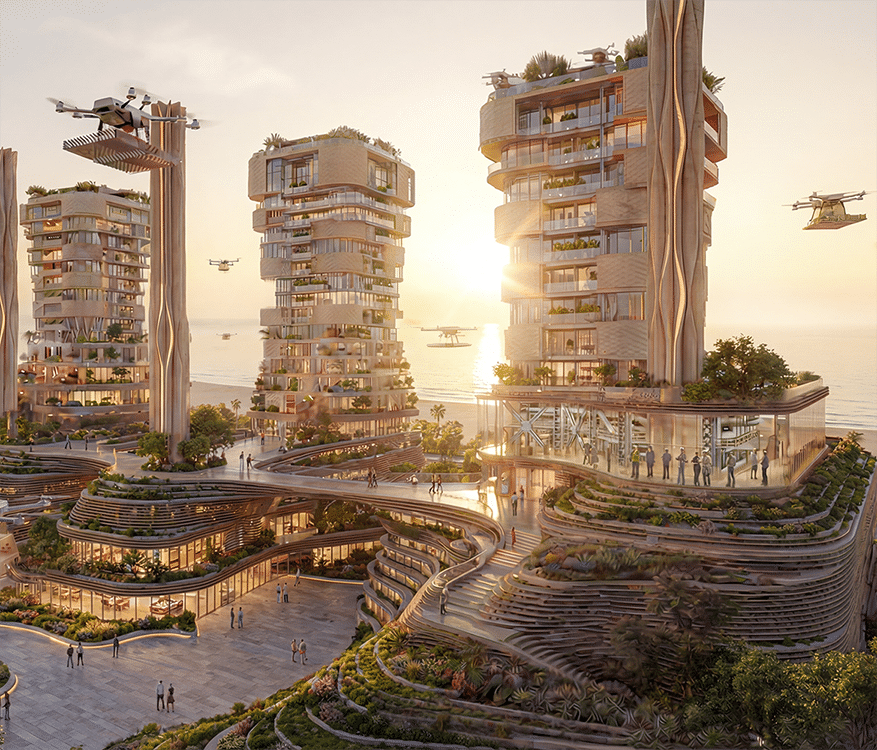
“Metabolising waste into habitat in a resource-scarce future”
“Mining the City” reconceives legacy industrial infrastructure as an active force for urban regeneration and material resilience. Rather than treating waste as a problem to be discarded, this project positions Barcelona’s material flows from household refuse to industrial by-products as the resource base for a new metabolic campus. By transforming entrenched systems of production and disposal into integrated loops of energy, material recovery, and habitat creation, the project aims to demonstrate how architecture can operationalize circularity at the district scale.

TERSA INCINERATION PLANT AND ENDESA ENERGY
The project is located between Barcelona and Sant Adrià de Besòs, adjacent to the TERSA and Endesa industrial sites and in close proximity to Les Tres Xemeneies, a landmark currently being transformed into the Catalunya Media City a major hub for design, media, and research. This area will host creative industries, academic programs, and Inditex’s relocated design teams, positioning the site at the center of Barcelona’s emerging innovation corridor.


PUNTO VERDES
Puntos Verdes (Green Points) are designated facilities in cities like Barcelona that allow residents and businesses to deposit specific, hard-to-recycle waste not accepted in regular street bins, like electronics, oils, batteries, furniture, paint, and textiles, helping improve recycling by sorting these special items for proper treatment, reuse, or recycling. They come in different types (Area, Neighborhood, Mobile) to suit different volumes and locations, making it easier to manage waste like coffee capsules, ink cartridges, and old appliances.

In this project, TERSA and Endesa are transformed into a single closed-loop metabolic system. All of Barcelona’s waste streams collected through Punto Verdes and selective recycling bins are redirected to an upgraded TERSA Mechanical, where metals, plastics, glass, and wood are processed into on-site building materials: recycled metals form the tower structures, plastics are 3D-printed into interlocking wall systems, and glass is reused for insulation. Organic waste is treated through TERSA’s waste-to-energy infrastructure, producing electricity, biogas, and bottom ash reused as ecological concrete for housing construction. Endesa’s role shifts over time from natural gas–based production to biogas generated from urban biowaste, closing the energy loop. Once inhabited, the housing feeds the system back through organic waste and recyclables, which re-enter TERSA as inputs for energy and material production, completing a continuous cycle where waste becomes energy, structure, and habitat.

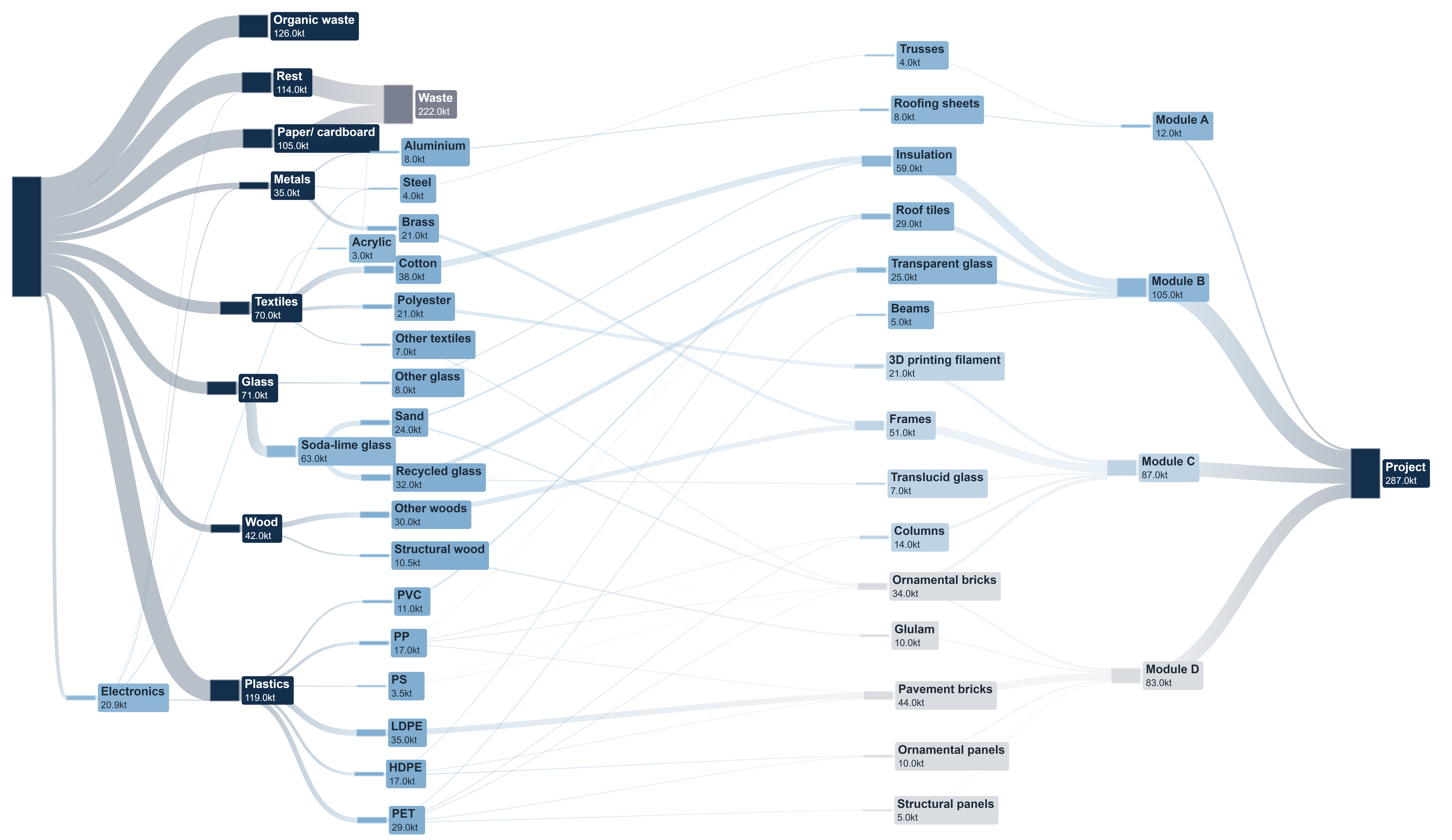
A Stranded Island’s Transformation

SYSTEM TRANSFORMATION OF TERSA AND ENDESA INTO A CLOSED-LOOP METABOLIC CAMPUS
Our project reimagines the existing waste and energy infrastructure at the TERSA Waste-to-Energy plant and the adjacent Endesa facilities as the heart of a closed-loop urban metabolism. Currently, TERSA processes municipal waste from the Barcelona metropolitan area through mechanical and biological sorting and controlled combustion, generating electricity and steam while reducing landfill disposal. Bottom ash from this process can already be reused as material in ecological concrete, closing one part of the material cycle. In the proposed transformation, organic biowaste from households feeds directly back into energy generation: instead of being treated as linear residual waste, separated organic fractions are sent into upgraded anaerobic digestion and waste-to-energy systems to produce renewable electricity, district heat, and bio-based energy carriers that power both the factory and the surrounding housing campus.


The project evolves in three phases: first, the factory is retrofitted for circular production.
Second, a large recycled-steel cover is constructed to host public space and future growth.
Third, housing towers are assembled using recycled steel frames and drone-delivered 3D-printed wall systems. Once inhabited, residential organic waste and recyclables feed back into TERSA, closing the loop between waste, energy, material production, and living.

MASTER PLANS


The master plan integrates three user systems simultaneously: factory production, public life, and residential living. Industrial processes remain operational at ground and underground levels, while selected areas are opened to the public through museums, exhibition routes, and educational spaces. Above this, a continuous landscape hosts parks, sports facilities, and co-working spaces for students and researchers, transforming the plant into an active civic destination.
Residential towers are layered within this system, with private access and services, while remaining connected to shared public spaces. Pedestrian routes link the site to the river, sea, and surrounding neighborhoods, using landscape as both buffer and connector to allow industry, culture, and housing to coexist as one metabolic urban system.

TIMELINE (0-5 YEARS)

TIMELINE (5-20 YEARS)

TIMELINE (20-50 YEARS)

TIMELINE (50-57)