
Guest Lecturer: Sameer Kishore
Middlesex University Dubai
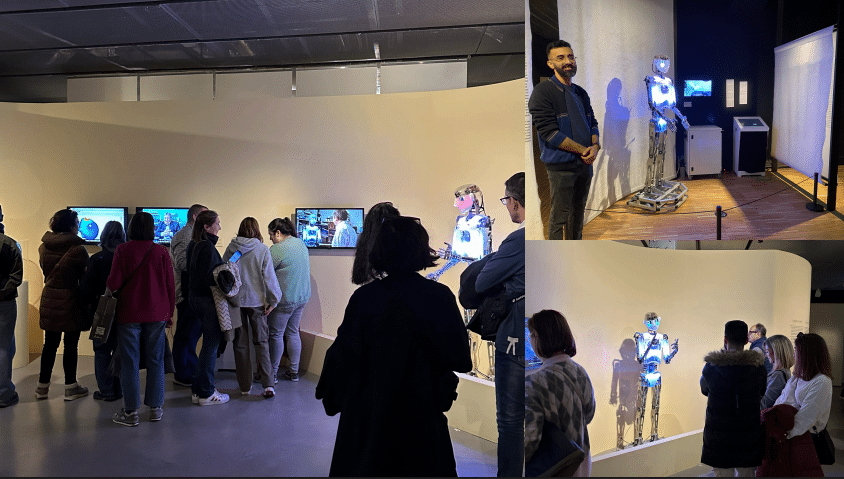
Sameer Kishore, researcher and lecturer in human–machine interaction, robotics, virtual reality, and psychology, delivered a lecture exploring the relationship between humans and technology. Although the topic initially appeared highly technical, the discussion focused largely on human perception, behaviour, responsibility, and the psychological impact of emerging technologies.
One of the central ideas repeated throughout the presentation was:
Problem first, technology last.
Instead of starting with a robot, an AI model, or a VR headset and searching for applications, the lecture emphasized the importance of first understanding the problem being addressed. Technology should be selected only after the need has been clearly defined.
This principle appeared consistently across the different research projects presented.
Embodying a Robot
Sameer began by introducing research from his PhD, where participants could remotely control a humanoid robot located in another country. Through a VR headset and motion tracking system, a person could see through the robot’s eyes, hear through its microphones, speak through its speakers, and control its movements with their own body.
The technical challenge involved real-time video streaming, motion capture, synchronization, and latency. However, the most interesting outcome was psychological rather than technical.
Many participants reported a strong feeling that they were no longer where their physical body was located. Instead, they felt present where the robot was. This phenomenon, known as presence, became one of the central themes of the lecture.
The project demonstrated how technology can create the illusion of being physically present in a remote location and raised questions about how humans perceive their own bodies and surroundings.
How Easily the Brain Can Be Tricked
Several experiments illustrated how flexible human perception can be.
One example was the well-known VR plank experiment, where participants stand on what appears to be a narrow plank extending from the top of a skyscraper. Even though they know they are standing safely on the floor, many still hesitate to step forward and experience genuine fear.
Another example was the Barbie Doll Illusion, where participants embodied a miniature virtual body and began perceiving surrounding objects as significantly larger than normal. The experiment showed that the perceived size of one’s body directly influences the perception of the environment.
The lecture also referenced the Pinocchio Illusion, a phenomenon in which people can be made to feel that their nose has grown far beyond its actual size.
Together, these examples demonstrated that our experience of reality is not fixed. The brain continuously constructs reality from sensory information, and with the right combination of visual, tactile, and auditory cues, perception can be altered surprisingly easily.
Talking to a Future Self
One of the most memorable projects combined virtual reality, voice cloning, and large language models.
Participants entered a virtual environment where they could have a conversation with an older version of themselves. Their future self was represented by an aged avatar, complete with changes in appearance, posture, movement, and voice.
Speech recognition, AI models, and voice synthesis worked together to create a real-time conversation. Spoken questions were transcribed, processed by a language model, converted back into speech, and delivered through the avatar within a matter of seconds.
Although technologically sophisticated, the project was inspired by traditional psychological techniques that encourage people to imagine conversations with their future or younger selves. Virtual reality simply provides a more immersive and emotionally engaging medium for the same exercise.
The project highlighted the potential of combining AI and immersive technologies with therapeutic and self-reflective practices.
Ethics Cannot Be an Afterthought
Ethics was a recurring theme throughout the lecture.
When building systems that interact with people emotionally, especially in therapeutic contexts, researchers must carefully consider how AI responds to sensitive topics such as depression, trauma, self-harm, or suicidal ideation.
Sameer explained that projects involving these technologies require collaboration with psychologists, psychiatrists, and ethics review boards. Research proposals must undergo independent evaluation and include safeguards that prevent harmful or inappropriate behaviour from AI systems.
One of the key messages was that meaningful work in this field requires interdisciplinary collaboration. Technical expertise alone is not sufficient when projects directly affect human emotions, behaviour, and well-being.
Responsibility Beyond the Human Body
One particularly interesting research project investigated whether people feel responsible for the actions of a robot they control.
Participants embodied a robot that behaved in socially inappropriate ways, including speaking offensive words to others. Even though the participants were not directly speaking themselves, many still reported feelings of guilt, embarrassment, and responsibility.
The findings suggested that the stronger the sense of embodiment, the stronger the emotional response became. Participants who felt a greater sense of ownership over the robot’s body were also more likely to apologise for the robot’s behaviour.
The study demonstrated that feelings of responsibility can extend beyond the physical body and become attached to digital or robotic representations of oneself.
Human-Centred Design
Another important lesson concerned the importance of involving end users throughout the design process.
A project intended to assist visually impaired people was presented as an example. The system incorporated computer vision, object detection, and distance sensing. While technically functional, the project had not initially been tested with visually impaired users.
The example illustrated a common problem in technology development: solutions are often evaluated by the people who build them rather than by the people who are expected to use them.
The lecture emphasized that successful innovation depends not only on technical performance but also on understanding the needs, experiences, and contexts of the intended users.
What Robots Reveal About Humans
The discussion also explored an interesting behavioural phenomenon: why people often push, kick, or otherwise mistreat humanoid robots.
Research has shown that people frequently interact with human-like robots very differently from ordinary machines. A refrigerator is perceived as an object, while a humanoid robot often triggers social responses associated with another person.
This raises an important question: when people bully robots, what does that behaviour reveal about humans themselves?
Rather than focusing solely on the capabilities of robots, the lecture suggested that robots can also serve as tools for studying empathy, social behaviour, responsibility, and human psychology.
Final Thoughts
Although the lecture included robotics, virtual reality, artificial intelligence, motion capture, and large language models, the central theme was ultimately about understanding people rather than technology.
The projects demonstrated how technology can influence perceptions of presence, identity, responsibility, and emotion. They also highlighted the importance of psychology, ethics, and human-centred design in the development of future technologies.
A recurring message throughout the lecture was that meaningful innovation begins with understanding human needs. Technology serves as a tool for addressing those needs rather than being an objective in itself.
Questions and Discussion
The lecture concluded with an open discussion covering several broader topics related to robotics, AI, and society.
How can robots become more human?
One participant asked whether robots should become more natural by making mistakes, showing imperfections, or displaying creativity similar to humans.
Sameer responded that the question is not only technical but philosophical. Before attempting to make robots more human, it is important to understand what qualities are actually considered uniquely human. While AI systems already make many mistakes, creativity, self-awareness, and the ability to meaningfully learn from mistakes remain far more complex challenges.
Rather than focusing on making robots indistinguishable from humans, it may be more valuable to understand what robots are genuinely useful for and where human qualities remain essential.
Does technology reduce diversity and authenticity?
A discussion emerged around the differences between analogue and digital experiences, using vinyl records and digital music platforms as examples.
The conversation suggested that people often romanticise older technologies because of their imperfections and physical interaction. At the same time, digital tools solve many practical problems and offer convenience, consistency, and accessibility.
The discussion highlighted an ongoing tension between efficiency and the unique experiences created by imperfect, human-operated systems.
Do different cultures respond differently to robots in public spaces?
One participant asked whether research is being conducted on how different cultures and communities respond to robots and other autonomous technologies when they are introduced into public spaces.
The question referenced examples such as shared mobility systems and public technologies that may be accepted in one location but face resistance in another.
Sameer explained that this is an active area of research within social robotics and human–robot interaction. Universities, research institutions, and technology companies are increasingly studying how robotic systems are received by different cultures as robots become more common in public environments.
He highlighted examples comparing the United States and Japan, where public acceptance of robots has often developed differently depending on cultural attitudes, expectations, and the context in which robots are introduced. The success of robotic systems depends not only on the technology itself, but also on social norms, cultural expectations, and how people perceive the role of robots in everyday life.
Why do people bully robots?
The final discussion returned to the topic of robot abuse and the tendency for people to push, kick, or challenge humanoid robots.
While this behaviour is often used by robotics companies to demonstrate the robustness of their systems, it also raises deeper questions about human behaviour. The discussion suggested that the way people treat human-like machines may reveal underlying attitudes toward social interaction, empathy, authority, and responsibility.
Rather than being purely a robotics problem, it may ultimately be a question about understanding human nature itself.
