The conversation around Artificial Intelligence in Architecture, Engineering, and Construction (AEC) often begins and ends with the concept of “efficiency”. We discuss doing things faster, reducing man-hours, and automating mundane tasks. But as the industry faces unprecedented challenges, the true purpose of AI is shifting.
It is no longer just about speed; it is about managing complexity and making smarter decisions.
From Intuition to Data-Driven Decisions
Historically, the AEC industry has relied heavily on intuition and “standard practice.” While valuable, these methods often struggle to account for the thousands of variables in a modern building project.
The core objective of AI is to transform raw data into actionable intelligence. By delegating data classification and problem identification to algorithms, we can navigate vast datasets, structural, environmental, and financial, to find the “optimal” solution rather than just a “functional” one.
Navigating the “Black Box”
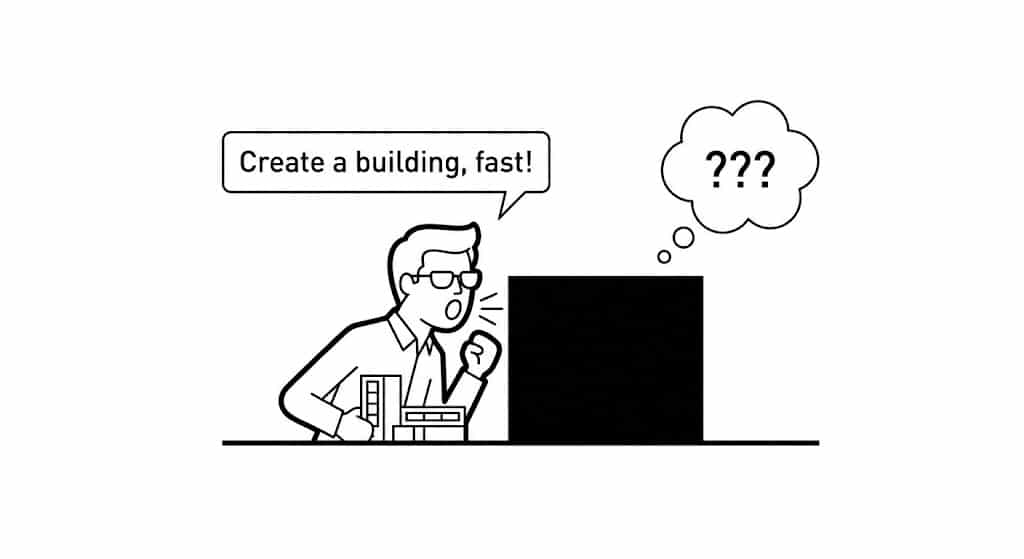
One of the most discussed aspects of AI is the “Black Box”, the opaque process by which a neural network reaches a conclusion. However, in the AEC world, this isn’t a hands-off process.
The true work lies in alignment. By using specific biases and parameters, we steer these “digital neurons” toward our specific goals. We aren’t just letting the machine think; we are training it to understand the nuances of our site, our materials, and our vision. We are the curators of the algorithm.
Innovation in Practice: Leading the Charge
We are already seeing this transformation through pioneers in the field:
- Urban Analysis: Platforms like Infrared City are using deep learning to identify urban behavior and microclimates, allowing us to design with the environment rather than against it.
- Structural Optimization: Firms like Thornton Tomasetti utilize surrogate models to run complex structural simulations in near real-time, drastically shortening the feedback loop between form and stability.
- Site Supervision: Through Computer Vision, AI-powered cameras now monitor construction progress and safety, ensuring that the “digital twin” matches the physical reality on site.
The Future: Augmented Intelligence
The goal of AI in AEC is not to replace the architect or the engineer. Its purpose is to augment our capabilities. By freeing us from the burden of manual data processing, AI allows us to return to the essence of our profession: creative problem solving.
We are entering an era where we don’t just design buildings; we design the systems that help us build a better world. AI is the tool that gives us the “superpowers” to do exactly that.