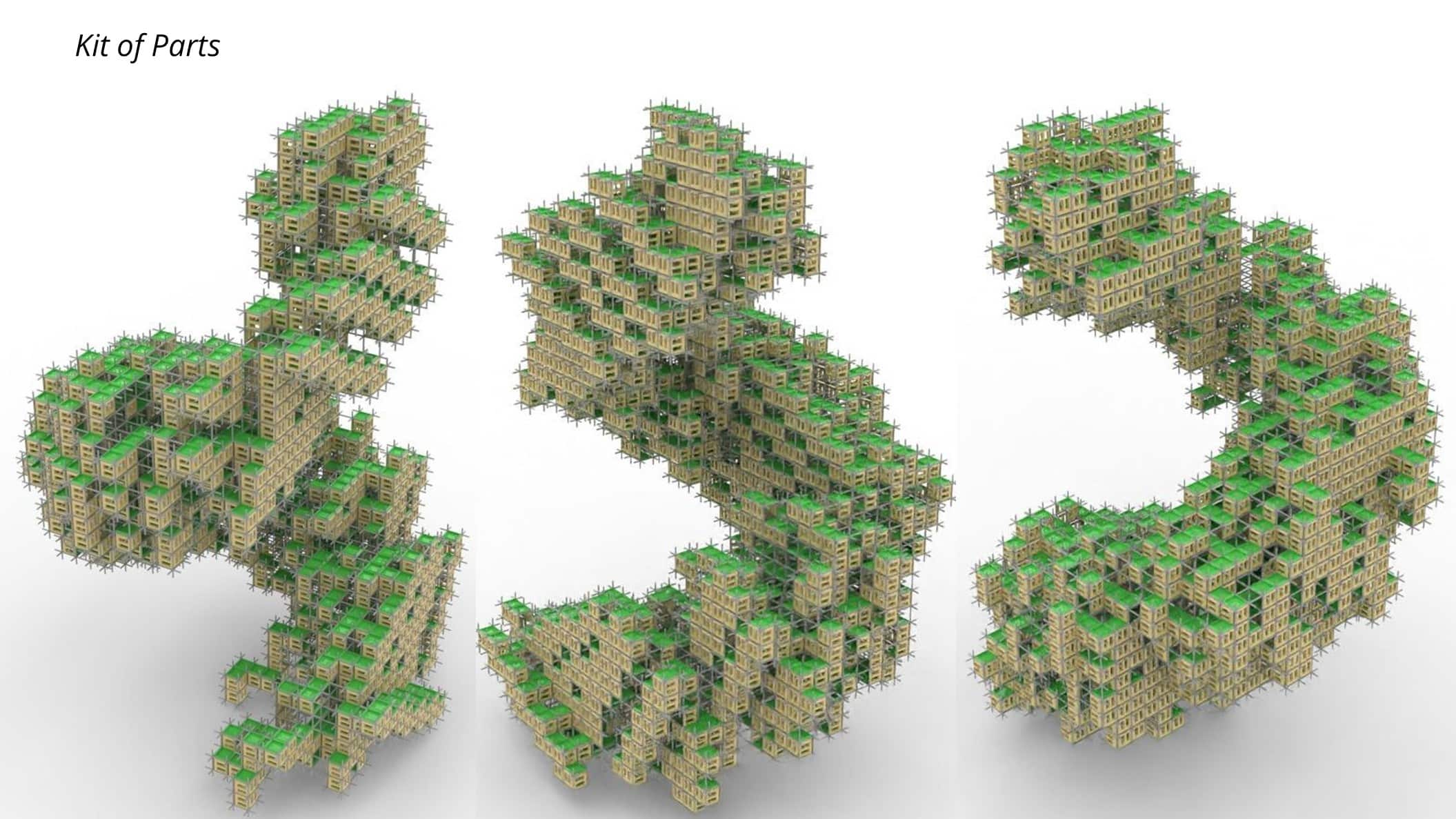
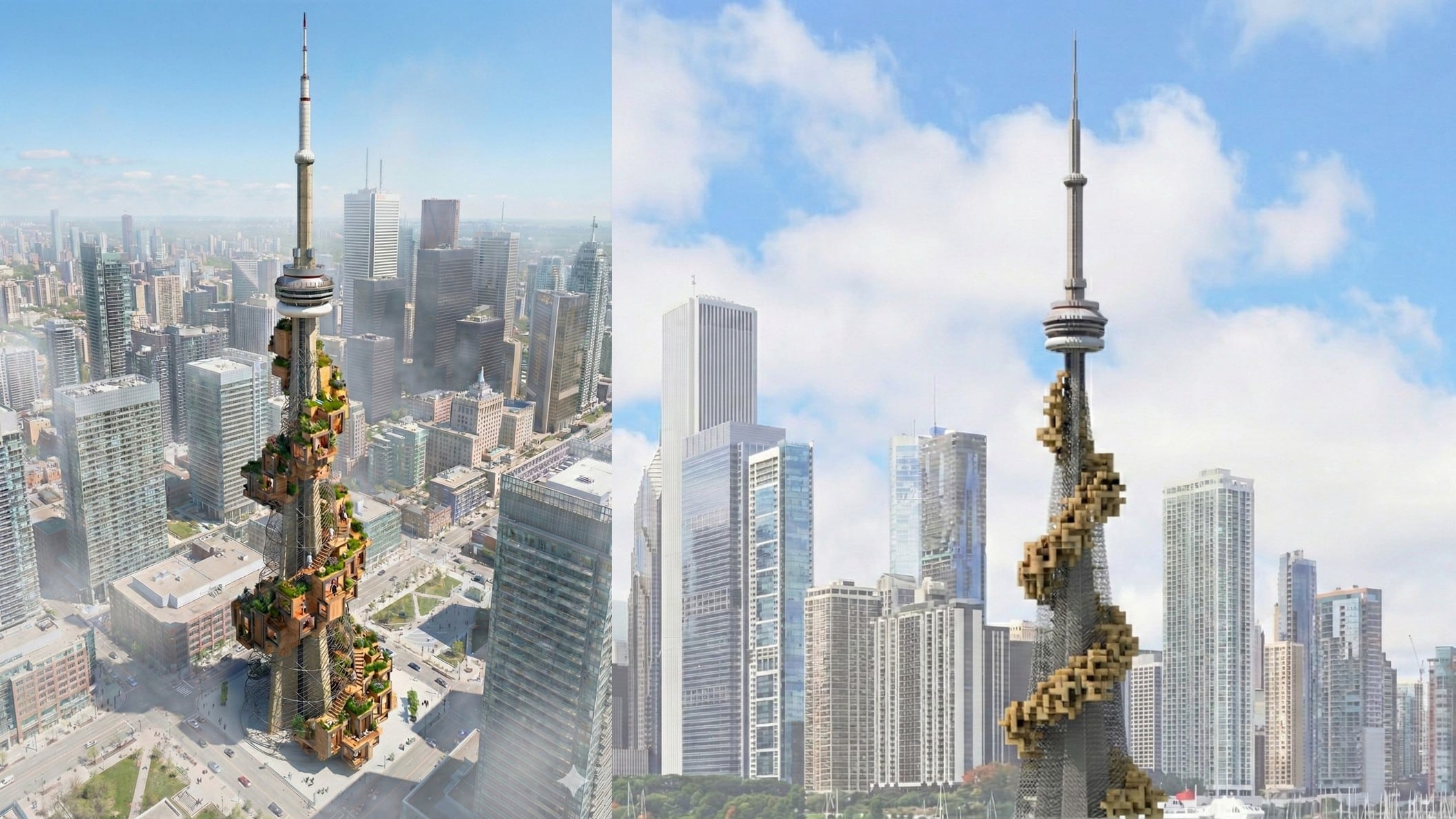
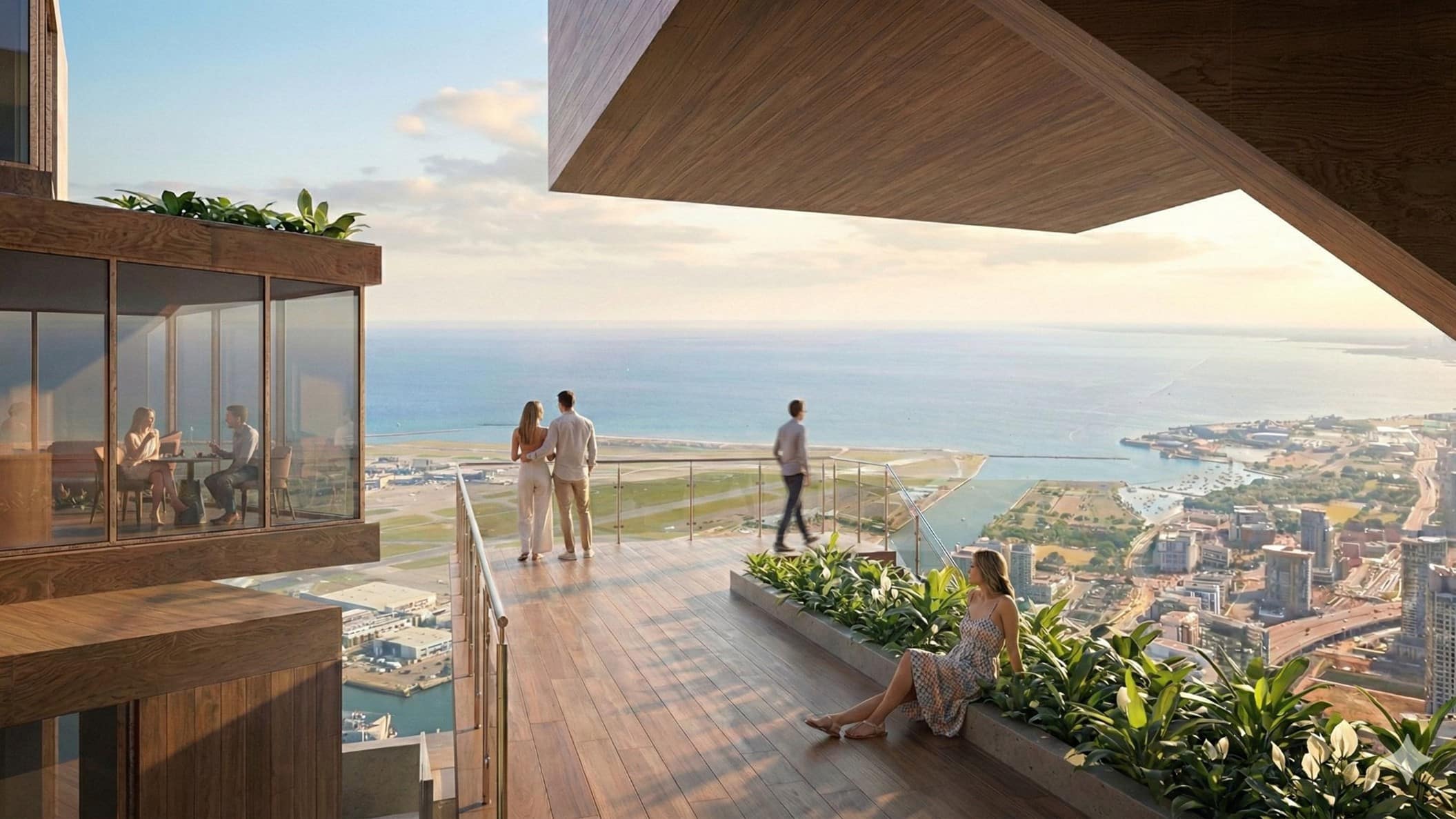
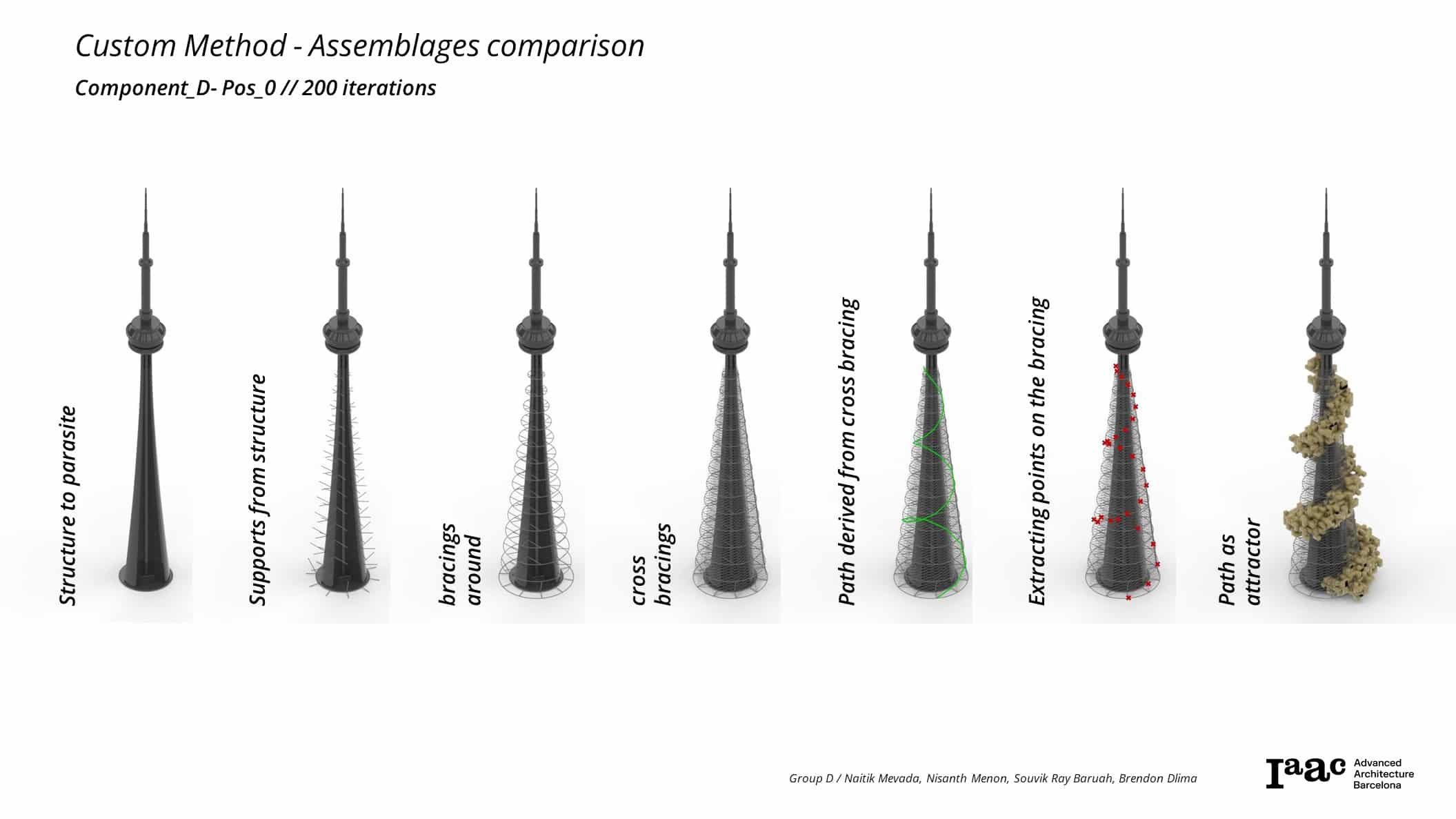
The core objective of the project was to develop a system of assemblages that could grow into complex, self-supporting structures. A structure-to-parasite logic, where new assemblies derive their path from existing structural supports, such as bracings and cross-bracings.
Components
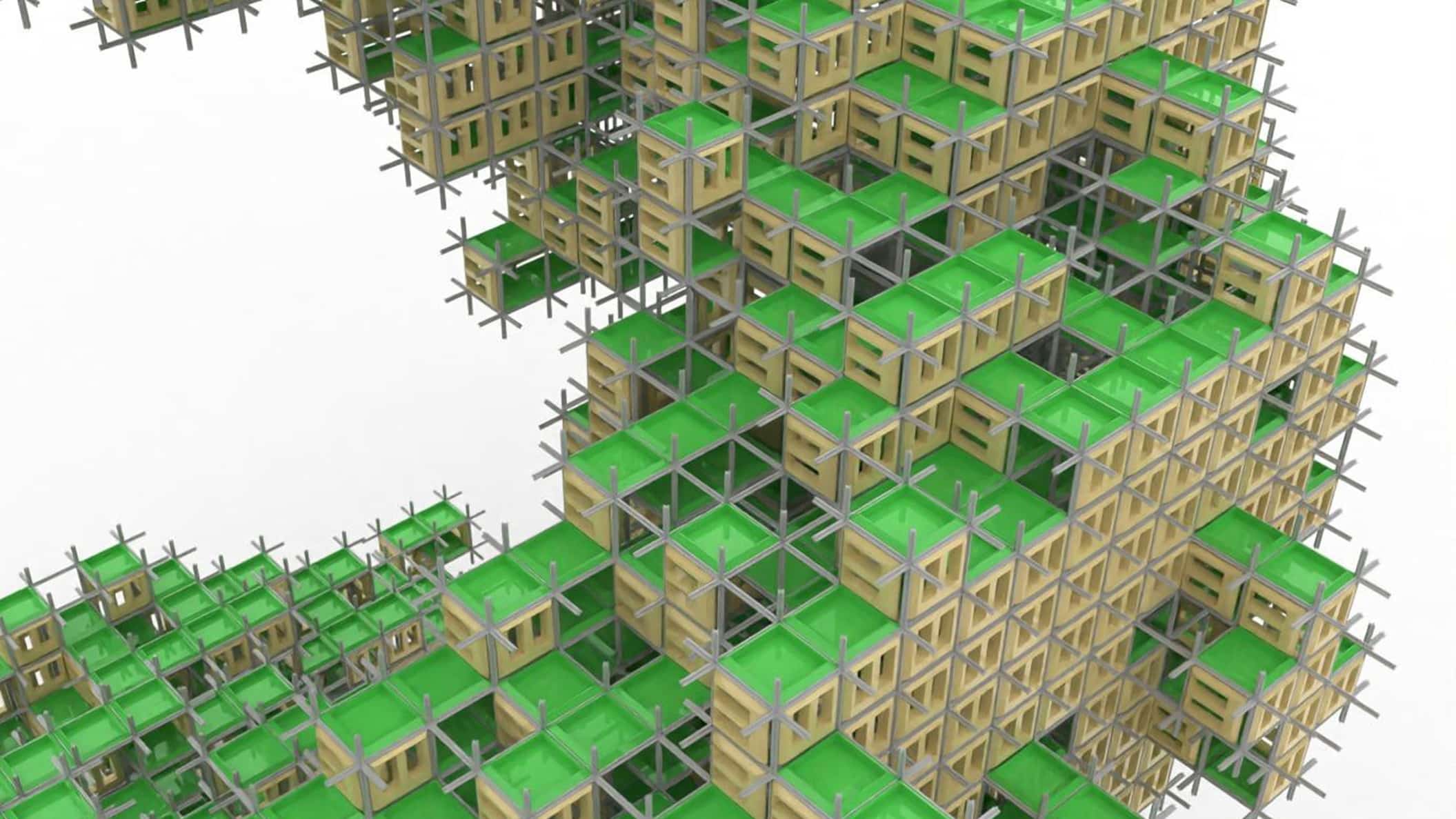
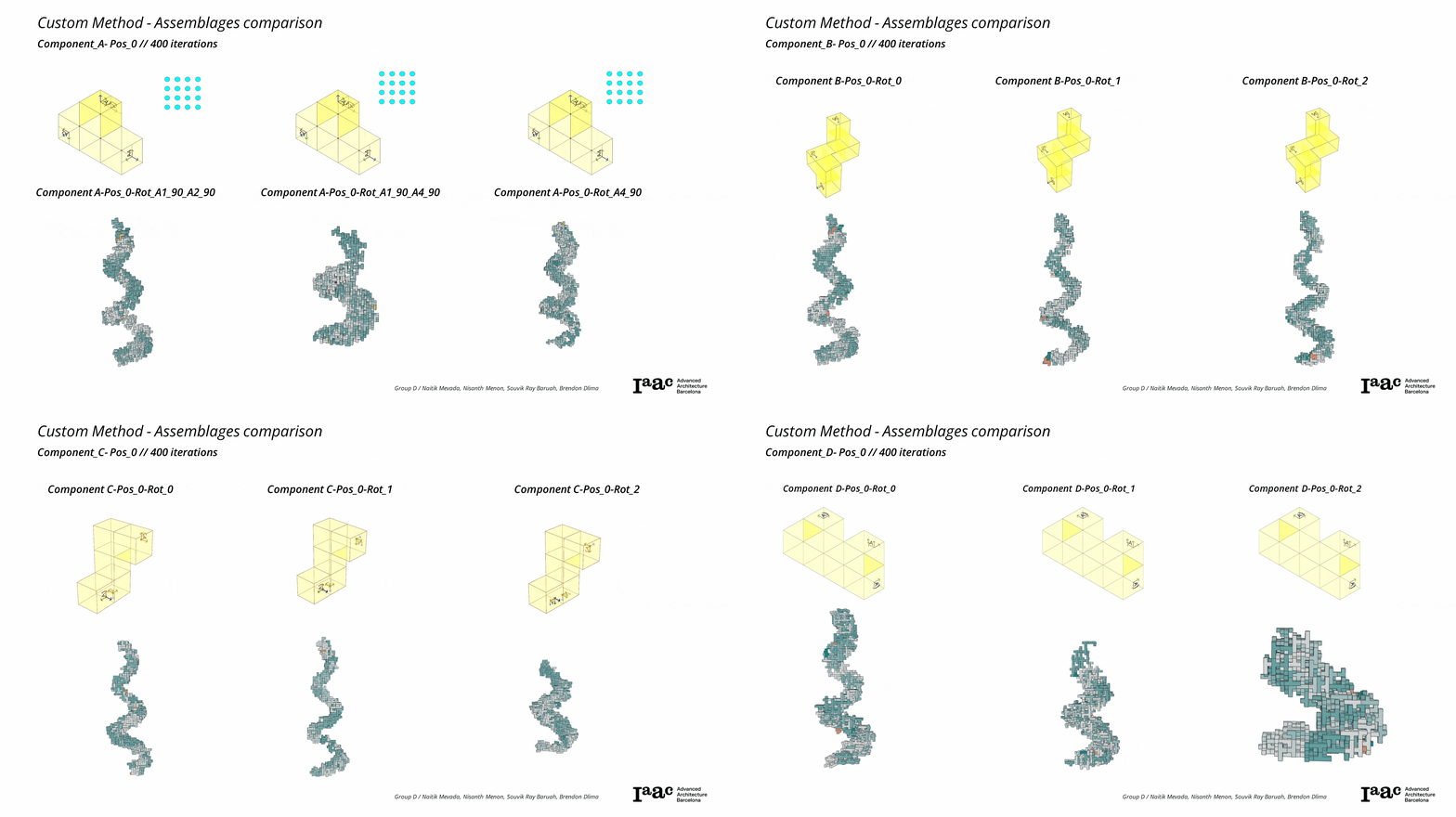
In this specific project, the component is created through the additive aggregation of individual cubic voxels onto an initial seed point or a pre-existing structural framework. By defining a rigorous set of geometric rules that dictate where each new unit can attach, such as specific face-to-face alignments or diagonal offsets, the system generates a unique and complex geometry from a collection of simple, identical units.
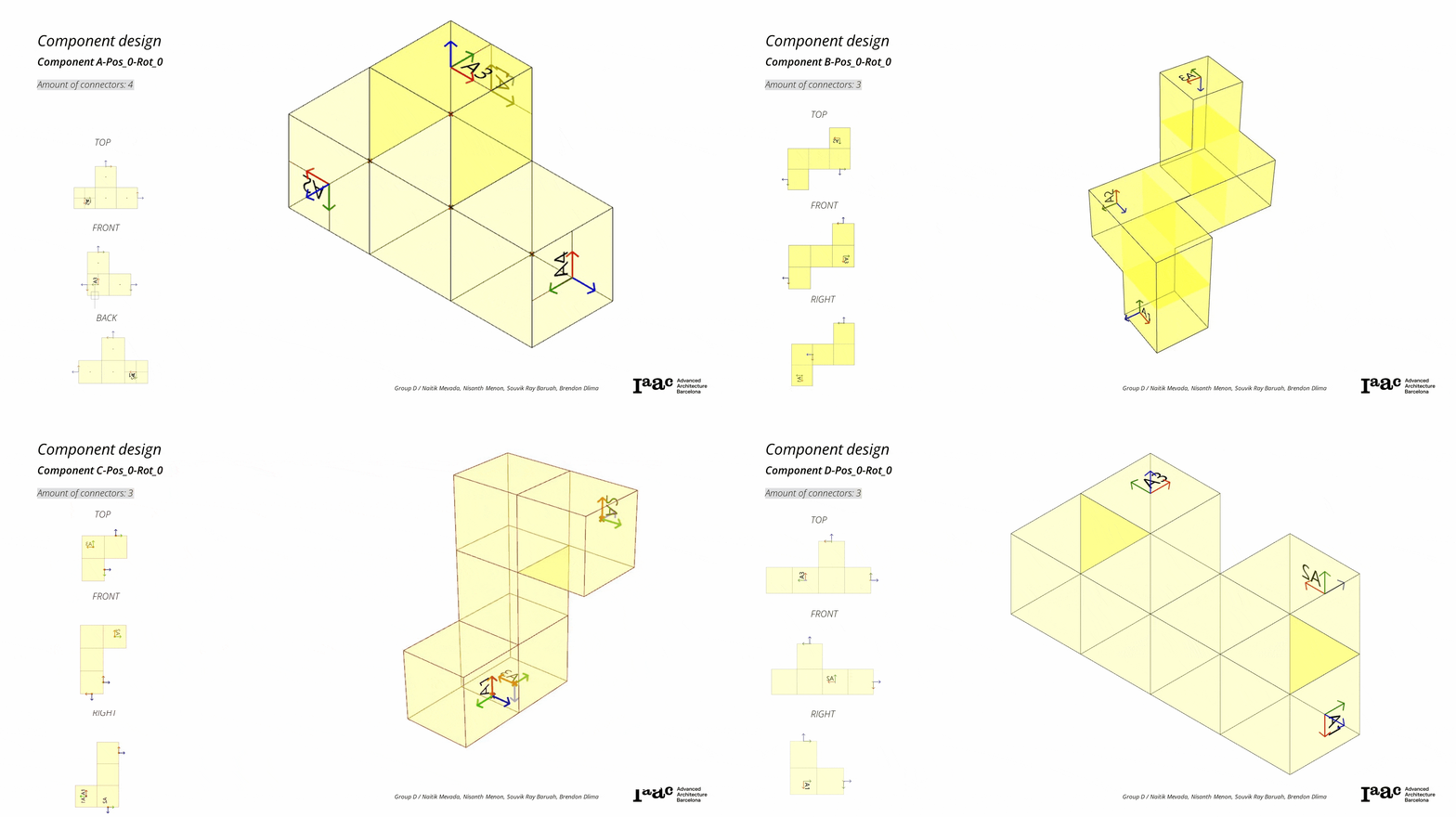
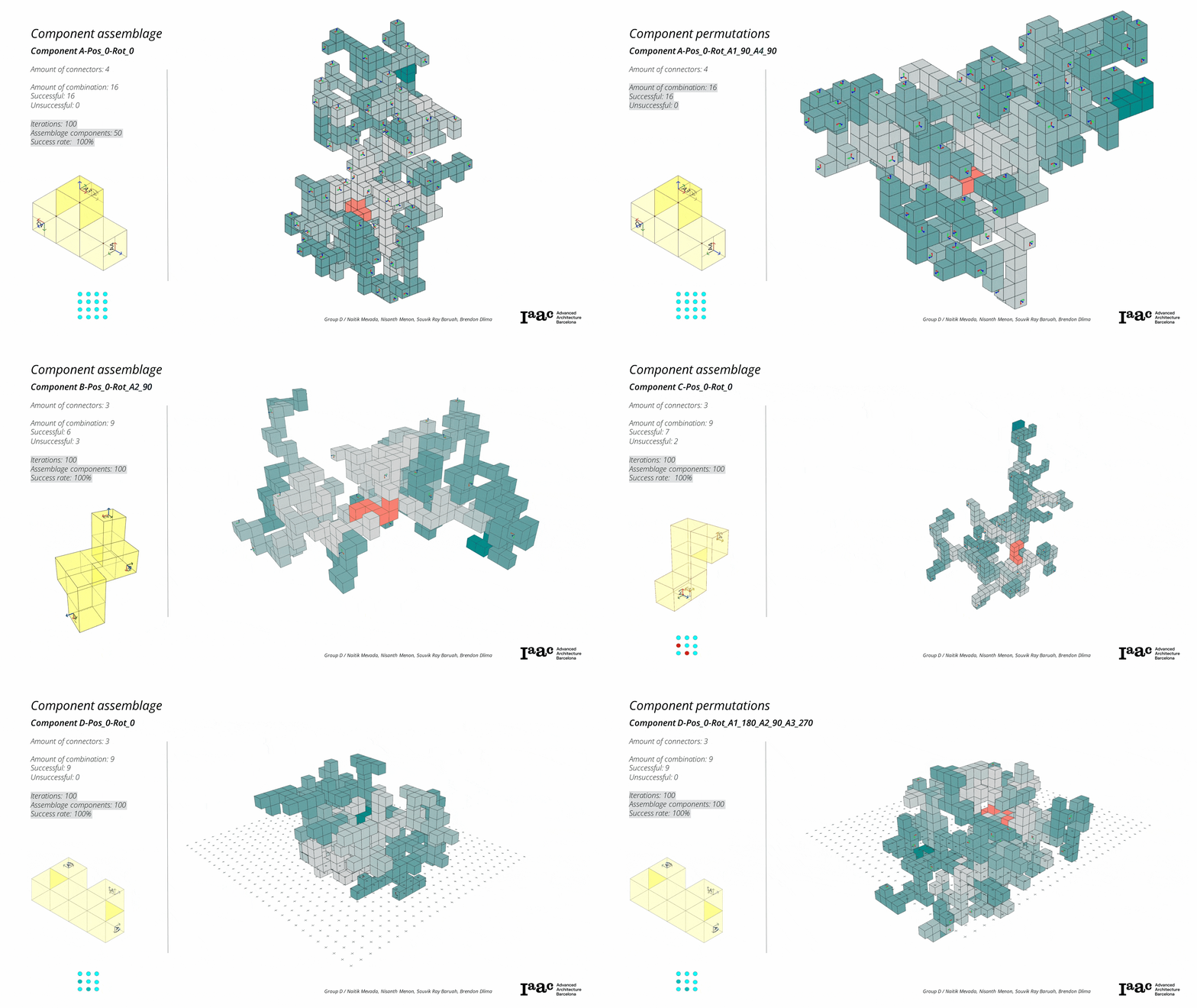
Initial Assemblages
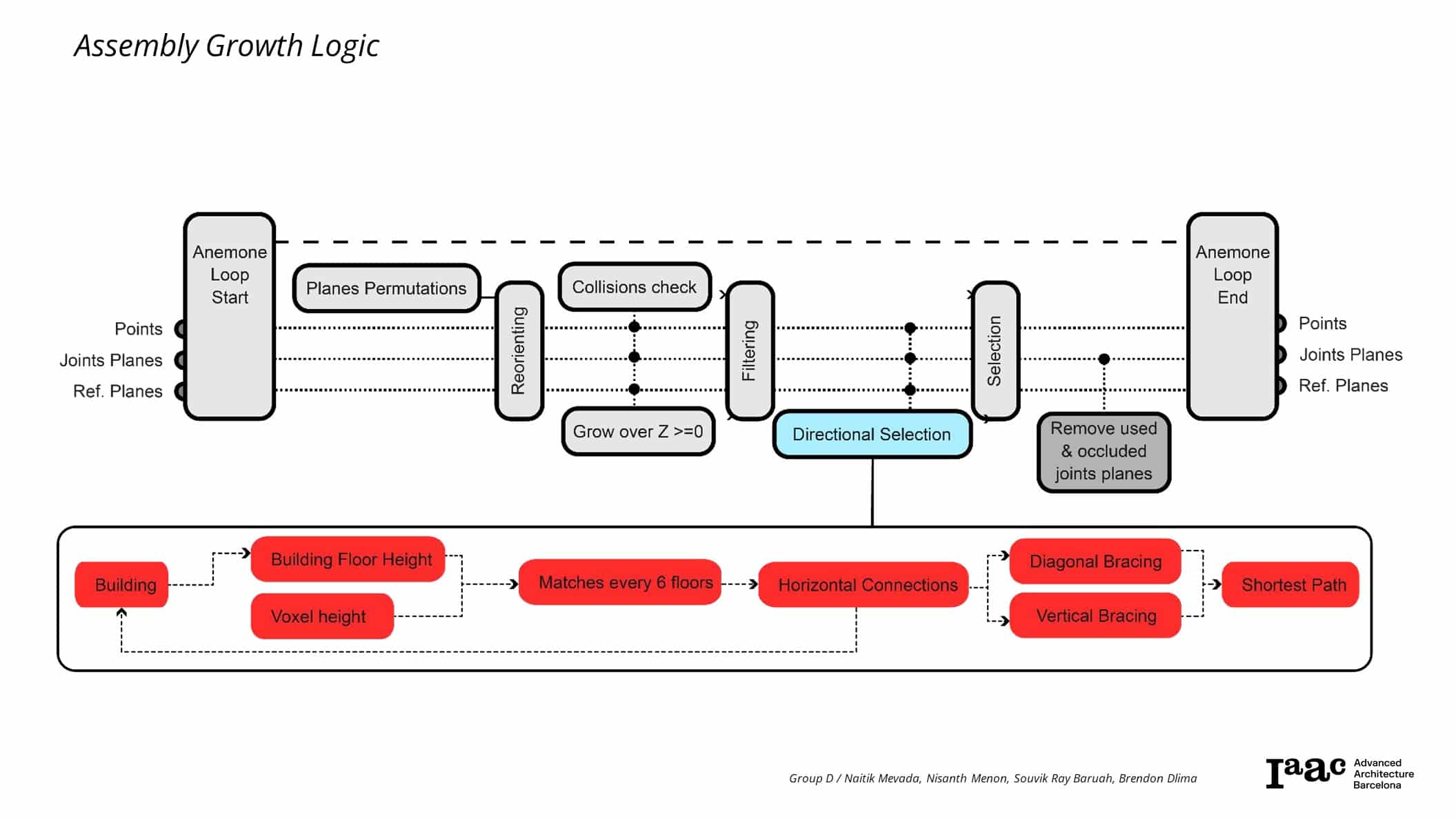
Growth Logic
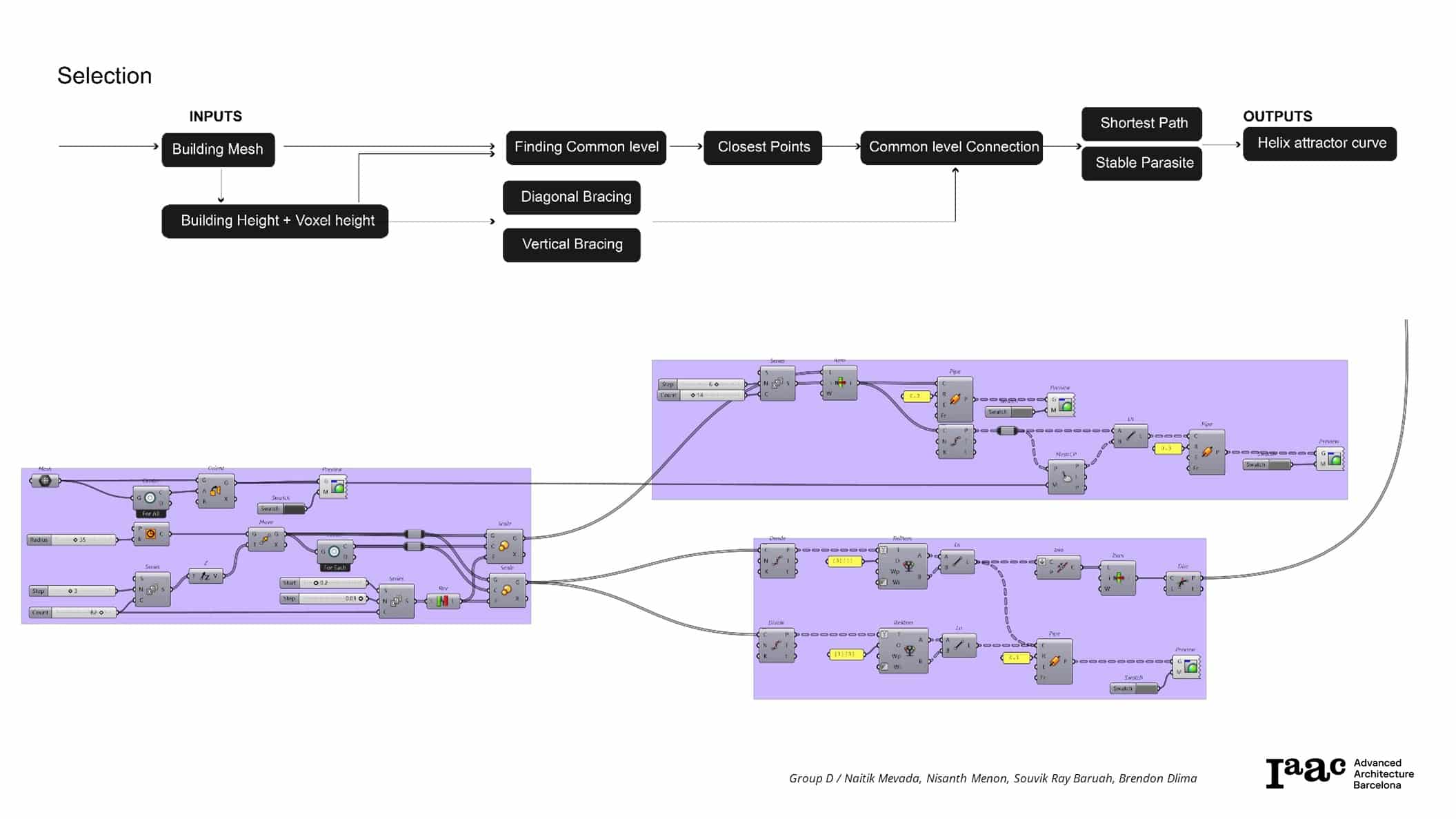
The assemblage begins by extracting the primary cross-bracings from the original structure to serve as a guide. From these lines, a specific growth path is derived, and key points are isolated along the bracing to act as anchor positions for the new components. These points then function as “attractors,” pulling the modular voxel units toward them to ensure the new “parasite” growth remains physically and geometrically tied to the main framework. As the voxels aggregate onto these points, the system tests different component rotations and handle configurations, allowing the assembly to expand into a dense, interlocking network that reinforces the existing structural logic.
Evaluation Criteria
The evaluation of the system relies on a custom criterion titled Horizontal and Vertical Connection, which analyzes how the parasitic growth occupies three-dimensional space. This metric assesses the spatial distribution of the modules to ensure they provide adequate coverage and structural support across multiple planes. By measuring these specific assemblage features, the process evaluates the architectural utility of the form and how the system maintains its spatial integrity as it increases in complexity.
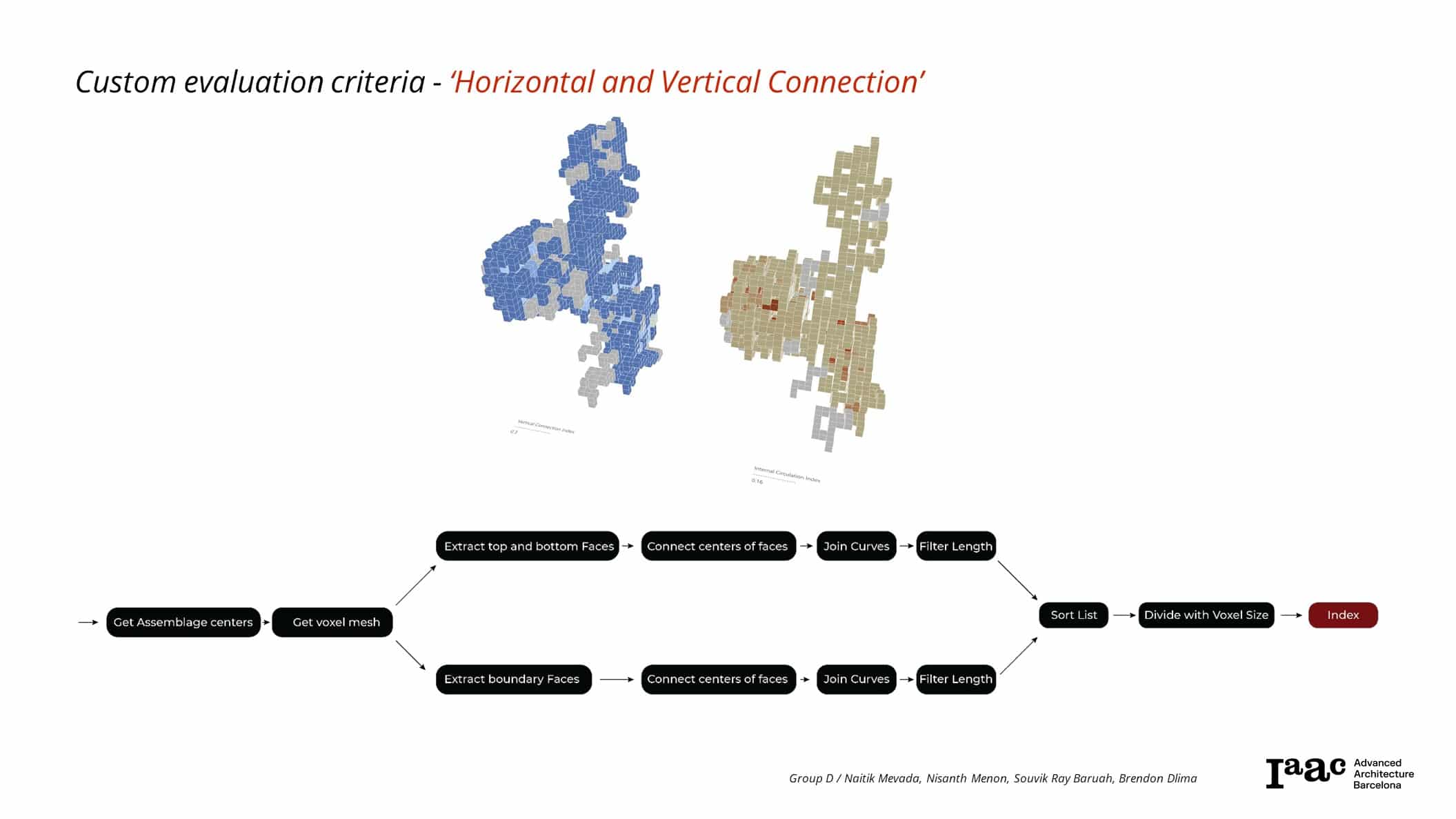
The logic for the horizontal and vertical connection criteria is determined by measuring the maximum bounding dimensions of the assembly along the X, Y, and Z axes. By calculating the total length and width to find the horizontal spread and comparing it against the total height for the vertical reach, the system creates a ratio that defines the spatial orientation of the growth. This data is then translated into a custom index that categorizes each assemblage based on its physical proportions and its ability to bridge distances within the structural grid.
Data Set
The dataset evaluates each modular assemblage through a systematic comparison across seven distinct criteria that quantify its physical and spatial performance. These metrics include Compactness, Contact Area, Occlusion, Porosity, Privacy, Verticality, and Horizontal Connection. By synthesizing these measurements into a comprehensive data profile for every permutation, the system allows for a direct comparison between different component rotations and iteration scales. This rigorous indexing effectively identifies which configurations are most successful at navigating the structural envelope and fulfilling their intended architectural role.
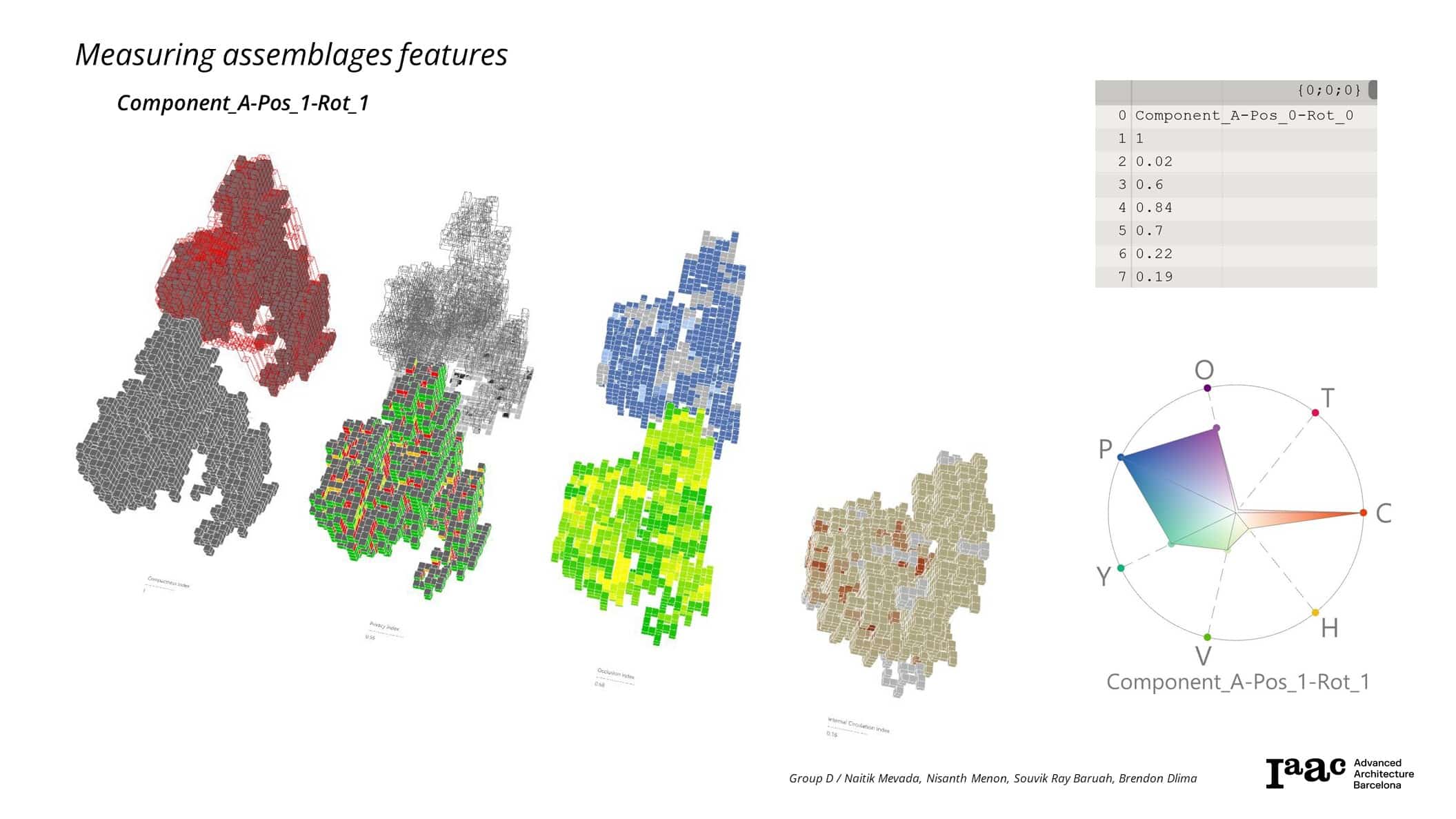
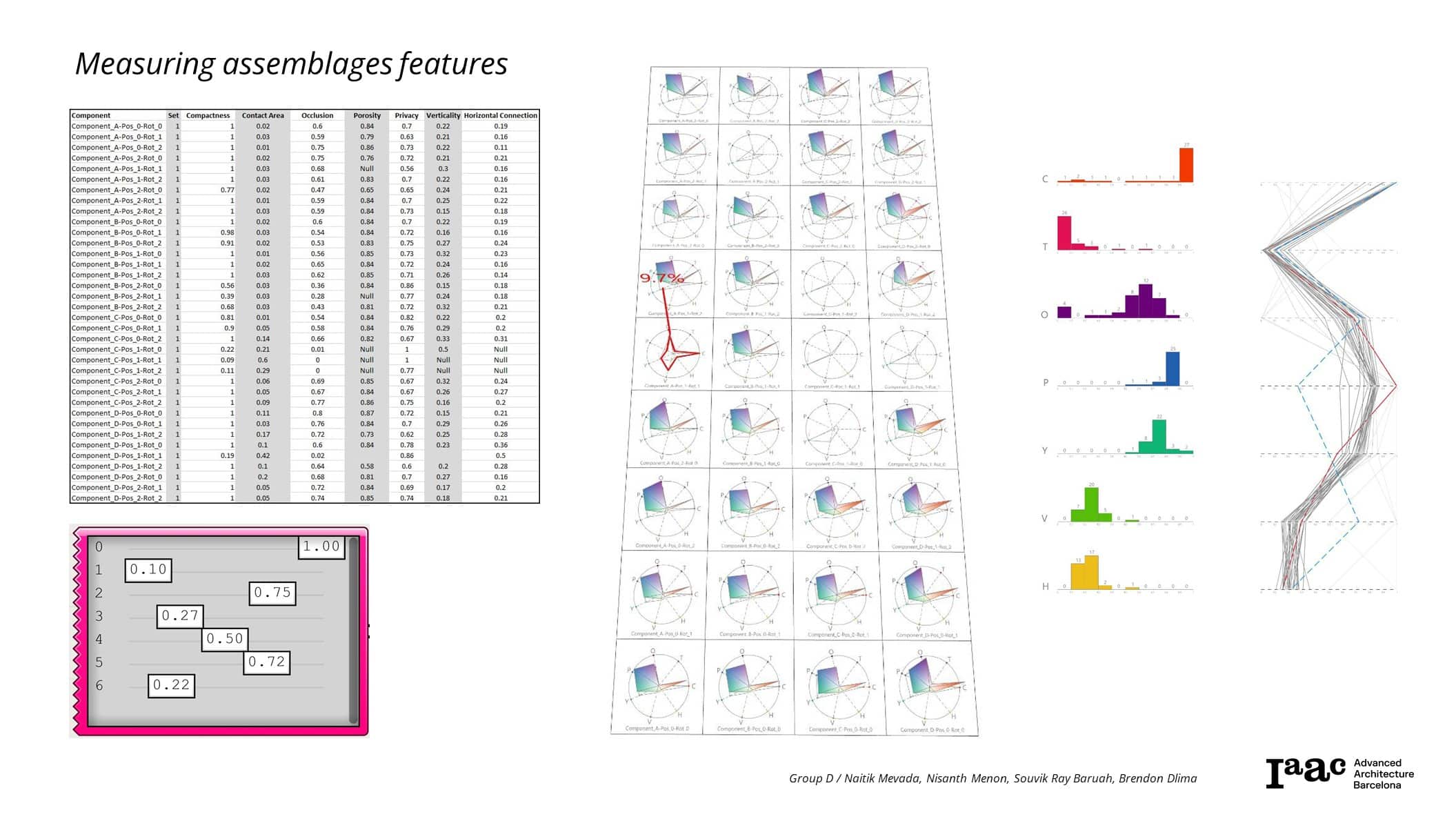
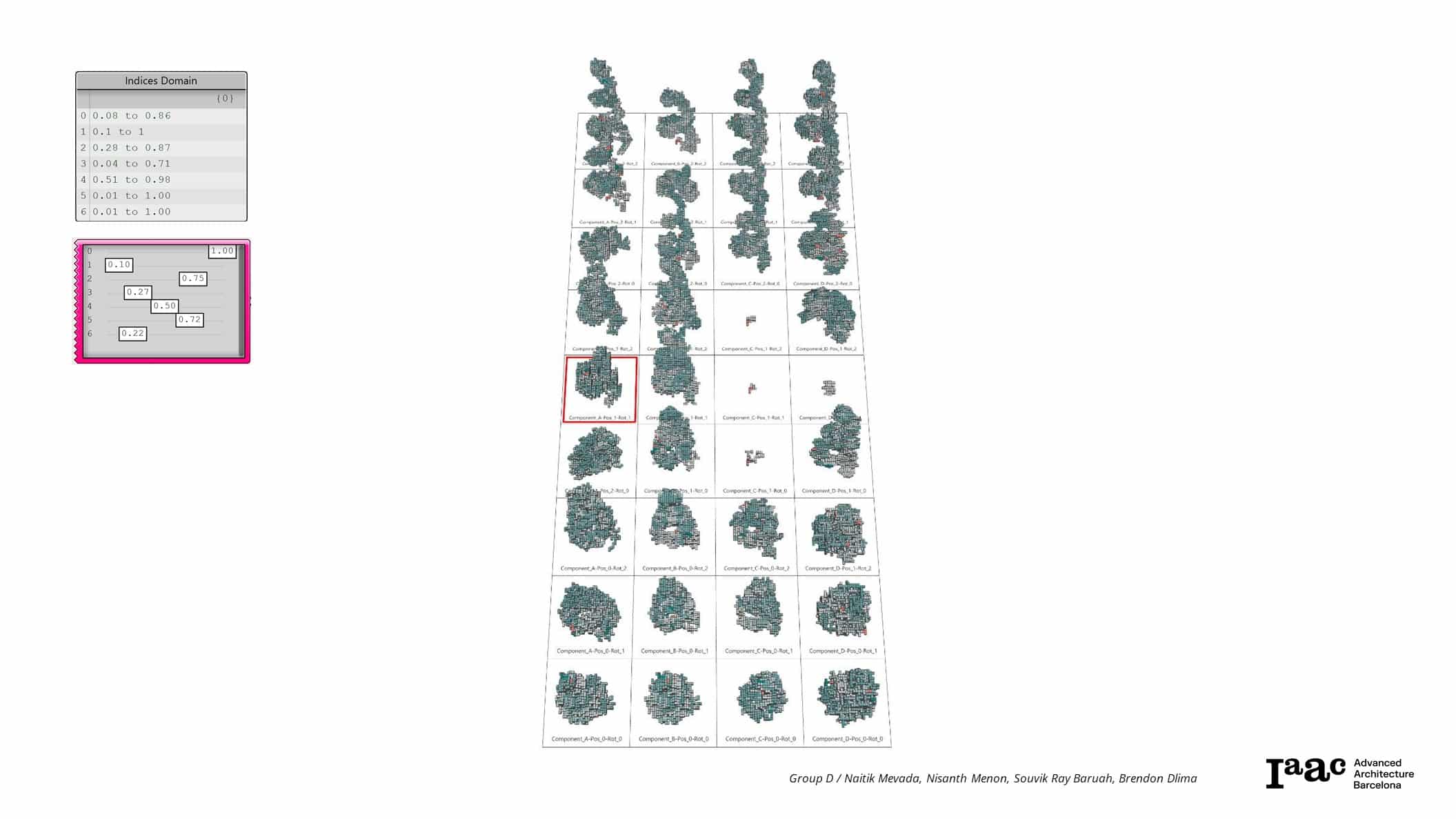
The selection process culminates in the identification of a single, most fitting assemblage that best satisfies the project’s performance requirements. By mapping every generated iteration against the established dataset, a specific configuration is isolated from the catalog as the optimal solution for the structural envelope.
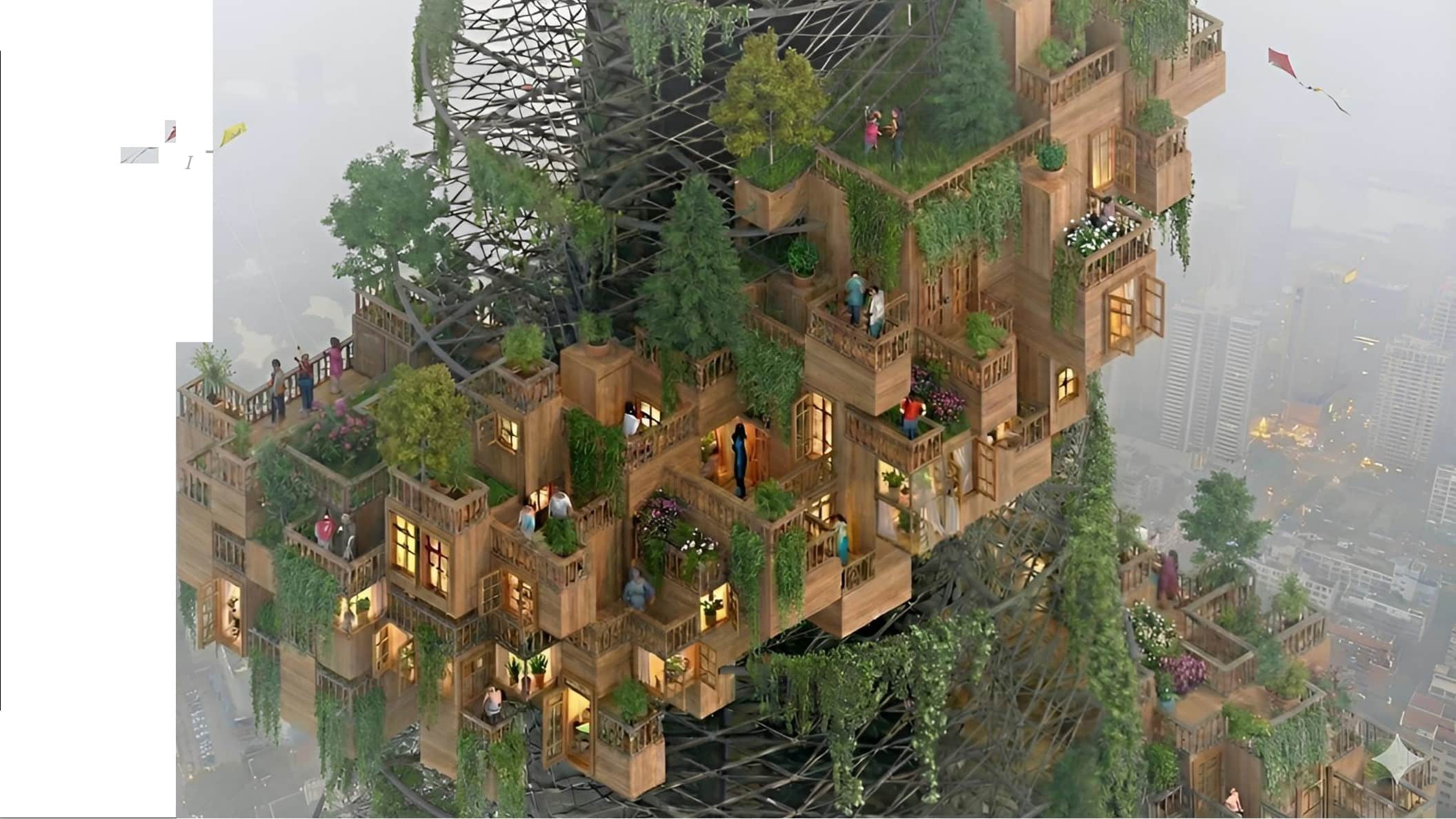
Architectural Integration
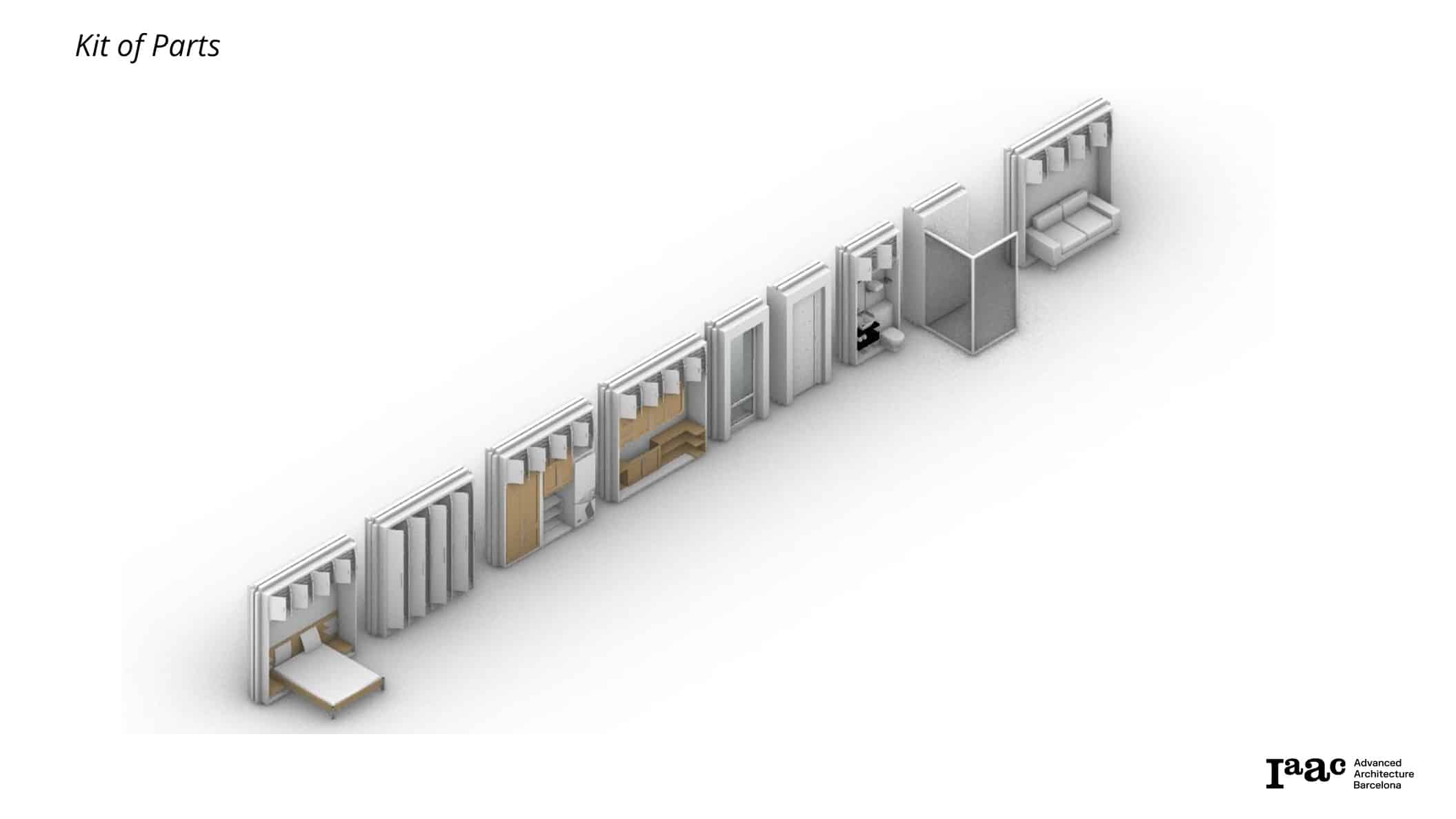
Once the optimal assembly is selected, the abstract voxels are replaced by specific architectural elements from the kit of parts. This transformation is governed by the original evaluation criteria and a set of spatial conditions that dictate exactly where each unique element such as floor slabs, facade panels, or structural joints is placed within the network. By mapping these physical components onto the growth logic, the system ensures that the most robust elements occupy high stress or high connectivity zones, while more porous modules are distributed according to the established porosity and privacy indices. This step moves the project from a geometric simulation to a functional architectural construct, where every module is strategically positioned to fulfill a specific role within the final parasitic structure.