
As part of our Software III course at IAAC, our team conducted a comprehensive structural analysis on our Willow Protocols system using Karamba, a parametric structural analysis plugin for Grasshopper.
The Challenge: Beyond Aesthetics
Our Adaptive Willow Wall is designed as a collaborative human-robot woven structure with variable thickness, integrated furniture, and thermal performance. While the design looks aestethic and performs functionally, the critical question remained: how does it actually perform structurally?
This is where parametric structural analysis became essential. Rather than guessing or building costly physical prototypes to failure, we could test multiple design scenarios digitally before fabrication.
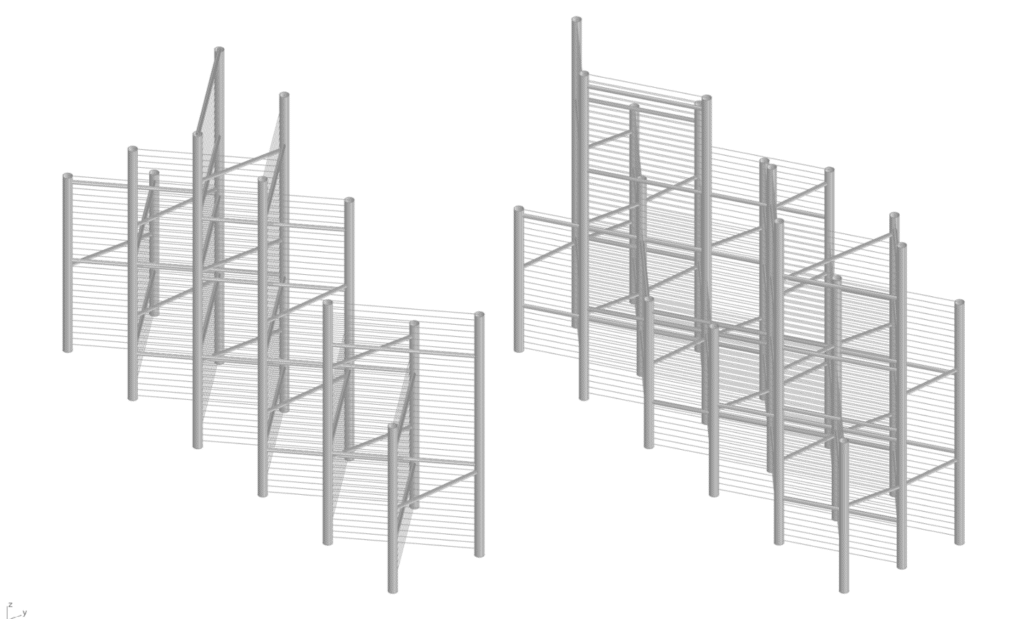
The Structural Model
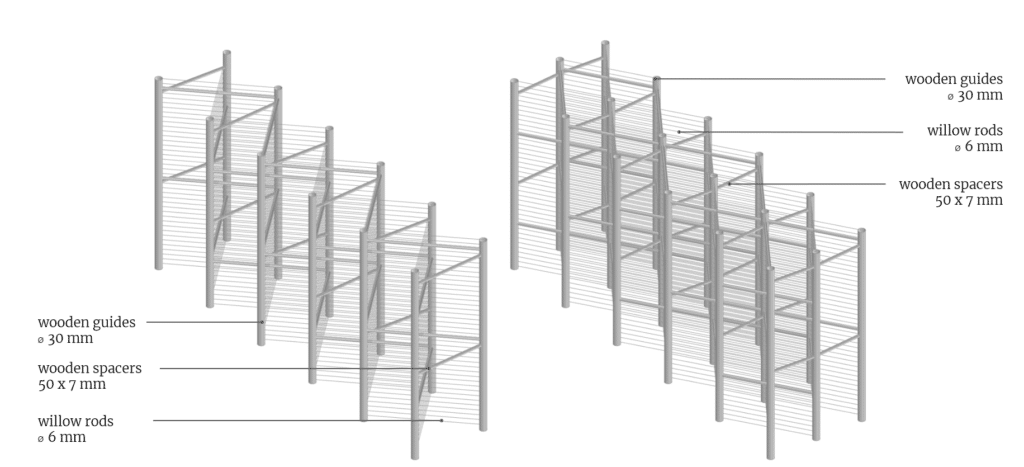
We modeled our wall system with three main components:
- Wooden guides: Vertical support columns (Ø 30mm) that form the main structural frame
- Willow rods: Thin soaked willow branches (Ø 6mm) woven between the guides to create the wall envelope
- Wooden spacers: Horizontal separators (50 × 7 mm) that stabilize the guides and distribute loads
Initial Strain Calculation
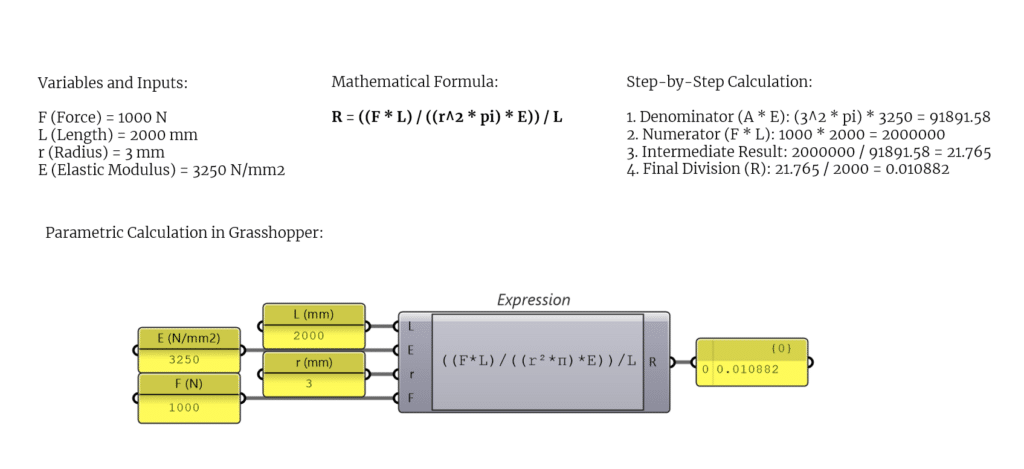
One of the first steps was understanding the initial strain in the willow rods. Using parametric calculations in Grasshopper, we determined the pre-tension in the woven rods based on material properties:
- Force (F) = 1000 N
- Rod length (L) = 2000 mm
- Willow rod radius (r) = 3 mm
- Elastic modulus of willow (E) = 3250 N/mm²
This calculation yielded an initial strain of approximately 0.01 mm, which we applied to all models as Load Case 1 (LC1).
Load Cases & Analysis Scenarios
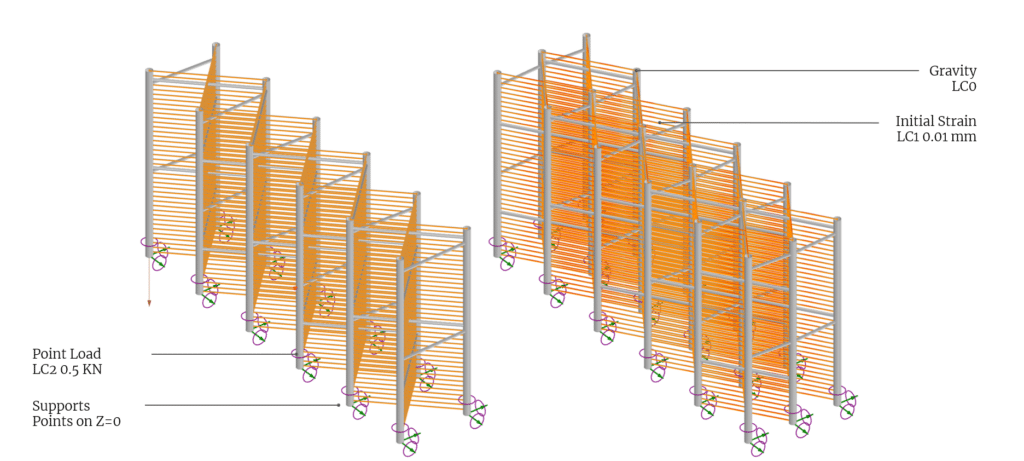
We tested three load cases:
- LC0: Gravity (self-weight)
- LC1: Initial strain in willow rods (0.01 mm pre-tension)
- LC2: Point load of 0.5 kN applied to the structure
For each scenario, we analyzed both Serviceability Limit State (SLS) conditions (day-to-day use) and Ultimate Limit State (ULS) conditions (extreme loads before failure).
Key Findings
1. More Layers = Better Performance
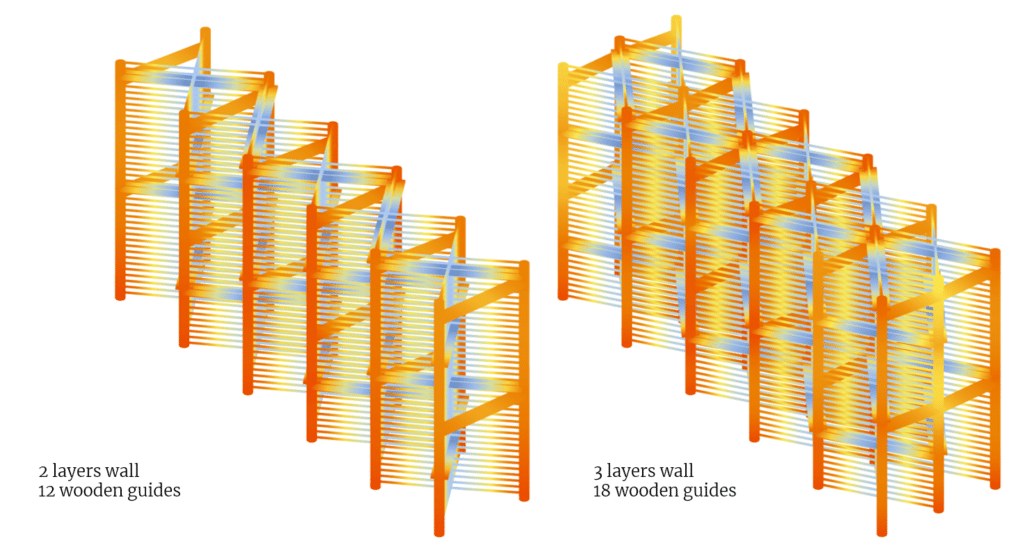
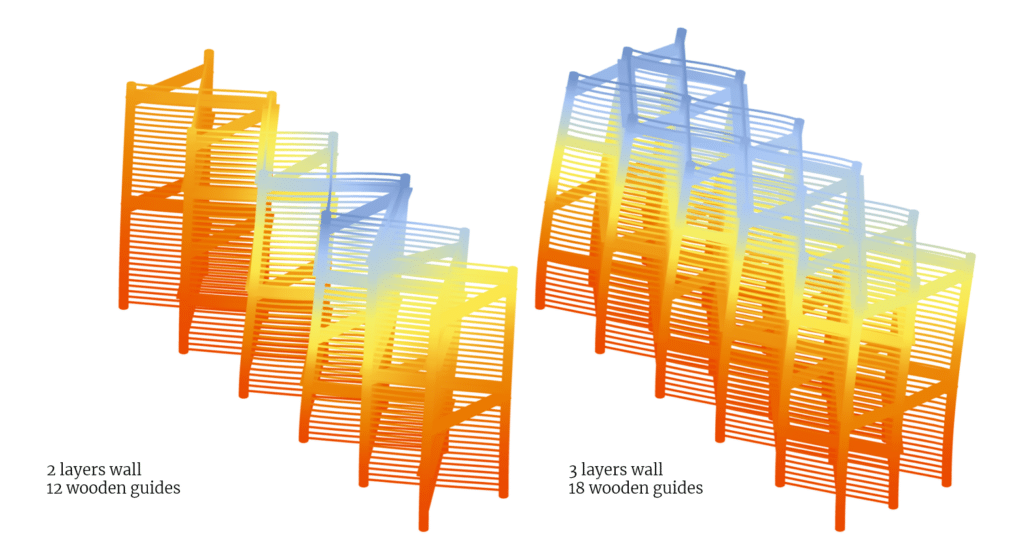
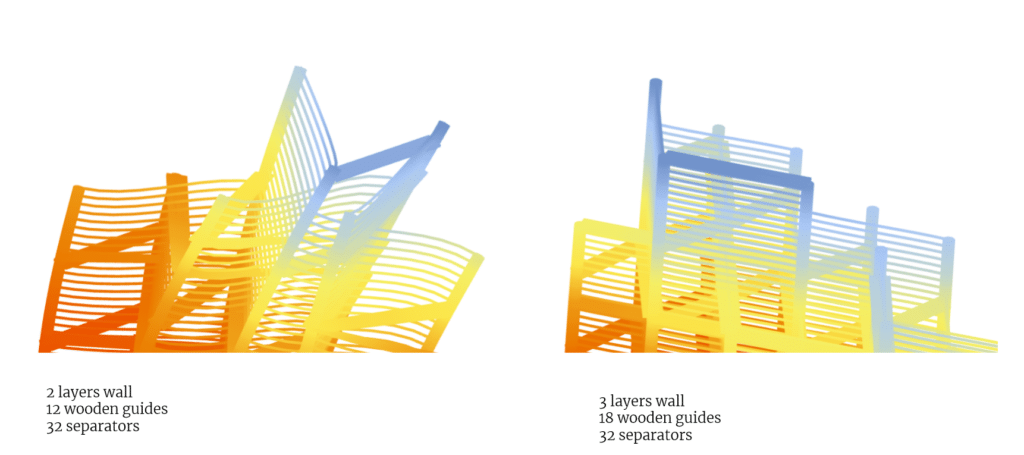
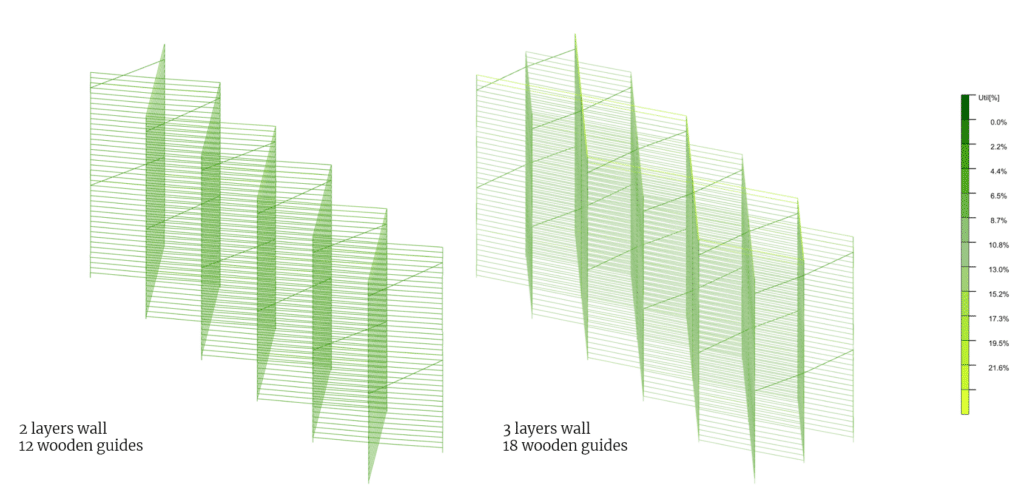
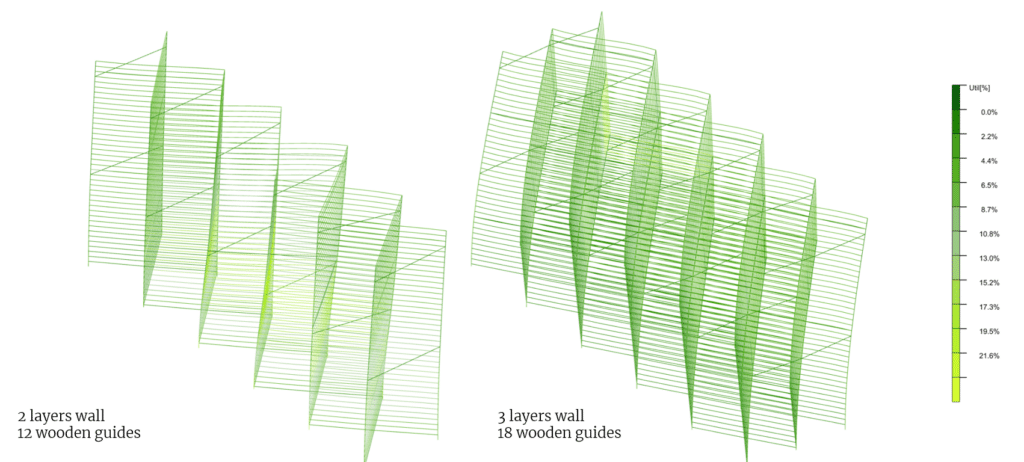
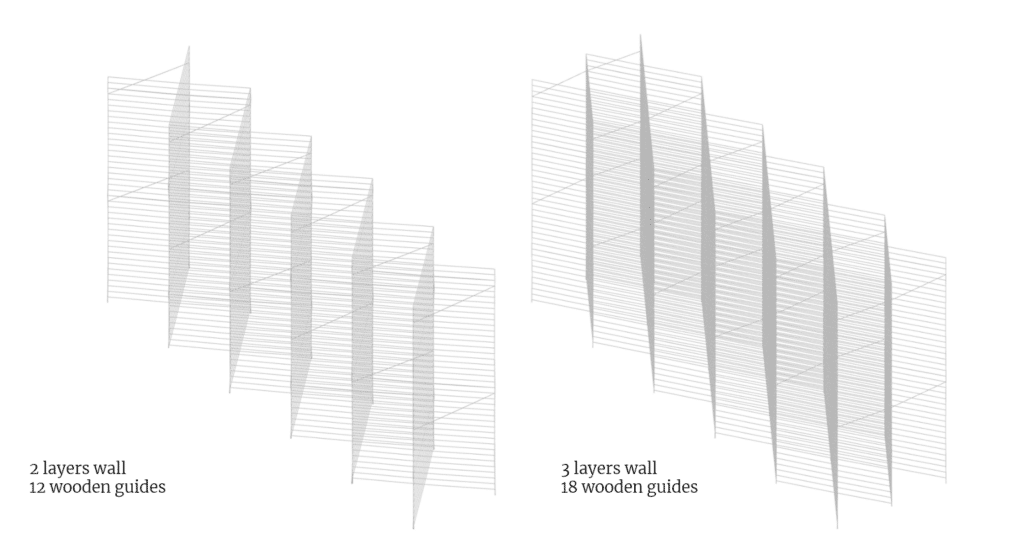
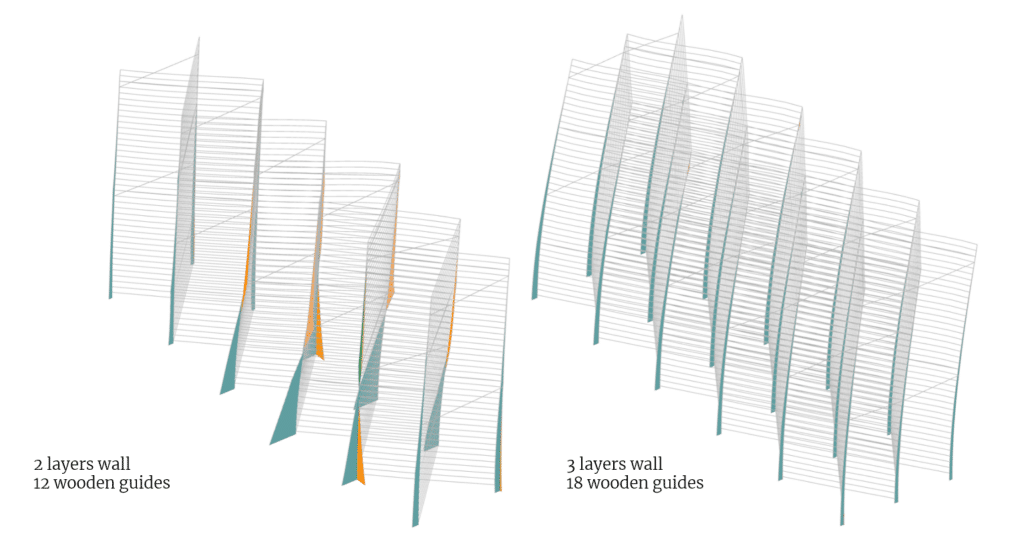
We compared two configurations: a 2-layer wall with 12 wooden guides versus a 3-layer wall with 18 wooden guides.
Result: The 3-layer design significantly outperforms the 2-layer system.
When subjected to point loads and combined loading scenarios, the 3-layer wall exhibits:
- Lower stresses at the support points
- Minimal total deformation
- Better load distribution across the structure
This makes intuitive sense—more vertical supports mean the load spreads more evenly, reducing the burden on any single guide.
2. Separator Spacing is Critical
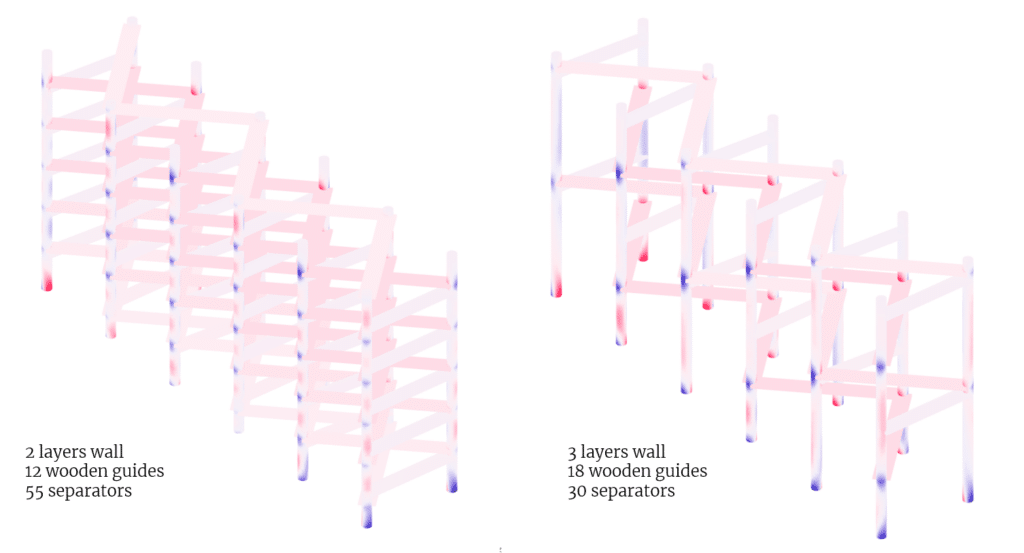
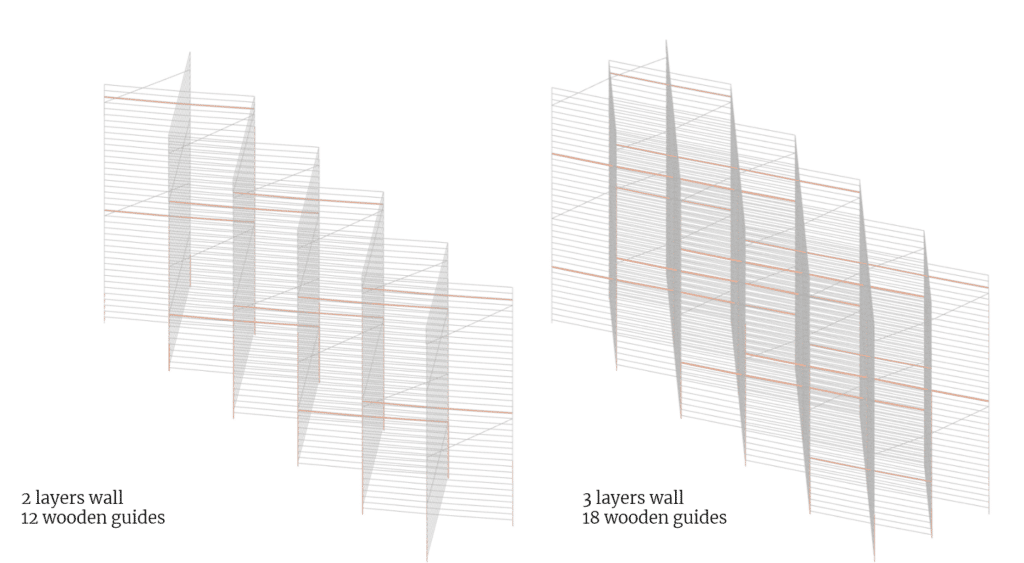
The wooden dividers (separators) that run horizontally between guides act like bracing in traditional construction. Their spacing directly controls how well the wall resists deformation.
Our finding: An ideal spacing of approximately 1 separator every 25 cm provides optimal performance.
Why? The separators prevent the wooden guides from buckling laterally under load. Spacing them closer than 25 cm adds weight without significant benefit; spacing them farther apart allows excessive deflection in the unsupported spans.
For our 3-layer wall with 18 guides, this translated to approximately 32 separators for optimal performance—a significant reduction from traditional over-engineering approaches.
3. Orientation Matters as Much as Quantity
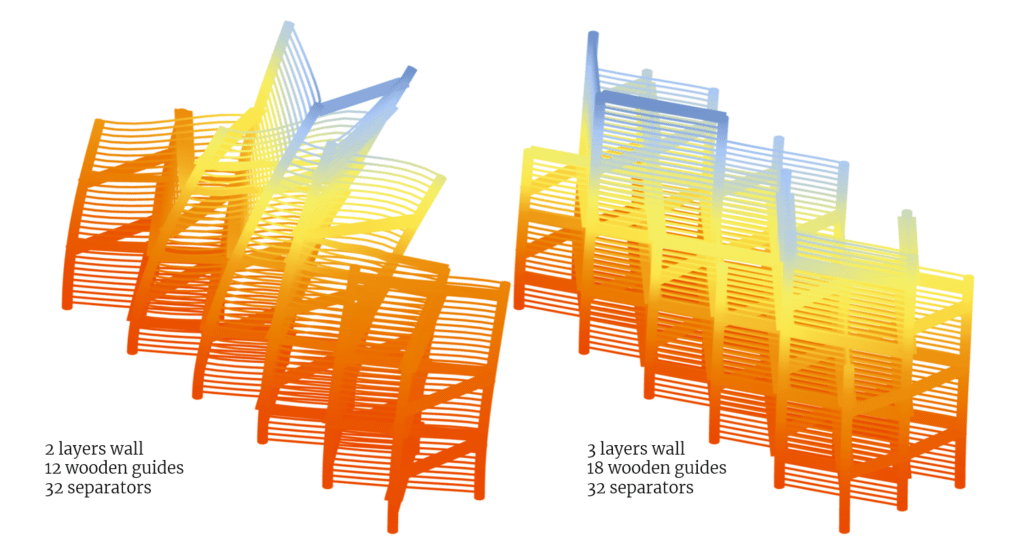
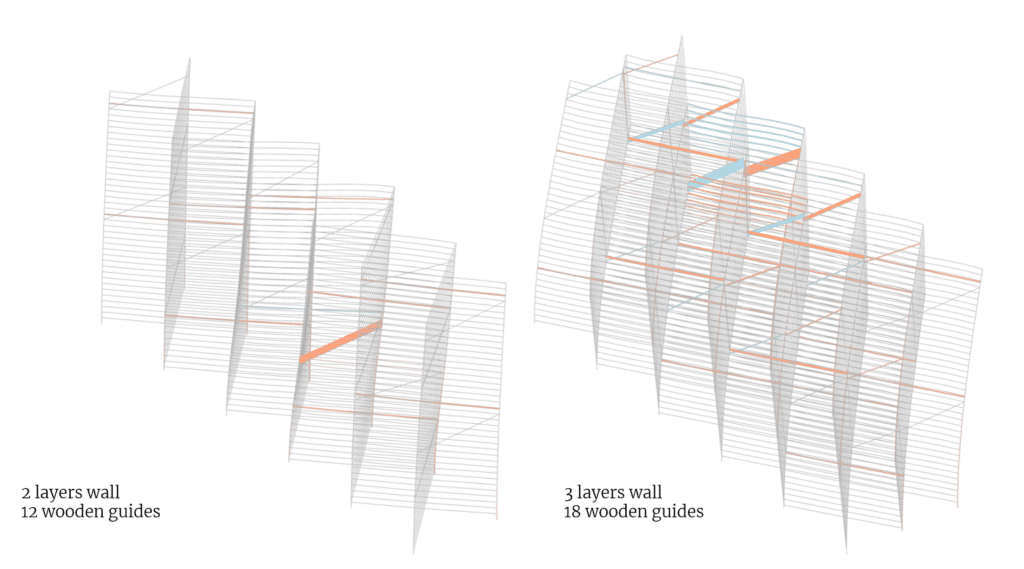
The most surprising finding came from analyzing separator orientation. We compared:
- Perpendicular separators: Traditional horizontal bracing running perpendicular to the guides
- Diagonal separators: Bracing running at an angle across the structure
- Mixed orientation: Combination of both
Result: A hybrid approach performs best.
The diagonal separators provide excellent lateral stiffness, preventing the guides from swaying. However, the perpendicular separators excel at resisting tensile forces in the woven willow rods themselves. By using both strategically, we achieve superior overall performance—particularly at the ends of the wall, which remained more stable in the mixed-orientation design.
Parametric Exploration
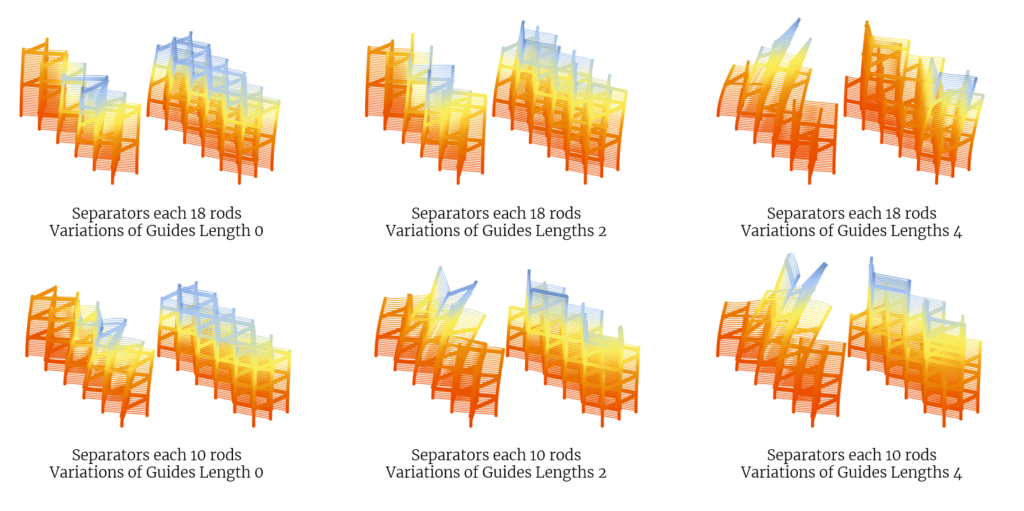
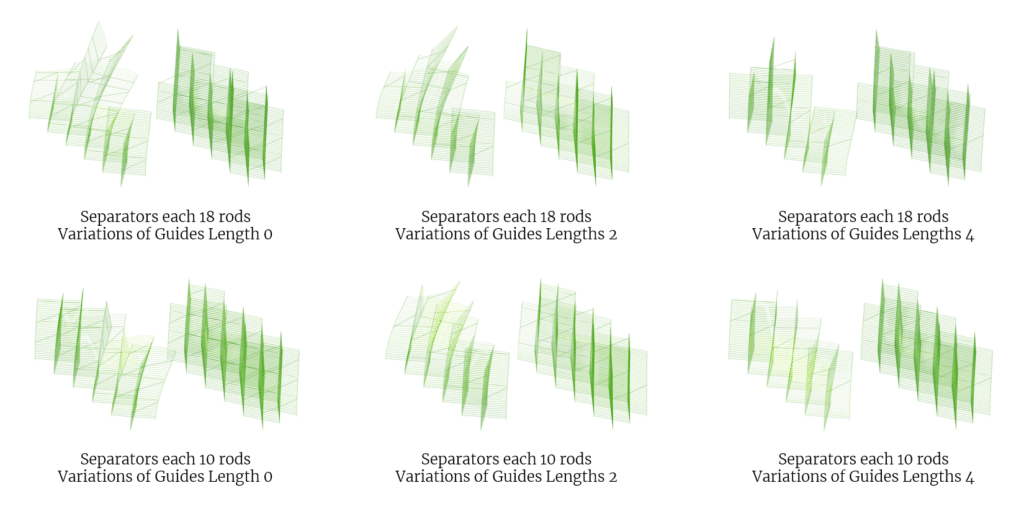
Rather than testing static designs, we leveraged Karamba’s parametric capabilities to run multiple variations simultaneously:
- Different numbers of guides (12, 18, 24…)
- Various separator spacing intervals (every 10 rods, every 18 rods, variable lengths)
- Load combinations and magnitude adjustments
This parametric approach revealed non-linear relationships: sometimes adding more separators actually increased certain types of stress because it changed how loads distributed through the system. This reinforced the importance of design optimization over intuitive over-specification.
Visualization & Stress Mapping
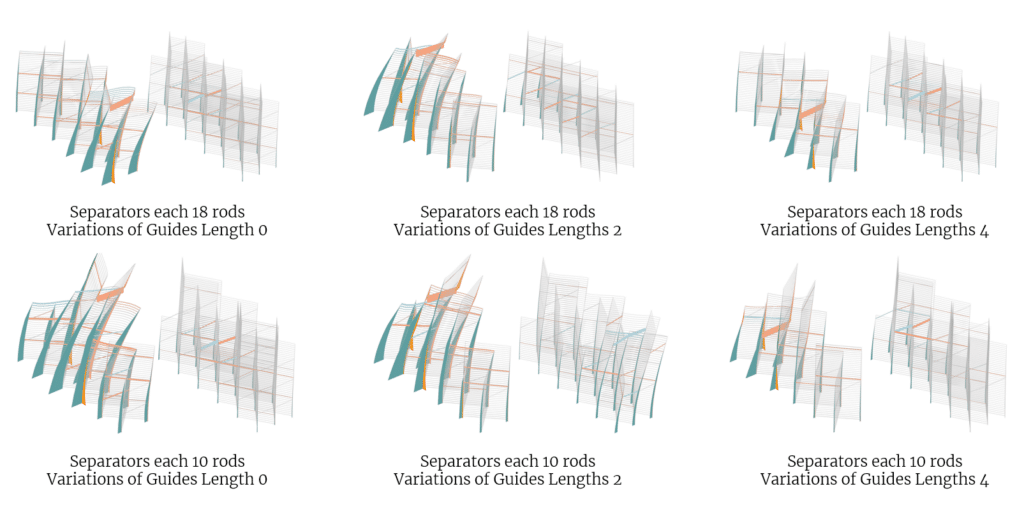
Karamba outputs allowed us to visualize:
- Displacement fields: Where and how much the structure deforms
- Axial forces (Nx): Tension and compression along the guides
- Bending moments (My, Mz): Rotation and bending stresses in each axis
These visualizations were critical for understanding failure modes and identifying weak points. For example, moment visualization immediately showed us that diagonal separators significantly reduced bending stresses at the wall edges—validating our hybrid approach.
Design Conclusions
Our structural analysis yielded three actionable design principles:
- Increase layers strategically: Moving from 2 to 3 layers provided substantial performance gains at a reasonable material cost
- Optimize separator spacing: 25 cm intervals emerged as the “sweet spot” between structural performance and material efficiency
- Mix bracing orientations: Combining diagonal and perpendicular separators leverages the strengths of both approaches
Why This Matters for Adaptive Architecture
This analysis demonstrates a critical practice in contemporary design: parameterizing structural behavior to drive formal decisions. Rather than designing first and testing later, we integrated structural analysis into our design loop from the start.
For our team, Karamba answered specific questions:
- How many layers do we actually need?
- Where can we save material without compromising performance?
- Which design variations meaningfully improve behavior?
These answers directly informed our fabrication priorities and material budgeting for the final prototype.
The Bigger Picture
As computational design continues to reshape architecture, tools like Karamba bridge the gap between ambitious formal concepts and engineering reality. They allow small teams to perform analyses that once required dedicated structural engineers, enabling a more integrated, iterative design process.
Our Adaptive Willow Wall project demonstrates this potential: a human-robot collaborative, parametrically optimized, structurally validated design—all developed within the constraints of an academic studio course.
