
A close reading to a Herbert A. Simon’s 1962 essay “The architecture of complexity” paper.
Simon was a polymath: economist, cognitive scientist, organization theorist, AI pioneer, and design thinker. The paper moves across domains rather than staying inside one discipline, searching for structural patterns shared by very different complex systems.
Context: AI as a Complex Ecosystem
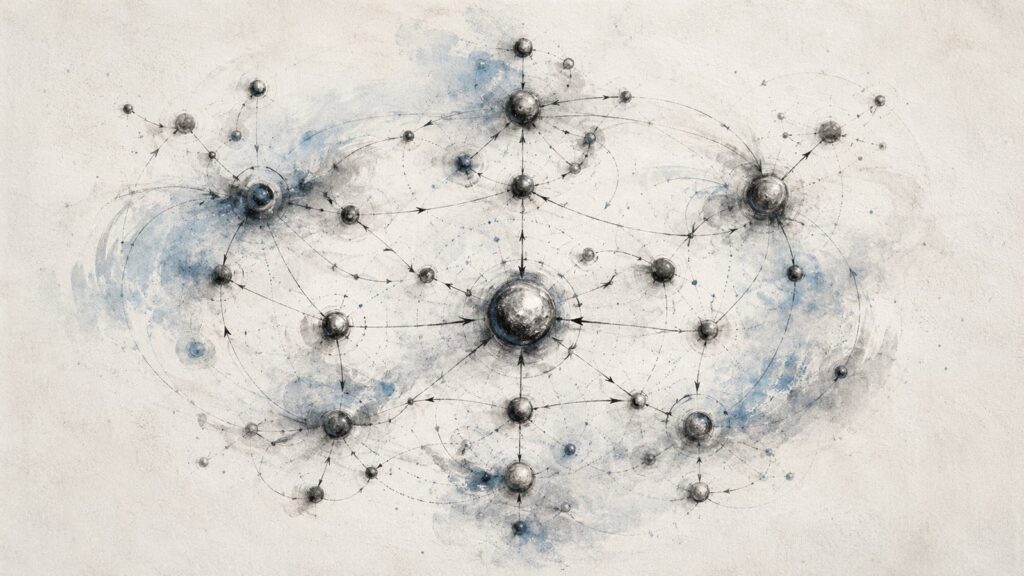
Artificial intelligence is often described as if it were a single tool: a model, a chatbot, a generator, or a machine that produces images, text, or decisions. Looking at AI from a wider view, it has been framed as a complex ecosystem made from algorithms, datasets, infrastructures, interfaces, training processes, and human practices, all of them interacting with one another, and embedded in cultural, political, ethical, and professional contexts.
Simon was not writing about contemporary AI, but he asks a question that remains urgent: how can complex systems exist, evolve, and become understandable? If AI is a system of interacting systems, then we need tools for reading complexity without reducing it too quickly.
This analysis was then structured as a close reading rather than a simple summary. The goal was to follow how Simon builds his argument and translate it into questions for architecture, computational design, BIM, and agentic AI workflows. Our position was not that hierarchy explains everything, but that it gives designers a useful first lens for reading systems that otherwise appear chaotic. In that sense, the activity followed the seminar’s agora format: a shared space for discussion, interpretation, and critique.
Thesis: Complexity Is Not Necessarily Chaos
The central thesis of our study is that complexity is not necessarily chaos. Complex systems become possible, evolvable, and understandable when they are organized through stable levels of structure. Hierarchy, stable subassemblies, near-decomposability, and abstraction are not just technical terms; they are ways of making complexity legible.
Simon’s essay remains useful for architecture and AI because it gives designers a language for thinking across scales. It helps us see a city as a nested system, a building as interacting subsystems, a BIM model as a structured description, and an AI workflow as a chain of goals, agents, tools, data, and feedback. Our reading led to a simple conclusion: design intelligence is not only about producing objects. It is also about choosing the right level of analysis and understanding how local actions contribute to larger systems.
1. What Is a Complex System?
Complexity as Interaction
The first step was to clarify what Simon means by a complex system. Complexity is not just a matter of having many parts. A system becomes complex when its parts interact in ways that make the behavior of the whole difficult to infer directly. The whole is “more than the sum of the parts” in a practical sense: even if we know the components, it may still be difficult to predict the complete system.
Levels of Description
This allowed us to avoid a false opposition between reductionism and holism. Simon does not reject analysis. Parts still matter. But analysis only becomes useful when we choose the right level of description. If we look too closely, we may drown in detail. If we look from too far away, we may miss the important interactions.
Simon answers this question through hierarchy, which became the second numbered section of the presentation.
2. Hierarchy as Nested Relations
Hierarchy Beyond Command
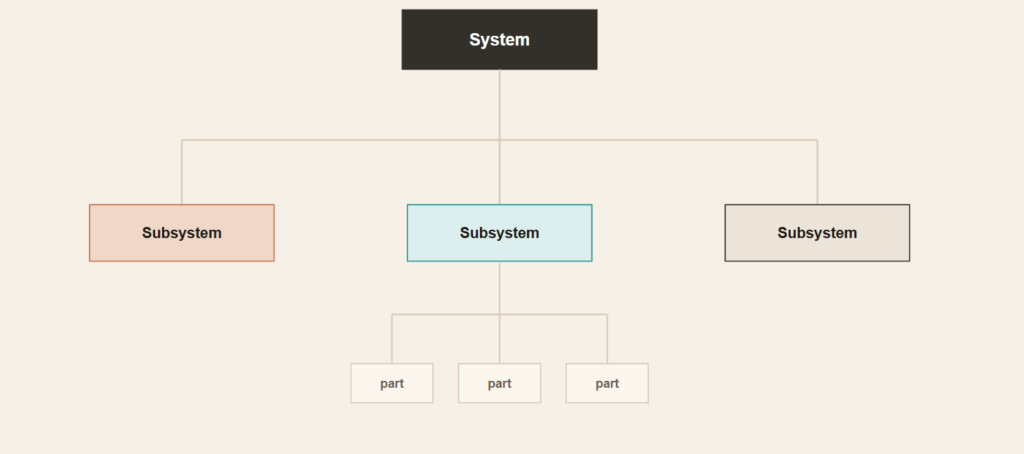
In Simon’s essay, hierarchy does not simply mean command, authority, or top-down control. It means a nested structure: systems made of subsystems, which are themselves made of smaller subsystems. This appears across social, biological, physical, symbolic, and designed systems. A city contains districts, buildings, rooms, components, and details. A BIM model contains categories, families, types, and instances.
Architectural Translation
This was the first major bridge to architecture. Architectural thinking already works through nested levels: urban scale, building scale, rooms, components, details, drawings, and assemblies. Simon gives this habit a theoretical frame: hierarchy is one of the reasons complex systems can be described, designed, and discussed. For us, this made the text feel less like a distant systems theory essay and more like a vocabulary for habits architects already practice.
3. Why Hierarchical Systems Evolve Faster
The Watchmaker Parable

The second part of the study focused on Simon’s argument about evolution. His watchmaker parable compares Tempus and Hora. Both produce watches of equal complexity. Tempus assembles his watch as one fragile process; if interrupted, the unfinished work falls apart and he must begin again. Hora builds the watch from stable subassemblies. If interrupted, only a small portion is lost.
Stable Intermediate Forms
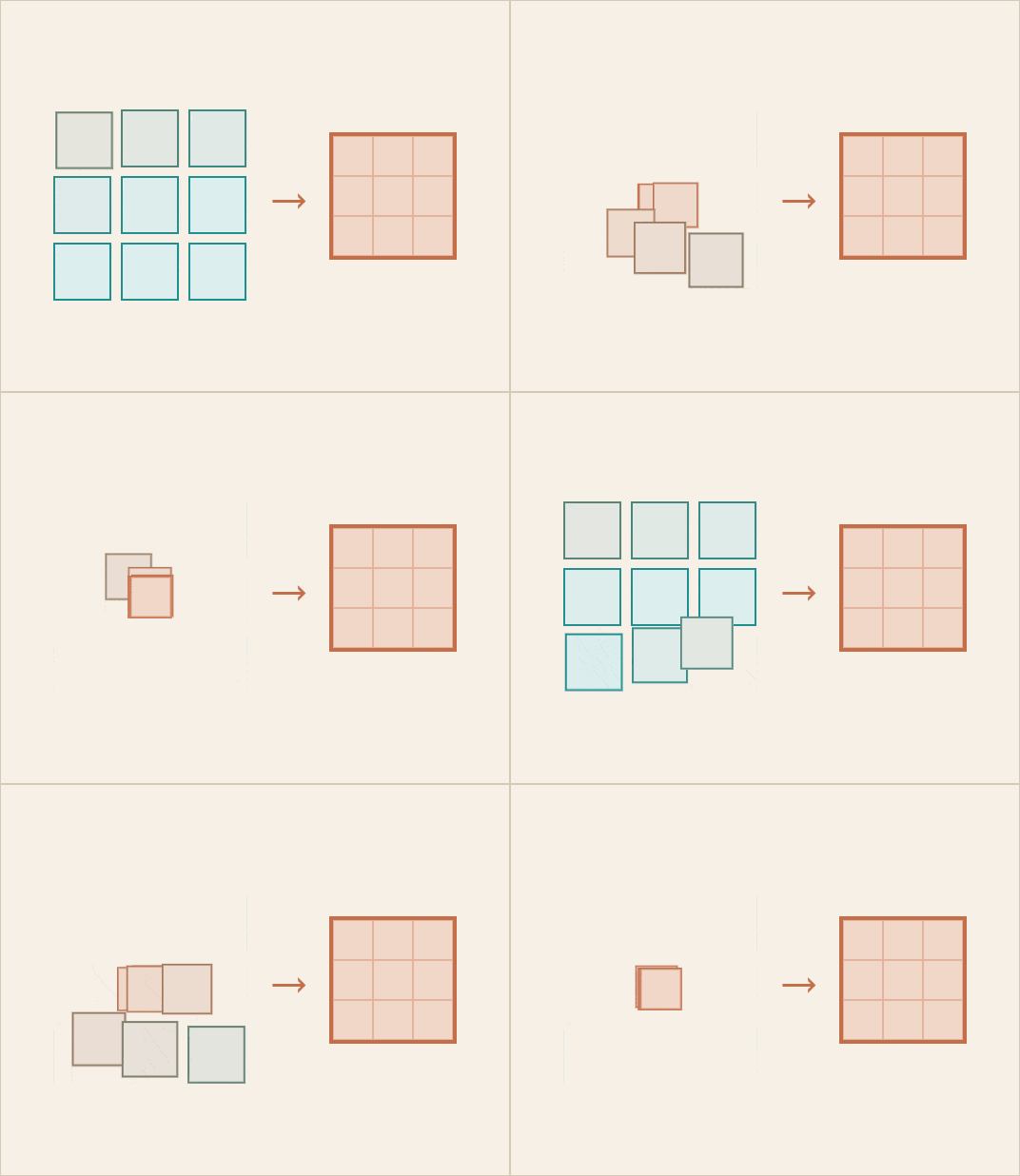
The lesson is simple but powerful: complex systems become easier to produce when they are built through stable intermediate forms. If every complex structure had to appear all at once, the probability of success would be extremely low. If partial structures can stabilize and become building blocks, the system can grow step by step.
Architectural and Computational Subassemblies
For architecture, this principle is familiar. Buildings depend on packages, teams, modules, standards, interfaces, construction sequences, and partial decisions that support later work. The same is true in computational design: a definition may contain clusters, a script may contain functions, and a workflow may contain reusable tools.
Problem Solving as Search
This also connects to problem solving. Simon compares problem solving to a search through a maze. A partial solution acts like a stable subassembly: it gives us a place from which to continue. Search is not completely blind, because feedback, previous experience, and inherited solutions reduce the field of possibilities. This became an important connection to AI workflows, where prompts, tools, agents, datasets, and feedback loops form a search process rather than a single command.
4. Near-Decomposability: Local and Global Behavior
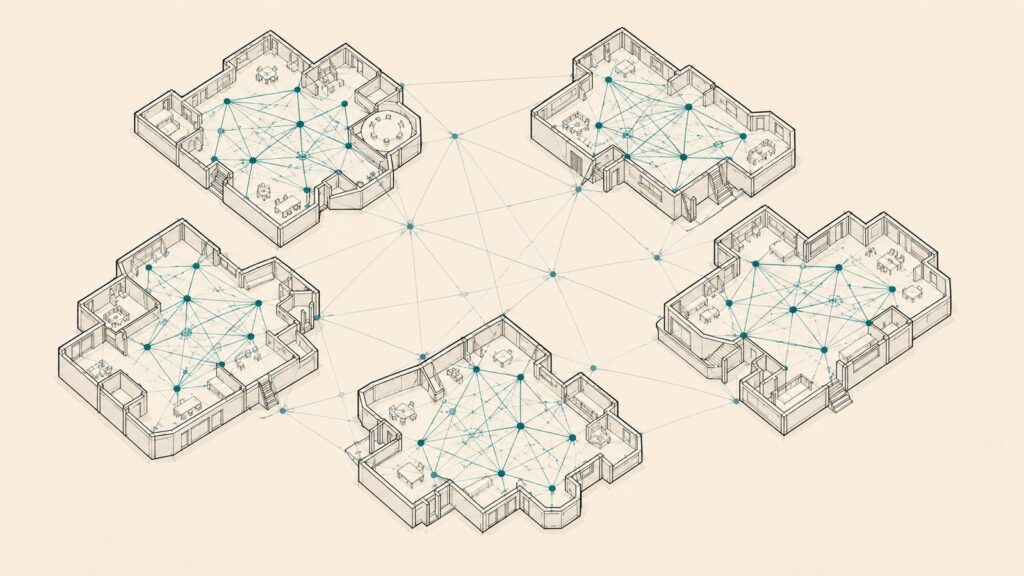
Strong Local Interactions and Weaker Global Interactions
The third major concept was near-decomposability. A nearly decomposable system is not fully disconnected, but its internal interactions are stronger than its external interactions. In other words, elements inside a subsystem affect one another more strongly and more quickly than they affect elements outside that subsystem.
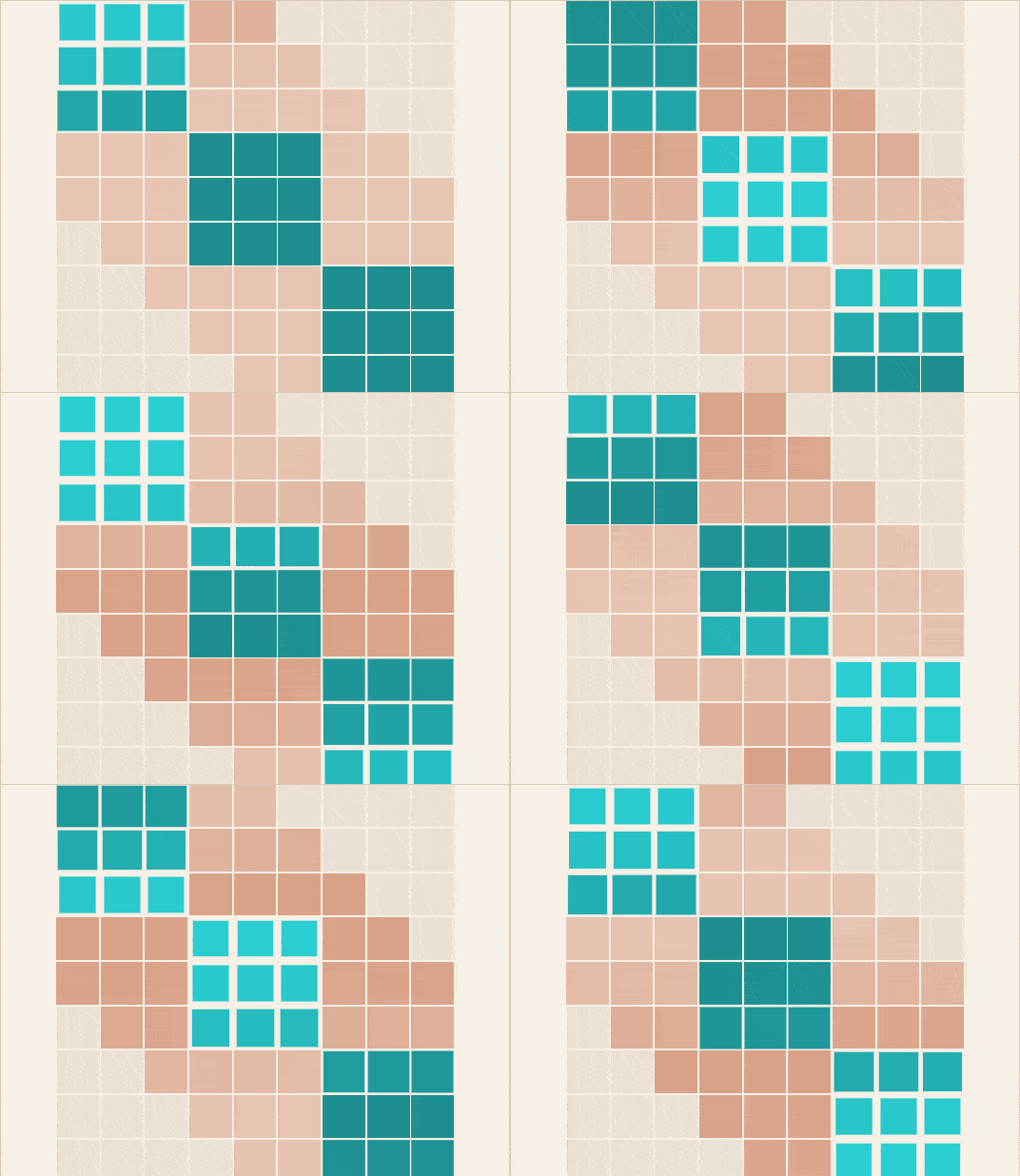
Building Heat-Flow Example
Simon uses buildings, organizations, economies, and physical chemistry to explain this dynamic. In the presentation, the building heat-flow example made the concept concrete. Cubicles inside one room may reach a local thermal balance quickly, while rooms influence one another more slowly through weaker boundaries. The building behaves as a whole, but it can still be understood through local zones and slower global interactions.
Design Relevance for Architecture and AI Systems
This is highly relevant to design. A studio, classroom, office, or public room is not isolated from the rest of a building, but it has a local intensity of use, climate, visibility, acoustics, and social interaction. In AI systems, a similar logic appears when a workflow is divided into goals, planners, agents, tools, and data sources. Each part has local behavior, while the system also produces global effects.
Modularity and Temporal Relations
Near-decomposability helps explain why modularity works. Not every element needs to know every other element directly. Local interactions can be analyzed in the short run, while long-run behavior can be understood through aggregate effects. For designers, complexity is not only visual or formal. It is temporal and relational. We must ask which interactions are fast or slow, strong or weak, local or global.
5. Describing Complexity: Abstraction, State, and Process
Hierarchical Description
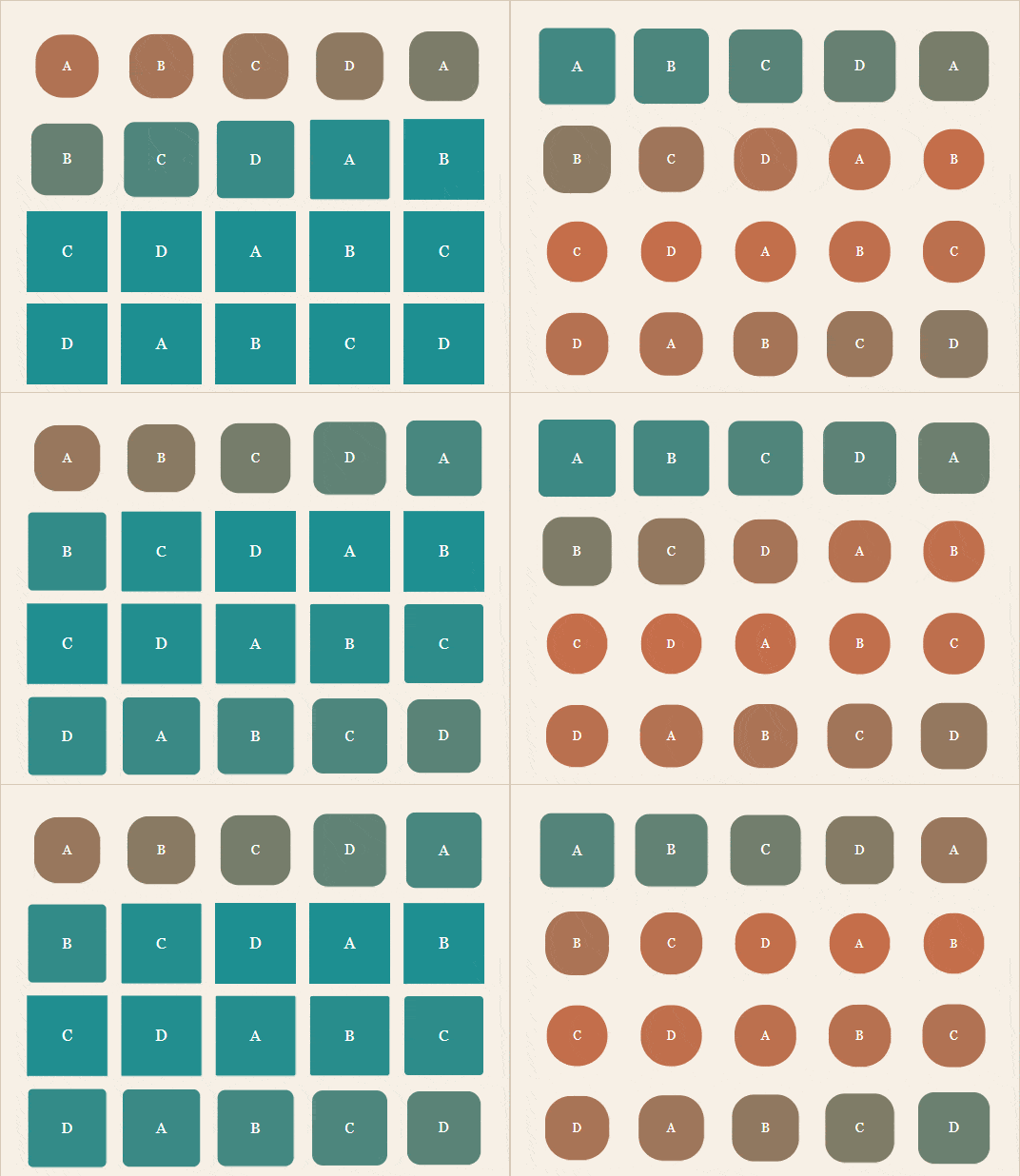
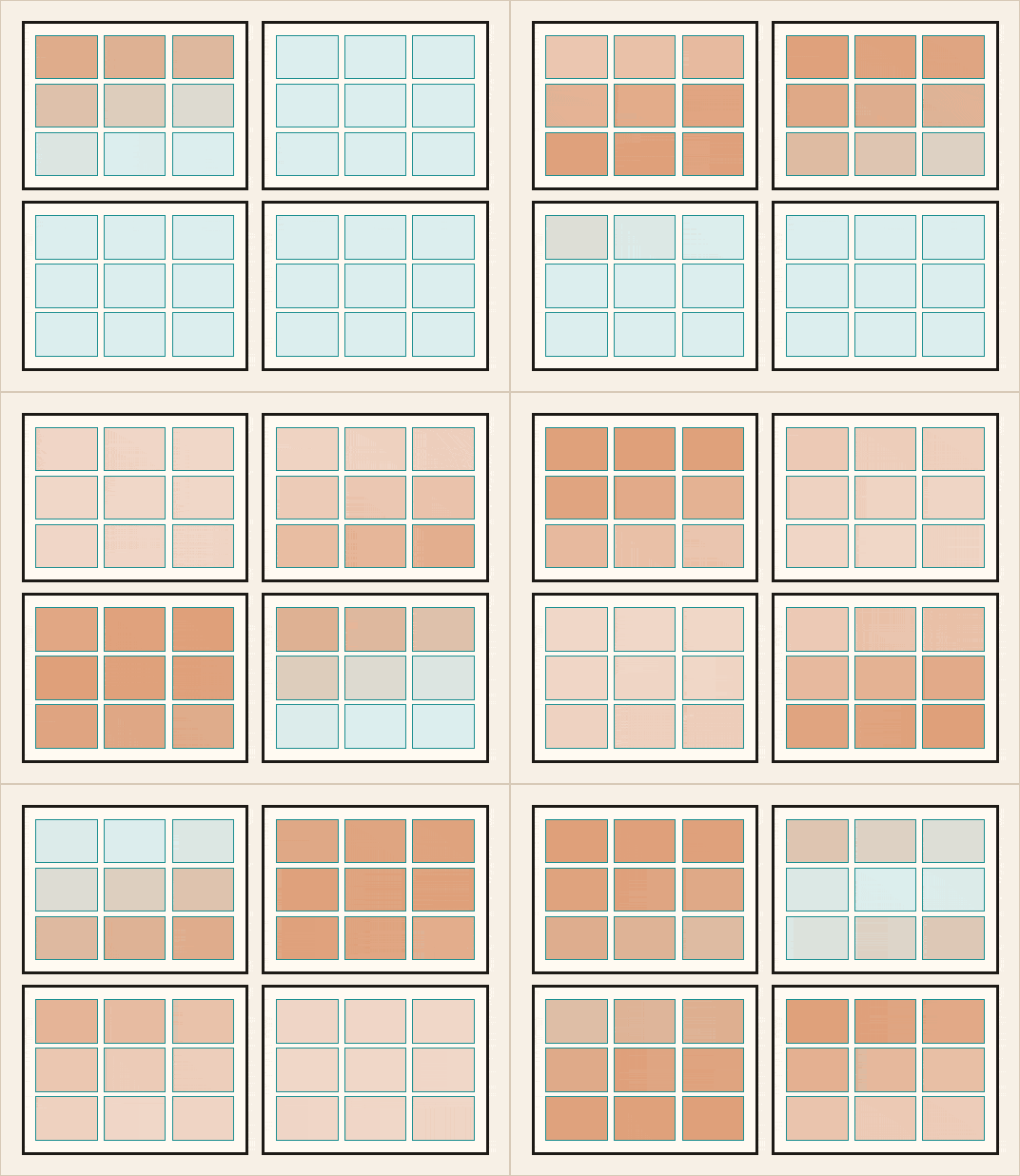
The fourth part of the study examined how hierarchy helps us describe complex systems. Simon argues that people often represent complex objects in levels. When drawing a face, for example, one might begin with the outline, then add features, then add details. Description moves from general structure to finer resolution.
Architectural Abstraction
Architecture works in the same way. A drawing set, model, or construction document is an organized description that selects a level of detail. Plans, sections, details, schedules, and specifications are useful because they abstract.
State and Process Descriptions
Simon also distinguishes between state descriptions and process descriptions. A state description tells us what something is: a drawing, image, model, or final arrangement. A process description tells us how to produce it: a recipe, algorithm, script, sequence, or rule. Architecture constantly moves between these two forms. AI makes this translation even more visible, because many design outputs now emerge through prompts, scripts, models, and iterative procedures.
6. Synthesis: Contemporary Relevance and Critical Limits
Thesis Restated
The central thesis of our study is that complexity is not necessarily chaos. Complex systems become possible, evolvable, and understandable when they are organized through stable levels of structure. Hierarchy, stable subassemblies, near-decomposability, and abstraction are not just technical terms; they are ways of making complexity legible.
Relevance for Architecture and AI
Simon’s essay remains useful for architecture and AI because it gives designers a language for thinking across scales. It helps us see a city as a nested system, a building as interacting subsystems, a BIM model as a structured description, and an AI workflow as a chain of goals, agents, tools, data, and feedback. Our reading led to a simple conclusion: design intelligence is not only about producing objects. It is also about choosing the right level of analysis and understanding how local actions contribute to larger systems.
Critical Question
At the same time, the study raised a critical question that became central to our discussion. If hierarchy makes complexity easier to understand, what happens to systems that do not fit cleanly into hierarchical levels? Social, cultural, informal, or opaque systems may resist neat decomposition. Some forms of intelligence and collective behavior may remain difficult to describe through stable parts and levels alone. This is where the presentation became more than an explanation of Simon: it became a question about what architecture and AI might fail to see when they only trust clean structures.
Productive Framework
For this reason, Simon’s text should not be read as a final answer, but as a productive framework. It gives us a way to begin reading complexity, while showing where our descriptions may be incomplete. In the context of AI in architecture, this is especially important. AI systems are not neutral tools waiting outside society. They are complex environments made of technical, human, material, and cultural relations. To work with them responsibly, architects need to understand what these systems produce, how they are structured, how they evolve, and how they shape design worlds.
