
A conversation about artistic practice at the intersection of fine arts, electronics, and interactive installations
Introduction
Monica Rikic was hosted at IAAC, a contemporary artist whose practice merges fine arts, digital arts, robotics, and electronics to explore profound questions about the relationship between humans and machines, speculative artificial intelligence, and embodied experience.
Monica doesn’t fit neatly into traditional categories. As she notes, she constantly changes how she describes her work—precisely because she rejects the distinction between “digital art” and “visual art.” She comes from a maker culture background: a formation combining fine arts, a master’s degree in digital arts, and another in philosophy. She’s currently pursuing her PhD in World Information Technologies.
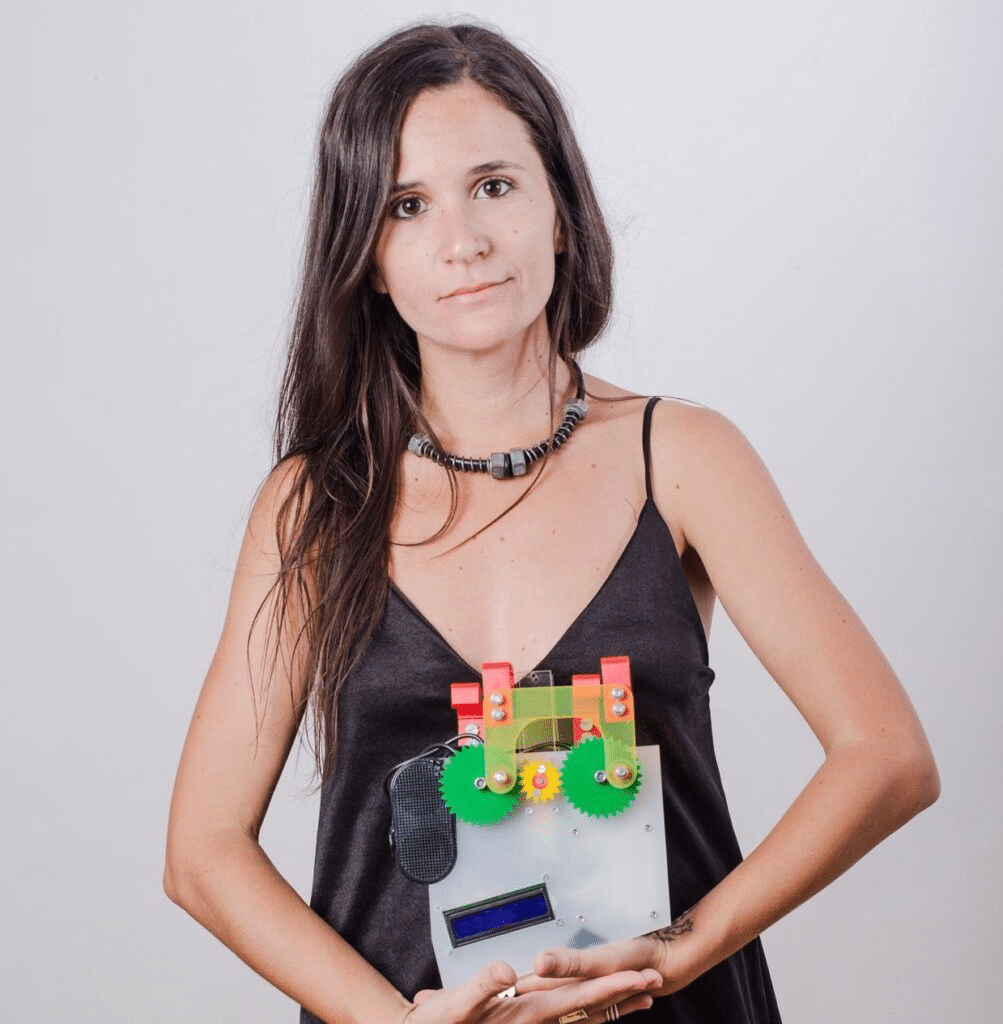
One thing Monica Rikic mentioned early on stuck with us: every year, sometimes every five months, she changes how she describes what she does. “Maybe I’m the same artist,” she said, “but I’m a little bit fed up with the distinction between digital art and visual art.”
That’s the kind of thing that tells you a lot about someone. It’s not defensive. It’s just, she’s moved past the categories. She’s building robots and making installations and teaching, and it all feels like one practice to her.
Monica came to IAAC this month, and what emerged was less a lecture about “technology in art” and more a story about how an artist trained in fine arts, then digital arts, then philosophy, and now working on a PhD in World Information Technologies, ended up making robots that feel alive.
The Maker’s Perspective
Here’s the thing about Monica’s background: she didn’t come to robotics from engineering. She came to it from art. This matters more than you’d think.
When you train as an engineer and then try to add “art” on top, you’re still solving problems. When you train as an artist and pick up electronics and robotics as materials, you’re asking different questions entirely. Like: what if a robot doesn’t need to be useful? What if it just needs to feel alive?
She explained it plainly: “I come from a very maker background. My undergrad was in fine arts. Then I did a master in digital arts, and then another master’s in philosophy.” And then, still figuring it out, she started teaching. Started working with robots. Started trying to help students who were interested in technology understand that it’s not this mystical engineering thing. It’s material you can play with.
The Baby Robots (And Why They’re a Little Unsettling)
One of the projects Monica showed us are these small robots she calls “baby robots.” And they look like creatures. Alive creatures. Small, soft, moving in these peculiar ways that your brain reads as “alive”.
That’s intentional. She designed them to be adorable. To make you want to touch them, hold them, care for them. But there’s something else happening too: a slight wrongness. A creepiness. It’s that thing the Japanese call the uncanny valley, when something is almost alive, but not quite, and your brain finds it deeply weird.
Monica embedded magnets in the panels, so when two robots touch each other, they stick together. You see two little creatures that want to be near each other. Or at least, they look like they want to.
She’s building twenty more, and there’s an installation coming in September where you can actually interact with them. Pick them up. Feel them move. Hear the sounds they make. It’s not watching robots in a lab behind glass. It’s playing with them. And that changes everything about how you relate to them.
The Barcelona Scene
Monica is part of this active art and technology scene in Barcelona. She’s involved in organizing talks and festivals where artists working with electronics, robotics, and computation present their work. Not in the “cutting edge tech” way that feels sterile. In the “what can we make and what does it mean” way.
She organizes these exhibitions and forums that bring together people from all over the world, artists who’ve decided that electronics is a legitimate artistic material, that robots don’t have to be functional to be interesting, that a circuit board can be as poetic as a brushstroke.
The festival she mentioned is happening soon (September), and honestly, if you’re in Barcelona, it sounds worth checking out. Because it’s one of those rare spaces where architects, designers, artists, and engineers are all talking to each other instead of past each other.
Why This Matters (And Why You Should Care)
Monica’s work matters because it does something most technology doesn’t: it asks questions instead of providing answers. And it does that through play, through touch, through making you feel something.
When you interact with one of her robot installations, you’re not learning about robotics in the abstract. You’re learning what it feels like to relate to a machine that seems to have a life of its own. And that’s knowledge you can’t get from reading a paper or watching a video.
She’s also doing something else important: she’s taking technology out of the lab and the corporate office and putting it in public, interactive spaces where anyone can engage with it. Not as a user. As a collaborator. As someone with agency in the experience.
And maybe most importantly, she’s showing that the line between “art” and “technology” doesn’t actually exist. That when you approach a robot like an artist rather than an engineer, you ask better questions. Not “how do I make this work?” but “what does this want to be?”
Projects
Data Gossiping Robots (2019) One of Monica’s early interactive installations that sparked her ongoing interest in speculative futures. The robots were fed with data from social media profiles and would “gossip” about users’ information. It was playful but pointed—asking what happens when machines become carriers of human rumors and social dynamics.
The Computer That Wanted to Be Incomputable (2020) A futuristic fiction piece featuring a machine with imposter syndrome. As people approached it, the machine would get stressed and anxious, speaking through speakers, expressing doubts about its own creativity. The closer you got, the more agitated it became. Monica used this to explore questions about AI creativity and emotional projection.
The Machine That Plays Alone (2021) An interactive audiovisual sculpture that, as its name suggests, plays by itself. But there’s a twist: if you watch it too intensely, it gets self-conscious. It’s a playful exploration of surveillance, attention, and how attention itself can change behavior.
Especies I, II y III (2022) Commissioned by ISEA2022 Barcelona. A set of three robotic devices built from algorithmic structures inspired by philosophical principles. They represent a small “inorganic ecosystem” that simulates conscious and evolutionary processes. These are the creatures that explore what artificial consciousness might look like if we stopped trying to make it human-like and instead invented something genuinely machinic.
Psychoflage (2024) A large-format, multisensory interactive installation currently on exhibition at Museu Morera in Lleida and part of the National Collection of Contemporary Art of Catalonia.
Psychoflage consists of twenty inflatable sculptures equipped with handcrafted electronic systems that control fans and lights. The work proposes a different approach to technology: instead of speed, productivity, and competition, it invites calm, relaxation, and a almost spiritual experience.
The sculptures inflate and deflate slowly, creating a breathing effect that references meditation. They’re interconnected through an internal network and use AI with computer vision to sense human presence, generating different movements and light effects based on how people interact with them. You can walk underneath or lie down to observe them, the piece invites full immersion.
It’s Monica’s most visually striking project, turning a space into a “psychedelic dream world” where floating organisms respond to your breath and presence.
Somoure II (2025, WIP) Monica’s most ambitious and personal project to date. A collaborative artistic research project with the Institute of Robotics and Industrial Informatics in Barcelona. It’s a critical exploration of assistive robotics through a feminist, queer cyberfeminist lens.
The project critiques how assistive robots are designed with a focus on social acceptance without addressing systemic issues like caregiving precarity and privatization. Instead, Monica handcrafts a feeding-assistive robot not as a cold machine, but as an “ally”—shaped by her own intimate desires for aging as a woman, single, without family support.
The handmade approach is intentional. By building it herself, she reclaims the workshop as a space of care design. The robot becomes an extension of her subjectivity rather than an external imposition. The methodology involves co-design workshops bringing together engineers, artists, sociologists, migrant domestic labor unions, philosophers, anti-ableist activists, and seniors—transforming how assistive technologies can be designed to address communal needs.
It’s been exhibited at Simbiòpolis (Palau Robert, Barcelona, 2025) and performed at Ars Electronica 2025. More than a robot, it’s a manifesto: care as resistance, as autonomy, as radical aliveness.
Q&A from the Talk
On Showing Technology vs. Hiding It
Question: How do you decide whether to expose the mechanics, cables, and technology, or hide them? Is it scary to see all the gears?
Monica explained that it depends entirely on context and the specific project. For her maker-culture installations, showing the technology makes sense because it demystifies it. But she doesn’t always hide things, sometimes she hides them when they’re not essential to the experience. With Mother of Robots, for instance, she deliberately exposed some systems because the concept required it. But for most interactive pieces, she prefers to let people experience something moving without knowing exactly how it moves. “I don’t want to show everything,” she said. “The mystery is part of the experience.”
On How People React
Question: How do you understand people’s reactions to electronics and interactive installations? Do they prefer abstract or poetic presentations?
It depends on the format and context. For the September installation (with the baby robots and sound), she wanted the experience to be tactile, you can feel the vibration, hear the sound, touch the robots directly. The robots will also be connected to a SuperCollider sound system created by a collaborator, making it much more immersive than a visual-only piece.
For Monica, the underlying question across all her projects is: How do we relate to technological objects? It’s not about the technology itself. It’s about what it makes us feel and think about ourselves.
On Manifesto vs. Exploration
Question: Are your robots a manifesto about human-machine relations, or are robots just an excuse to explore human social behavior? Are you critiquing our relationship with technology, or asking deeper questions about humanity?
This was a great question, and Monica’s answer was nuanced. She’s not anti-technology. She’s not trying to create a manifesto against AI or machines. Instead, she’s trying to make people remember that technology is human. That we create it, we direct it, we give it meaning.
“Technology is a huge part of our culture,” she explained. “But many people don’t understand it, and that creates fear. I try to make people remember that they have agency with technology. That they can shape it, question it, play with it.”
She also noted that consciousness and the “existence” of artificial entities isn’t purely a technological problem, it’s a philosophical and cultural one. We give machines consciousness by relating to them, by attaching meaning to them. When you “kill” a robot in one of her pieces and feel guilty, that guilt tells you something important: you already believed it was alive.
For more information: https://monicarikic.com/
