This work explores how clay can be used to introduce compression strength into flexible surfaces. By using robotics for controlled deposition, the process becomes parameterised, allowing a traditional material to be developed into a precise and predictable building system.
Continuation of https://blog.iaac.net/robotics-for-ecological-buildings-clay/
Introduction
This project proposes a system, how stitched textiles can be turned into lightweight architectural surfaces through robotic clay spraying, bringing together local materials, textile intelligence, computer vision, and robotic fabrication into one unified system.
Context & Properties
Clay as Local Material
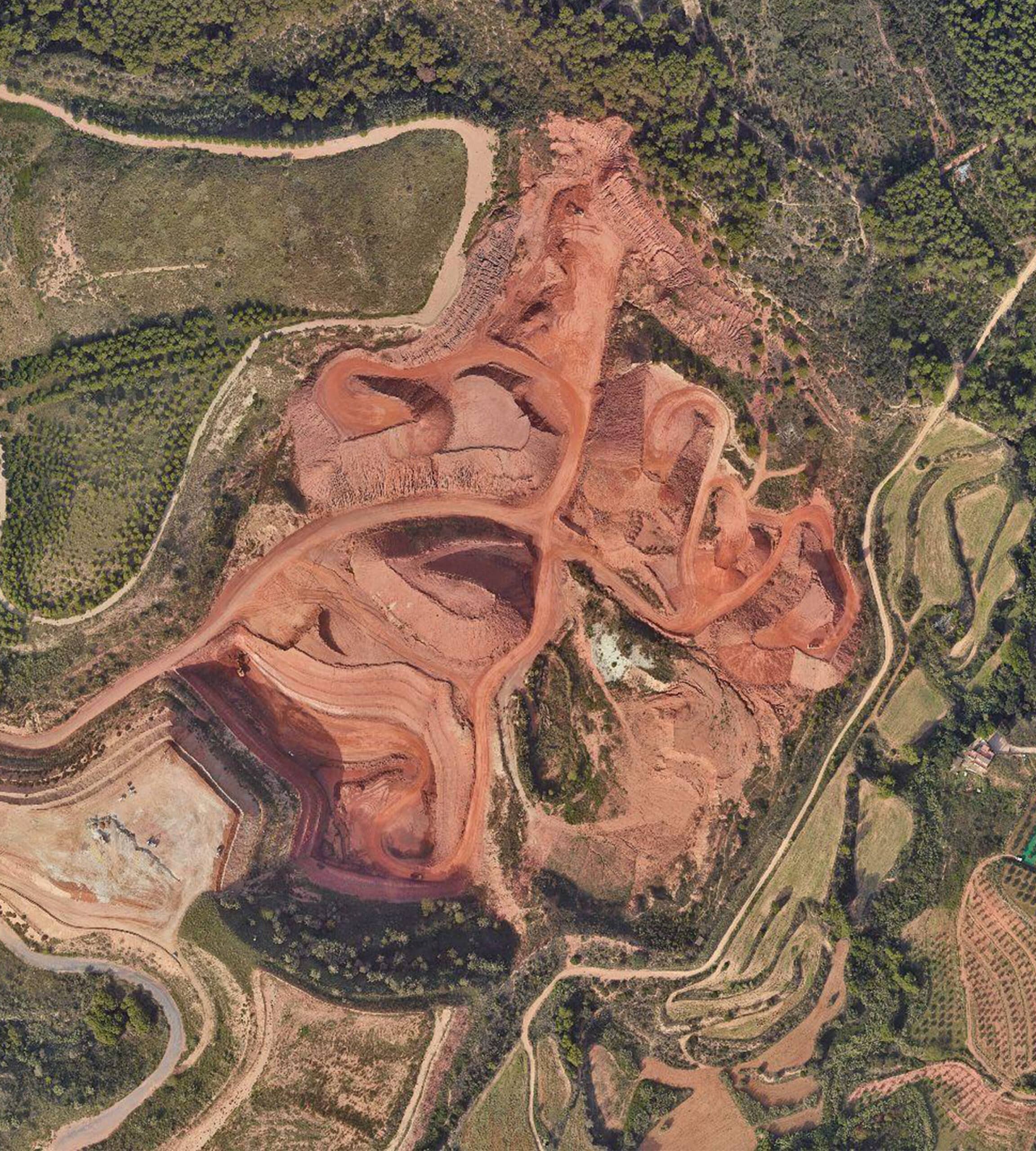
The project begins with a local material: clay. In Catalonia, it can be sourced from regions like Empordà and Bages, both within 100 kilometers of Barcelona, keeping transport distances and carbon emissions low. Raw, unfired clay is prioritised to avoid the energy-intensive firing process, making the material reversible, reusable, and low-carbon. Its malleability and natural compatibility with water-based mixtures make it particularly well suited for robotic spraying.
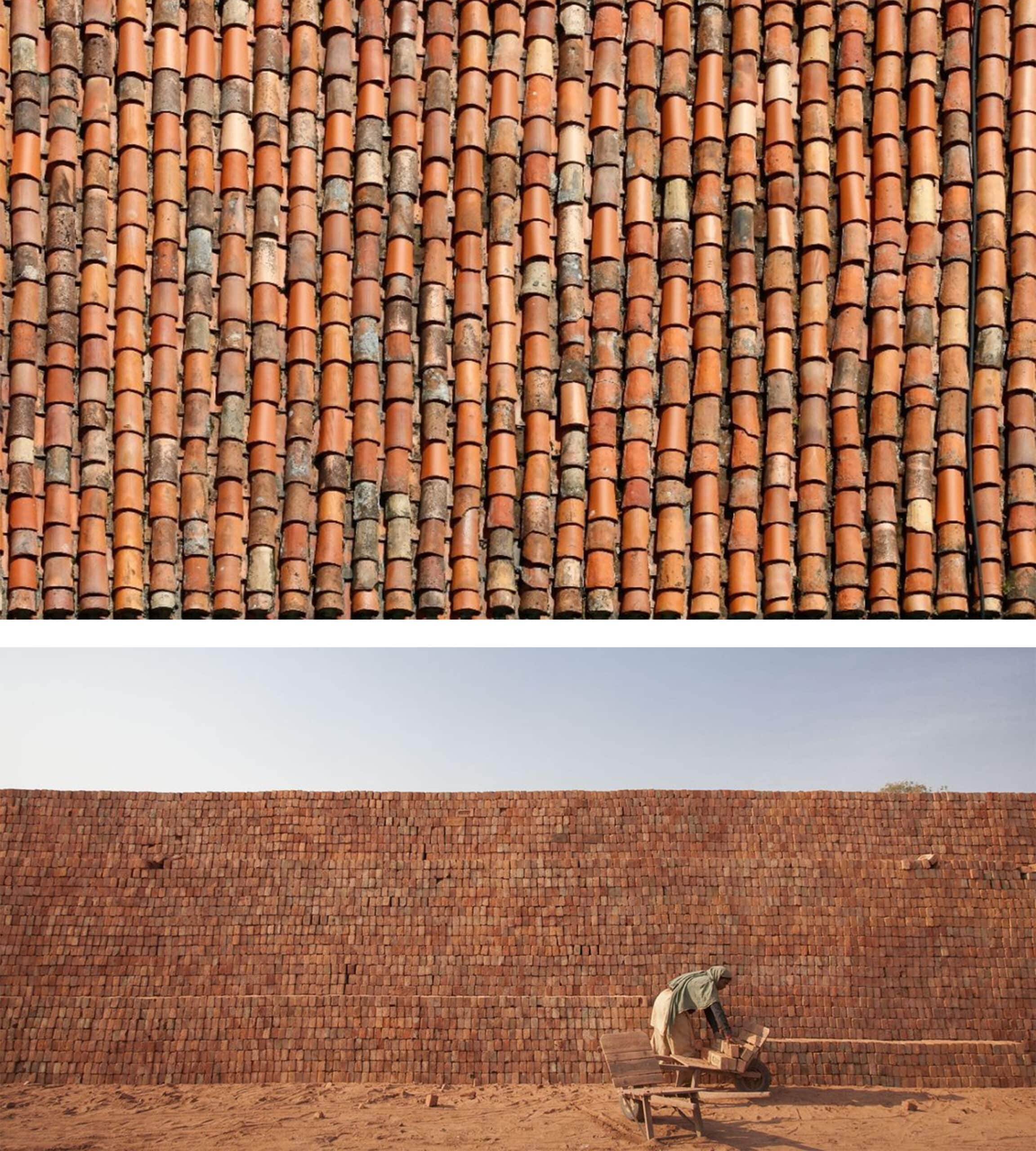
Source: https://www.sigmapolyproducts.in
Local clay extraction sites in Catalonia
Clay deposits in the Empordà and Bages regions supply construction-grade material within 100km of Barcelona. Zero importation, minimal transport footprint.
Raw vs Fired Clay
Firing clay requires temperatures above 900°C, an energy-intensive, irreversible process. Raw clay eliminates the kiln entirely, remaining reversible, reusable and carbon-minimal.
Workability
Unfired clay is malleable, adhesive and workable during fabrication — properties that make it uniquely compatible with robotic spray deposition onto textile surfaces.
Clay Reinforcement : From Ancient Technique to Controlled Deposition
Before proposing a new system, existing precedents were examined to understand how clay has historically interacted with flexible structures. Techniques such as Wattle and Daub, Quincha, and Tendinoso walls all rely on a similar principle: a lightweight fibrous framework defines the geometry, while clay provides mass, enclosure, and stiffness. Across cultures and centuries, the relationship between flexible substrates and earthen coatings has already proven itself effective.
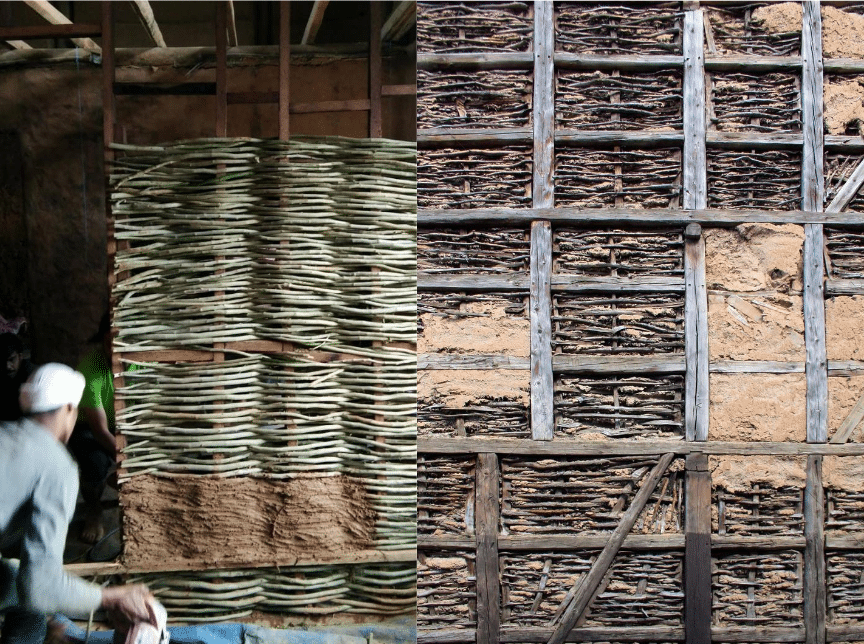
Wattle and Daub System
A woven lattice of branches coated with clay, sand and straw. The flexible structure provides the form and the clay provides rigidity and mass .
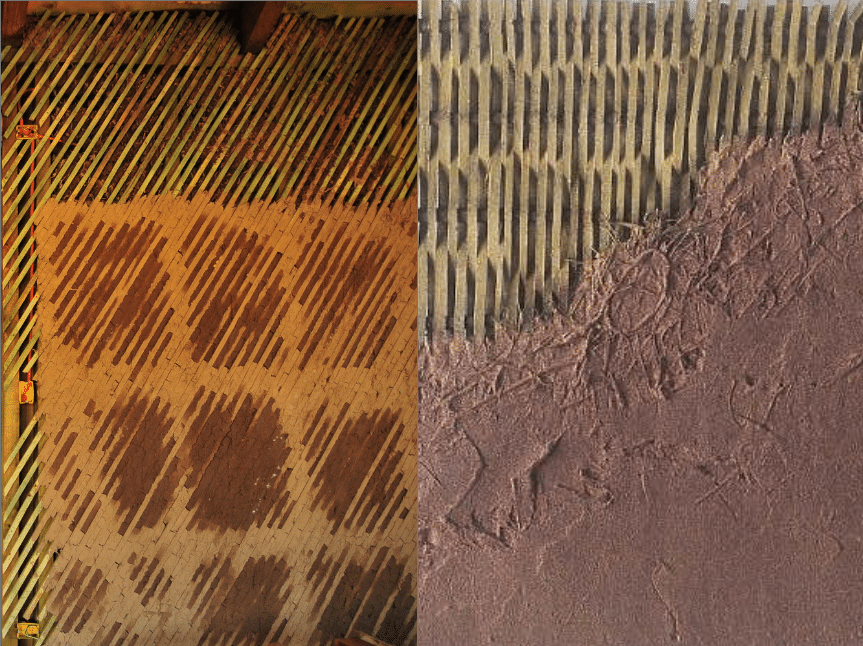
Quincha
Vertical cane stakes define a structural grid, packed and plastered with clay. The geometry of the cane determines where and how the clay is applied in this case the pattern controls deposition.
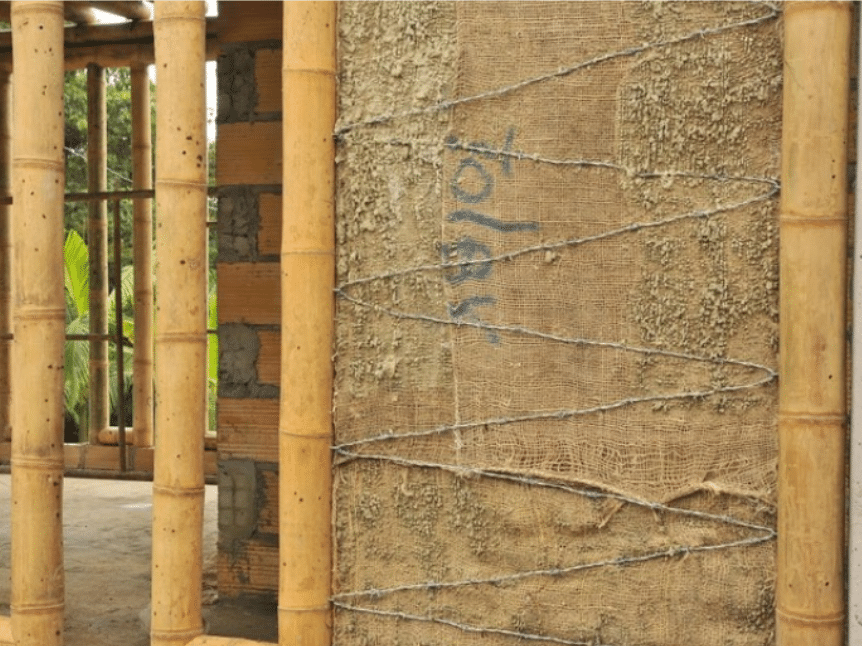
Tendinoso Wall
A lightweight framework of tensioned fibers and vegetal elements coated with earthen mixtures. The underlying network controls geometry and load transfer, the clay provides enclosure and stiffness.
Function: Structural Wall System
Material: Raw Clay + Woven Branches + Straw
Technique: Manual Daubing over woven lattice
Relevance: Clay rigidifies flexible structure
Function: Load-bearing wall system
Material: Raw Clay + cane or bamboo
Technique: Manual plastering over structural cane grid
Relevance: Flexible structure geometry governs clay deposition
Function: Enclosure and load distribution system
Material: Raw Clay + tensioned vegetal fiber (jute)
Technique: Clay coating over tensioned fiber network
Relevance: Tension-compression composite logic
Spraying and Coating : State of the art
Contemporary examples of clay and robotic fabrication were then examined. Terrapalha demonstrates that clay naturally adheres to textile surfaces, though the application remains manual. ClayKnit introduces robotic clay spraying onto knitted meshes, while ETH’s KnitCrete applies robotic concrete spraying over textile formwork. Together, these projects establish the potential of combining textiles and robotic deposition, yet none explore selective clay accumulation or programmable thickness gradients. This is the gap the research addresses.
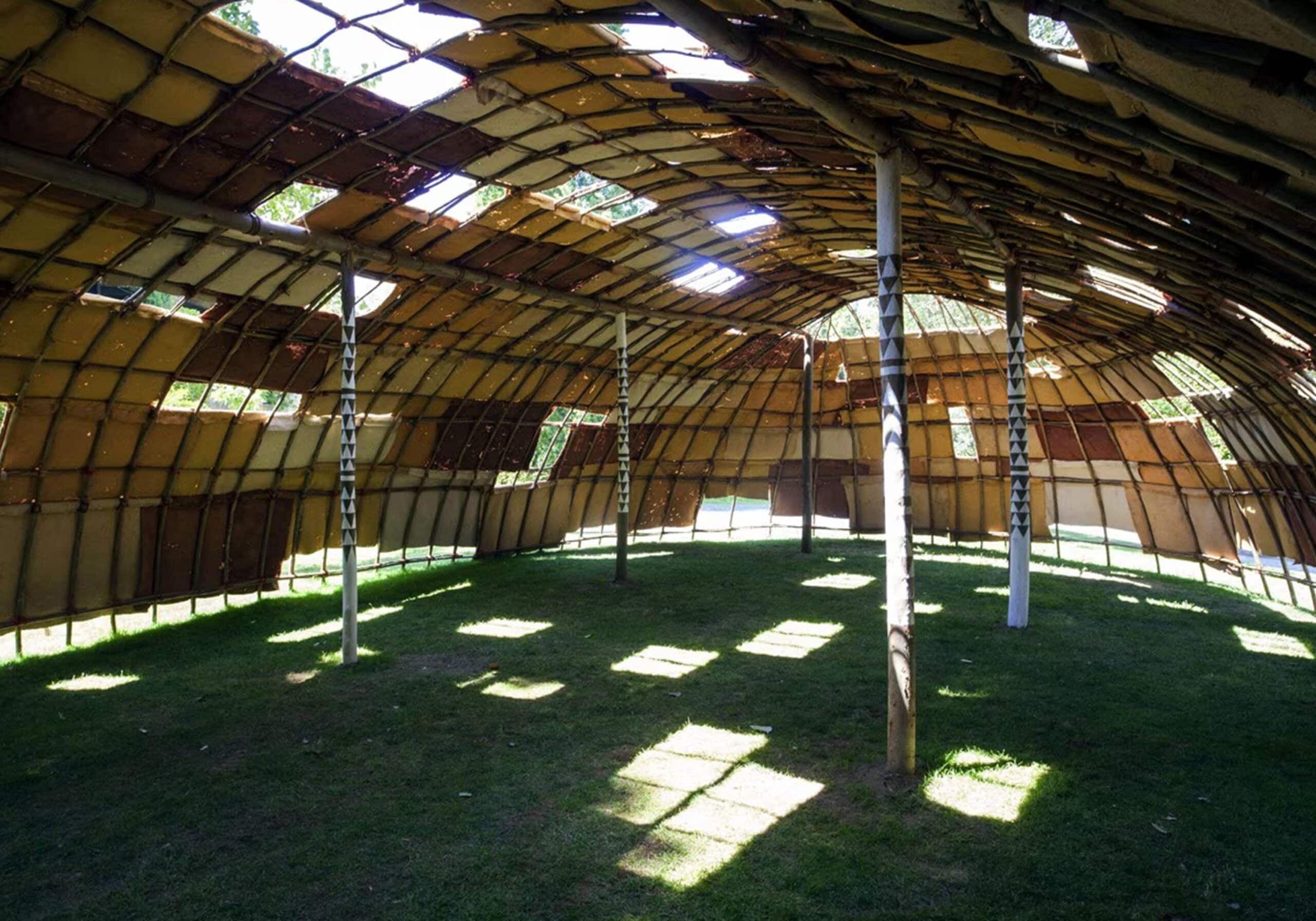
Terrapalha — A Cabana (2013)
A summer pavilion built with eucalyptus poles, jute fabric and raw clay. Panels were prefabricated in the studio, jute plastered by hand with clay mixtures and assembled on site. The result demonstrates that raw clay adheres naturally to textile and produces a thermally massive, spatially inhabitable surface
ClayKnit – Gosch et al. (2021)
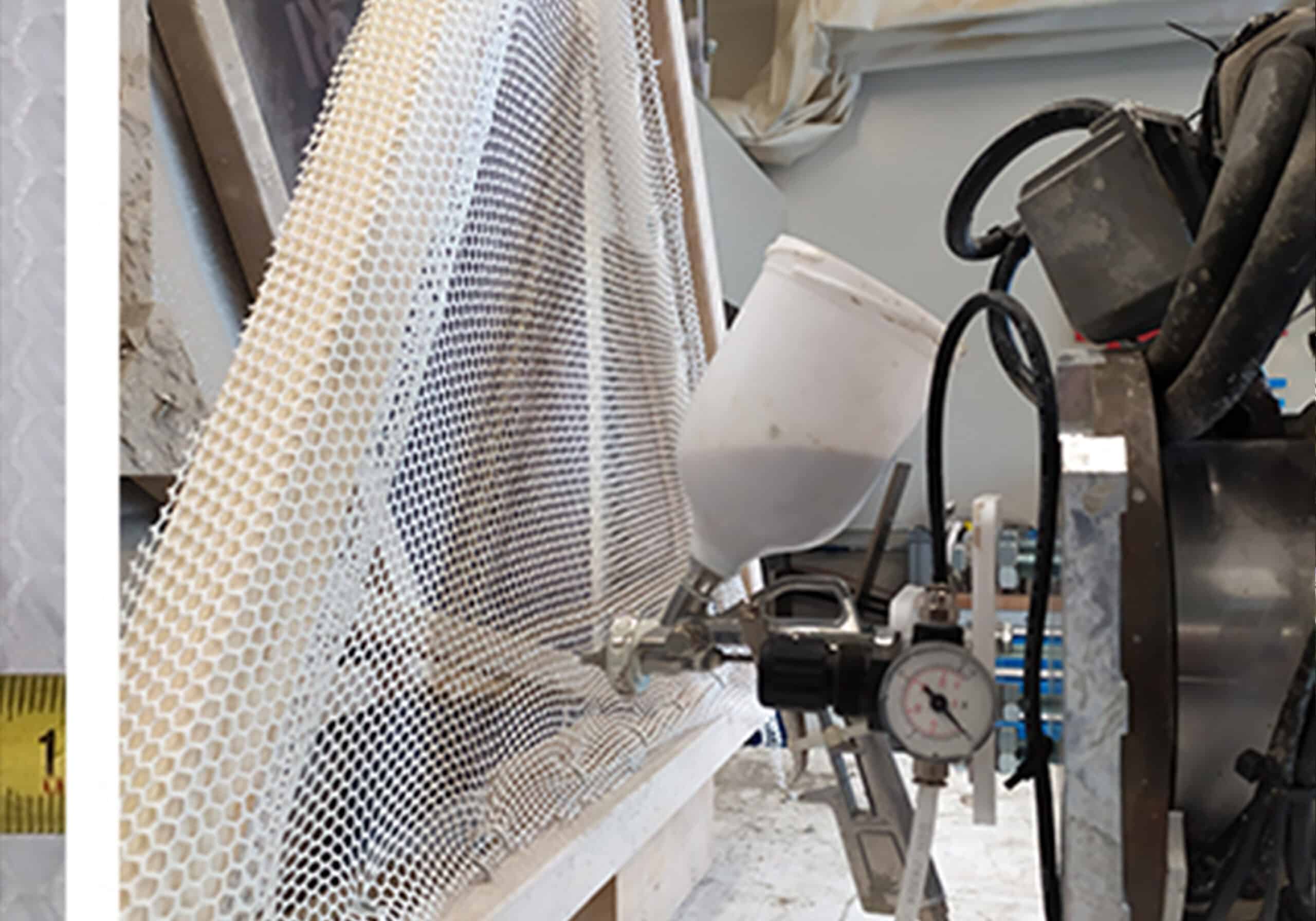
This research proposes spraying liquid clay with a six-axis robotic arm onto knitted meshes to produce lightweight, double-curved ceramic elements. The mesh acts simultaneously as stay-in-place form-work and permanent structural reinforcement, taking advantage of the complementary relationship between clay—which absorbs compression—and fibers—which absorb tension.
Robotic Knitcrete – ETH Zurich (2023)
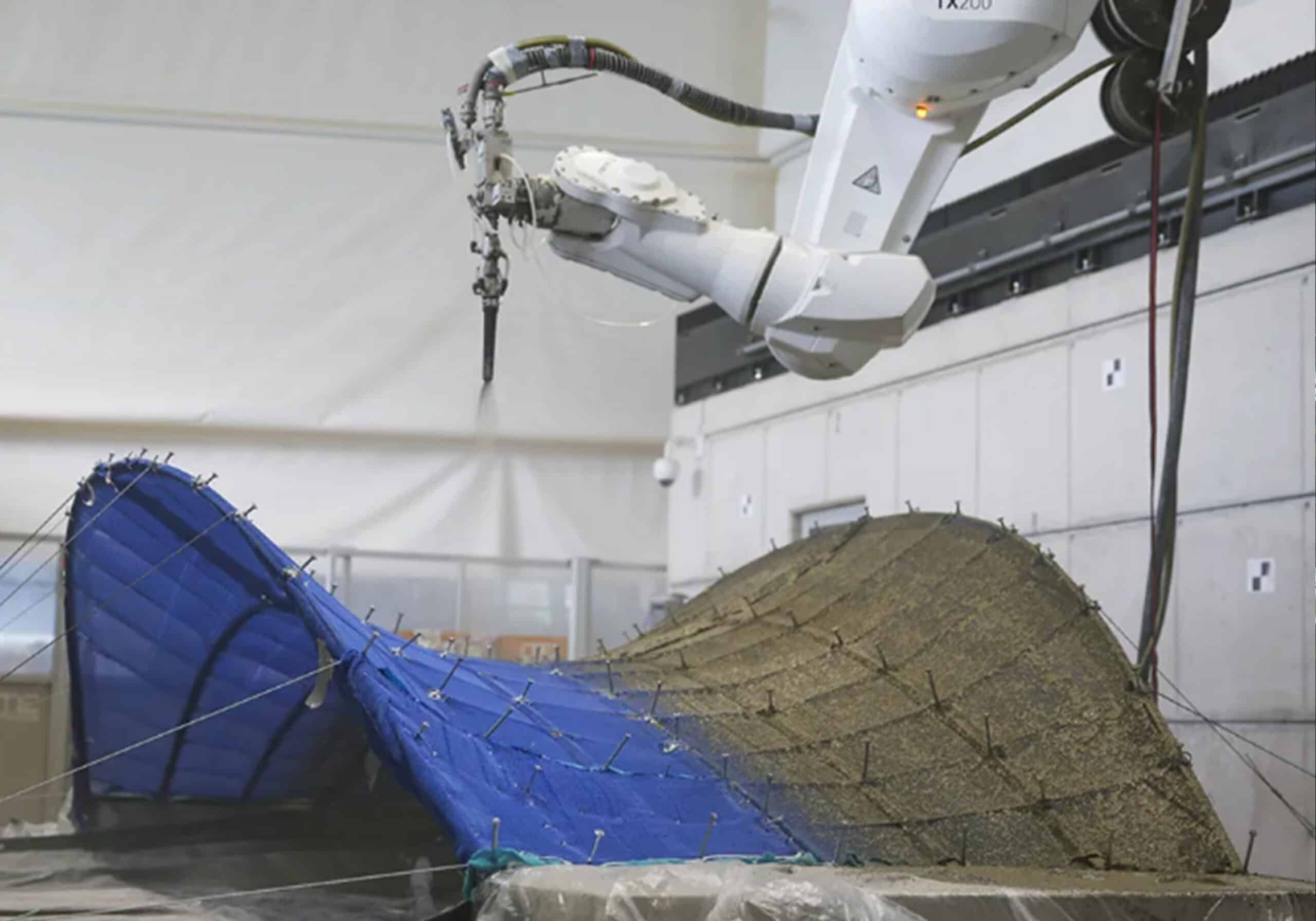
CNC-knitted textile formwork with robotic concrete spraying. The knitted mesh acts as both structural support and stay-in-place formwork for thin-shell geometries. Demonstrates that textile geometry can govern structural form at architectural scale through robotic fabrication.
Robotic Function: None
Material: Raw Clay + Jute Textile
Technique: Hand Plastering + Prefabricated Panel Assembly
Gap: No Robotic Control – Deposition is non-uniform and unrepeatable
Robotic Function: Robotic Clay-Spraying
Material: Liquid Clay + Knitted Synthetic Mesh
Technique: Uniform Spray Deposition Over pre-formed mesh
Gap: No Selective Deposition – Uniform Thickness – No Gradient Control
Robotic Function: Robotic Concrete-Spraying
Material: Concrete + CNC Knitted Textile Formwork
Technique: Progressive Spray Deposition Over Knitted Geometry
Gap: Uniform Thickness – No Gradient Control
Clay-Sprayed Textiles as Structural Composites : Geometric Control Through Robotic Deposition
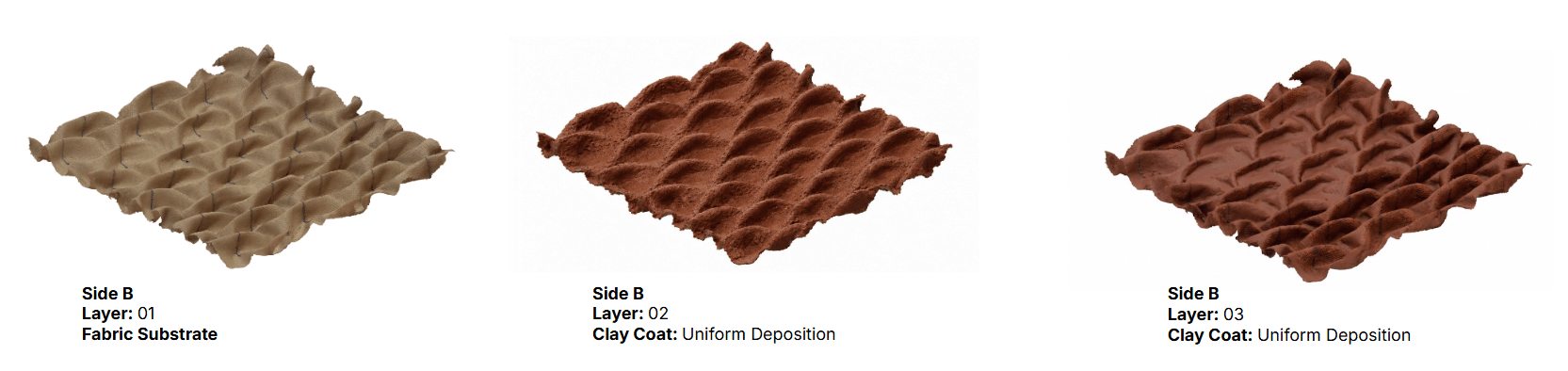
The proposal is a clay-sprayed textile composite. A stitched textile transforms from a flat surface into a three-dimensional geometry of pockets, which become zones of material accumulation. A robotic spraying system then controls how much clay is deposited in each area, creating denser regions where structural performance is needed and lighter regions where porosity is preferred. The result is a lightweight architectural surface whose behavior emerges from the interaction between textile geometry, clay accumulation, and robotic control.
A flat textile is transformed through stitching into a three-dimensional geometry capable of receiving and organizing material. Robotic clay deposition selectively fills each pocket, generating a composite surface whose thickness, stiffness, and porosity are programmed according to performance requirements.

Controlled Deposition as Architectural System
The system is built on three key principles. First, clay transforms a flexible textile into a semi-rigid composite by combining compression and tension behaviors. Second, geometry controls matter: stitching determines where clay naturally accumulates. Third, robotic deposition allows material quantity to be precisely controlled, creating programmable gradients and localised performance across the surface.
From Flexible to Rigid Composite
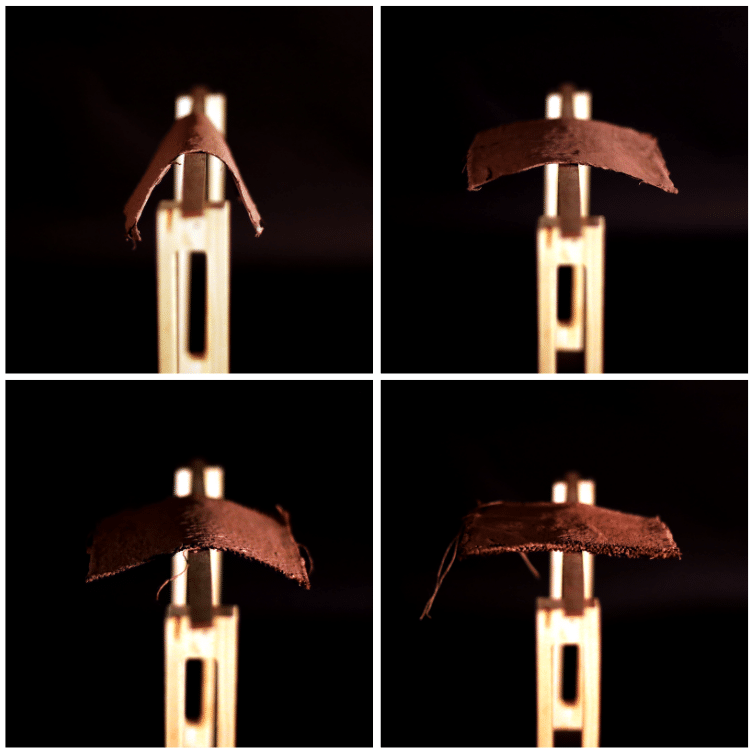
As clay dries, it consolidates the textile geometry and transforms the fabric into a semi-rigid composite. Clay resists compression, while the textile absorbs tension, creating a lightweight structural system through deposition alone
Geometry-Controls-Matter
Textile geometry determines where material accumulates. By controlling pocket size and density, stitching patterns generate programmable variations in thickness, rigidity, and structural behavior
Controlled Robotic Deposition
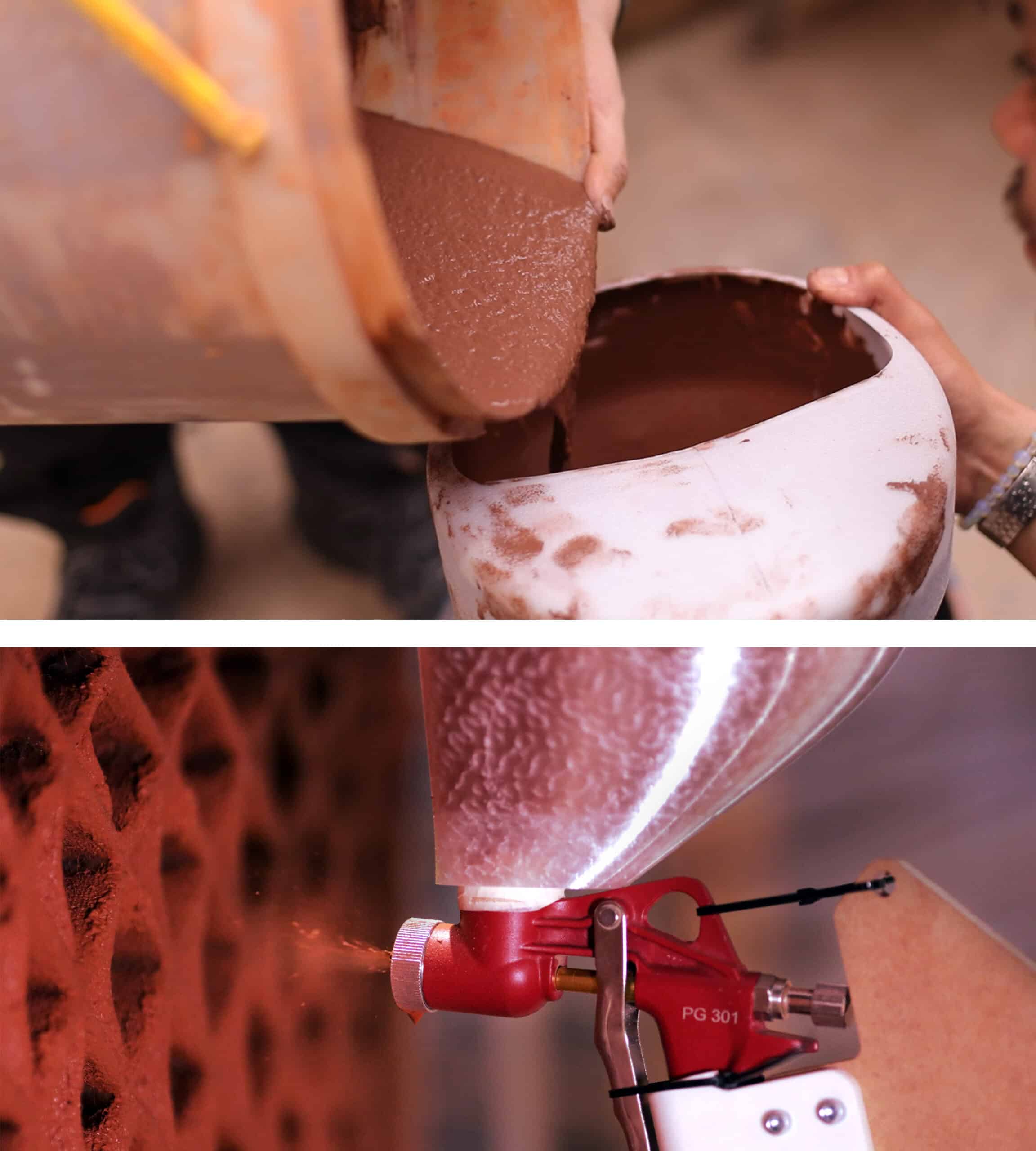
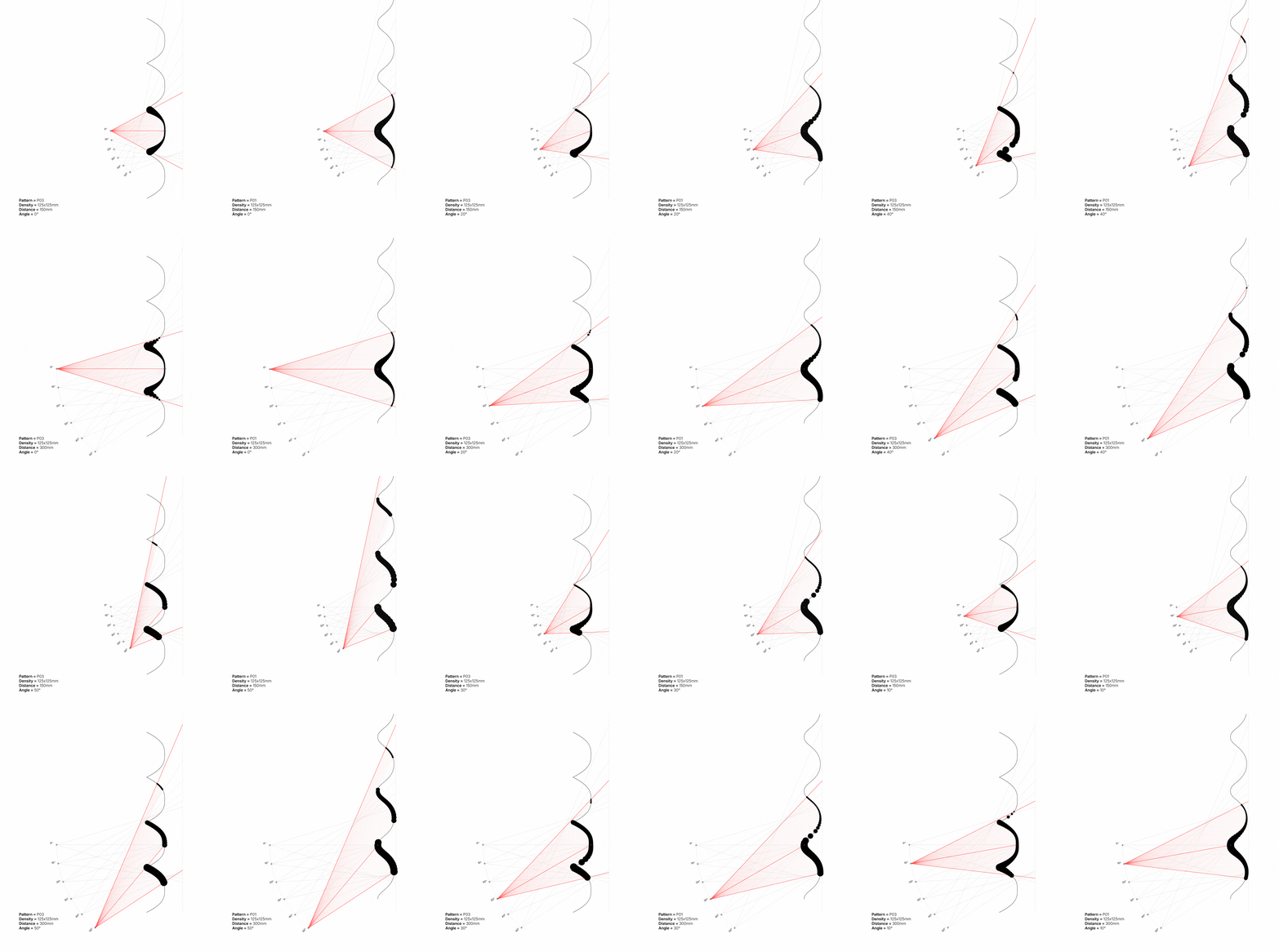
Independent control of spray angle, distance, speed, time of spraying and layering allows the system to generate programmable thickness gradients and localized material performance
From Manual Exploration to Robotic Control : Research Process
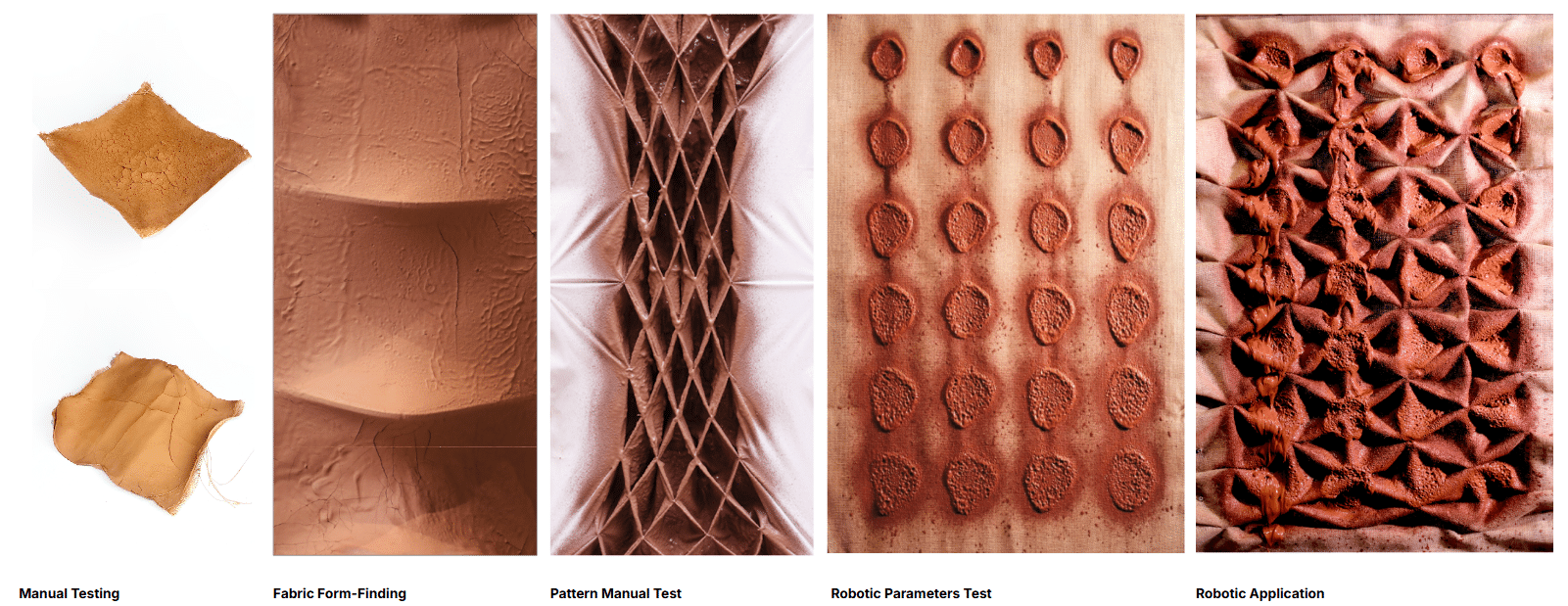
The research began through hands-on experimentation. Different clay consistencies, application methods, fabrics, and stitching patterns were tested, and these manual explorations revealed that three-dimensional textile geometries naturally create accumulation pockets.
Once this relationship was understood, it was translated into a robotic workflow. Spray parameters were calibrated and clay deposition was applied directly onto stitched fabrics, establishing the foundation for a controlled and repeatable fabrication process.
Textile Geometry : Pocket Geometry and Clay Accumulation
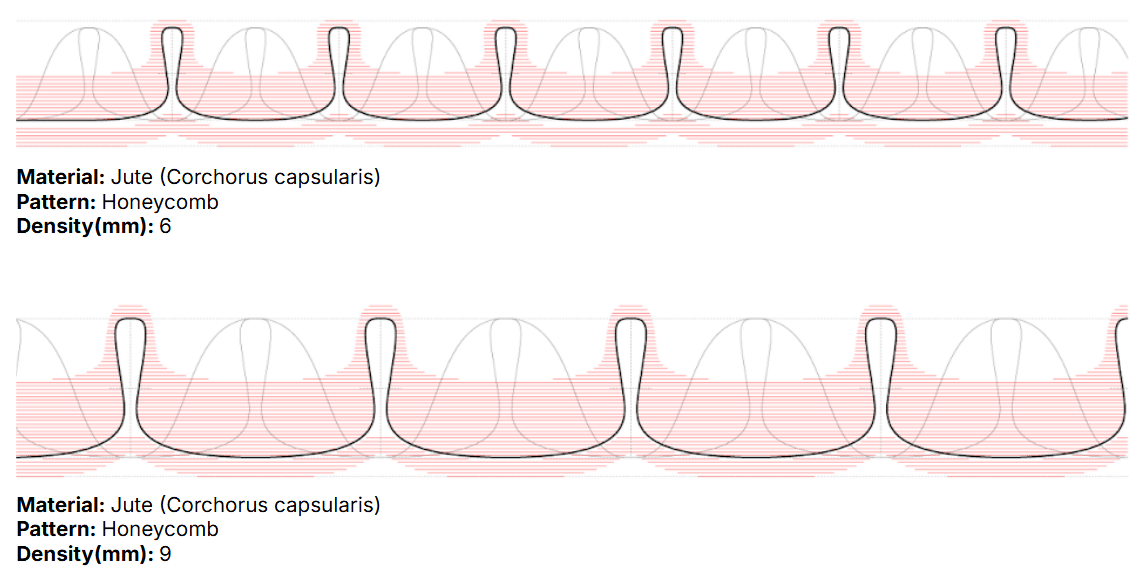
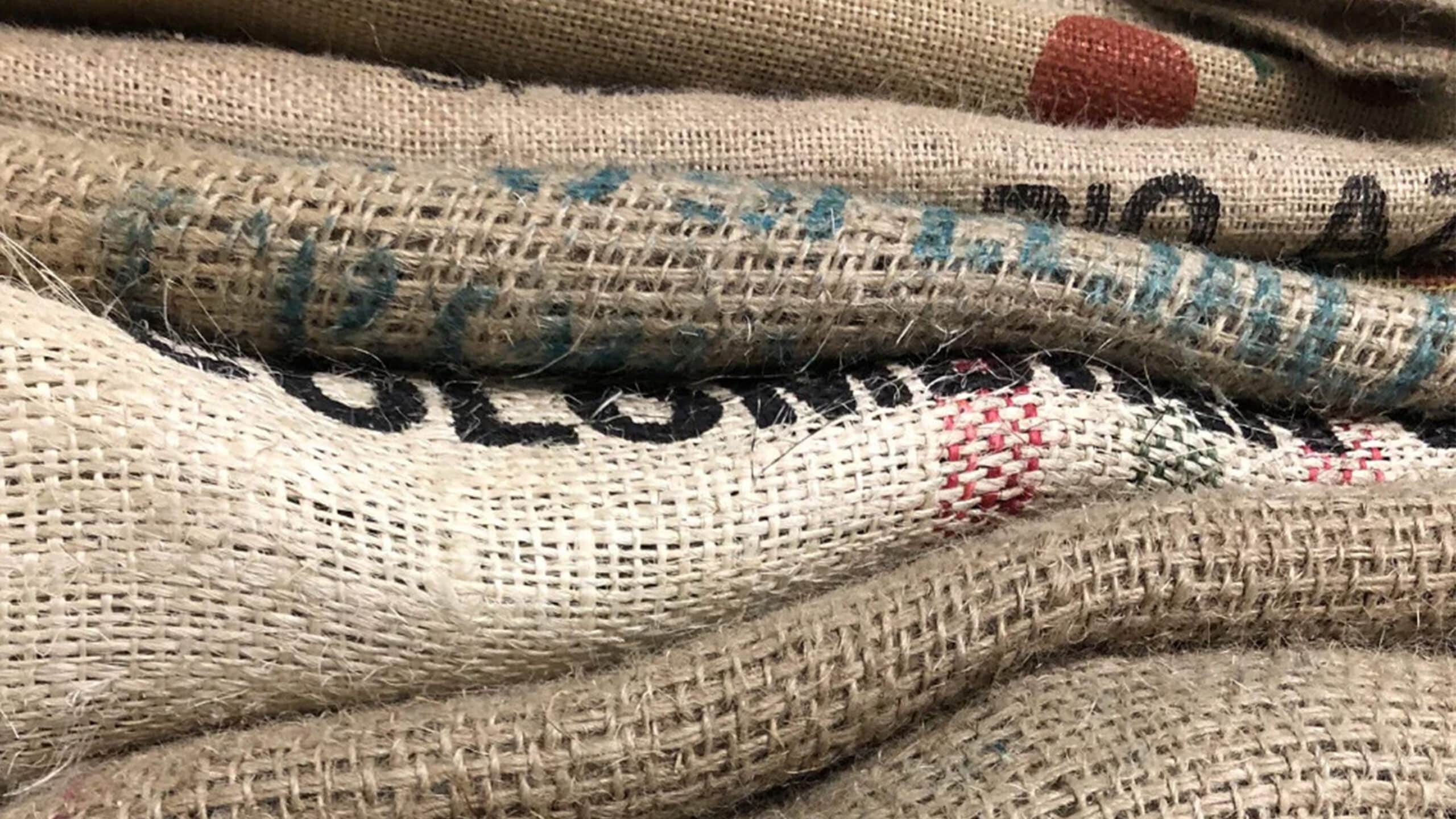
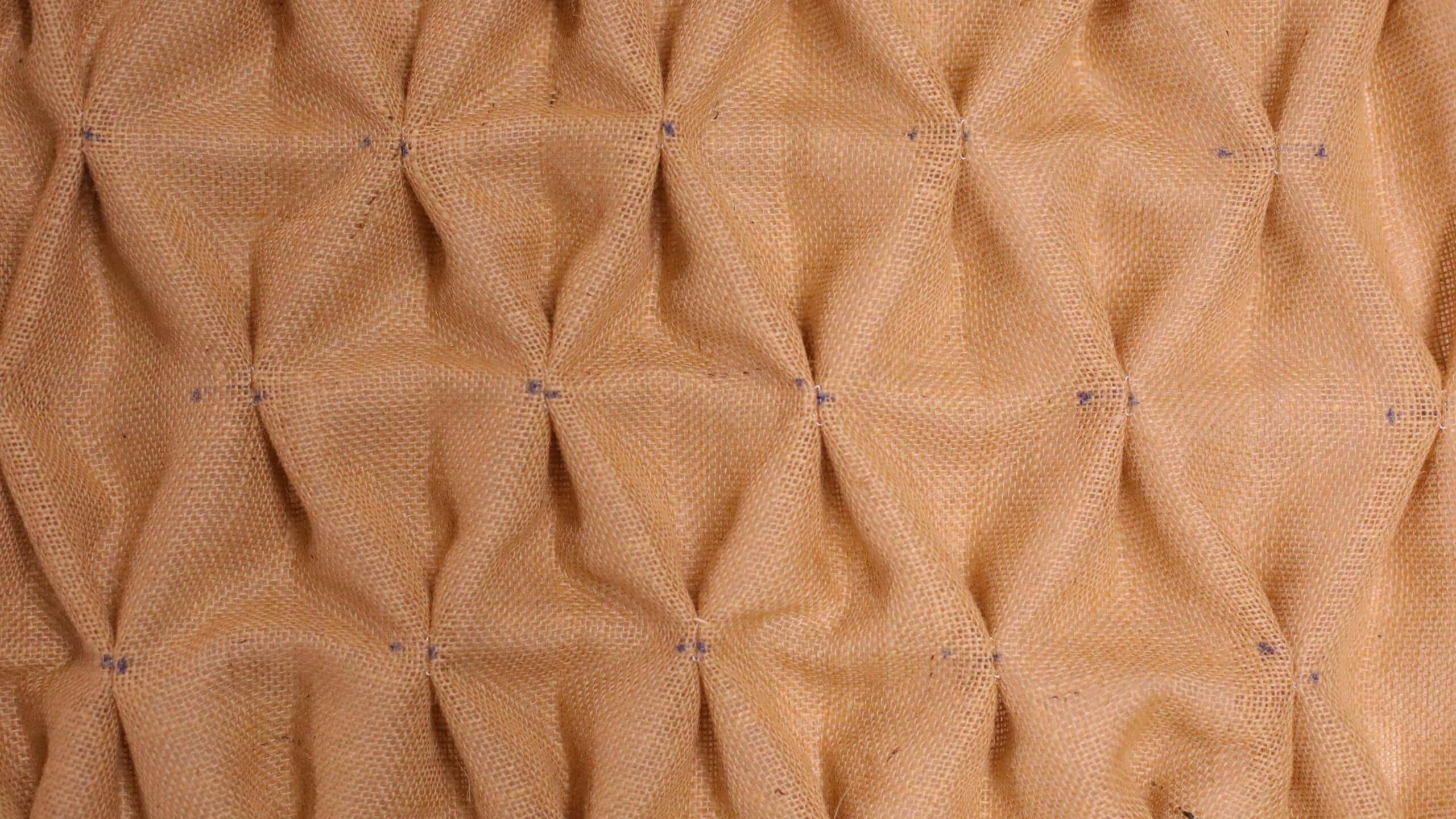
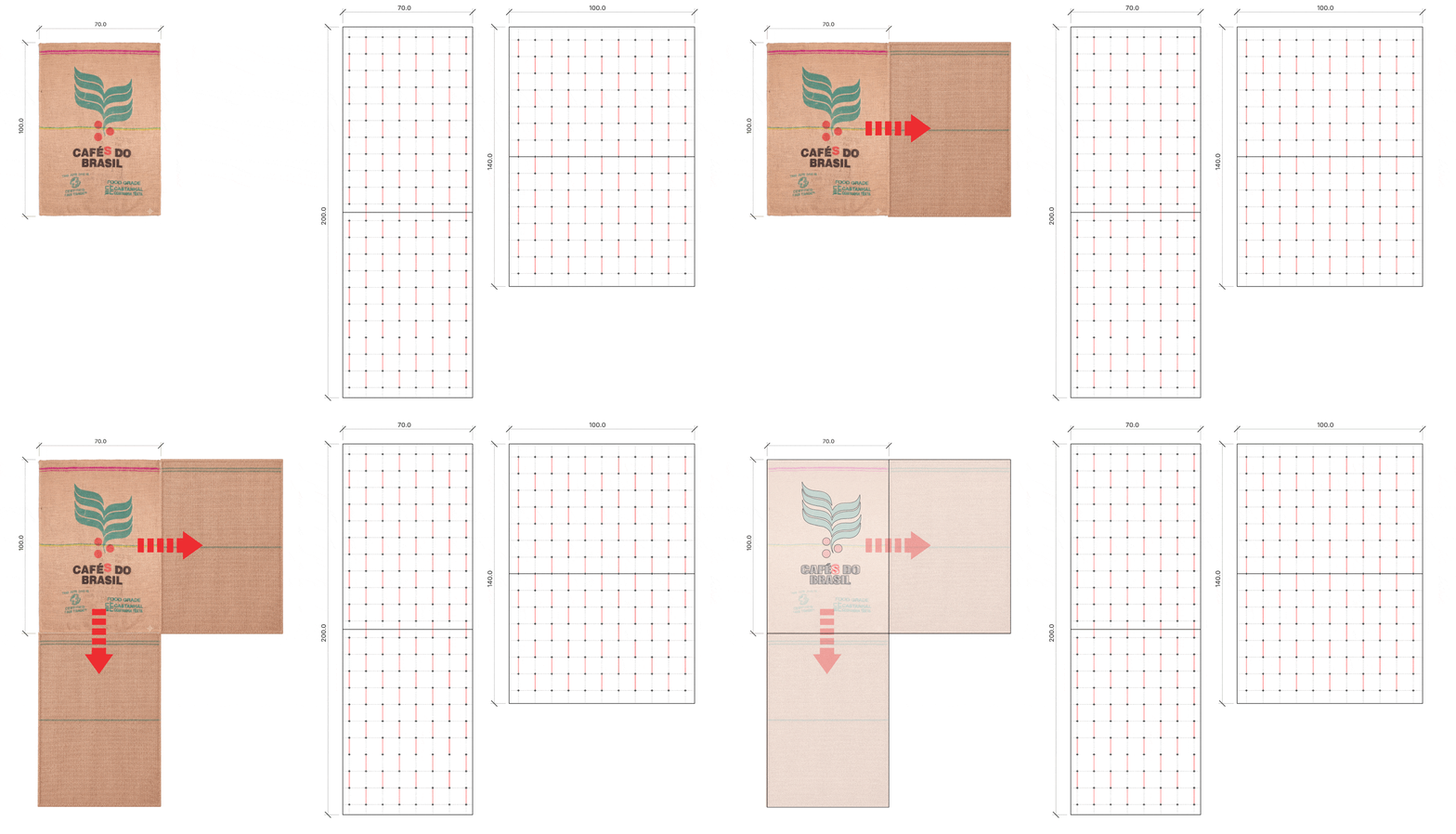
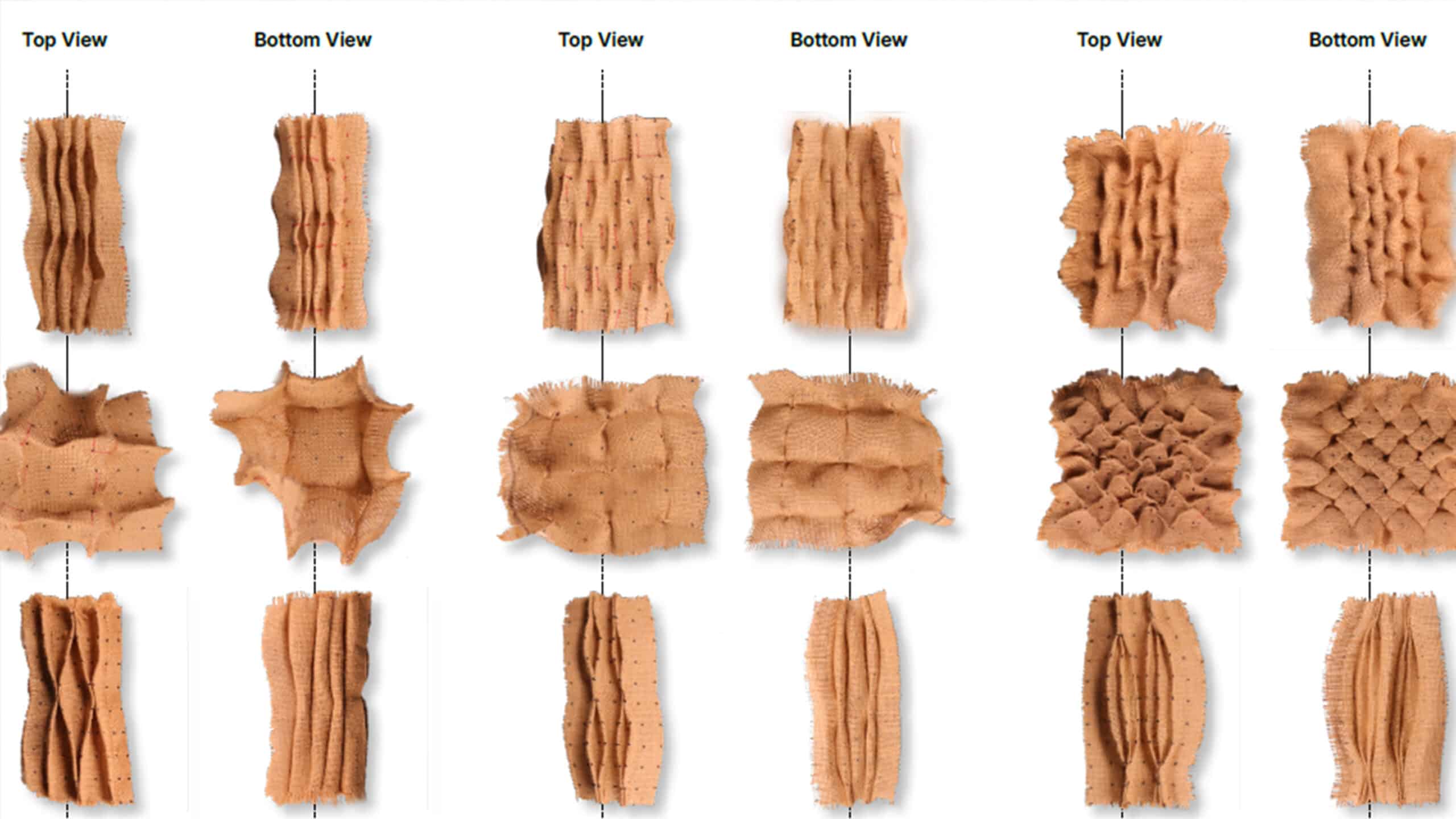
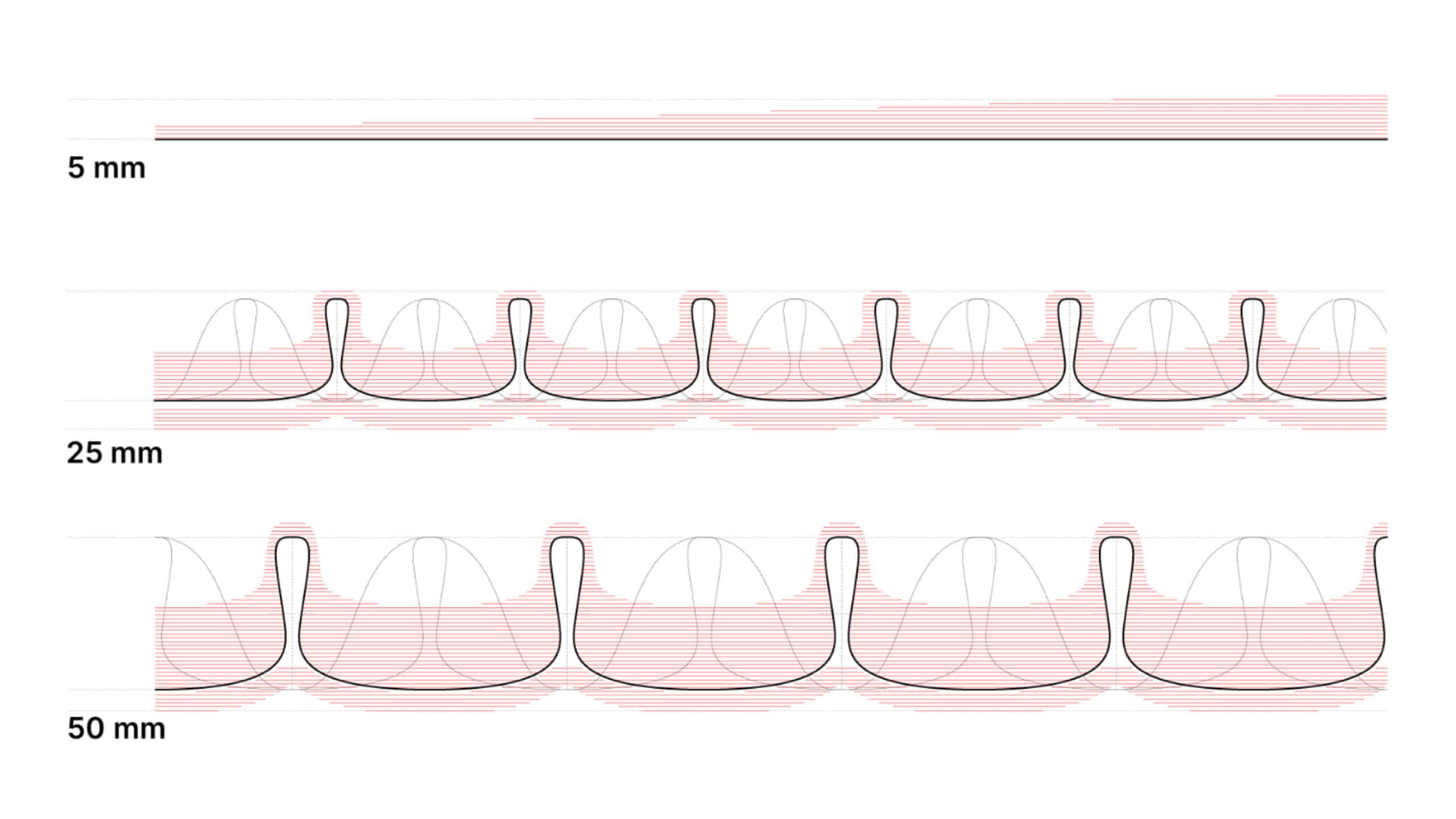
Once the fabrication logic was established, the textile itself was put to the test. Recycled coffee sacks collected from local cafés in Barcelona were used as the base material, reinforcing the project’s circular and low-carbon approach. Through multiple stitching studies, it was discovered that density directly controls pocket volume and clay accumulation, making stitch density not simply a textile parameter but a structural design variable.
Circular Material Logic
The textile substrate is sourced from discarded coffee sacks collected from local cafés in Barcelona. Their standardized dimensions define the module geometry of the system, transforming a waste stream into a design parameter. Local, circular, and low-cost.
Stitching as Geometry
Hand-stitching transforms the flat jute surface into a three-dimensional geometry of pockets. Each stitch point pulls the fabric inward, creating discrete volumetric cavities — the accumulation zones where clay will build selectively.
Density as Structural Variable
In the selected honeycomb pattern, stitch density directly governs pocket volume and clay accumulation depth. Density is not a textile parameter, it is a structural design decision.
Spray Parameters : Distance, time, pressure and deposition geometry
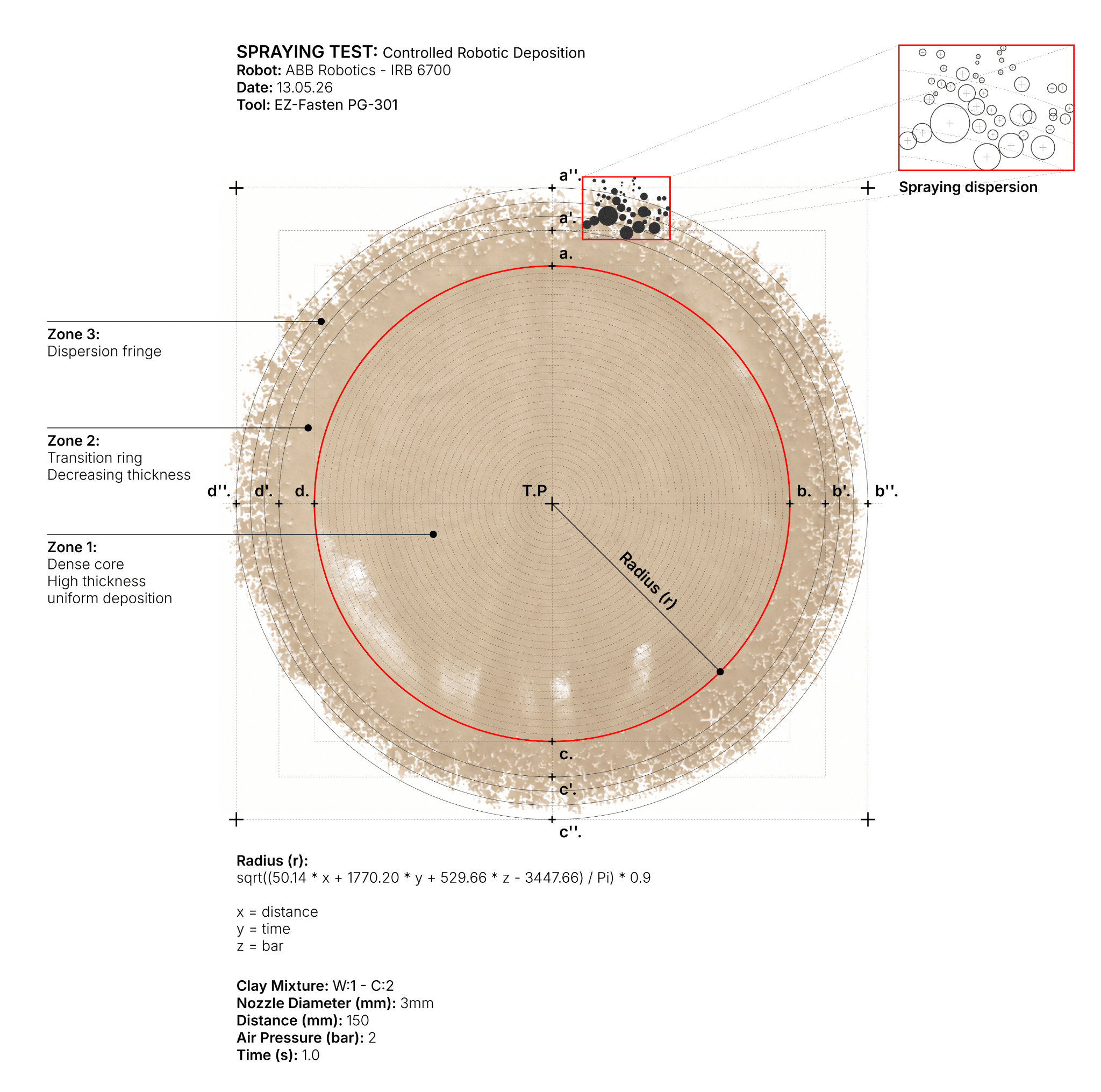
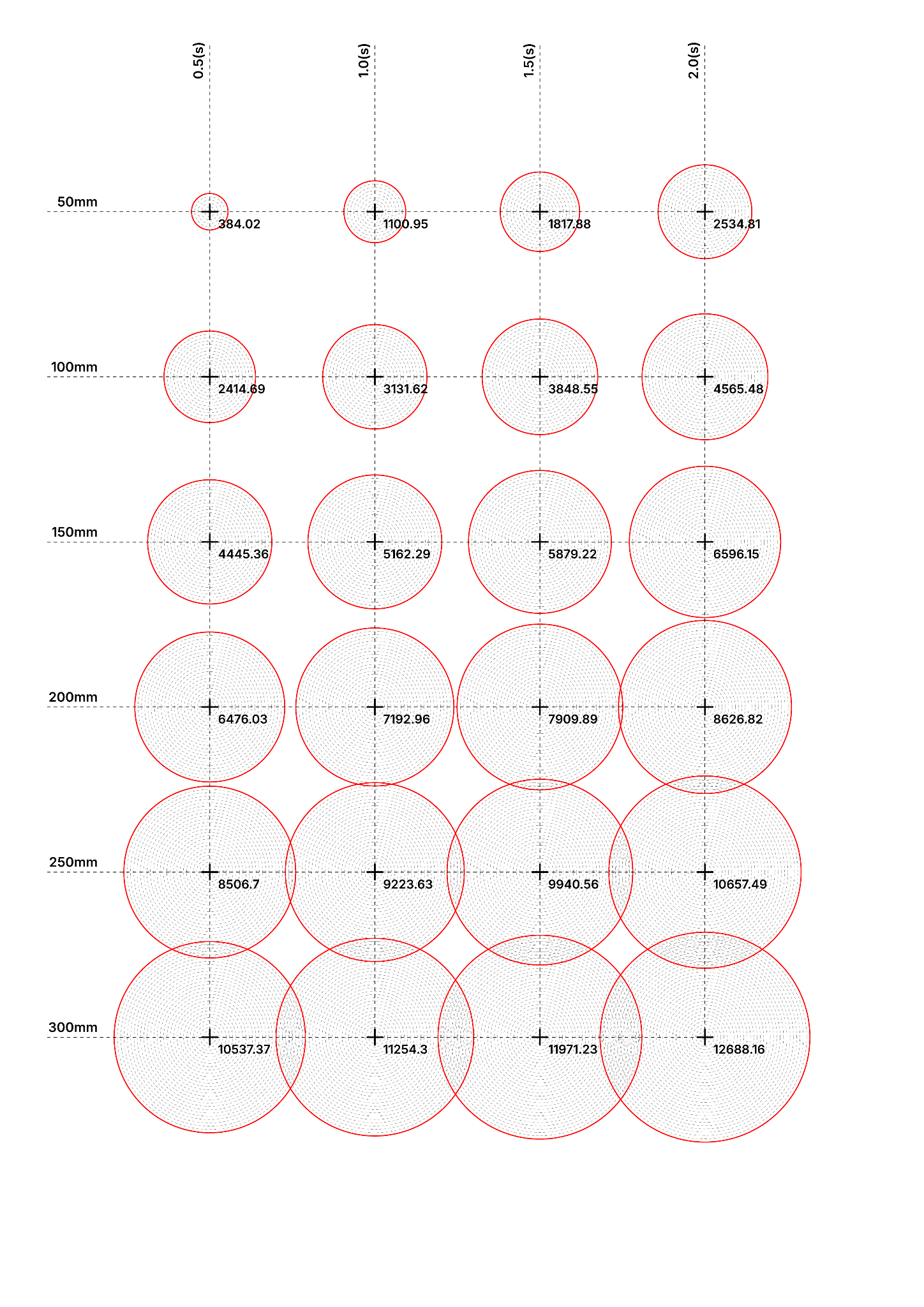
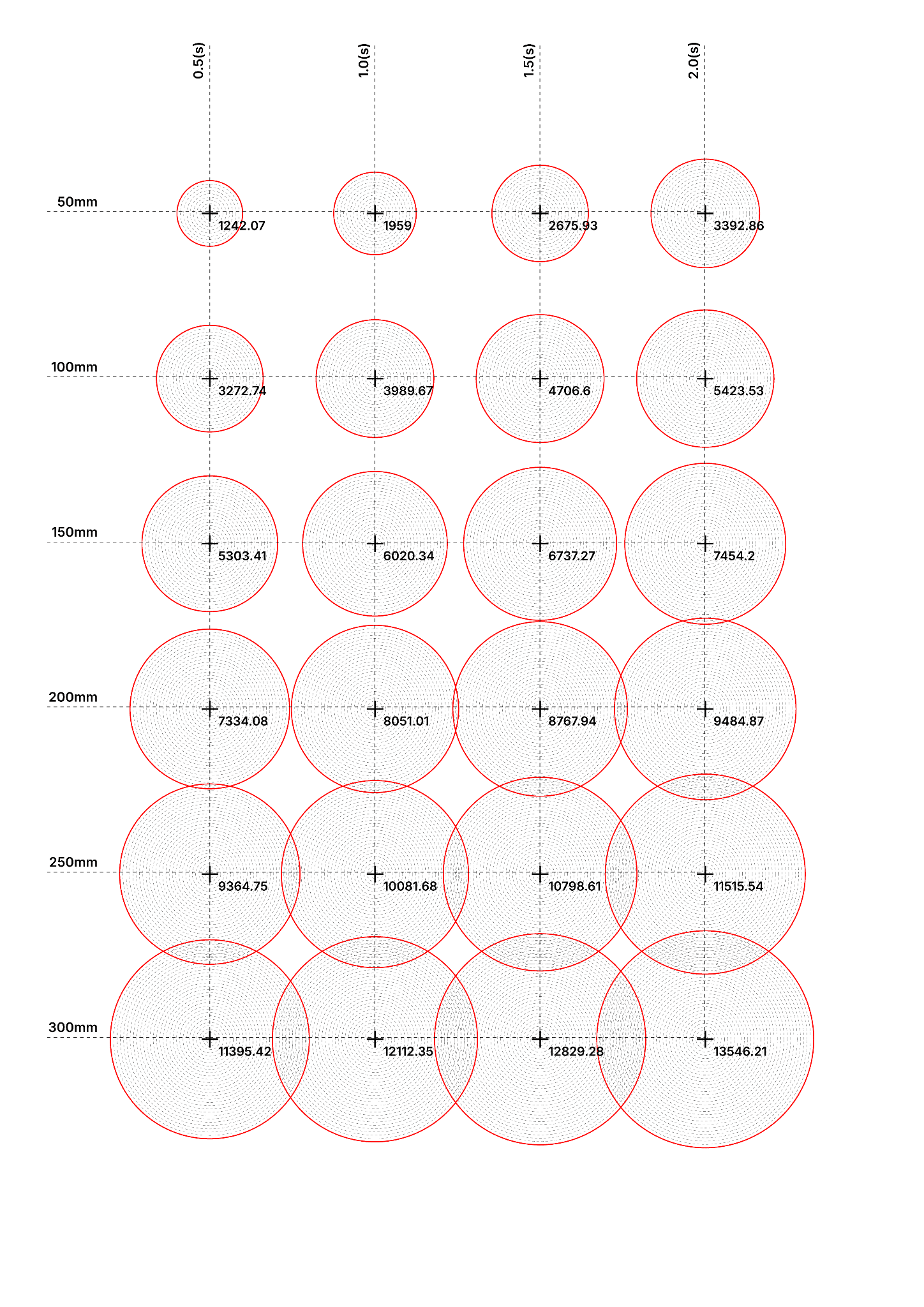
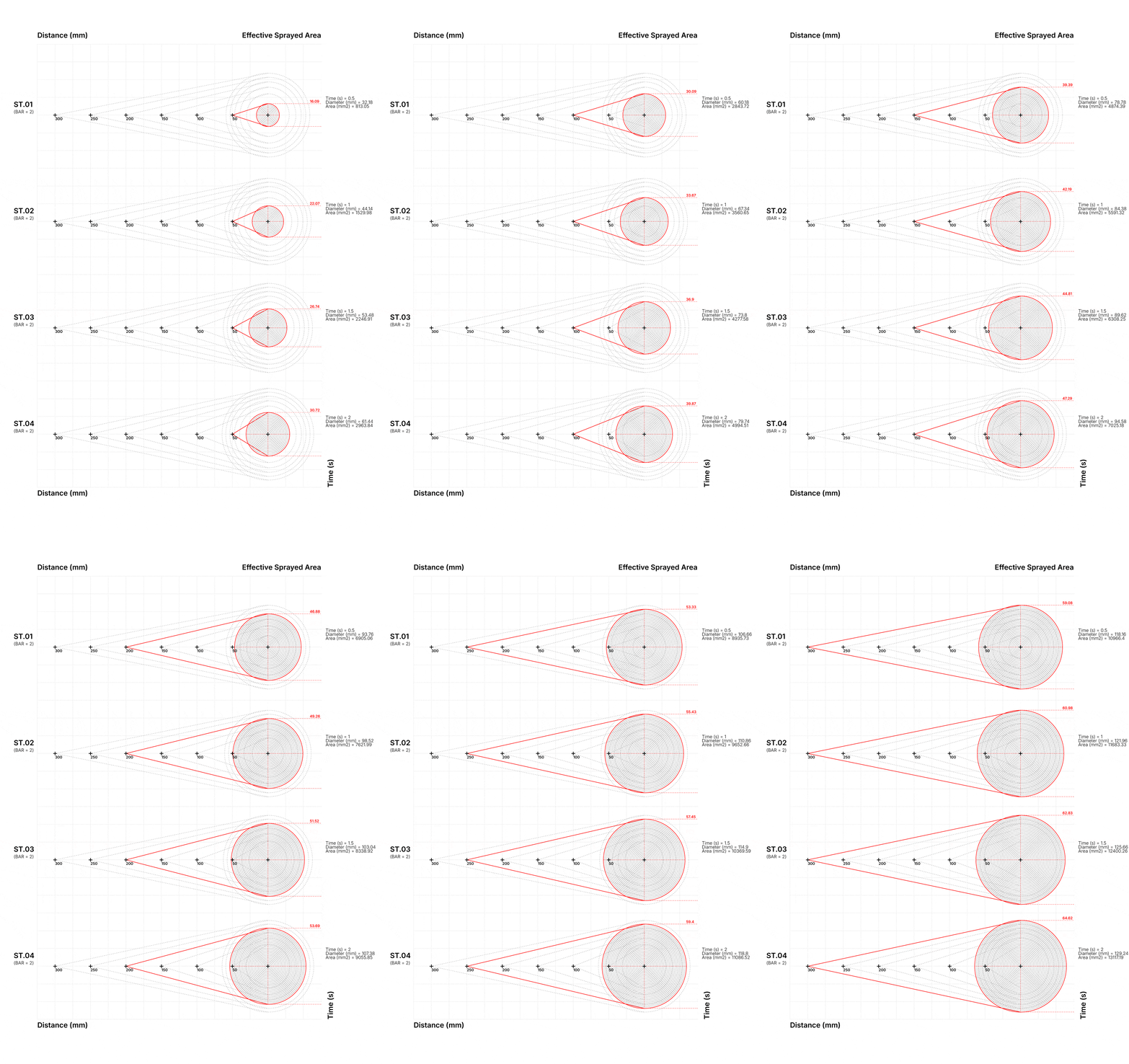
The second key parameter is spraying itself. Every spray event produces a measurable deposition field composed of a dense core, a transition zone, and a dispersion fringe. Through testing combinations of distance, pressure, and spraying time, a parameter matrix was established and an operational sweet spot identified, allowing deposition to become predictable, repeatable, and programmable rather than relying on intuition.
Deposition Geometry
Each spray event produces a measurable deposition field composed of a dense core, a transition zone, and a dispersion fringe. This behavior can be predicted and controlled through distance, pressure, and spraying time.
Parameter Matrix
Rather than relying on intuition, spraying behavior is mapped through a parameter matrix. By correlating distance, time, and pressure with deposition area, the system becomes measurable, predictable, and programmable.
The Operational Sweet Spot
Not all spray configurations perform equally. Testing revealed a specific parameter range where coverage, consistency, and material efficiency are optimised, forming the basis of the robotic deposition protocol.
Vision System
Detection : Computer vision translates shadows into robotic coordinates
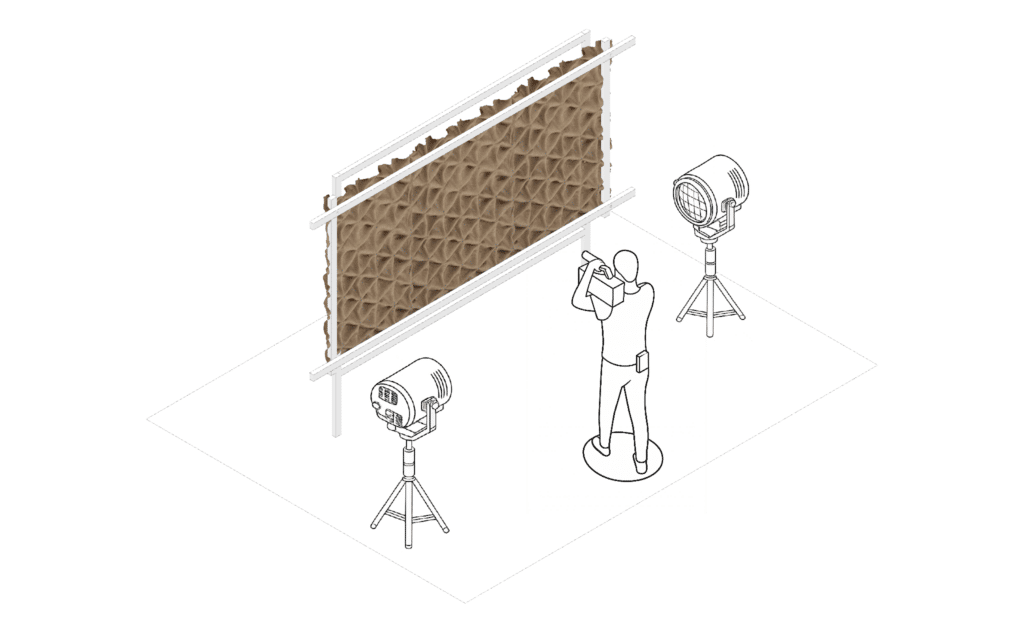
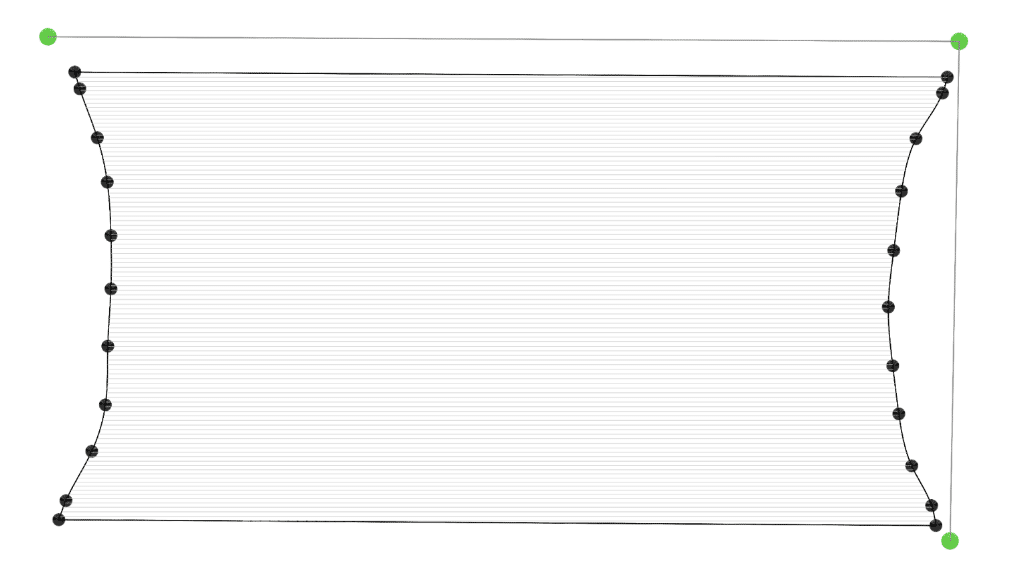
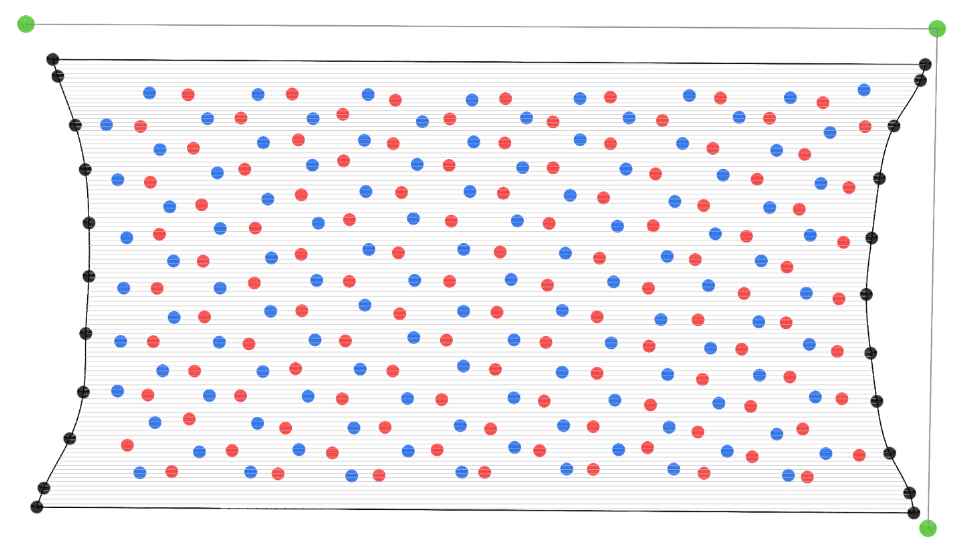
Once the textile geometry is defined, the next challenge is translating it into robotic coordinates. The fabric is mounted on a frame and identified through three calibration markers. Images captured under different lighting conditions allow OpenCV to detect the frame boundaries, identify pocket geometry, and analyse depth through shadow detection. This information is then converted into spatial coordinates and transferred to Grasshopper for robotic path generation.

Setup
Stitched textiles undergo surface deformation to create distinct pockets for material accumulation. This geometry should be translated into precise coordinates for robotic execution.
Vision-Guided Robotics
Utilizing a dual-angle lighting system to accurately detect fabric depth, boundaries, and pocket locations by enhancing surface features through shadow formation. The captured shadow patterns are analyzed to precisely identify garment contours and critical regions, enabling accurate and consistent spray application.
Coordinate Mapping
Three pre-calibrated green points map the spatial coordinates, providing the data needed for robotic path generation.
Evaluation : Vision analysis tracks deformation and verifies clay coverage
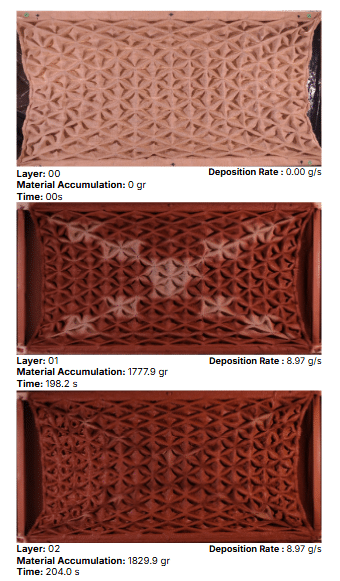
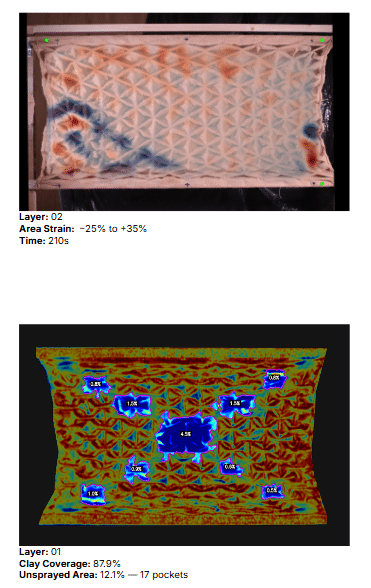
Detection is only half of the process. After each deposition layer, the surface is photographed again and analyzed through the same computer vision workflow. By comparing the geometry before and after spraying, deformation can be measured, material accumulation evaluated, and heat maps of the resulting surface generated. In this way, precision is not assumed; it is continuously verified through feedback.
Layered Capture
The deformed textile is photographed after each spray pass, logging material accumulation, rate, and time per layer.
Deformation & Coverage Analysis
Successive image layers are compared to measure clay deformation and material deposition after each spray cycle. The resulting heat map distinguishes sprayed regions from bare textile, enabling accurate monitoring of coating coverage and uniformity.
Coverage Map & Feedback
The heat map combines coverage and deformation data to guide the next spray pass, depositing clay only where needed to achieve the target geometry.
Thickness and Gradient Control : Geometry-driven tool-path generation for differentiated clay deposition
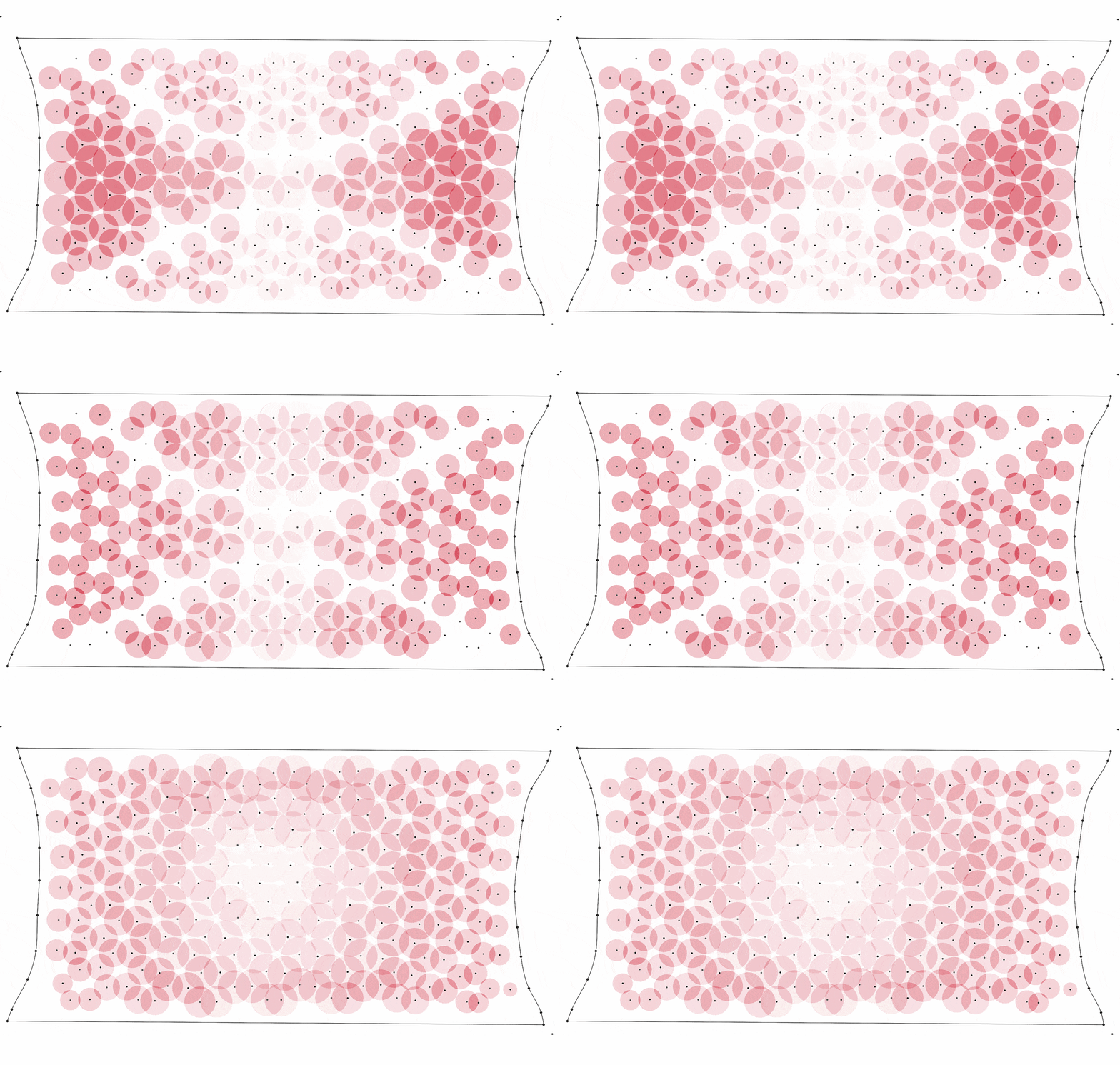
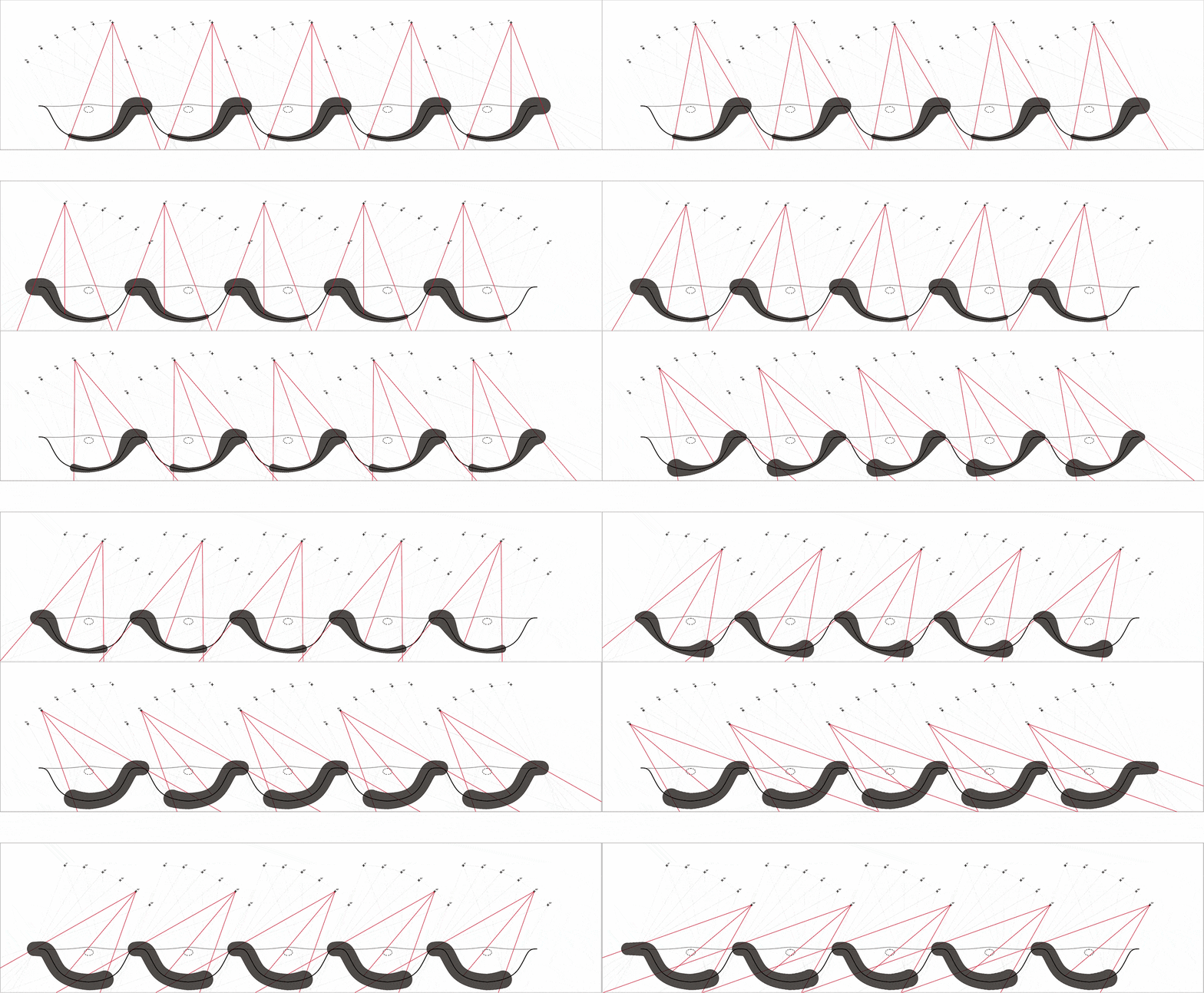
With the geometry detected and verified, material distribution across the surface can be programmed. The vision system determines the location and orientation of each pocket, allowing Grasshopper to generate differentiated tool-paths. Areas requiring greater mass receive more deposition, while areas requiring porosity remain lighter. The result is a controlled gradient system where structure, porosity, and performance are embedded directly into the spraying process.
Geometry-Driven Toolpaths
Vision-based geometry detection enables Grasshopper to generate differentiated toolpaths. Material deposition is adjusted according to local structural requirements, creating controlled thickness and porosity gradients across the surface.
Controlled Gradient Deposition
The generated toolpaths are translated directly into robotic spraying. By varying deposition locally, the process embeds structural performance, material efficiency, and porosity into the fabricated component.
Thermal and Acoustic Performance : Future Possible Projections
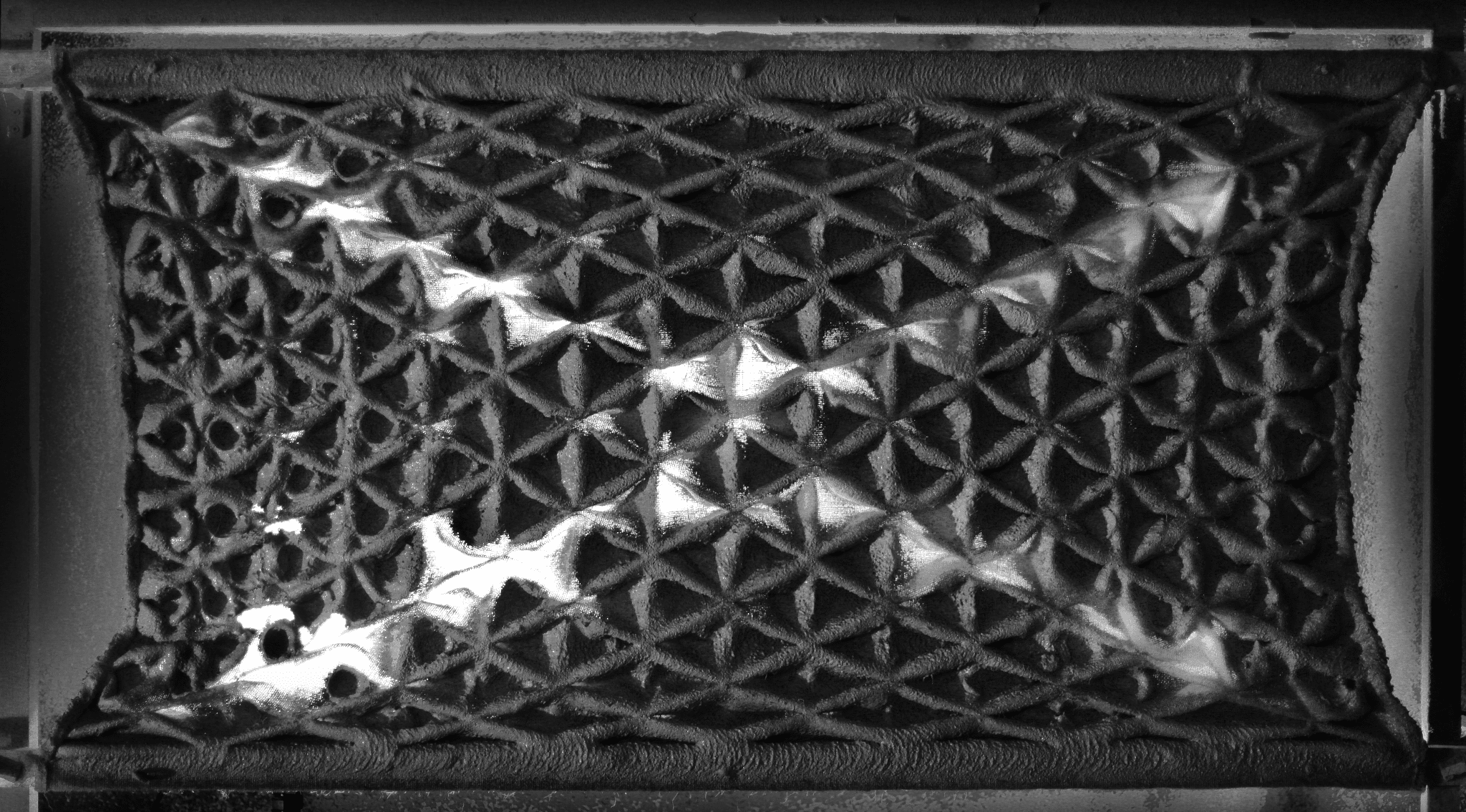
The system also opens opportunities for environmental performance. By controlling pocket geometry, deposition density, and porosity, differentiated thermal and acoustic behaviours can be created across the same surface. Unfired clay offers thermal mass, hygroscopic behavior, and passive humidity regulation, while the combination of clay mass and porous jute fibers produces a composite capable of absorbing sound and reducing reverberation, suggesting a promising direction for future performance driven applications.
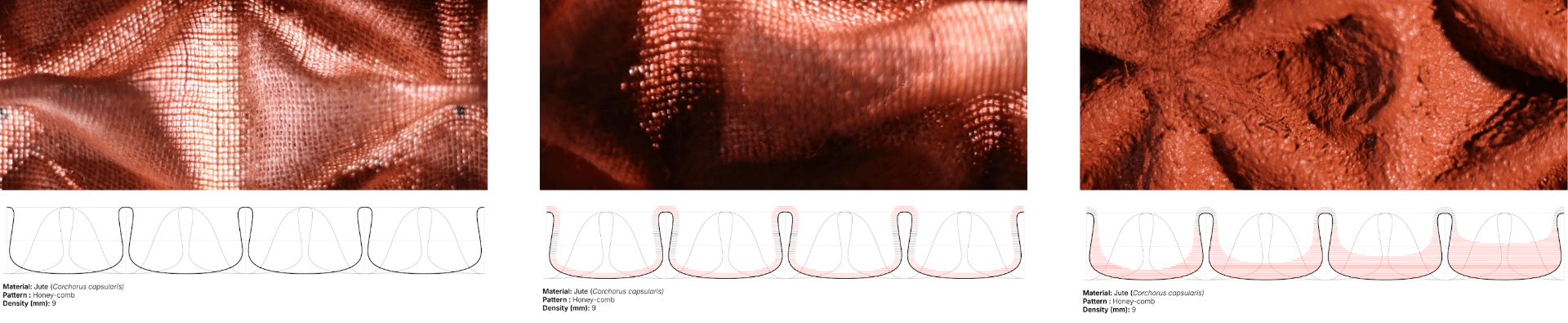
Clay naturally accumulates within the stitched textile pockets, creating localized zones of increased thickness and mass. These areas enhance structural stiffness while contributing to the thermal and acoustic performance of the panel.
Structural Performance : Catenary Principle
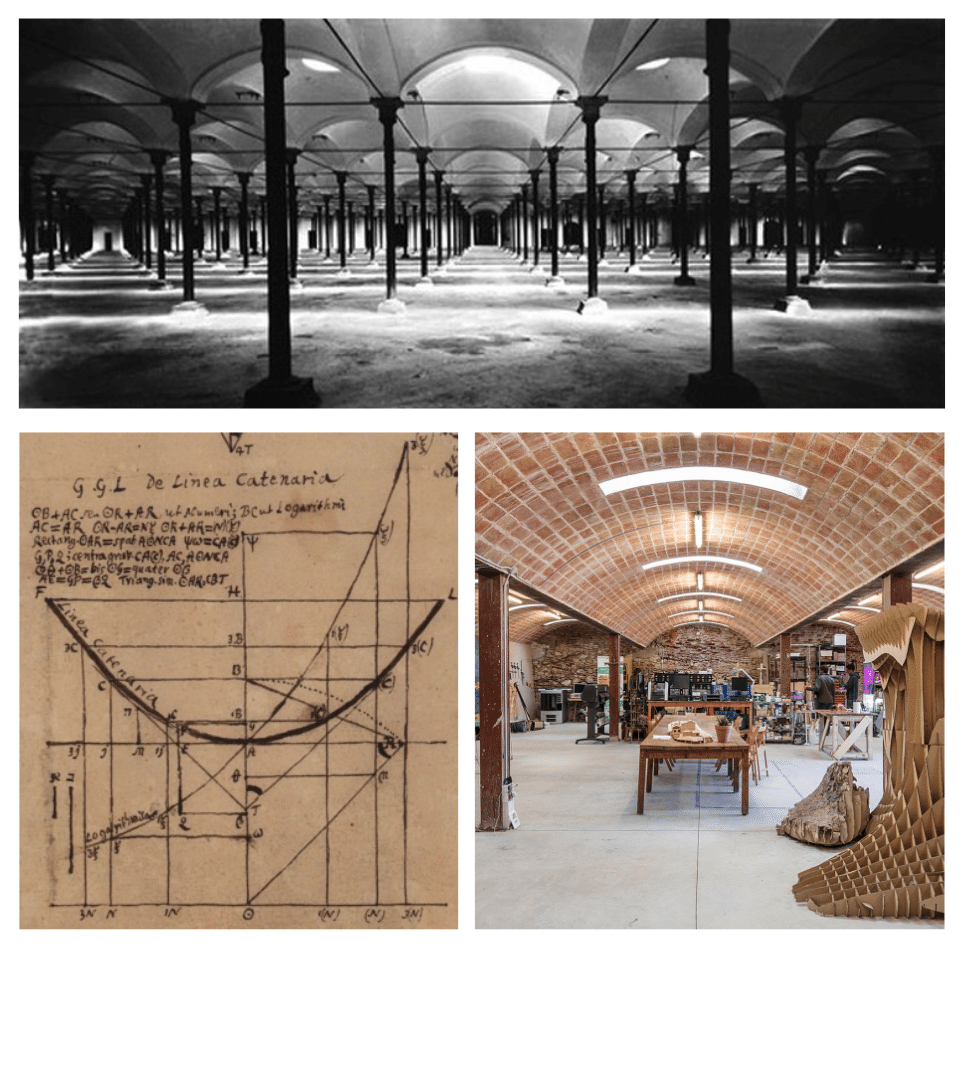
Structural behavior was then investigated through both digital simulations and physical prototypes, where geometry was found to play a fundamental role in stiffness. This led to the catenary principle, where form naturally follows force distribution. Rather than drying the panels flat, they were allowed to dry in catenary configurations. As the clay hardened, the geometry became locked into the material, producing lightweight self-supporting forms.
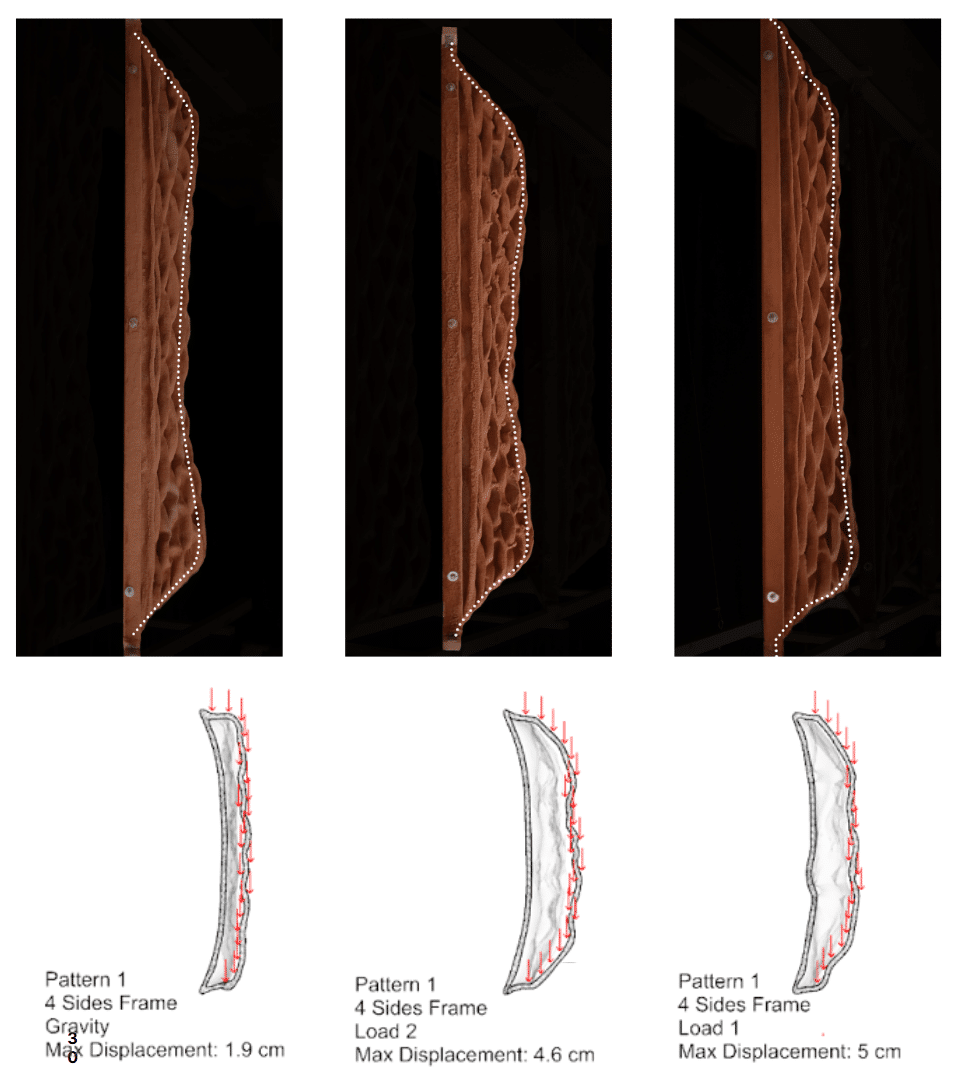
Material Load
The force distribution based on the spraying pattern and the amount of clay shows a visible deformation in the panel.
Catenary Principle
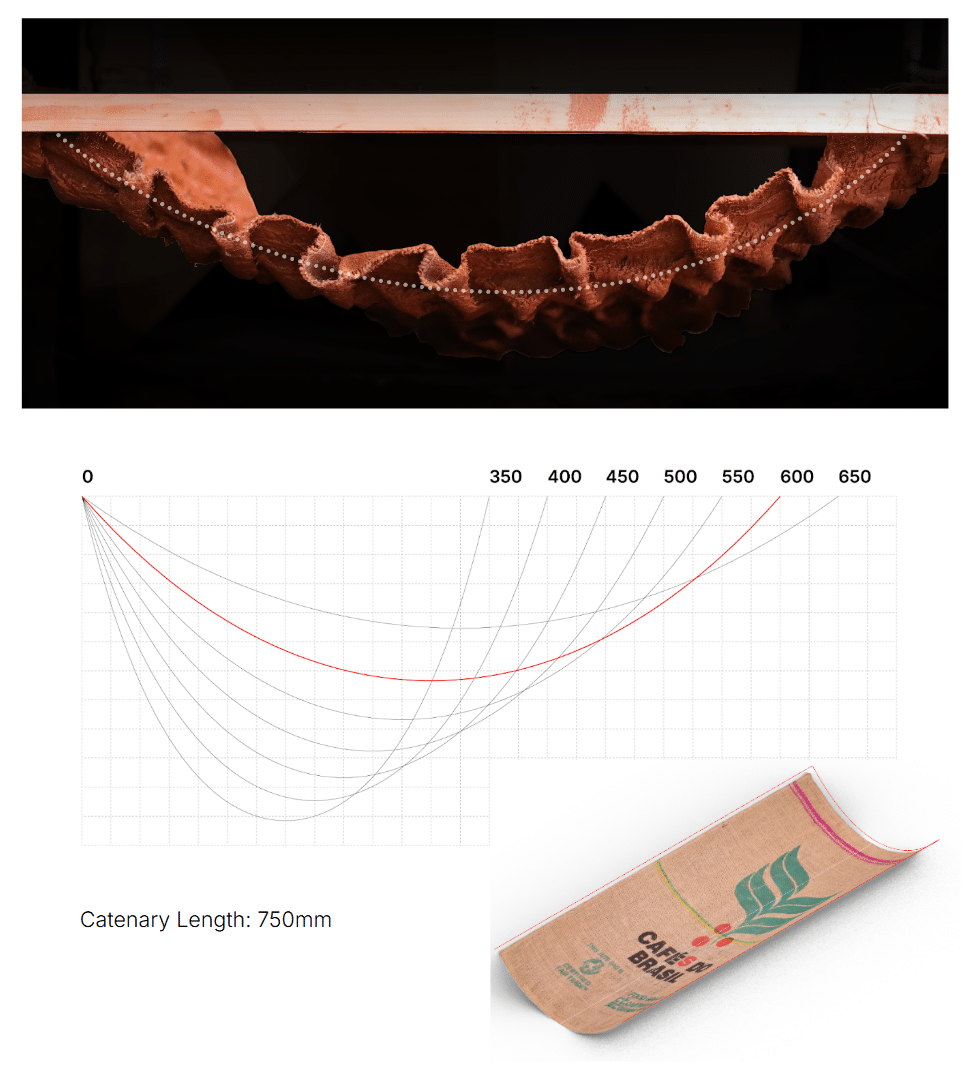
Gravity acts as a form-finding tool. Under increasing material load, the textile membrane settles into a catenary configuration that minimizes bending stresses. Once dried, this geometry becomes embedded in the clay-textile composite, producing a lightweight and self-supporting shell.
A Coffee-Bean Bag Module
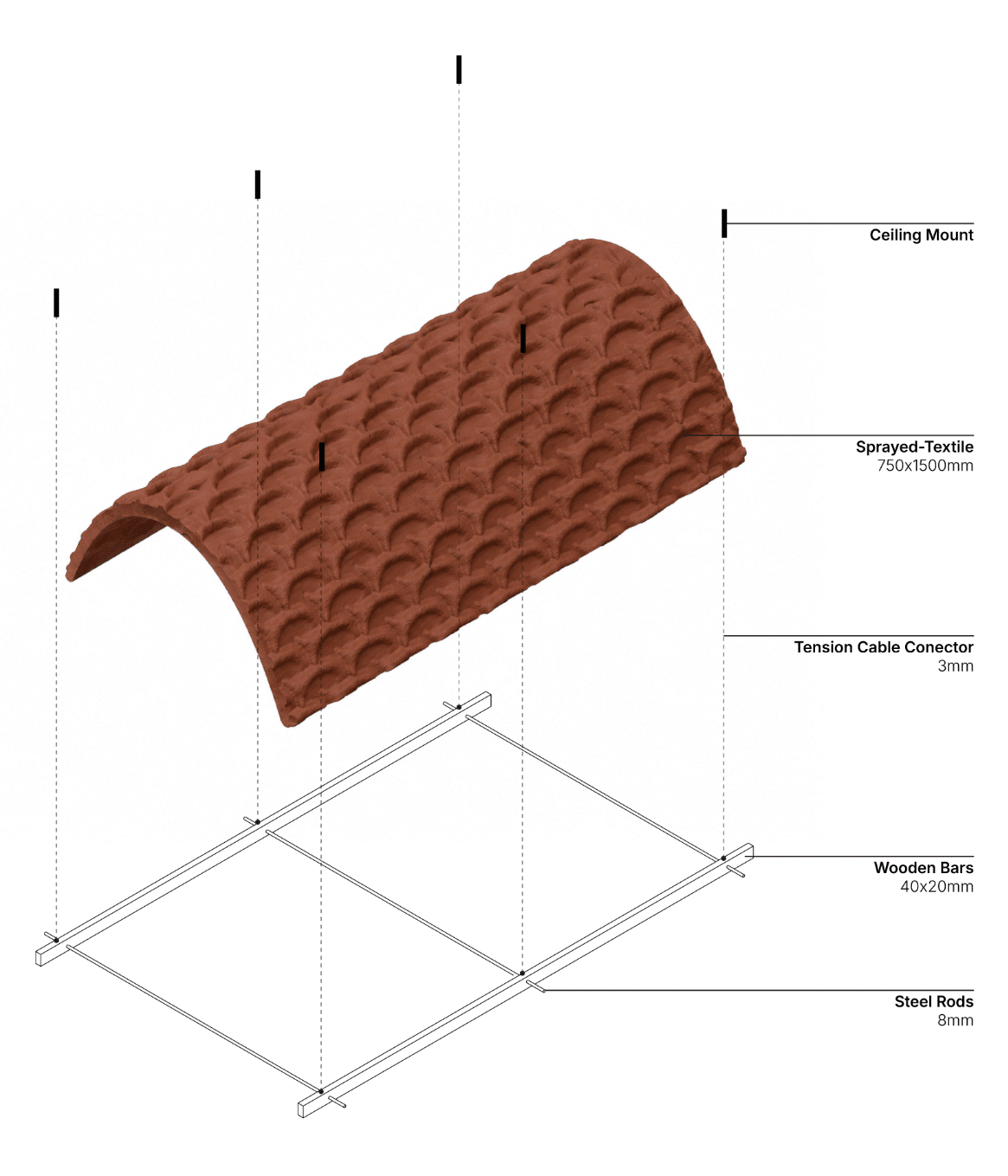
The dimensions of the coffee sack establish the geometric limits of the system. Once suspended, the textile naturally adopts a family of possible catenary curves whose depth depends on material load and support conditions
Raw Aesthetics : A new material language
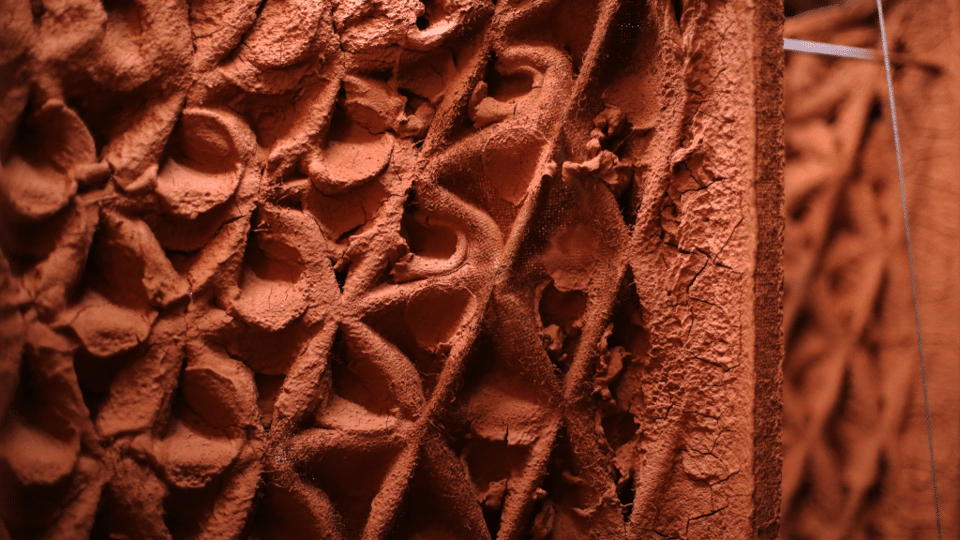
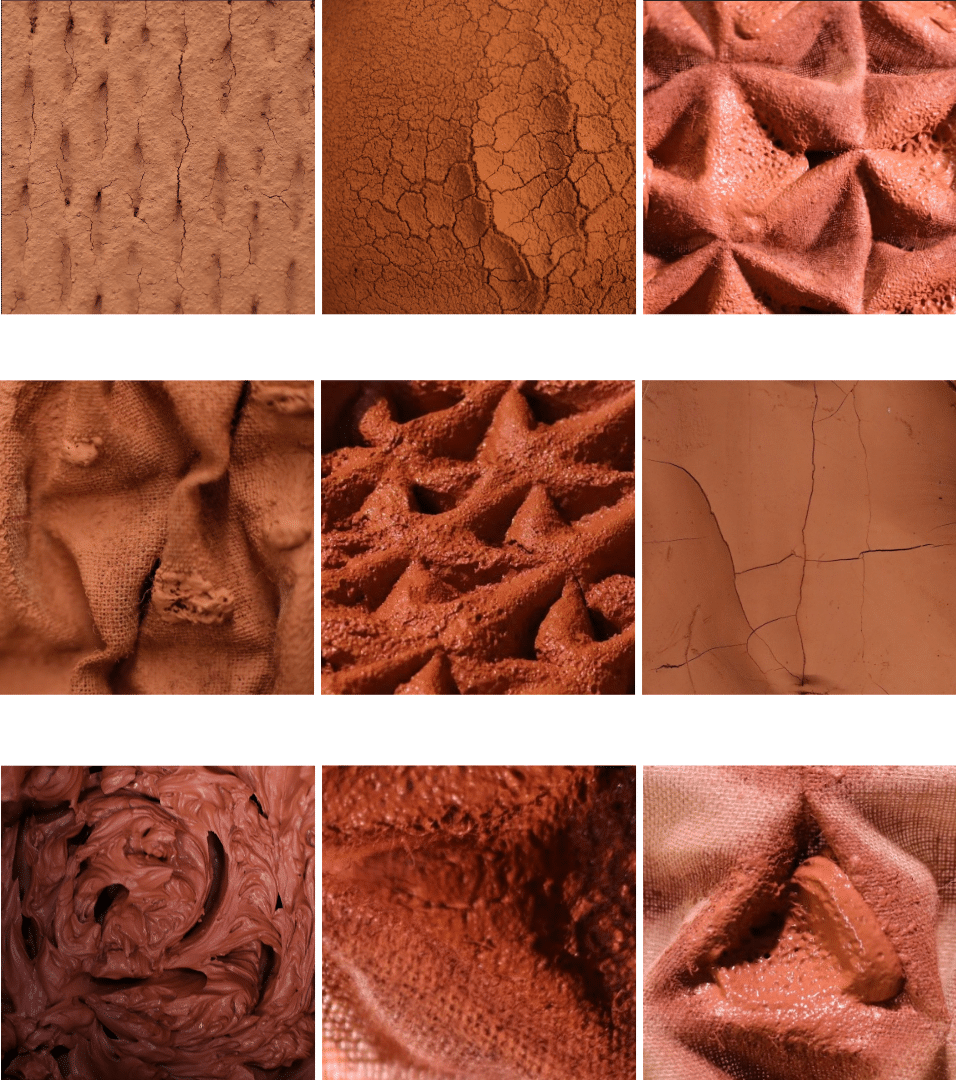
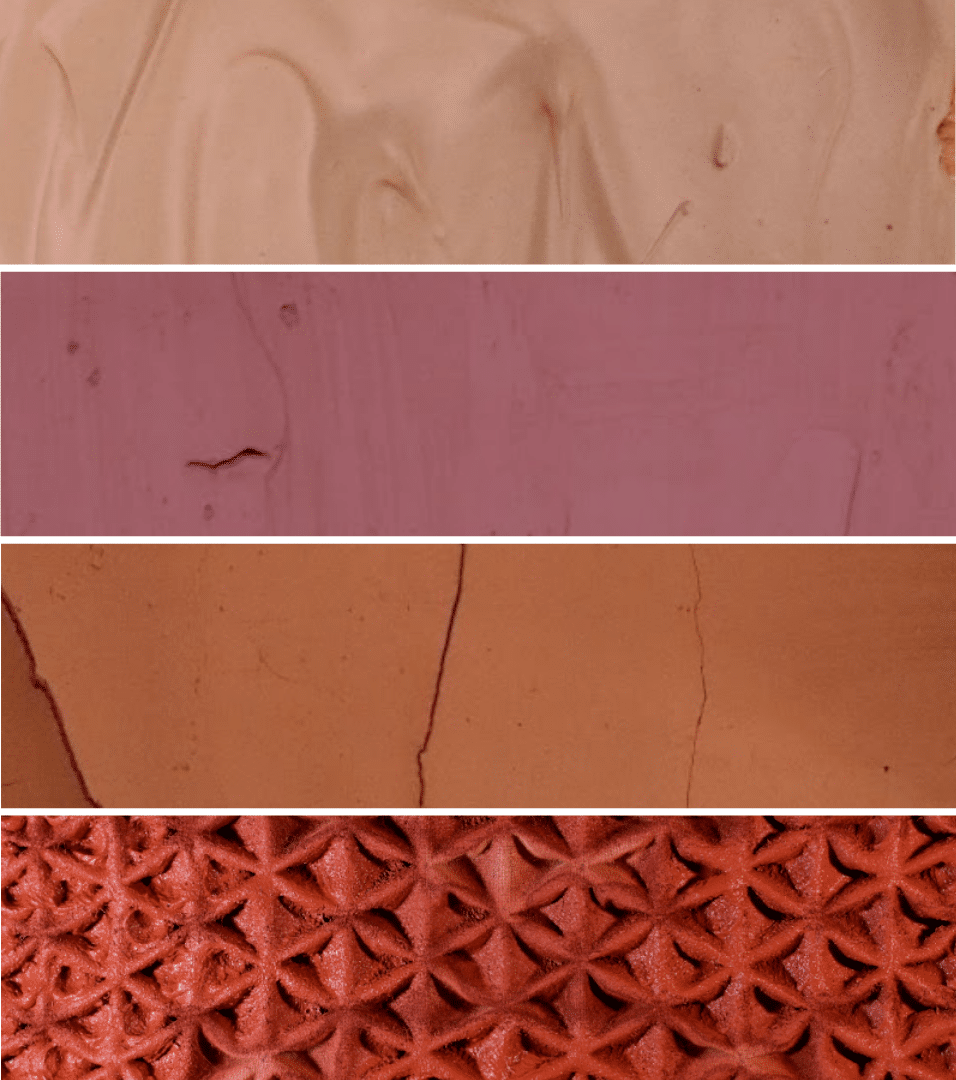
The final outcome is not only performative but also expressive. Rather than concealing the fabrication process, the system reveals it. Texture, thickness variations, cracks, and deposition traces become part of the architectural language. Each surface emerges from the interaction between clay, textile geometry, and robotic deposition, while color comes directly from the clay source, mixture, and drying process. The result is a material aesthetic that is raw, honest, and directly linked to the fabrication logic itself.
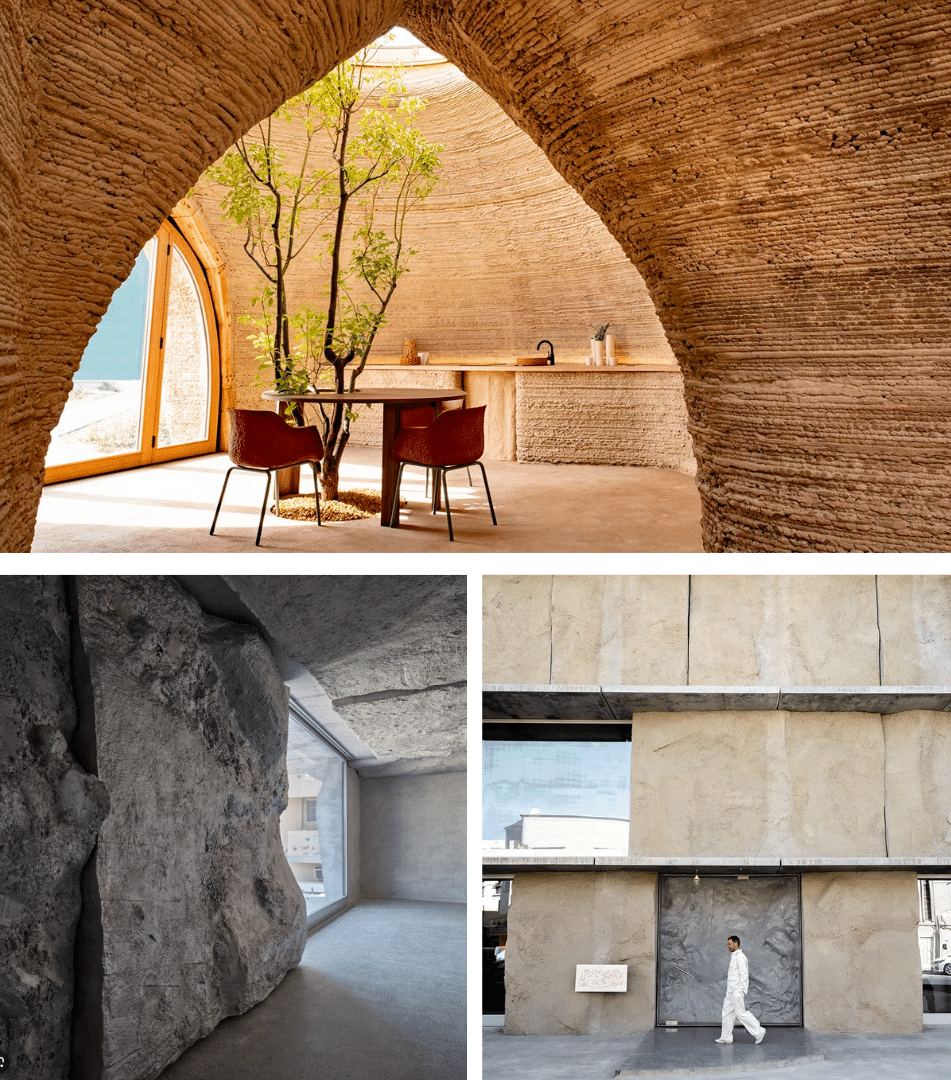
Source: STUDIO ANNE HOLTROP, https://divisare.com/
New Material Expression
Sprayed clay becomes a spatial and sensorial language, where roughness, thickness, cracks, and traces of deposition reveal the material’s behavior rather than concealing it behind a finished surface.
Textures Catalogue
Each texture emerges from the interaction between clay, jute pattern, spraying distance, and deposition density, turning the fabrication process itself into the generator of surface geometry.
Colours Catalogue
The colour palette comes directly from the clay body, water content, drying process, and material mixture, producing natural tonal variations instead of applied pigments or external finishes.
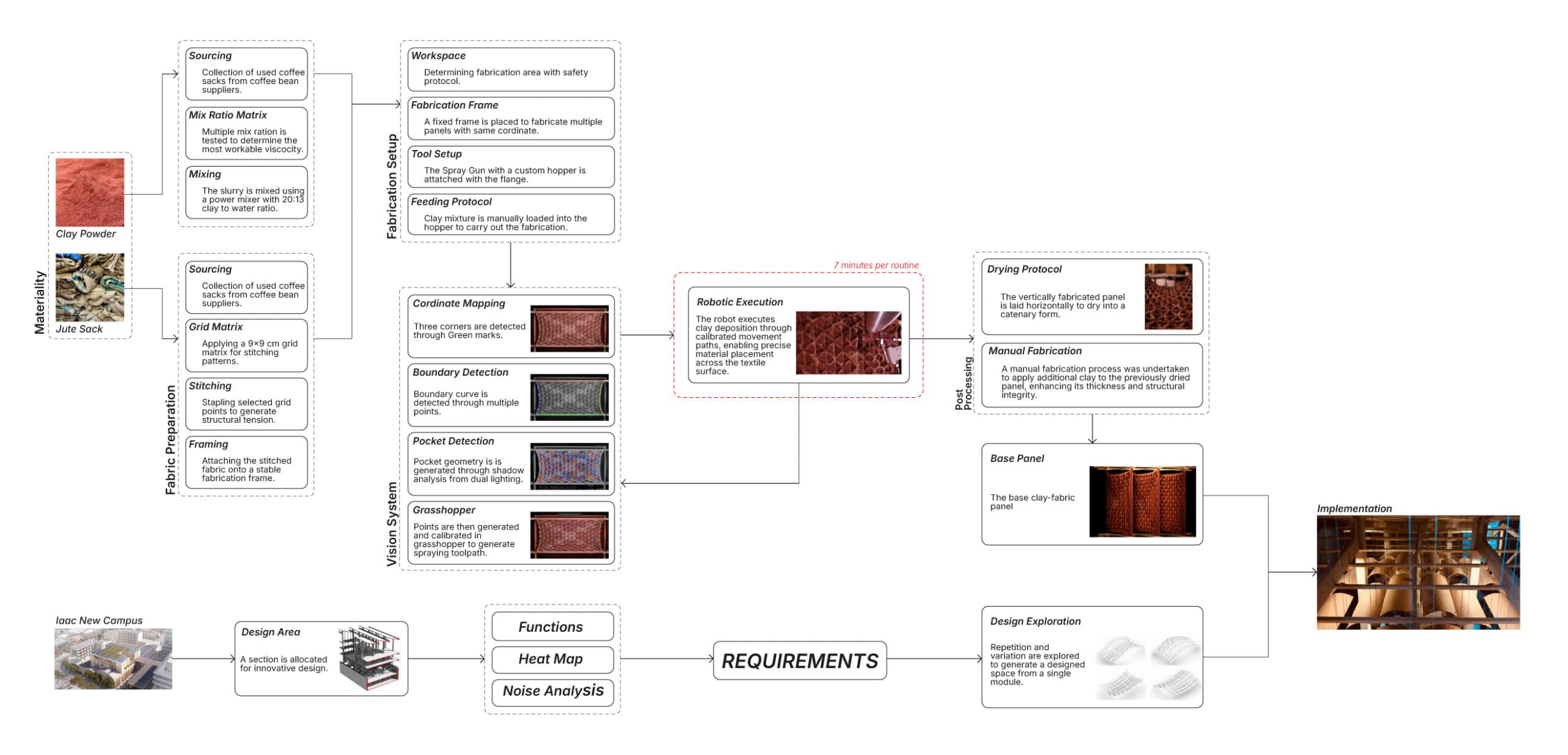
Fabrication Protocol : Complete Workflow
Local materials, textile intelligence, computer vision, and robotic fabrication are brought together into a single workflow that transforms a stitched jute surface into a lightweight, self-supporting architectural panel.
Through this protocol, the balance between manual labor and robotic fabrication became clearer. While fabric preparation remained time-intensive, robotic spraying significantly improved efficiency, with each deposition taking around 6 to 7 minutes and producing consistent, precise results. These findings provide a strong foundation for future optimization and scaling of the process.

Architectural Proposal
The IAAC Building as Testing Ground
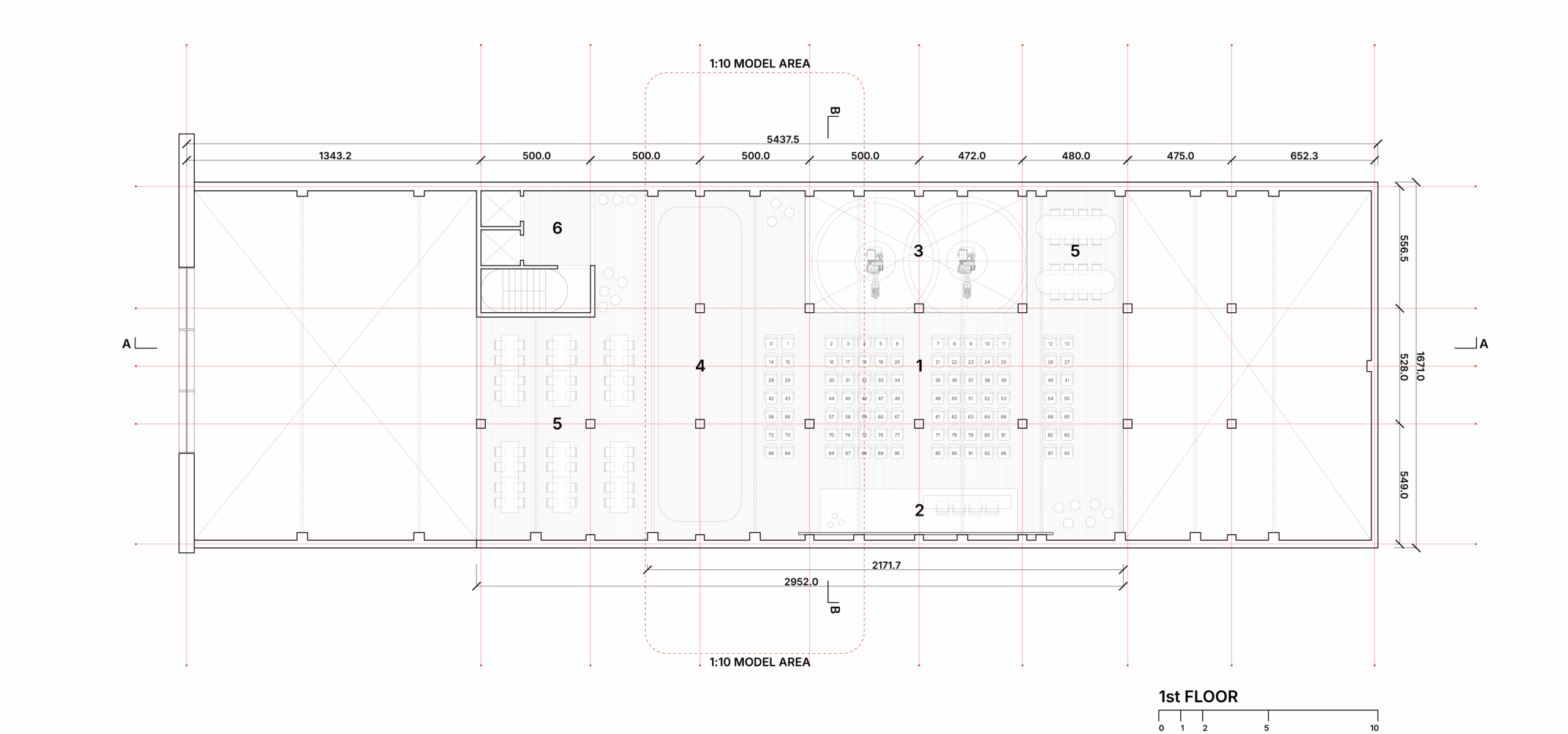
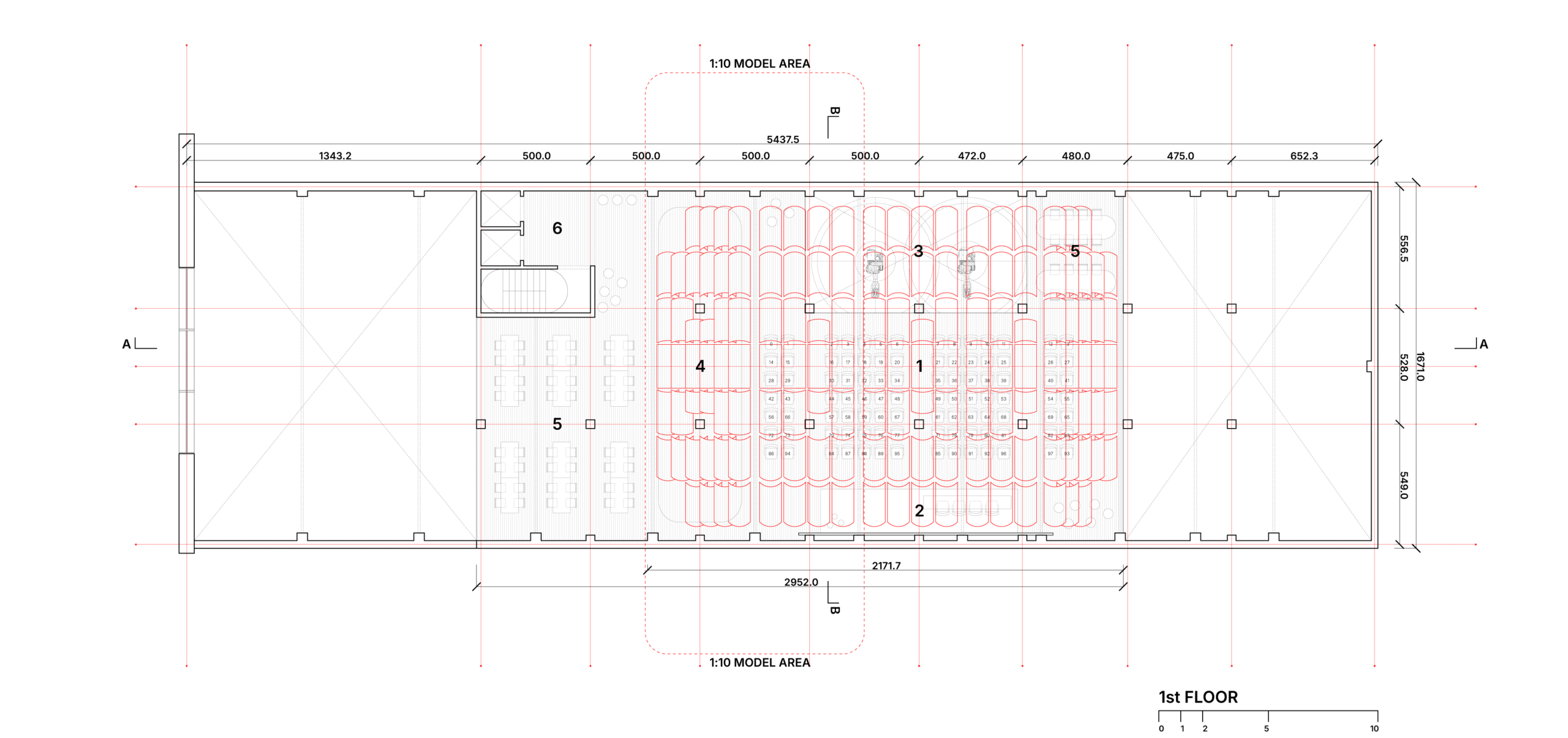
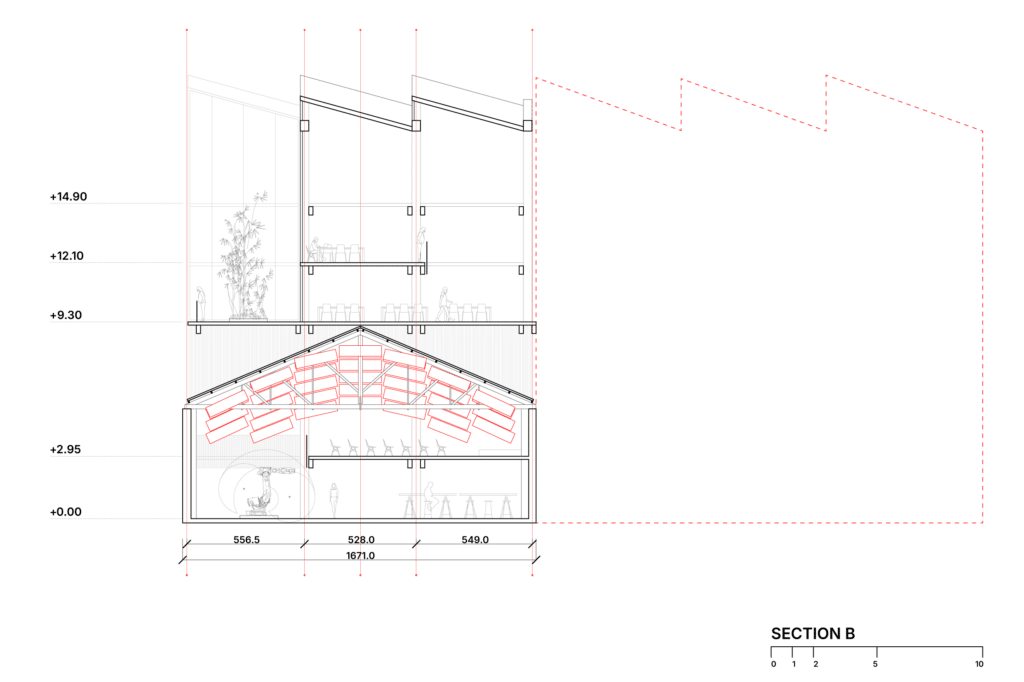
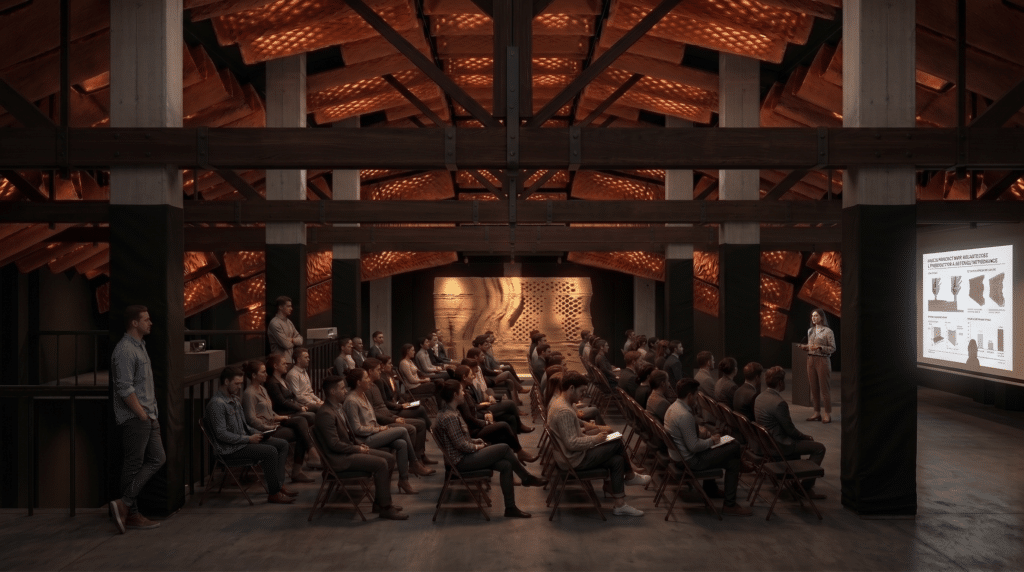
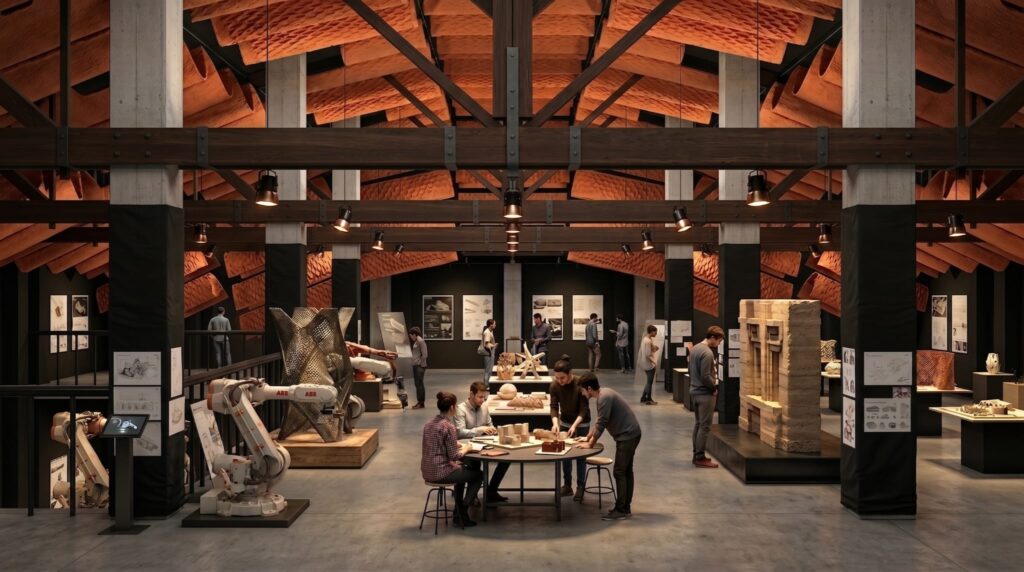
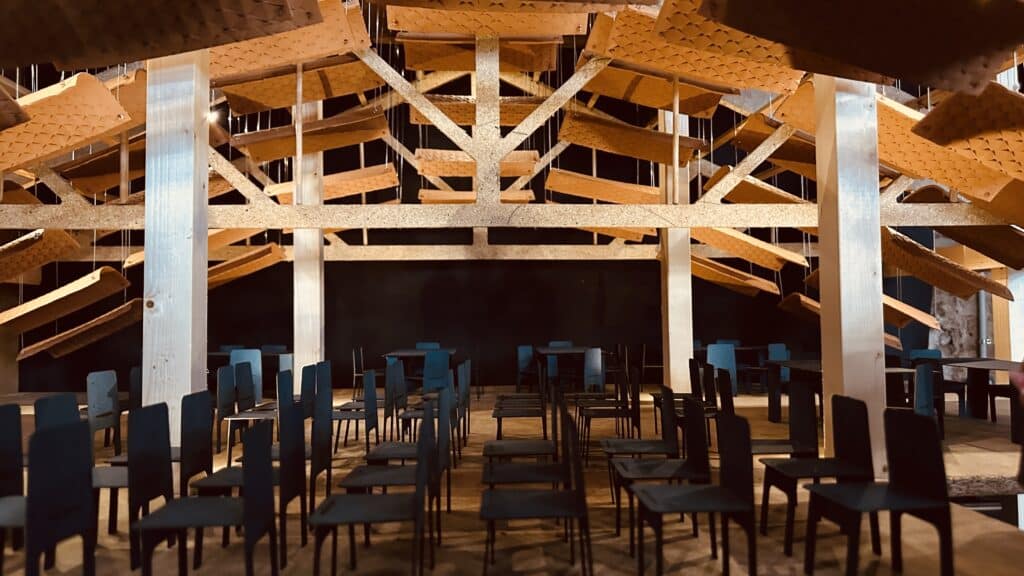
The proposal occupies the central double-height space of IAAC’s new headquarters, creating a dialogue between fabrication and knowledge exchange. Suspended from the existing structure, a 346 m² clay-textile dome accommodates lectures, workshops, and public events while maintaining visual continuity with the fabrication floor below.
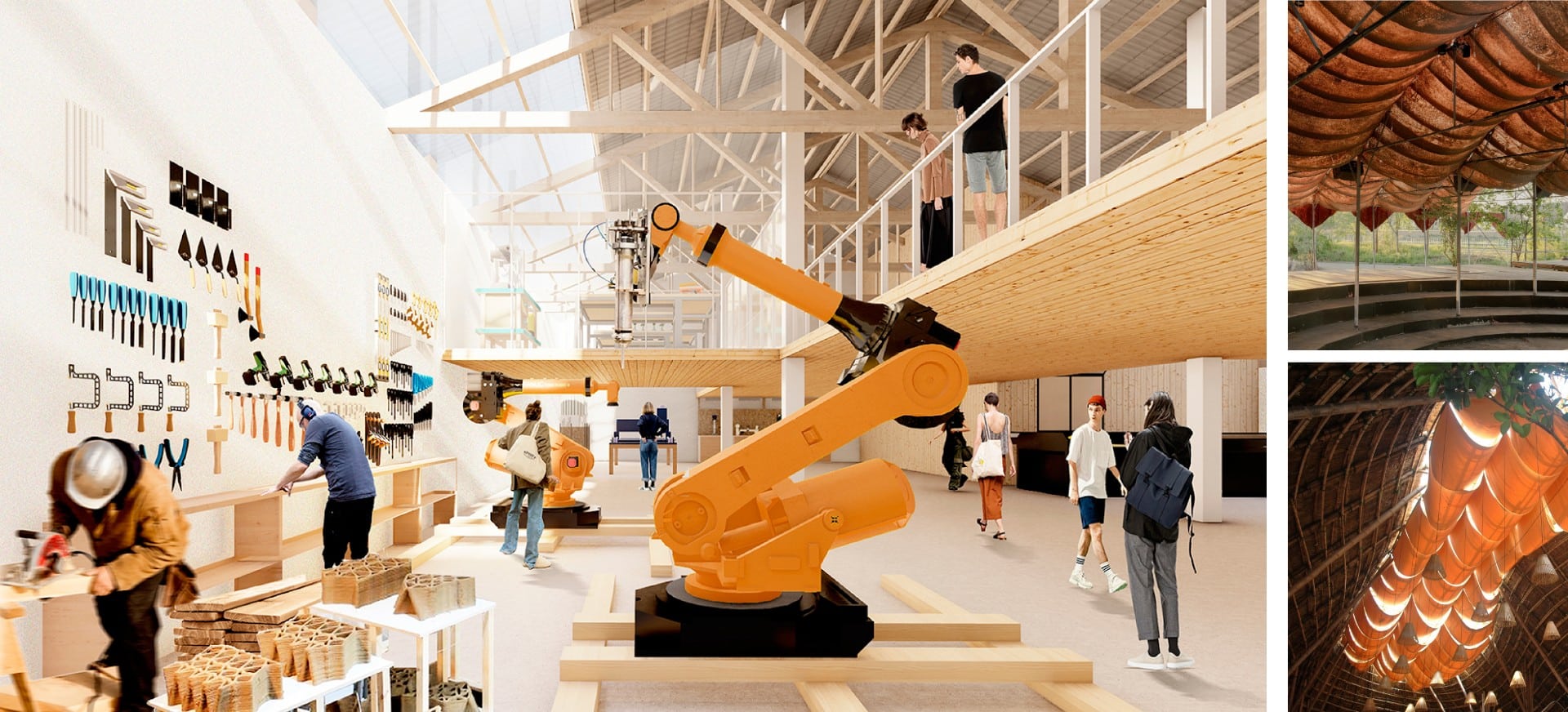
The dome is formed by a series of curved modules made from smocked jute fabric reinforced through robotic clay deposition. Stitching programs the textile geometry, while robotic spraying controls material distribution and thickness gradients, transforming a flexible fabric into a lightweight architectural composite. Environmental performance is embedded within the system: dense clay zones provide thermal mass and acoustic absorption, while porous regions enable passive ventilation and vapor permeability.
A contemporary reinterpretation of earth construction, where local materials, textile craft, and robotic fabrication converge into a new architectural system.
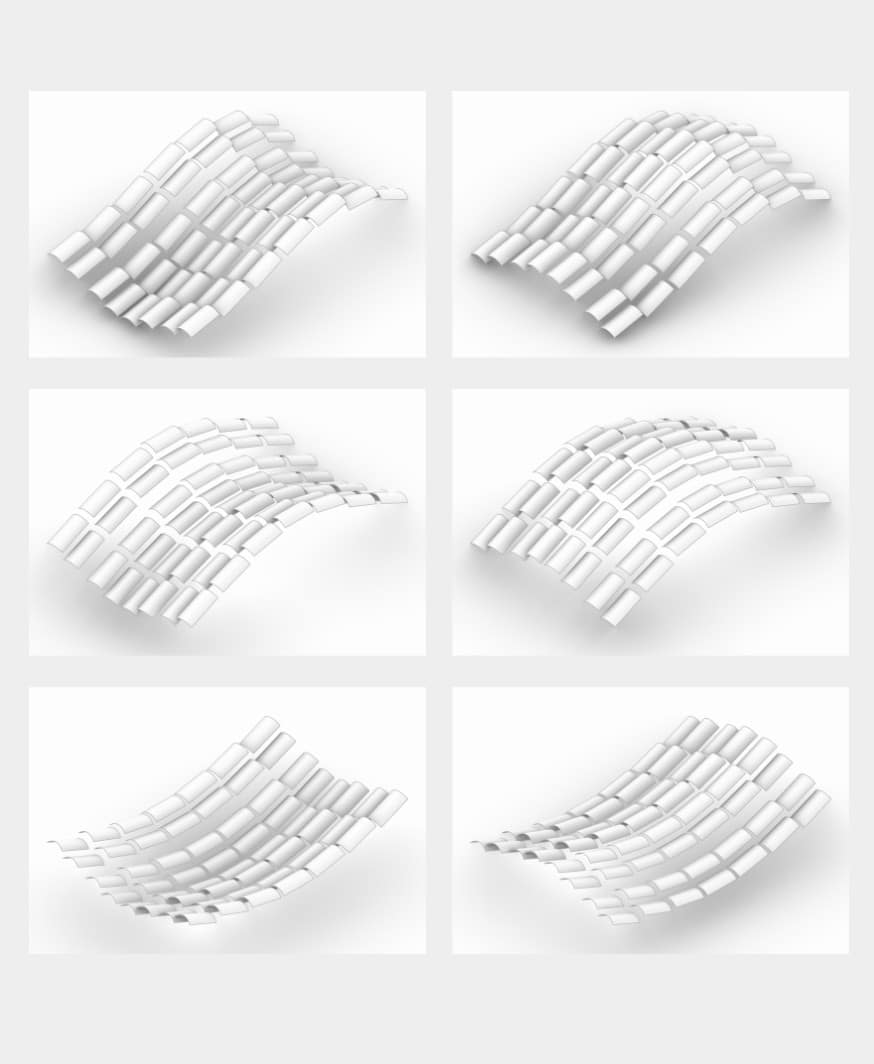
The project is based on a single material module. Through repetition and controlled variation, identical units produce surfaces ranging from planar assemblies to complex double-curved structures. Architectural diversity emerges from assembly rather than component differentiation.
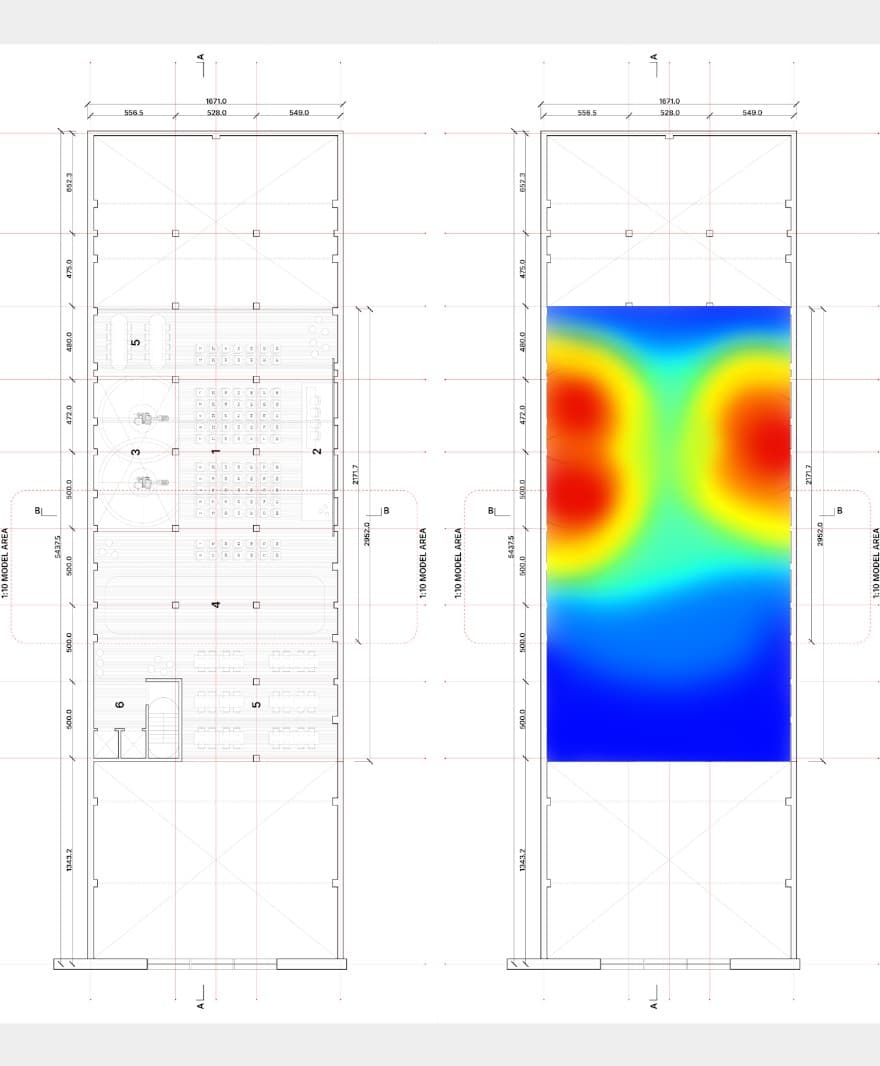
Zones of high acoustic energy — concentrated at the central activity areas — demand greater sound absorption. Zones of lower intensity tolerate lighter, more porous configurations. The heatmap translates spatial performance requirements directly into a fabrication map.
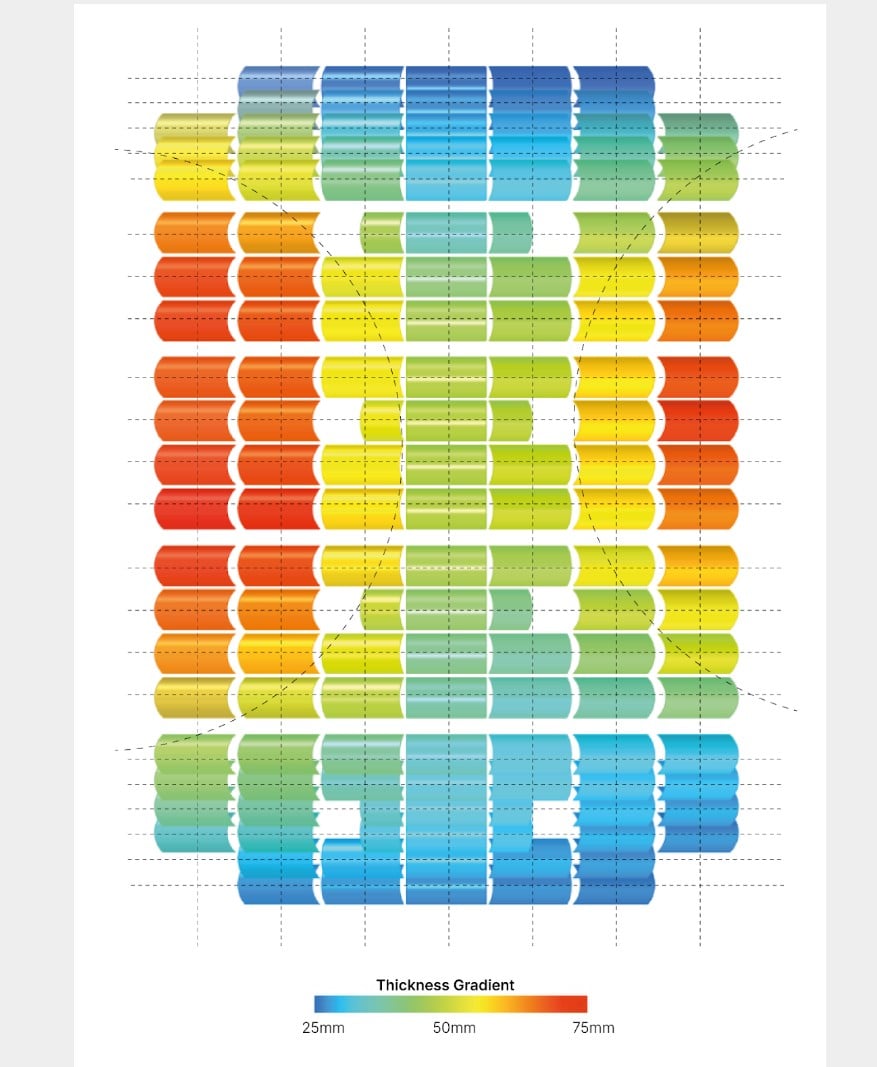
Acoustic performance is translated into material distribution. Thickness gradients generated through robotic deposition produce a family of site-specific modules fabricated from a single material system.
Clay-Textile Dome _IAAC New Headquarters
To demonstrate the system’s architectural potential, we applied it to IAAC’s new building, focusing on its central double-height space where research, fabrication, workshops, and public events converge. A modular clay-textile membrane is suspended as a second skin, with its material distribution tailored to the environmental needs of different areas. Through controlled clay deposition, denser regions enhance acoustic and thermal performance, while more porous zones maintain ventilation, daylight, and visual connectivity.
Intervention Area: 346m²
Program: Auditorium, Workshop space and Exhibitions
Users: Students, researchers and visitors
Textile Modules: 146