
Syllabus

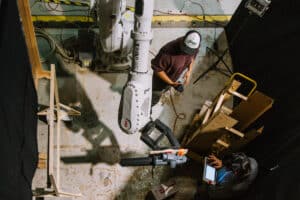
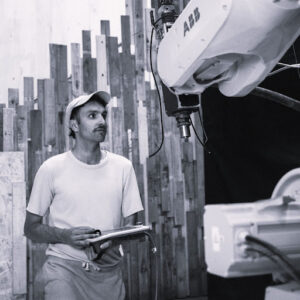
This studio-based course facilitates an exploration into the convergence of vernacular material traditions and contemporary robotic fabrication within the specific geographical landscape of Catalunya. Students begin by conducting a comprehensive material survey of endemic natural resources to analyze their physical properties, extraction methods, and regional cultural significance.  The final phases emphasize the development of a digital-to-physical feedback loop, utilizing computational tools like Grasshopper to simulate toolpaths and refine robotic interactions

Learning Objectives

  • Explore local materials and understand how they were traditionally used in the region.
  • Test material behaviors through hands-on experimentation and prototyping.
  • Translate physical movements into digital instructions for robotic arms.
  • Use computational design tools to simulate and refine fabrication processes.
  • Develop building systems that combine traditional logic with robotic automation

Faculty


Faculty Assistants


Projects from this course

Living Fibers: Robotic Needle Felting as an Architectural Construction System

MAA/MRAC Studio Term 3 — 2025/2026 | Robotics for Ecological Building When you think of wool, construction probably isn’t the first thing that comes to mind. But wool has a longer history as a building material than most people realize, and it carries inherent properties that make it genuinely compelling for architecture: moisture regulation, thermal … Read more

Robotics for Ecological Buildings

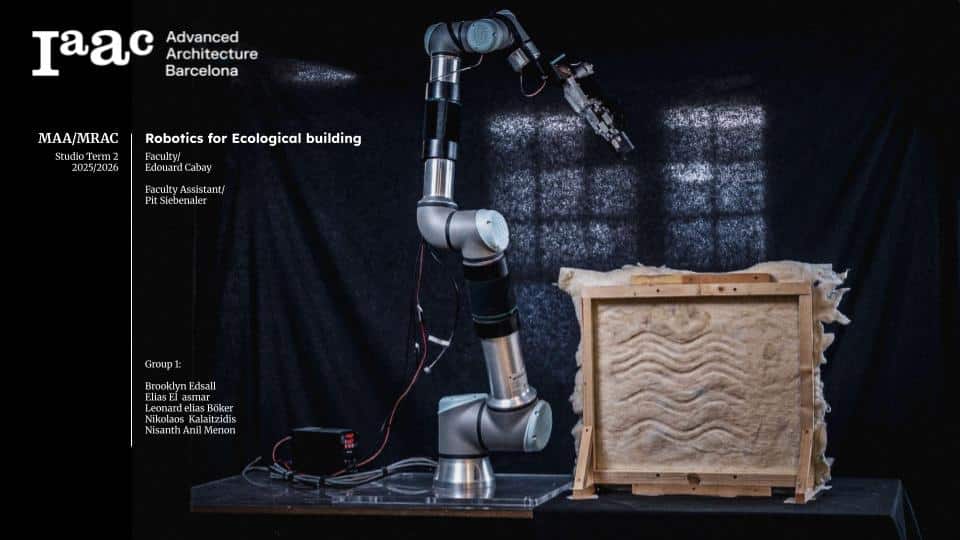
The Living Fibers MAA/MRAC, Studio Term 2, 2025/2026 Group 1: Brooklyn Edsall, Elias El  asmar, Leonard elias Böker, Nikolaos  Kalaitzidis, Nisanth Anil Menon Abstract:This project challenges the hyper-standardization of modern construction by investigating the architectural potential of raw, locally sourced Catalan wool. Our research elevates wool from a passive insulation material into an active, rigid, … Read more