
-A public seafront reclaimed from the port, built on what already exists.
Blue Edge proposes transforming a former container terminal in the Port of Barcelona into the city’s first publicly accessible southern waterfront with the focus on the transport system that connects this site with the rest of the city
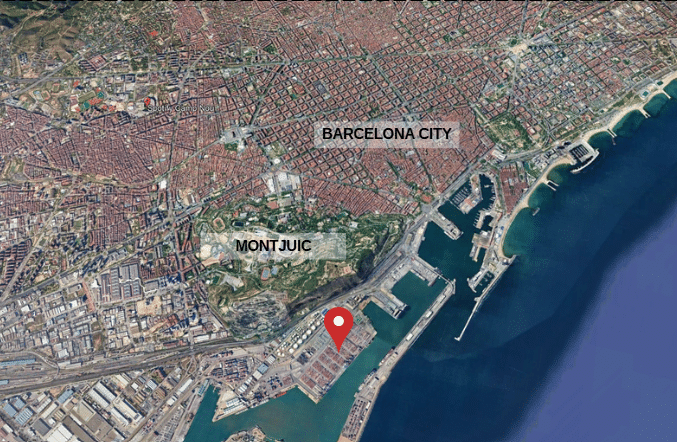
The site sits directly south of Montjuïc hill, sandwiched between the B-10 coastal highway and the Mediterranean Sea, approximately 1.5 km from Las Ramblas. Despite its proximity to the historic city centre, the site is completely unreachable by ordinary residents and visitors. Blue Edge begins as a public open space: 12 hectares of breathing room reclaimed from port infrastructure. The transport system is designed to make that reclamation real.
The site covers 1.65 km² and is bounded by the B-10 coastal highway to the north, with Poble Sec as a neighbour to the north and Barceloneta to the east. Today it holds cranes, containers, and density of a different kind: industrial, fenced, invisible.
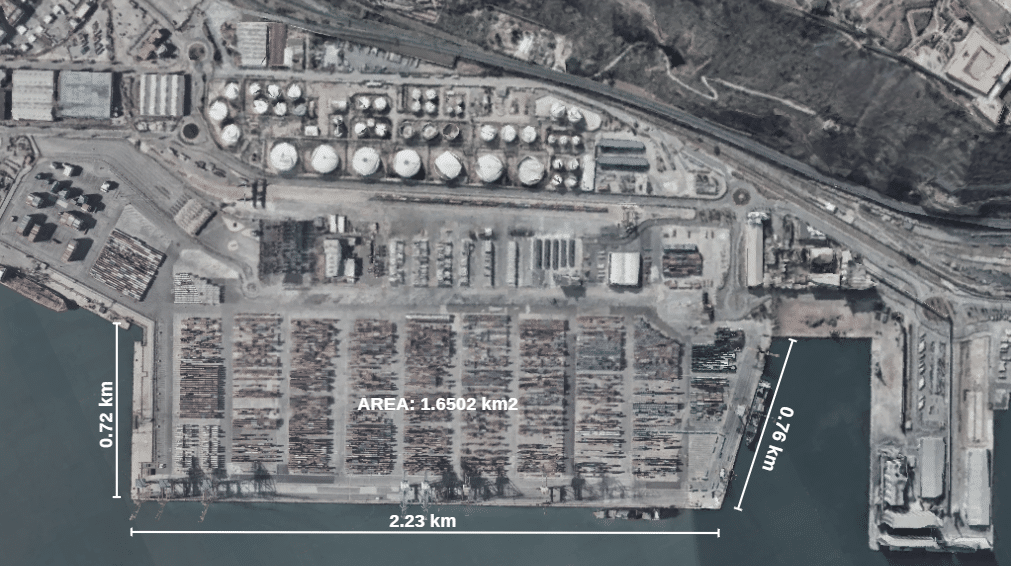
The site’s central problem was its invisibility. Physically close to the city but functionally unreachable. Active users before any intervention: approximately 80 to 100 per day, almost exclusively port workers. Public access to the waterfront: none.
The strategy does not build a road in. It builds ways in through what already exists, each connection erasing a different layer of disconnection.
CABLE CAR: THE LANDMARK CONNECTION
Montjuïc already has an existing aerial cable car network. The proposal extends that logic downward, a new line descending from the hill directly to the western entrance of the park. The ride takes passengers over the port and the water before depositing them at the park entrance. Arrival becomes part of the experience. For residents of Poble Sec and Montjuïc, this is their direct, car-free connection to the waterfront.
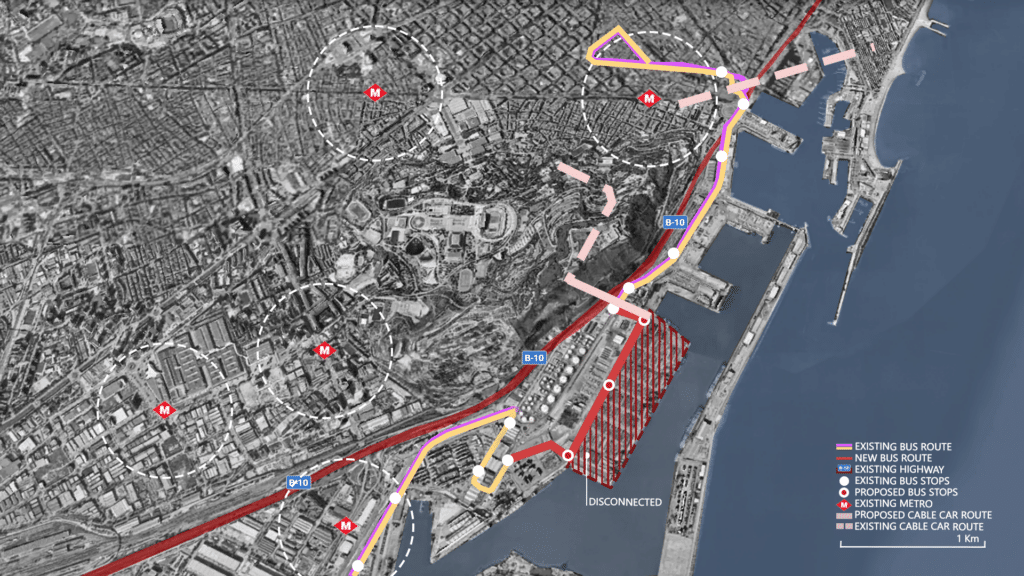
The proposed cable car route connects the existing Montjuïc system to the site with three new stops along the descent. On the same map, the rerouted bus line is visible in red, three new stops placed directly at the site’s east, centre, and west entrances. Zooming in, the cable car drops from the hill into the western tip of the park, bridging a gap that no road or footpath currently crosses. What was an uncrossable distance becomes a five-minute aerial journey.
BUS: THE EVERYDAY CONNECTION
The existing bus network served the industrial corridor — not the waterfront. The proposal reroutes it to place three stops directly at the site boundary. The bus never enters the park. It drops people at the threshold and leaves. Every point inside the site is now within 300 metres of a stop.
The new route is shown in red, curving away from the highway and bringing three stops to the site’s edge. A small intervention in the network produces a completely different level of accessibility.
FERRY: THE WATERFRONT CONNECTION
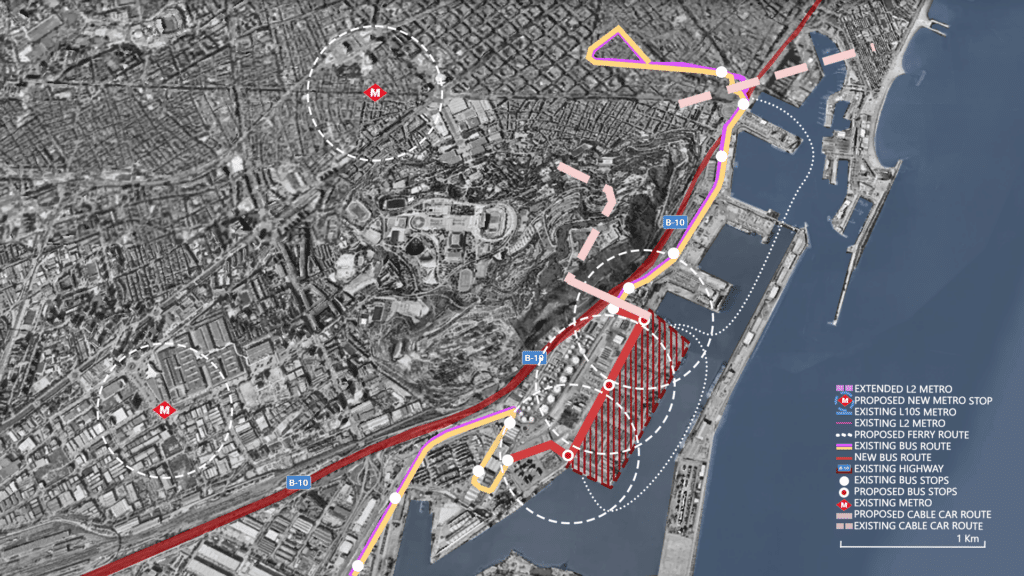
The water surrounding the site has always been treated as a barrier. The proposal flips that logic. Two ferry stops, one at each end of the site, connect it to Barceloneta, Port Vell, and the broader coastal network. Zero-emission and scenic, the ferry turns the Mediterranean from an obstacle into an arrival boulevard.
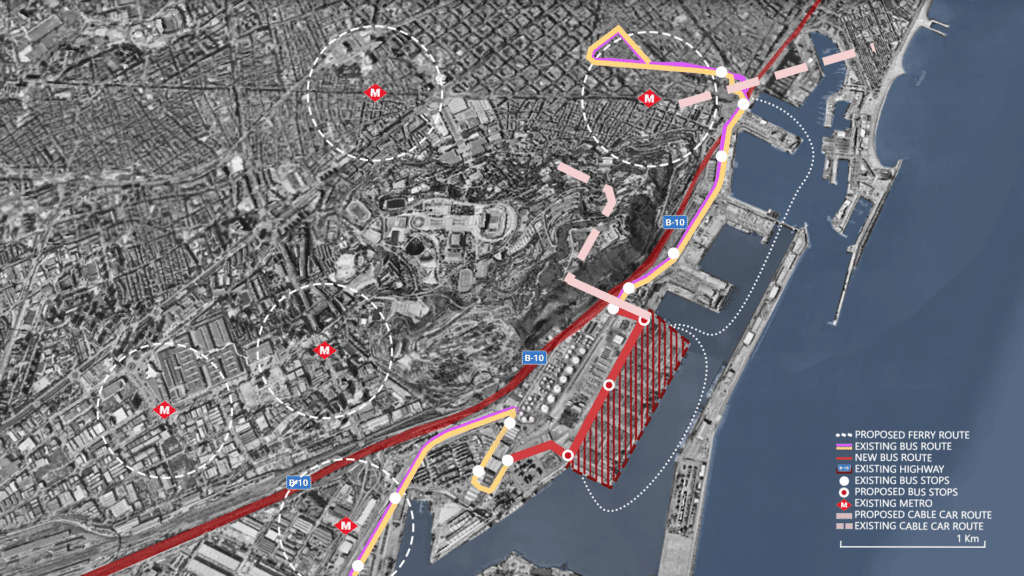
The proposed ferry route is shown as a dotted white line looping around the site from Port Vell. Two docking points mark the east and west ends — giving visitors the choice of which end of the park to arrive at.
METRO: THE UNDERGROUND AND ELEVATED CONNECTION
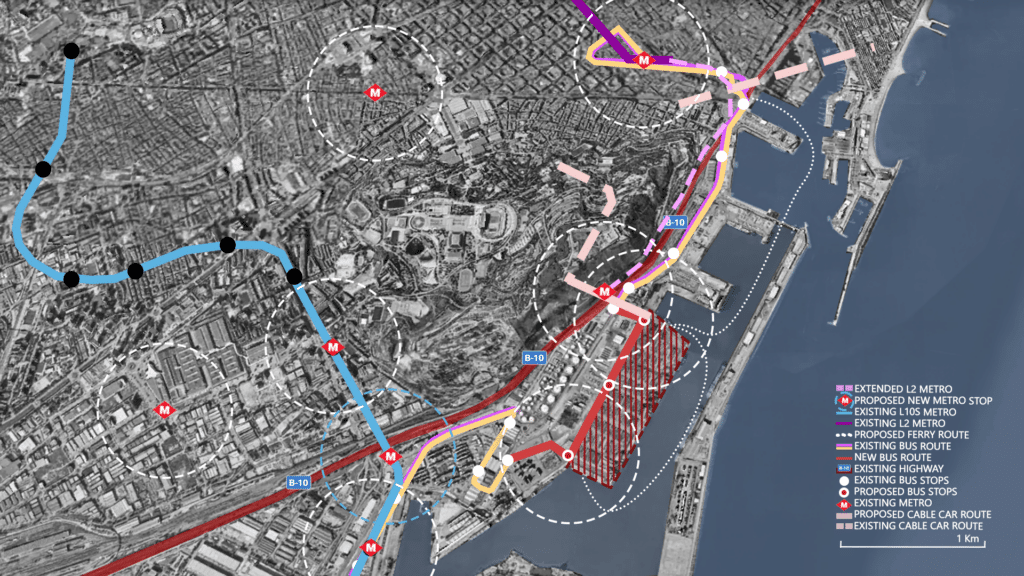
The metro extension adds a new stop to the L10S line at the site’s northern edge and extends the L2 line to the eastern entrance. What makes this intervention special is what happens as the lines approach the waterfront, they emerge above ground. Passengers surface from the tunnel and see the Mediterranean for the first time before they have even arrived. The infrastructure itself marks the moment of arrival.
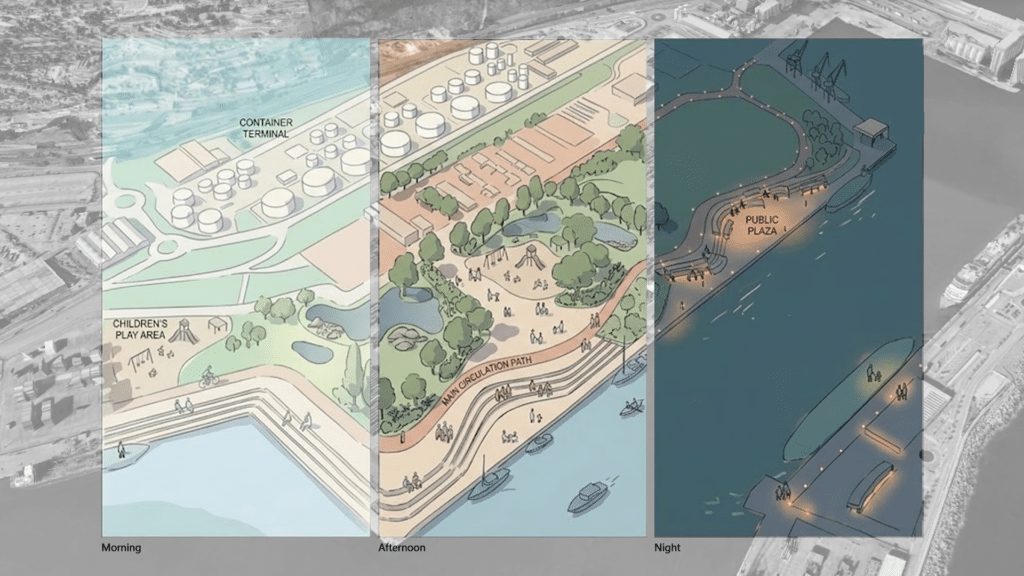
The park is designed to work across the full day. In the morning it is quiet, a place for runners, early walkers, and people who want the water to themselves. In the afternoon it fills up families, cyclists, boats on the water, the plaza buzzing. At night it transforms again, warm path lighting, groups gathered on the terraces, the public plaza glowing against the dark water. Three different parks. Same place.
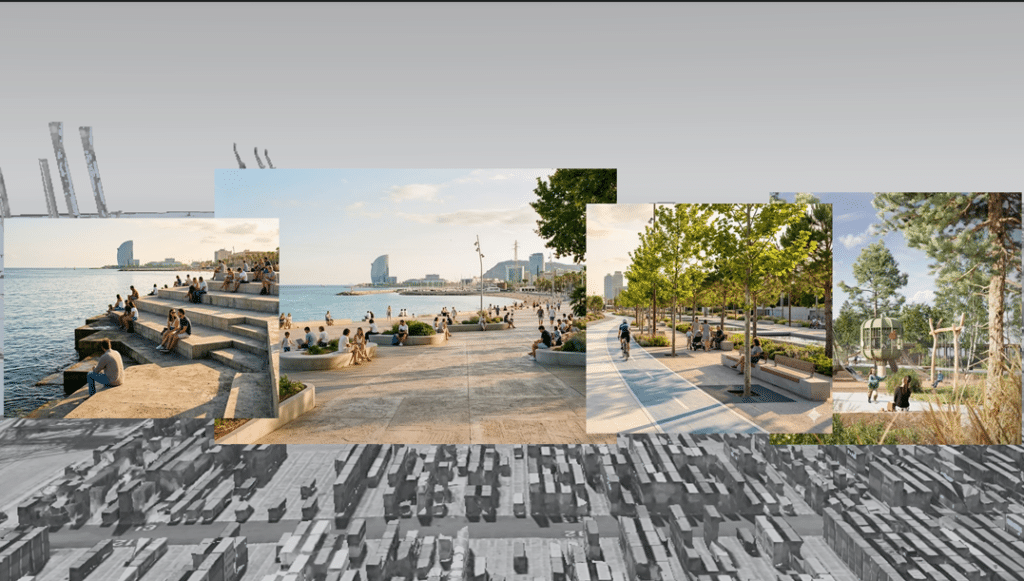
This is what the transformation looks like. From cranes and containers, to stepped waterfront seating, a public promenade, a cycling path, and a children’s playground.
Same site. Different city
The cranes are gone.
The water is still there.
Now so are the people.
