Intro
In recent years, the AEC industry has begun rethinking traditional linear workflows, where environmental analysis often comes too late to meaningfully influence design.
The development of in-house tools, shows how integrating environmental analysis into parametric, data-driven processes can guide decisions from the outset.
Topic
This research investigates how in-house software tools developed by AEC companies enables the early integration of environmental analysis within parametric design workflows. It examines how performance-driven tools influence design decision-making, workflow integration, and the role of sustainability criteria during early-stage architectural design.
Problem Statement
Despite advances in digital design tools, conventional linear processes often introduce environmental analysis too late, reducing its impact on early design decisions.
Thesis
Data-driven parametric workflows enabled by in-house software tools can facilitate the early integration of environmental performance analysis when applied to iterative design exploration.
Research Aim
This research will investigate how custom digital platforms reshape design processes and enable to automate environmental analysis and support collaborative exploration.
Projects like the Santiago Bernabéu Stadium and the Elements residential building by ARUP demonstrate how embedding performance intelligence early enables more sustainable, efficient, and informed design.
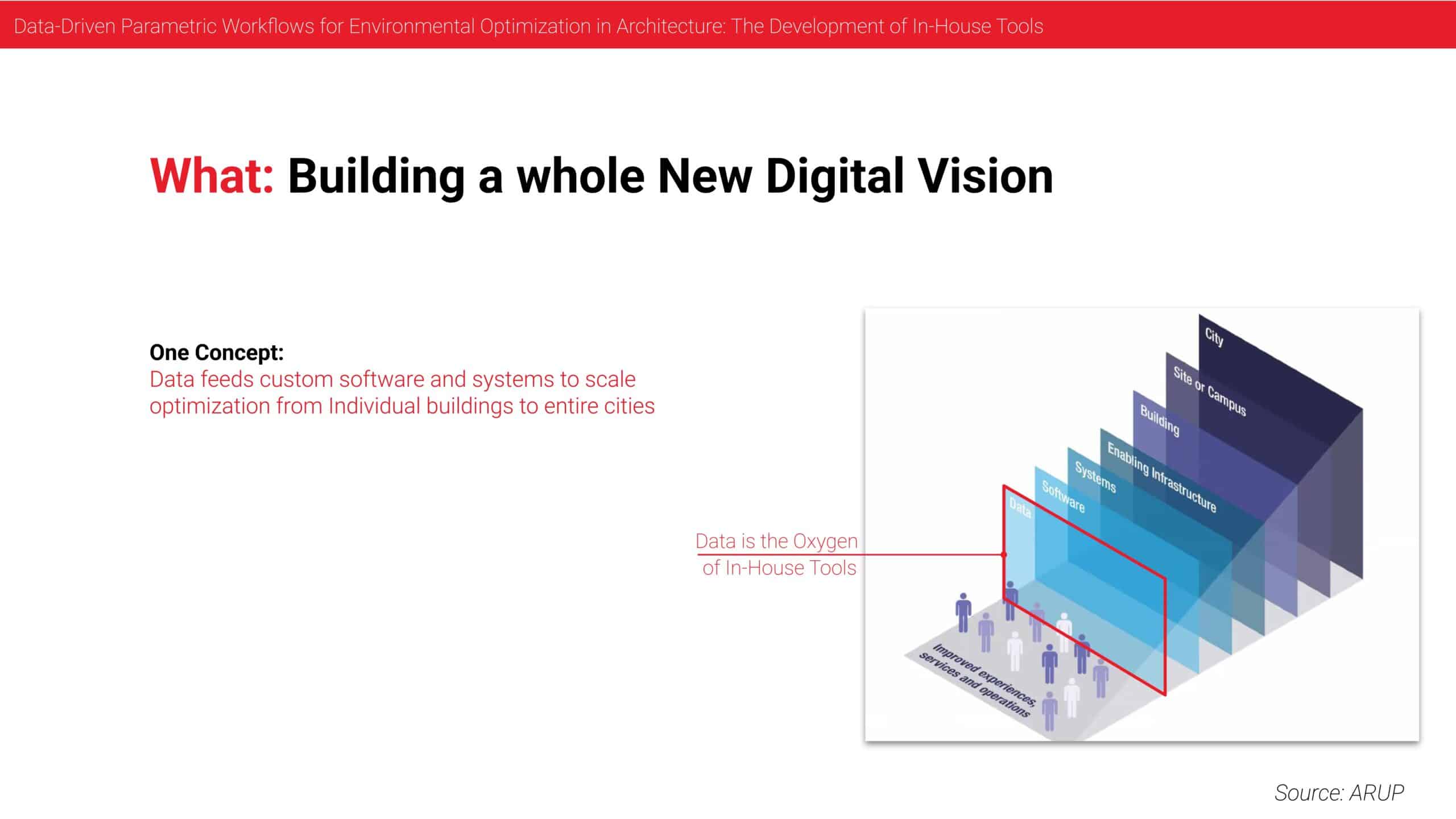
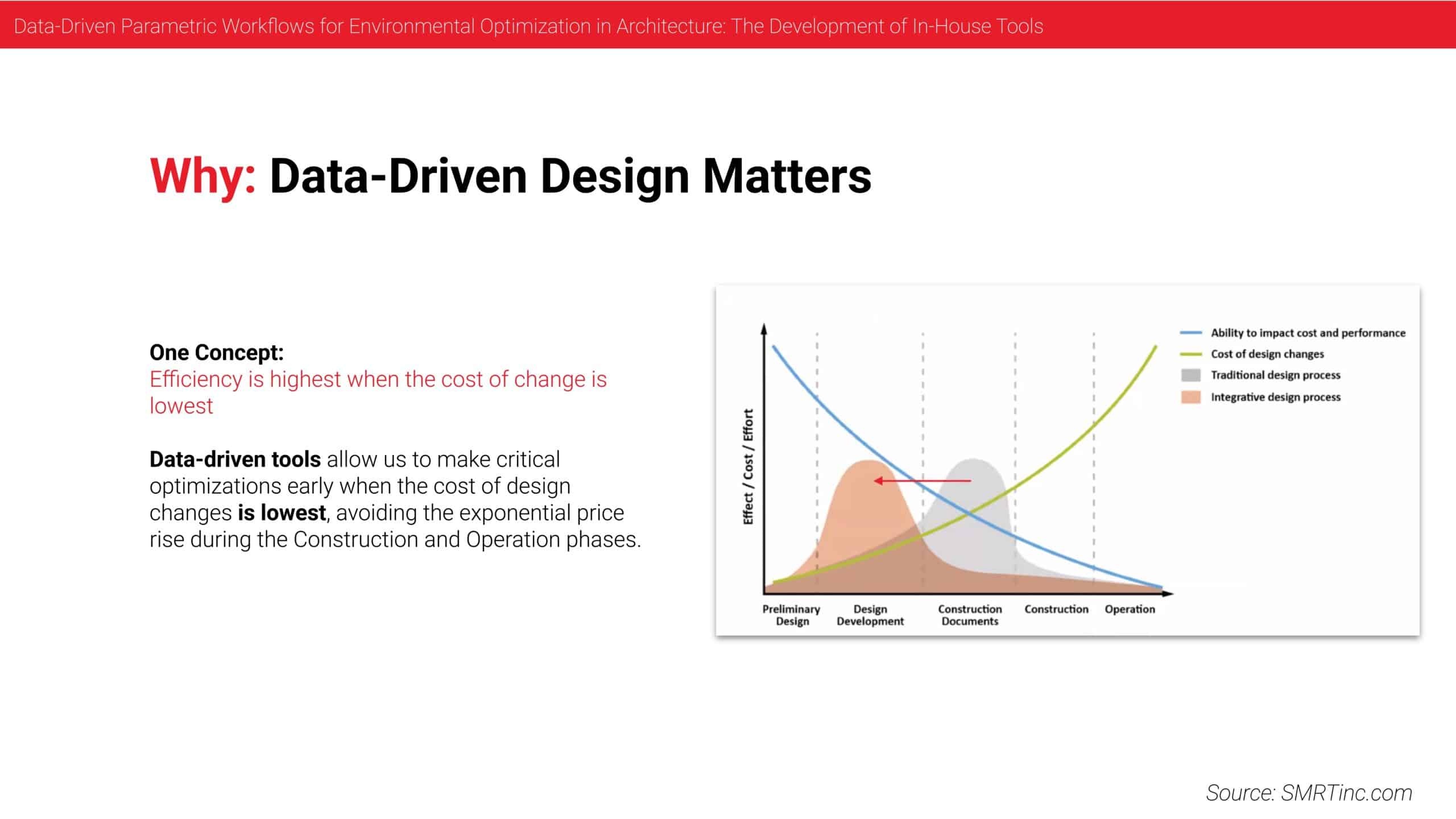
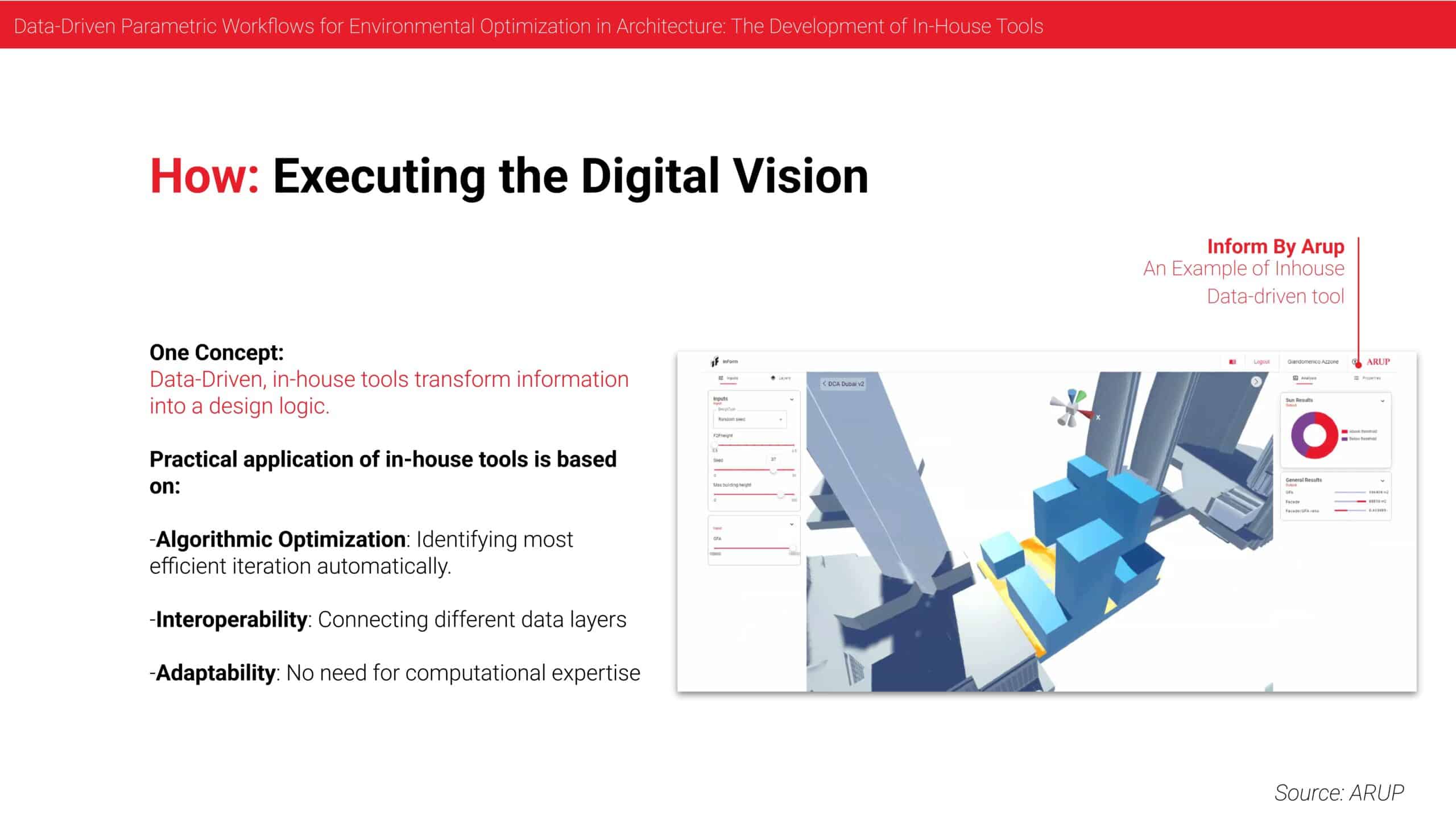
WHAT-WHY-HOW
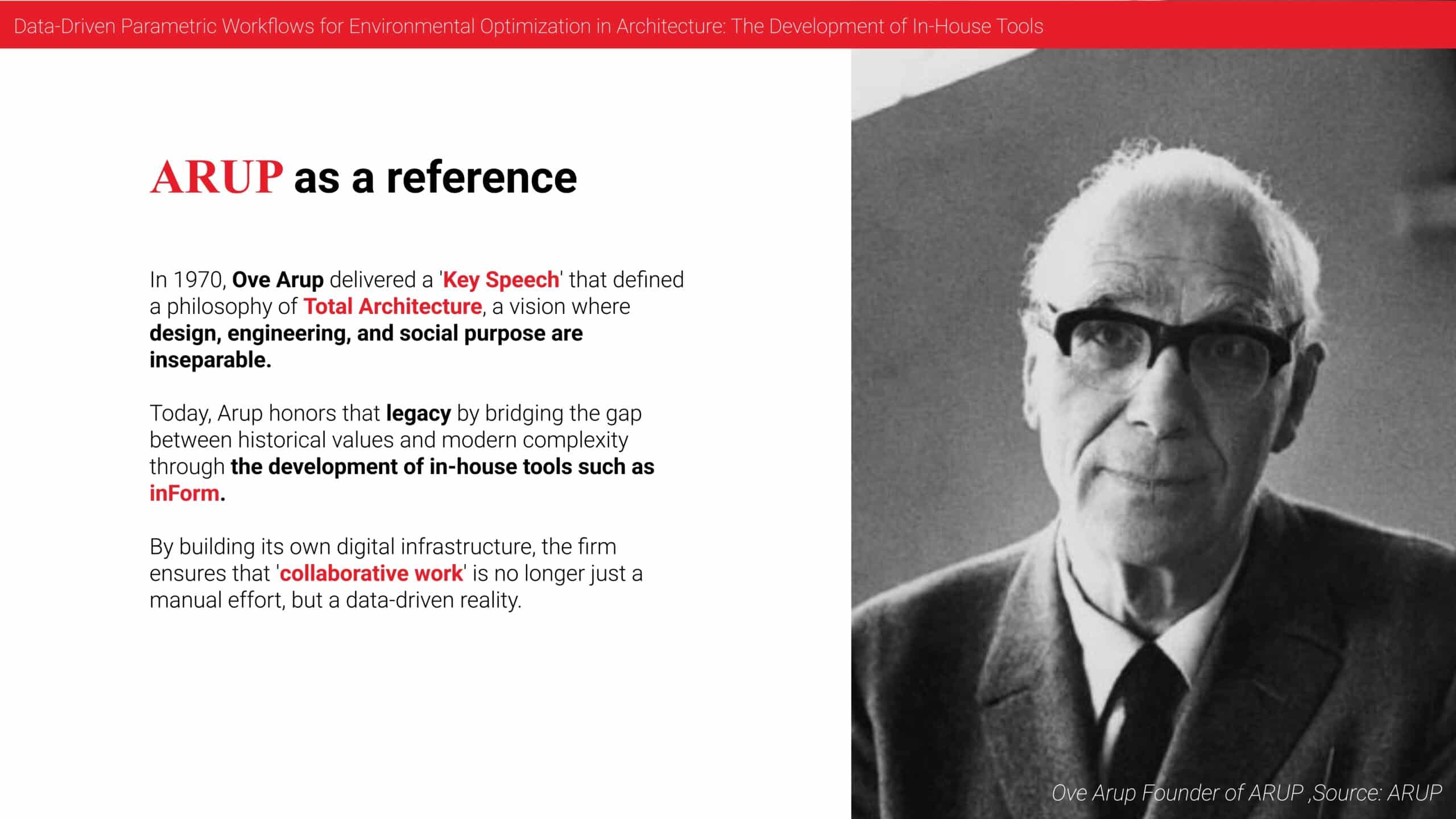
ARUP As A Reference
Interview With Expert 01: Rick Titulaer
Rania Chihaoui
For today’s session, we are very pleased to have Rick Titulaer with us, senior structural engineer and computational designer at Arup, participating in projects such as the refurbishment of the facade of Santiago Bernabeu and the current “Elements” residential project in Amsterdam. It’s a privilege to have this conversation Rick and to have you as part of our academic and professional network, your experience and perspective on computational design and environmental integration bring real value to our audience and we know our public is genuinely looking forward to this discussion.
Thank you for accepting our invitation and for taking the time to share your insights with us. We are truly grateful to have you here with us today.
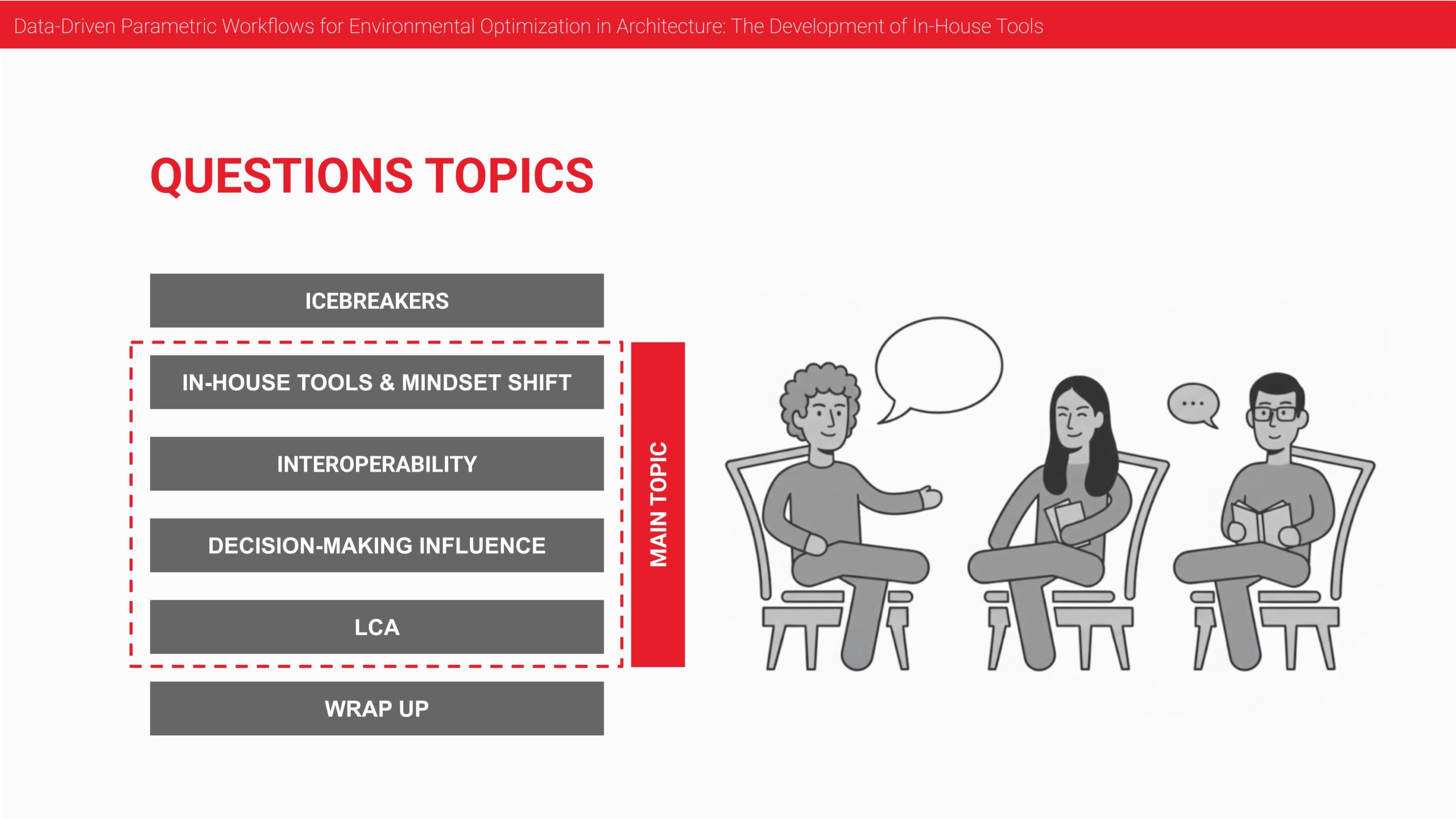
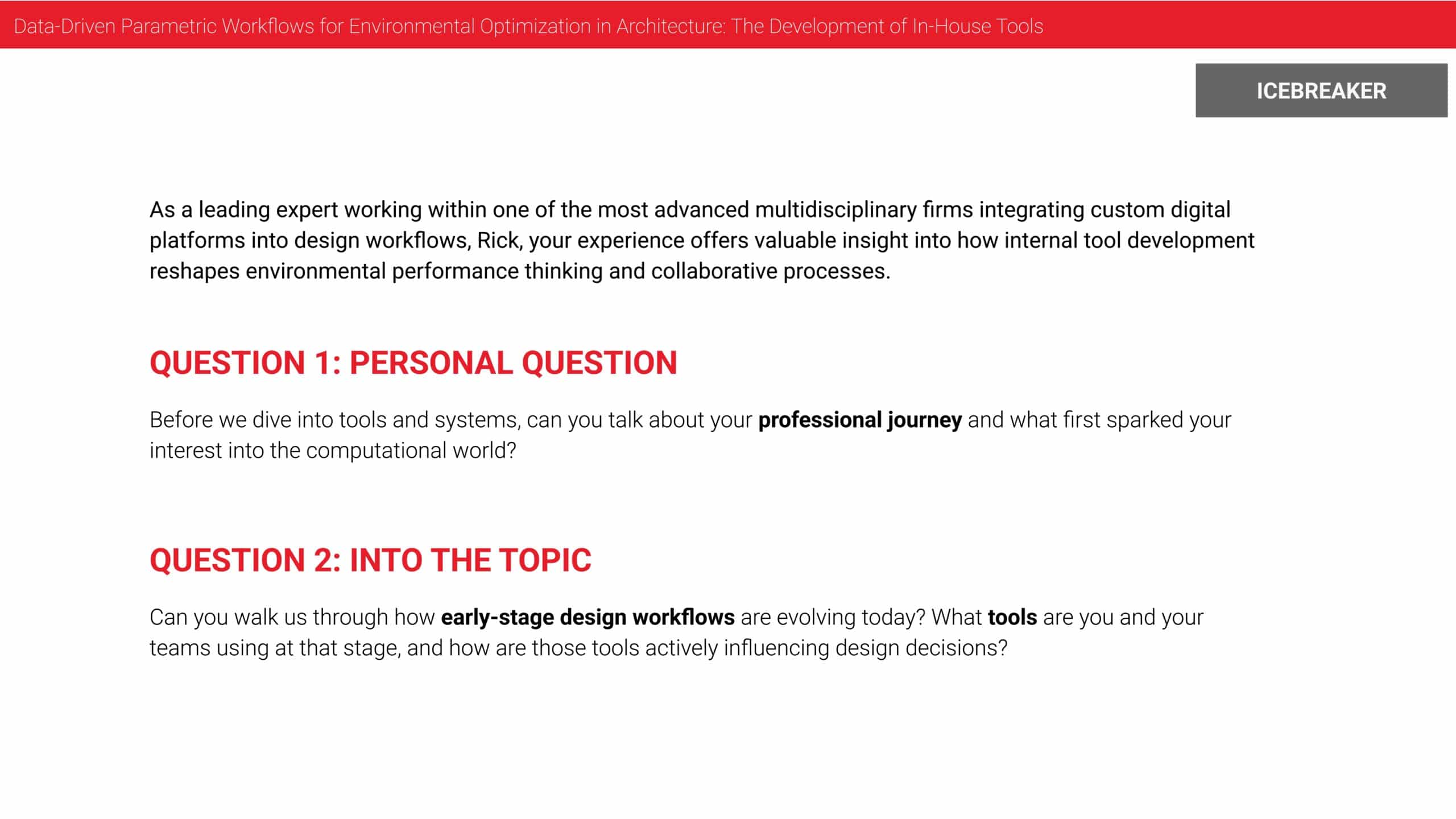
So before we dive into tools and systems, can you talk about your professional journey and what first sparked your interest into the computational world?
Rick Titulaer
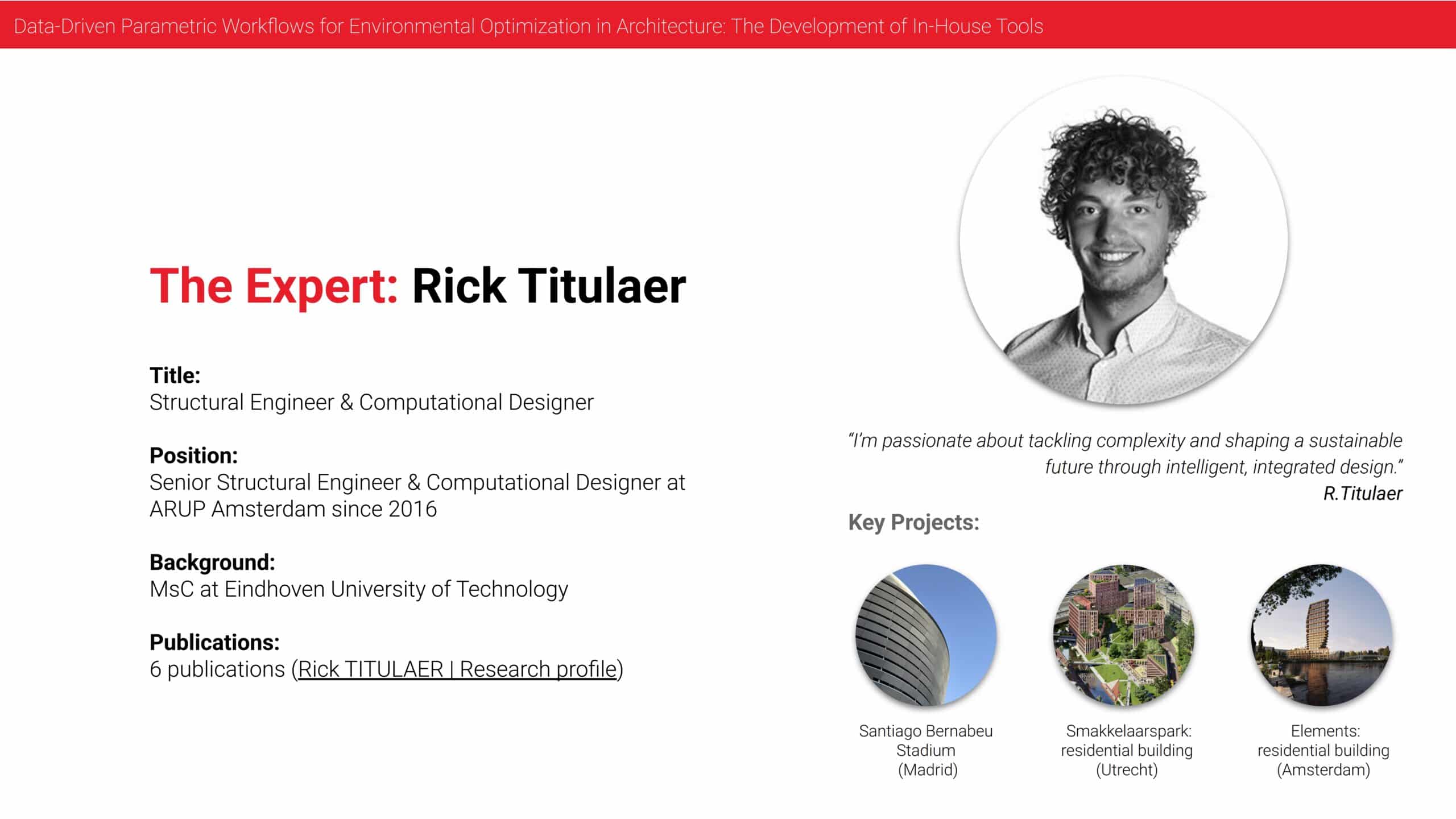
Yes, thank you for the introduction. For those who don’t know me, my name is Rick Titulaer. I’m a senior structural engineer and computational designer in Arup in Amsterdam. I was born in the south of the Netherlands. I did my studies in Eindhoven at the Technical University where I studied architecture and the built environment.
After that, I chose to specialize in structural design. So I did my masters in structural design and I graduated in 2016. Right after my graduation, I started as a structural engineer in Arup. I was fascinated by what my colleagues were doing with structural design, but also computational design. This sparked my first interest in how we can use computational design to explore more options, to automate the design and things like that. So right now my role is structural engineer and computational designer and I’m also the computational design skills network manager in Europe for Arup.
Andrea Cutroni
So, Rick, can you walk us through how early stage design workflows are evolving today and what tools are you and your teams using at that stage? And also, how are those tools actively influencing the decision making?
Rick Titulaer
Yes, very good question. First of all, I think we are living in interesting and challenging times. Interesting because we are living in a time where digital and AI are coming up and computational design, but challenging also because cities are growing and expanding and we are dealing with densification, more complex projects. We need to think about questions like comfort, sustainability and climate resilience. So both interesting and challenging. And this is where we think computational design can change things. By exploring different designs in the early stage, we can include all of these metrics from the start and therefore help our clients de-risk the design process in which we then have included all of these important KPIs from the start. So what tools are we using? We use mainly Grasshopper for early stage in combination with our internally developed platform called Arup InForm.
Grasshopper over the years we have collected an amount of analysis modules that can either do something on comfort or sustainability which we are able to reuse on all of our projects. In order to make important decisions on projects and to help influence design decisions, we push our Grasshopper scripts to our platform InForm, which is running our Grasshopper scripts with Rhino compute. This allows us to scale up so we can use batch computing where we can paralyze our computation process, as well as we can then store all the data and use interactive plots like the parallel coordinate plot, like many people will know, to explore the design and show the team and the design people how to make the decisions based on all the data that we have generated. So I hope that answers your question a little bit.
Andrea Cutroni
Yeah, absolutely.
Rania Chihaoui
It’s amazing, Rick. We’re actually learning how to use Rhino compute in this semester as well. This is really exciting.
Rick Titulaer
Nice! That’s very interesting.
Rania Chihaoui
Yeah. It is. It is indeed.
Andrea Cutroni
Yes.
Rania Chihaoui
For our next question. So Arup, you also talked about the grasshopper integration and the internal in-house platform like the Arup InForm. So can you please explain what is it about? How did building your own solution, probably within Grasshopper or within the software itself, can reshape the firm’s approach to environmental analysis and data-driven decision-making?
Rick Titulaer
Lots of questions. So maybe to start with the first one, as I mentioned before, our designs are becoming more complex. So we need to also comply with more rules and challenging design tasks. So with Inform, we try to make a platform which allows our clients to explore the design space interactively and see how one change might affect some KPI, but also allow our clients to create quantifiably better results. So they can actually prove to the municipality or to their board that they have designed a better building. And in the end, Inform also helps to collaboratively find the best fit compromise solution, because it’s not always easy to find the most optimal solution on a project, especially when you have multiple objectives that you need to either maximize or minimize. Therefore, having a platform like Inform, being able to play with your design and see collaboratively how a solution would score, that helps our clients a lot.
So that’s what we try to fill the gap because we saw back in 2019 when we started to build our platform InForm, we noticed that every time we do something in Grasshopper and we try to communicate it, it’s sometimes hard to convince a client. Whereas if we let them interact with the model, we let them interact with the results and together find a solution for a project or a design, we saw that that immensely helps decision making. So in 2019, we did that on the Santiago Bernabeu Stadium, where we prototyped an online viewer, where we played with the facade and let them interact with the model, which was really great.
And then afterwards, we had several projects that helped to develop this platform. This basically started off as an Amsterdam tool or platform and currently it is being used by Arup colleagues all over the world, which is really nice. And therefore, it starts to become more interesting, I think, because now we can also see what people in Sydney are building and we can try to collect that data and try to see maybe if we have in a few years projects from all over the world, we can train maybe AI or machine learning modules that then help us make even better decisions quicker.
I hope that answered the whole of your question. Was that clear enough?
Rania Chihaoui
That’s incredible, Rick, especially with the Santiago Bernabéu part.
Rick Titulaer
Nice.
Andrea Cutroni
So in Arup InForm, it’s not just about environmental analysis. So you can implement in our inform every grasshopper script. So is it implemented also for example, in other things like structural engineering?
Rick Titulaer
Yeah, so that’s a great question. We originally started off with environmental studies, but since the InForm platform runs any grasshopper script, we can do anything. So currently, people are building structural models for arenas or for towers and then exploring the design space through InForm.
We also have early stage massing projects where we not only do the environmental studies, but we also look at the concept for the structure, the weight of the building, and then also the settlements. Because in some projects, at least in the Netherlands, we had some challenges for some high-rise very close to a metro tunnel.
And therefore we had to predict the differential settlements and we wrote an algorithm to do that in Grasshopper. Since it’s then in Grasshopper, we would be able to ship it easily to Inform and then show the results there. So it’s very multidisciplinary, can be used on any scale like facade design to building design and even master planning. We did a carbon assessment for Madrid Nuevo Norte, a very large urban scale development where we built a tool through InForm, where the client could interact with some parameters to play with timber options and to get some results in quantities. So basically any Grasshopper script can go into InForm.
Andrea Cutroni
Amazing. Talking about collaboration, in many projects there is a natural distinction between designers, computational specialists, sustainability consultants. So computational tools allow designers to optimize performance early on, but those ambitions aren’t always carried through to later stages of delivery. So from your experience, especially with high-end projects, what strategies help ensure a stronger collaboration between these roles, so that optimization and KPIs remain central and can make the difference from the concept all the way to execution?
Rick Titulaer
Yeah, this is a very good question. And I think this is also the hardest part currently, even for us. So as we do many early stage projects, they often continue in a very traditional way after we’ve set sort of the rules. I think a key strategy to help ensure stronger collaboration, in our opinion, could be total design.
So having the interdisciplinary teams from the start, instead of having them join later in the process, like the sustainability consultants often come later in the process, but if you include them upfront in all the measurements or even high level, that could be very helpful in the early stage. Another strategy could be to embed performance metrics directly into design workflow rather than treating them as an external report.
And finally, I think also digital interoperability is crucial. So once we have a design coming out of InForm, how can we then push it into Revit or how can we make sure that the results are tracked throughout the design phases. Currently we’re also still facing this challenge. That’s a very hard thing, I guess.
Andrea Cutroni
Yeah, it’s the real challenge for all of us.
Rick Titulaer
Yeah, exactly, exactly.
Rania Chihaoui
It is super nice that you also mentioned total architecture, that’s also very Arup philosophy as well.
Rick Titulaer
Exactly. I’ve been taught well.
Rania Chihaoui
Yeah I can see that. Moving to the next question. You have an outstanding experience in landmark projects that helped into the evolution of Arup’s internal tools themselves. So of course the software is shaping the project but do you think like there were those projects that helped you rethink like this could be changed, maybe this could be optimizing the softwares themselves. Can you talk us through those experiences? Or the situation if it ever happened?
Rick Titulaer
Yes, I think that’s also a very good question. I think Elements is one of the projects where, like many projects, we learn a lot even on the computational design part. With Elements, we did the shaping of the tower according to the elements, so daylight and sun and wind and green.
It basically resulted in a revolution of InForm. So Inform was at some stage and Elements helped it become a better version. I think it all started for me, at least and maybe for Arup Amsterdam, in 2017 when we did Smakkelaarspark in Utrecht. It’s also a massing study which we did in a competition phase where we started to do this multi-objective optimization or exploration, where together with the client and the architect we set out some rules, some boundary conditions, some objectives and then started to optimize the massing on multiple KPIs and not only environmental, but also we aim to do something social, and then after that project we decided or we found out that it could be reused on other projects like Elements and now also other projects that are using these analysis modules. So I think in some way, projects have shaped the way we work, the way we analyze things and explore things, as well as the questions become more challenging every time,
I said before, for one project we had to do the differential settlements for a metro tunnel, which we had not done before, but we always did the sun hour analysis and the view analysis. It’s nice that every time we do something new, then we can expand our library and then help new clients to do the same thing better, and not for every project we need to do differential settlement studies, but it’s nice how we can differentiate our expertise like this.
Rania Chihaoui
That’s great. Thank you very much.
Andrea Cutroni
And looking ahead, Rick, how do you see digital design tools evolving in coming years? You talk, for example, about AI. So what developments could most significantly enhance the automation and collaborative integration of all kinds of analysis into the design processes?
Rick Titulaer
So I think the next phase in digital design tools will be about integration and intelligence.
We also already talked a bit about how an early stage design could progress over the design phases. So integrating these tools and analysis modules and keeping that consistent over the design phases is important. So we already have powerful tools for modeling and simulation, but they are often fragmented. The next step is connecting them into a more intelligent design platform where geometry, performance analysis and optimization work seamlessly together. And secondly, artificial intelligence AI will also play a growing role.
It is my feeling, especially in exploring design spaces and identifying promising solutions, especially in multi-objective design spaces, which can grow significantly large in scale. But I also think the human part, the designer will remain essential, because design is not only about optimization, but also about culture, social aspects and architectural intent. So I think that is a very interesting future, I would say.
Rania Chihaoui
Great, Rick. Wrapping up, so do you see yourself in the future developing your own independent plugins or digital tools, either within Arup or beyond it? And what are your main dreams and ambitions about the future?
Rick Titulaer
So on the first question, personally, I’m very interested in developing digital tools that help teams explore more complex design questions quickly and collaboratively. So we’re going to further develop Arup Inform. We are thinking about maybe making it externally available. So we don’t know yet, but that’s some discussions we’re having.
That helping of developing digital tools will be internal like Inform or external by developing plugins. I think the goal will be the same to enable better decision making in the design process. And then to answer your second question about my dreams. I think…
Yeah, the dream is to continue like this. I think we are on a really nice path with our platform, with our computational design projects, with our community. So it’s very nice to see, for example, within Arup, there are more than 1200 people express their interest in computational design. So the community is internal, very big, but also what you see in the market, it’s growing.
Thanks for the invite for the podcast, because I think it’s a very important topic and also in school and in universities to go into depth in computational design. I’m wandering off. But my dream would be to work on some more very nice projects, of course. I don’t know if another Santiago Bernabéu is possible, but that would be the dream of course we never know so yeah that that’s in a nutshell
Andrea Cutroni
Thank you so much, Rick. It’s been a pleasure. Thank you for your time, for the depth of insight that you shared with us today. It’s truly inspiring to see the effort that you and your team are putting on developing those in-house tools to really enhance the data-driven workflows and environmental optimization, structural optimization and we really admire how Arup is shaping the future.
Rick Titulaer
Nice, thank you Andrea. That is very nice to hear.
Rania Chihaoui
We genuinely really admire the impact of your team and, of course, and what Arup is bringing to the industry. And it really has been a pleasure. Thank you very much. Any final words?
Rick Titulaer
Thanks for the invite and I’m really looking forward to see you become great computational designers and if you ever have any questions then feel free to contact me.
Rania Chihaoui
Thank you.
Rick Titulaer
Thank you so much.
Henning Larsen As A Reference
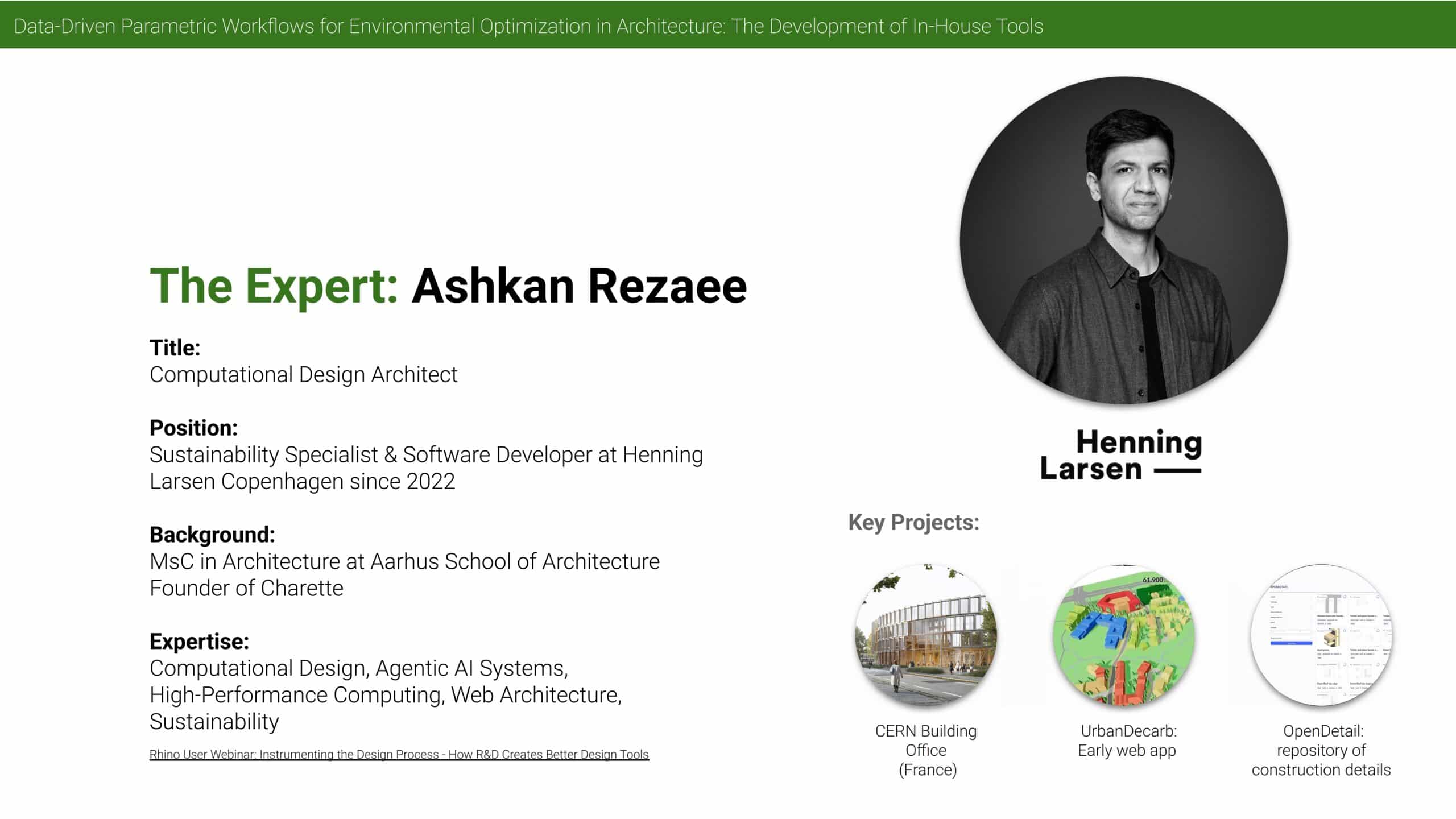
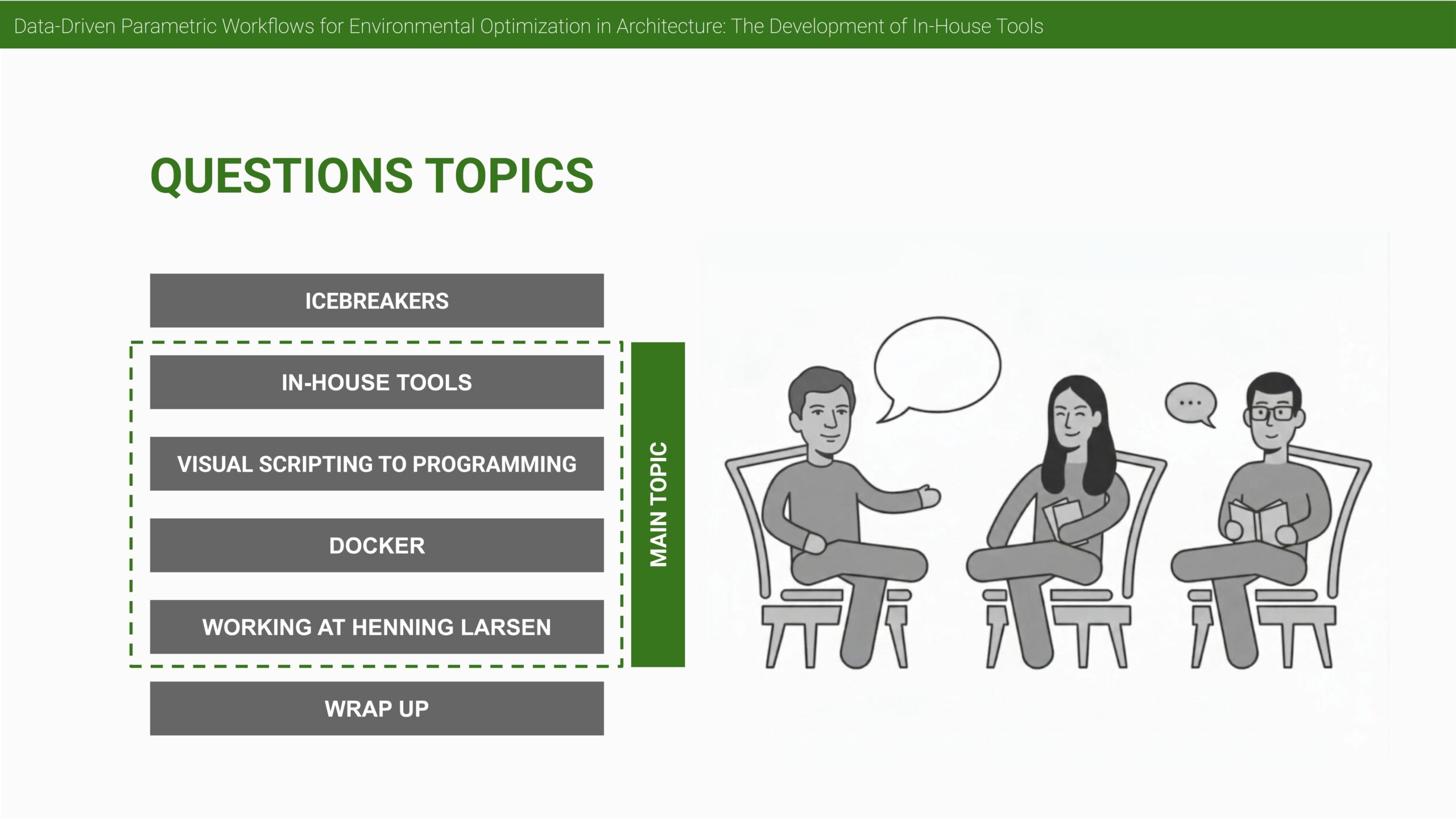
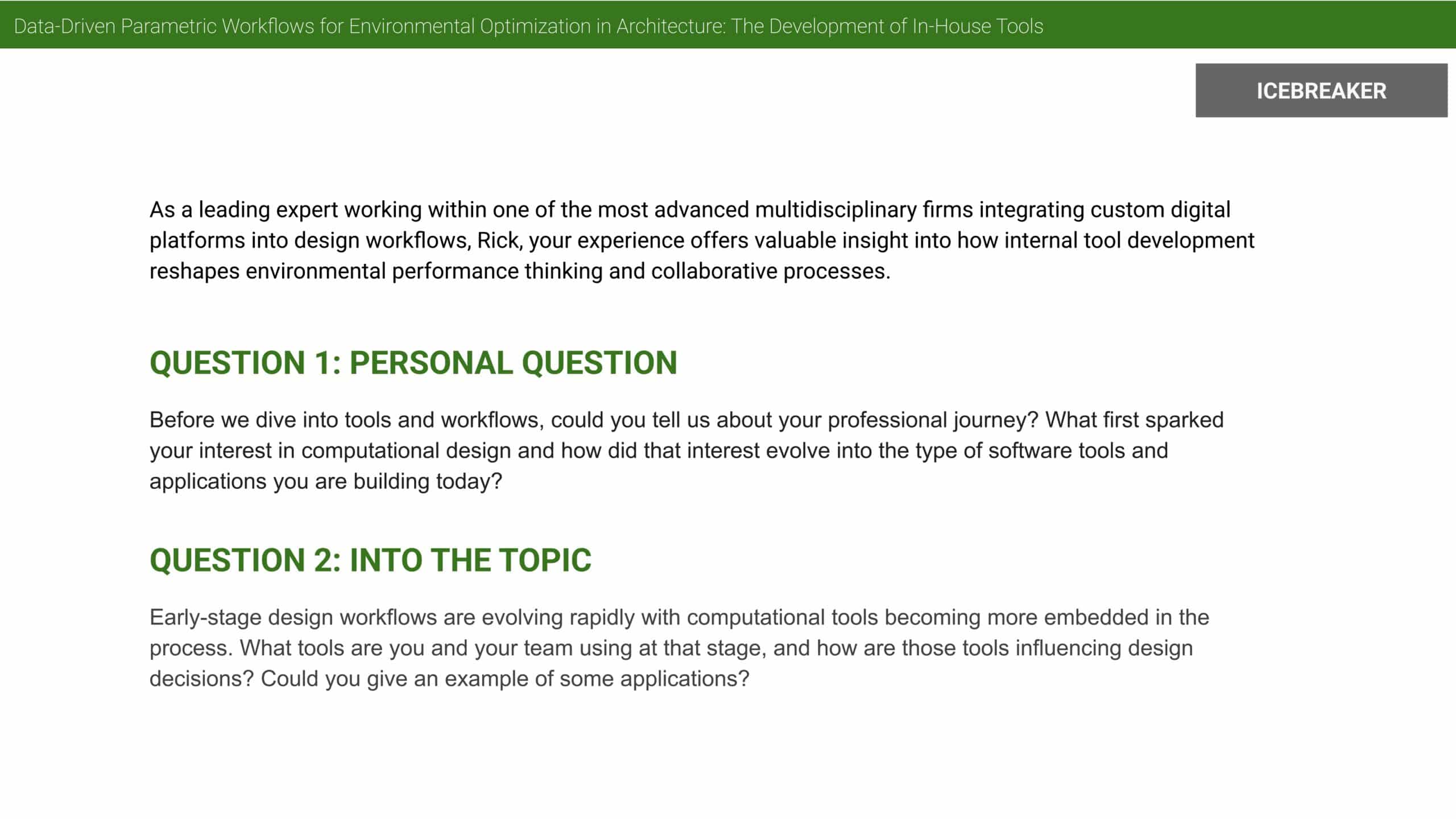
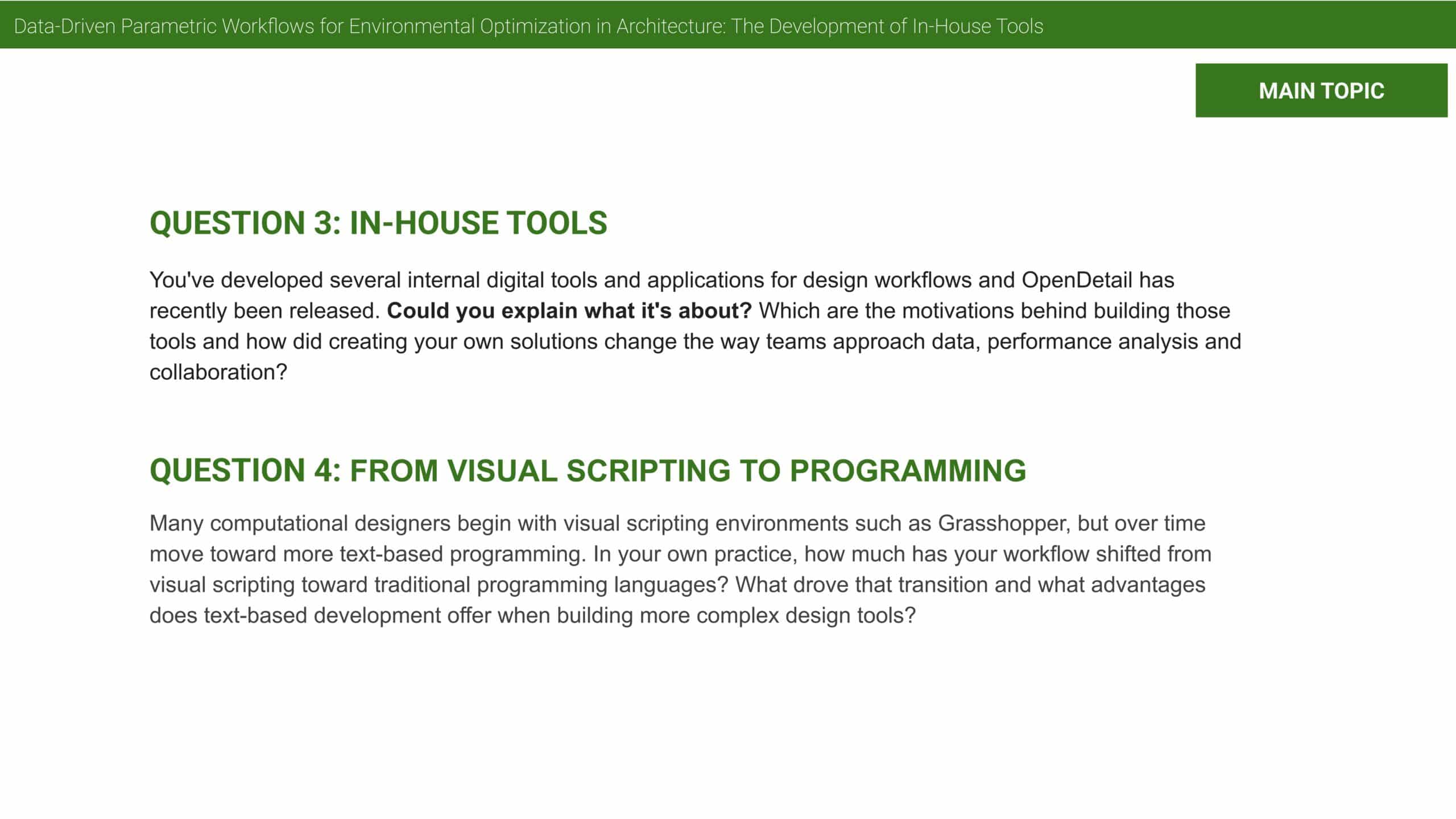
Interview With Expert 02: Ashkan Rezaee
Wrapping Up
In conclusion, this research and the accompanying podcast have highlighted how the AEC industry is moving toward a more integrated, data-driven future. By exploring in-house tools like Arup’s inForm and Henning Larsen’s custom digital workflows, it is clear that early-stage environmental analysis is no longer just a luxury but a fundamental driver of sustainable design.
We truly enjoyed the experience of producing this podcast, as it allowed us to engage directly with industry experts like Rick Titulaer and Ashkan Rezaee to bridge the gap between academic theory and professional practice. We used Riverside to record these sessions, which provided a seamless platform for high-quality collaboration.
This is an experience we definitely plan to expand in the future as we continue to investigate the intersection of architecture, software engineering, and environmental performance.