
MUTAVERSE is an AI-powered reality mutation engine. The project began with a simple speculative question:
What if one architectural image could evolve into multiple alternative realities while still preserving its original identity?
From Image Styling to Reality Mutation
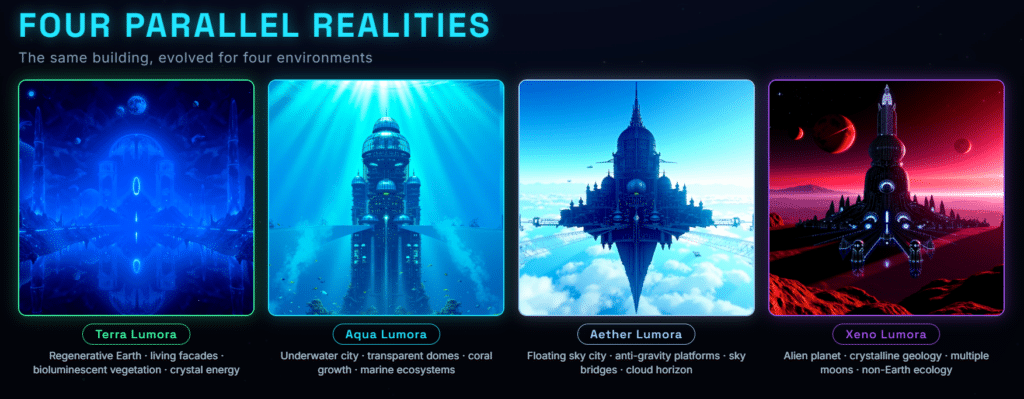
Rather than using generative AI only as a visual styling tool, MUTAVERSE explores how architecture can transform across different worlds, environments, and atmospheres. The project takes a single building image as input and generates four parallel design futures: Terra, Aqua, Aether, and Xeno.
The main idea is clear:
Architecture is preserved. The world evolves.
Training the Lumora Visual Language
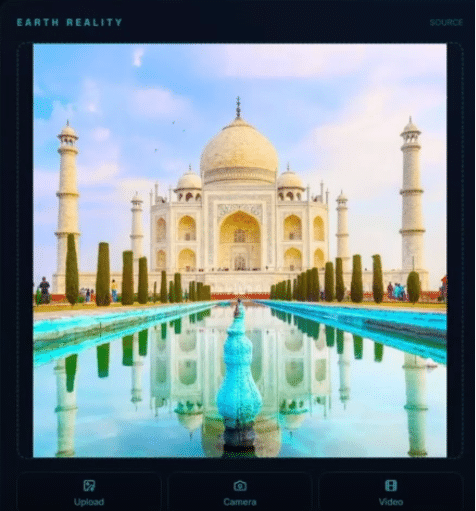
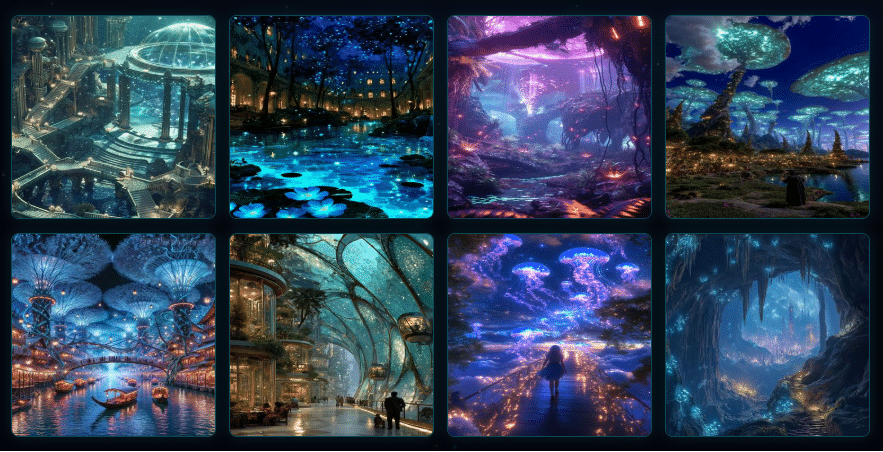
For the training process, we curated a dataset of 29 images representing this visual direction. Each image was captioned with the trigger word nisush_lumora, together with descriptions of materiality, lighting, mood, geometry, and atmosphere.
The LoRA was fine-tuned on FLUX.1-dev with Rank 16 training for approximately 2,000 steps.
Because the style was learned from our own dataset, the generated outputs became more coherent and recognizable as part of the same speculative universe.
INTERFACE: frontend.
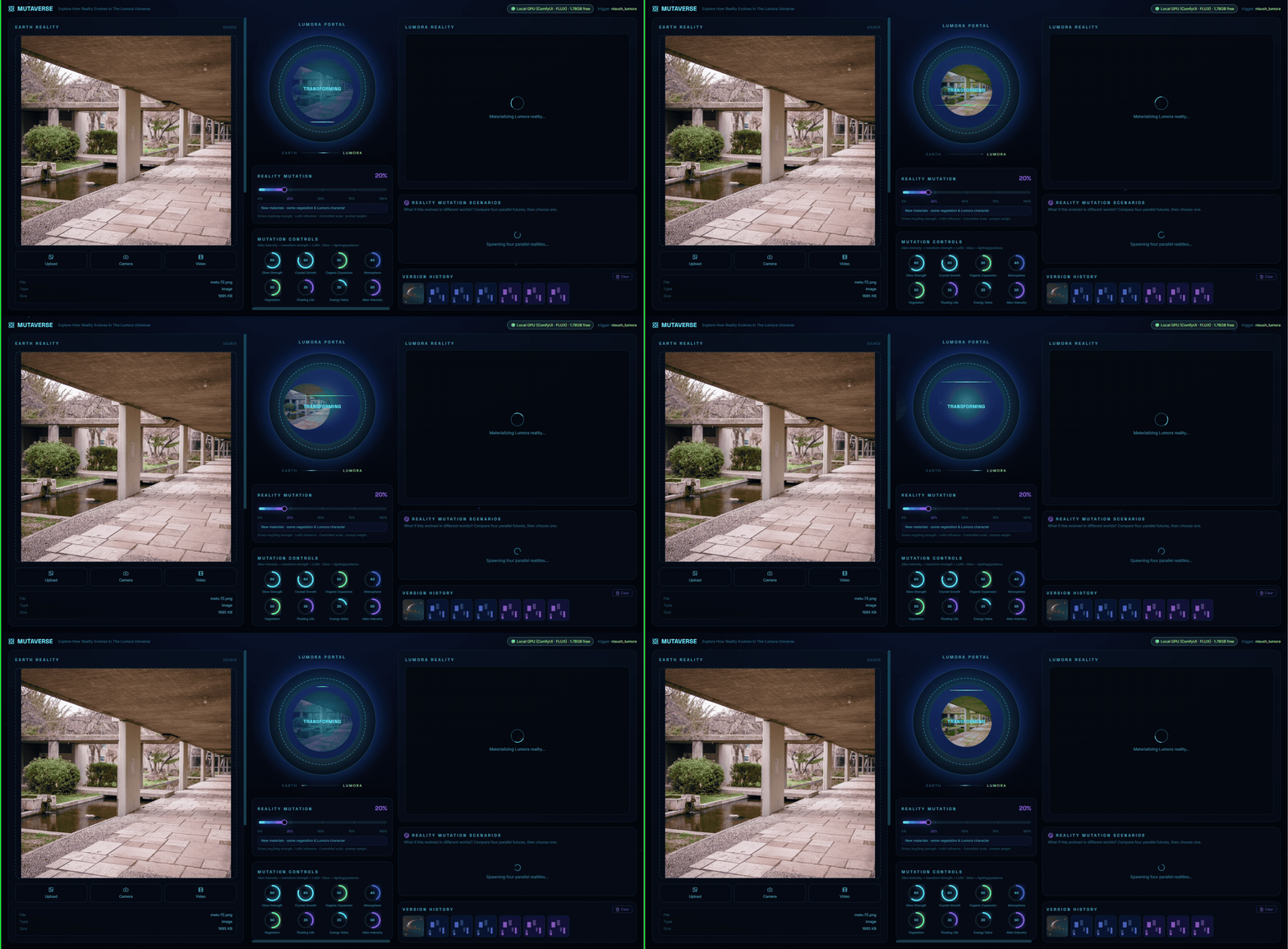
INTERFACE: backend.
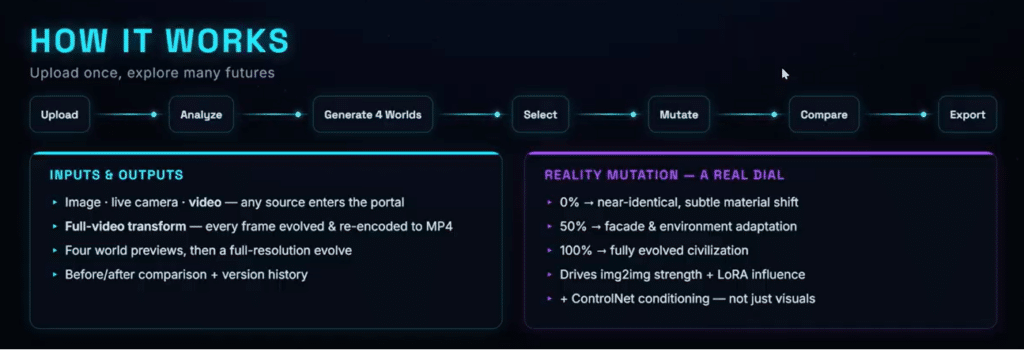
The MUTAVERSE workflow combines scene analysis, prompt generation, LoRA-based transformation, and structural preservation.
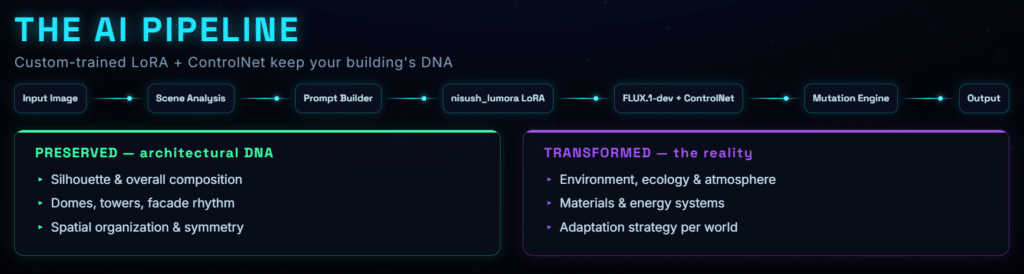
First, the uploaded image is analyzed to understand the architectural scene. Then, the system generates a world-specific prompt based on the selected reality. The image is transformed using FLUX.1-dev together with the custom Lumora LoRA.
To preserve the original architectural structure, the pipeline uses ControlNet with Canny Edge and Depth conditioning. This helps maintain the building’s silhouette, geometry, symmetry, and composition.
The pipeline separates two important tasks:
ControlNet preserves the architectural structure.
The mutation engine transforms the world around it.
This balance between preservation and transformation is what allows MUTAVERSE to keep the original building recognizable while still producing radically different speculative environments.
MUTAVERSE is not limited to static image uploads. The system can also accept live camera input and video sequences.
For video, the project transforms frames individually and re-encodes them into a Lumora-style clip. This expands the project from architectural image generation into animation, cinematic previsualization, and worldbuilding.
Although fully temporally consistent video generation remains part of the future roadmap, the current workflow already demonstrates how the system can move beyond single images and begin to operate across time-based media.
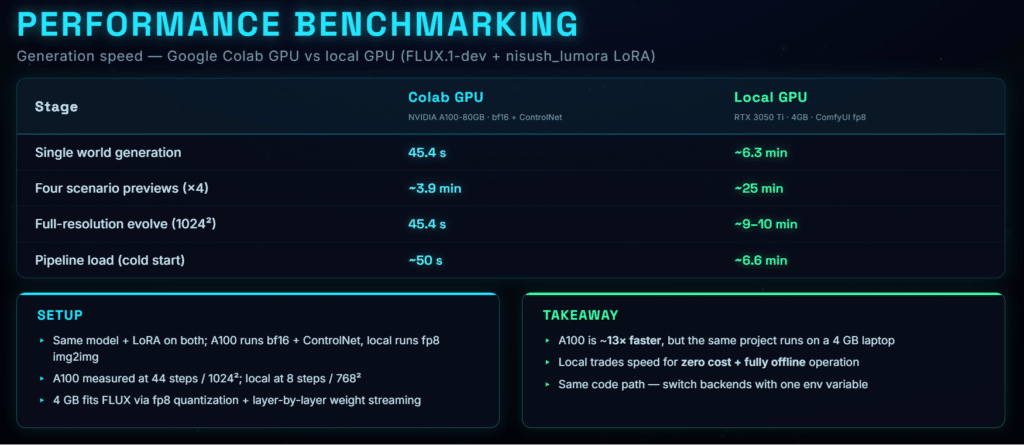
On a cloud NVIDIA A100 GPU, one world generation takes approximately 45 seconds. The same workflow was also tested locally on a 4 GB laptop GPU through ComfyUI with FP8 quantization, where each image takes around six minutes to generate.
The A100 setup is significantly faster, but the local deployment proves that the system can still run on consumer hardware. This makes the project more accessible and shows that the same model, LoRA, and workflow can scale from a datacenter GPU to an offline laptop setup.
Applications
MUTAVERSE can be used as a speculative design and worldbuilding tool across different creative fields.
For architects, it offers a way to quickly imagine how one building could adapt to different environmental conditions. For game designers and animators, it can generate coherent world variations from a single spatial asset. For researchers, it opens a discussion about how generative AI can be used not only for image styling, but also for exploring adaptive futures.
Potential applications include architectural concept design, speculative urban futures, game environment design, film previsualization, animation workflows, and research into adaptive design systems.
