
Design via Experimentation with the Black Box
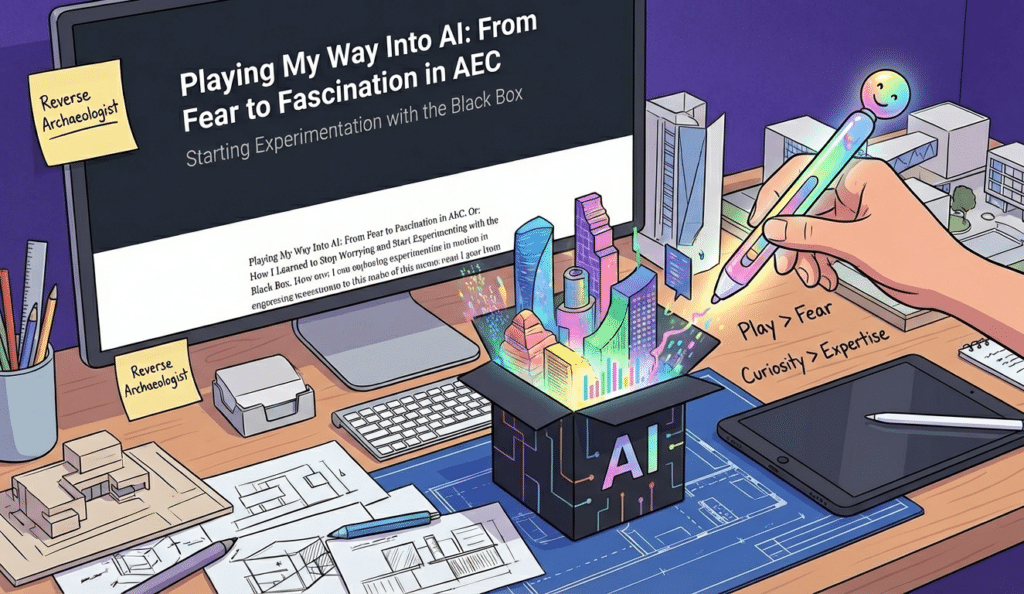
When I started my MaCAD program this semester, AI felt like a threat. As an industrial designer, I saw it as this incomprehensible pattern-finding machine that could somehow analyze thousands of products simultaneously, finding relationships I’d spend years trying to notice. The black-box nature terrified me—I couldn’t trace its logic, couldn’t learn from it, couldn’t defend its decisions to clients. Three months and several guest lectures later, I’m writing this from a completely different place.
The Shift
The transformation started when I stopped seeing AI as one monolithic force and began understanding it as an ecosystem of specialized tools. Each has its strengths, its quirks, its limitations. More importantly, I realized I didn’t need to understand every parameter to use them effectively—just like I don’t need to understand every chemical reaction in concrete to build with it.
Luca Prasso’s lecture hit different. Here’s someone who worked on Shrek (my childhood favorite!) calling himself a “Reverse Archaeologist.” He’s spent decades jumping between Google XR, synthetic data generation, AR/VR—always playing, always experimenting.
Watching him describe how these technologies keep reappearing throughout his career was revelatory. AR, XR, AI—they’re not separate revolutions. They’re part of an ongoing evolution of tools for bridging digital and physical worlds. But what really stuck with me was his approach: he doesn’t just work with technology, he plays with it. Breaks it. Recombines it. Has fun with it.
That’s when it clicked: mastery isn’t about understanding every tool perfectly. It’s about maintaining curiosity and grabbing whatever helps you realize your vision.
Sergey Pigach from Thornton Tomasetti brought me back to earth, demonstrating real-world AI applications in AEC today. AI agents handling complex building performance analysis that would be impossible manually. Am I still wrapping my head around how to implement them? Absolutely. But that’s okay—that’s part of the play.
My Way is Through Play
I’ve never really thought AI would completely replace me. But I’ve discovered something more important: play is my way into this world. Not defensive use, not just debugging code, but genuine experimentation. Messing around. Breaking things. Discovering happy accidents.
Now I use AI image generators as rapid ideation tools early in design. I explore spatial qualities without fear. I’ve moved from asking “Will this replace me?” to “What can I explore with this?”

Looking Forward
The real purpose of AI in AEC isn’t to automate design—it’s to handle computational complexity, freeing us to focus on what humans do best: understanding context, making ethical decisions, creating meaningful spaces for people. And for me? That journey starts with play.
AI will be in everything. The question isn’t whether to engage with it, but how. For the coming trimesters of MaCAD and my career beyond, I’m choosing curiosity over fear, experimentation over expertise, and play over perfection. What’s the next thing I can explore and learn from? I can’t wait to find out.
