The MaCAD is a unique online programme training a new generation of architects, engineers and designers ready to develop skills into the latest softwares, computational tools, BIM technologies and AI towards innovation for the Architecture, Engineering and Construction (AEC) industry.
How much kgCO2e does our HyperBuilding weight?
Introduction Life Cycle Assessment (LCA) is increasingly required in the building industry, yet it remains difficult to integrate into the design workflow. The challenge is that LCA operates across multiple scales, from macro-level building decisions to micro-level material choices. This is especially relevant for designers, since they have to engage with these considerations from the … Read more
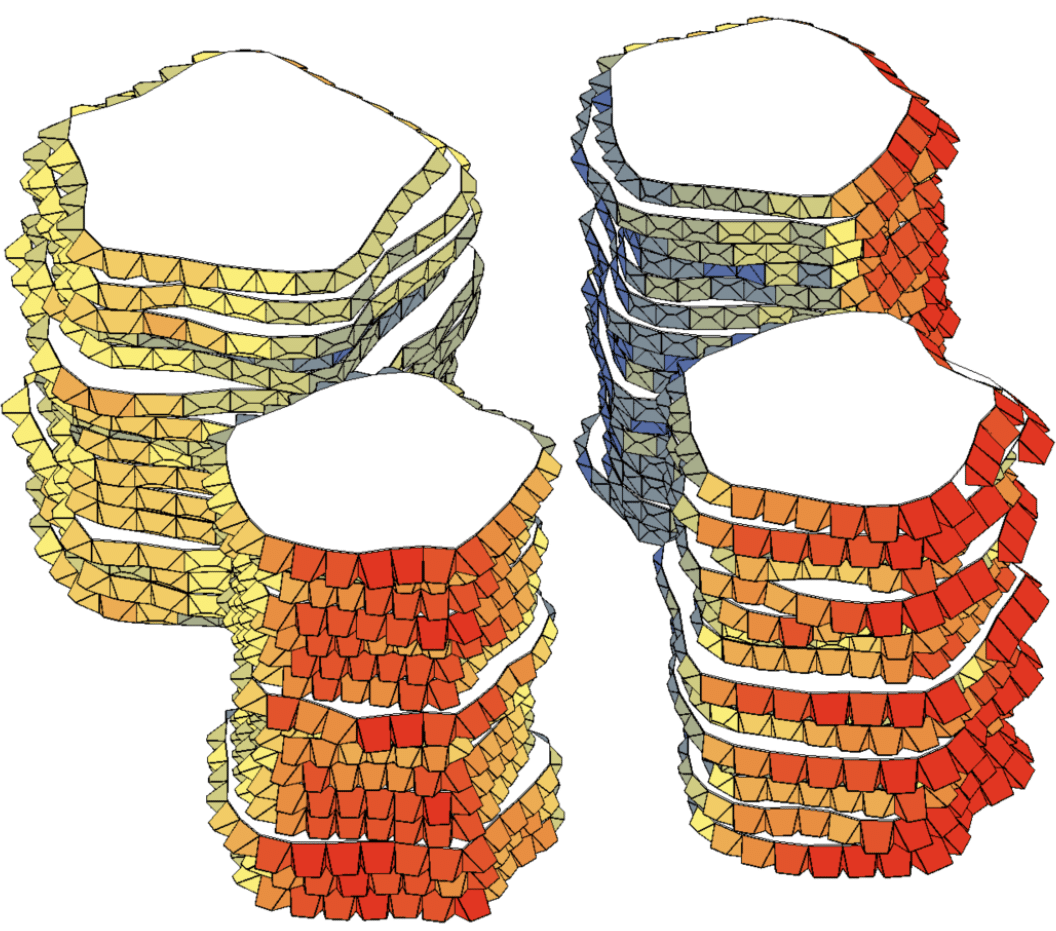
Architecture as Living Matter: Turning Data into Geometry
Introduction Hyperbuilding 03 In our project, the building is conceived not as an isolated object, but as a vertical living tissue within the broader human organism of the “Vertical Machine”. Much like a network of functional cells, it sustains life, maintains environmental balance, and coordinates with the system’s “lungs” and “heart.” This biological metaphor guided … Read more
Automated Cloud-Based Metadata Extraction: HB01 – Program Team
An automated pipeline that transforms raw 3D model metadata into structured cloud spreadsheets. This makes complex geometric data easily accessible and adaptable for various end-uses, from simple data reading to feeding live web platforms. Problem Statement Streamlining Complex Metadata Communication Communication across large design teams presents a significant challenge due to the massive volume of … Read more
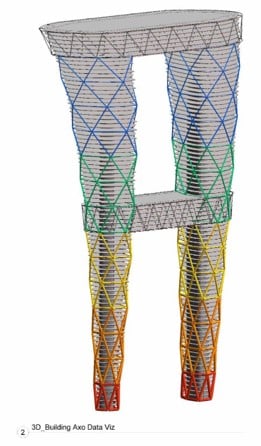
Integrative Modeling – HB03 – Structure & Façade
This is part of the Integrative Modeling Seminar, within the Hyperbuilding studio, where three hyperbuildings were developed in parallel. We are presenting Hyperbuilding 03 from the perspective of the Structure & Façade team, focusing on how integrative modeling was developed using Revit and Rhino Inside Revit. In the studio, the work is organized into three … Read more
Data-Driven Parametric Workflows for Environmental Optimization in Architecture: The Development of In-House Tools
Intro In recent years, the AEC industry has begun rethinking traditional linear workflows, where environmental analysis often comes too late to meaningfully influence design. The development of in-house tools, shows how integrating environmental analysis into parametric, data-driven processes can guide decisions from the outset. Topic This research investigates how in-house software tools developed by AEC … Read more
Integrative Modeling – HB01 – Structure/Facade
The Alveolar Spine – The Lung Analogy The core of Hyper building 01 is defined by the Alveolar Spine. Taking inspiration from the human lung, we’re developing a porous structural core that mirrors the function of the bronchi Defining the Volume To translate this concept into a working hyper building, we are implementing a data-driven … Read more
Turning Data Into Geometry: Rhino.Inside Revit workflows for modelling & documenting
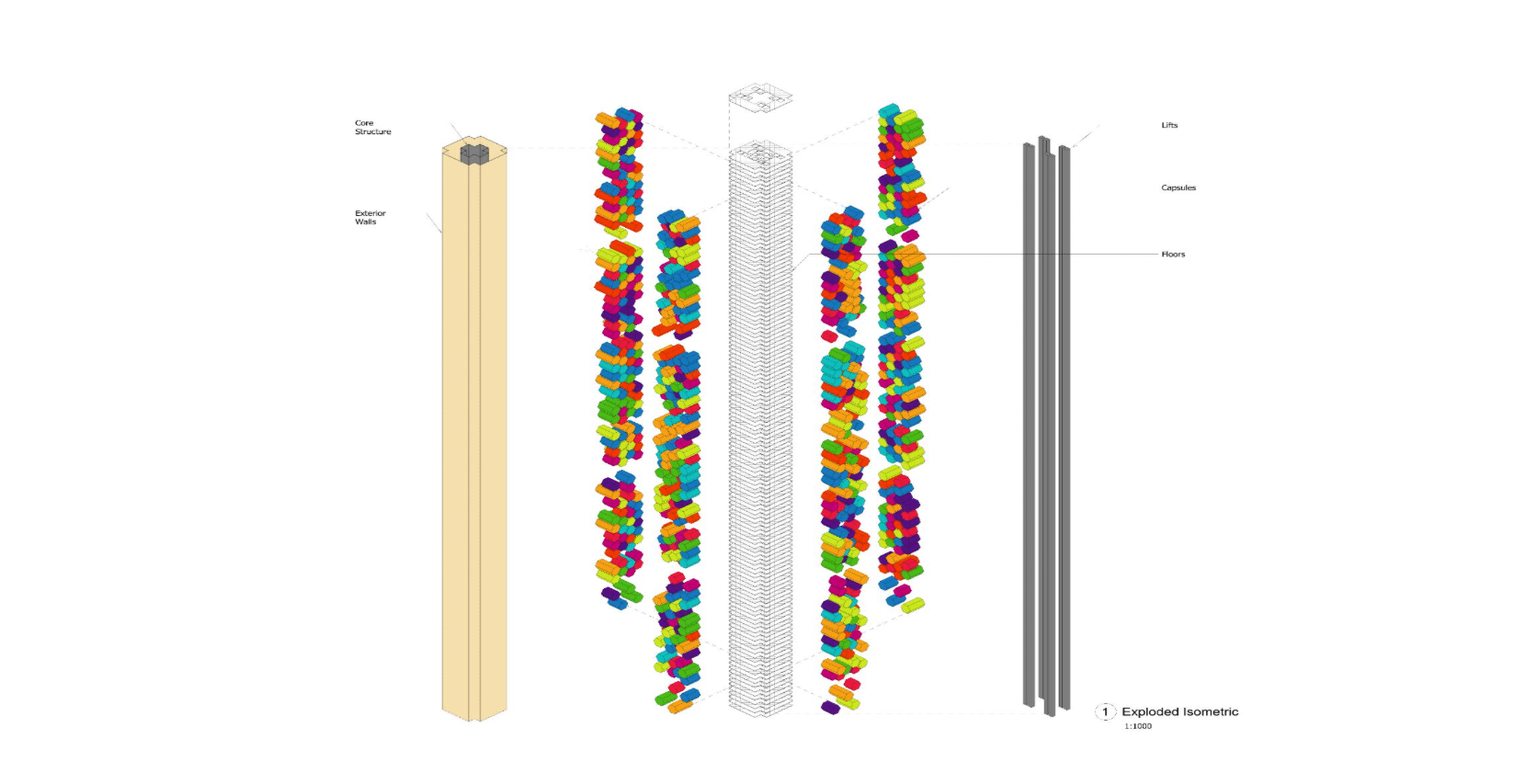
In the MaCAD Studio Seminar, our group worked as the Data Team for Hyperbuilding 01, one of three interconnected megastructures designed for Santiago de Chile, which together work as a single, cohesive vertical machine. Hyperbuilding 01 operates as both lung and skin for the urban environment. In response to Santiago’s severe air pollution, the building … Read more
Living Cubos
Living Cubos is a web-based voxelized geometry analysis tool developed in Grasshopper using the VoxelTool plugin. The goal of this project is to explore how voxel geometry can connect design decisions with material performance and environmental impact. The system allows users to interact with a parametric model directly through a browser interface. By publishing the … Read more
Street Cast
A parametric pedestrian simulation tool designed for event organizers, pop-up market curators, and temporary activation planners operating in urban pedestrian corridors. The tool allows users to place a programmatic attractor within a defined corridor and simulate how it redistributes pedestrian flow in real time. By adjusting parameters, users can predict where foot traffic will concentrate, … Read more
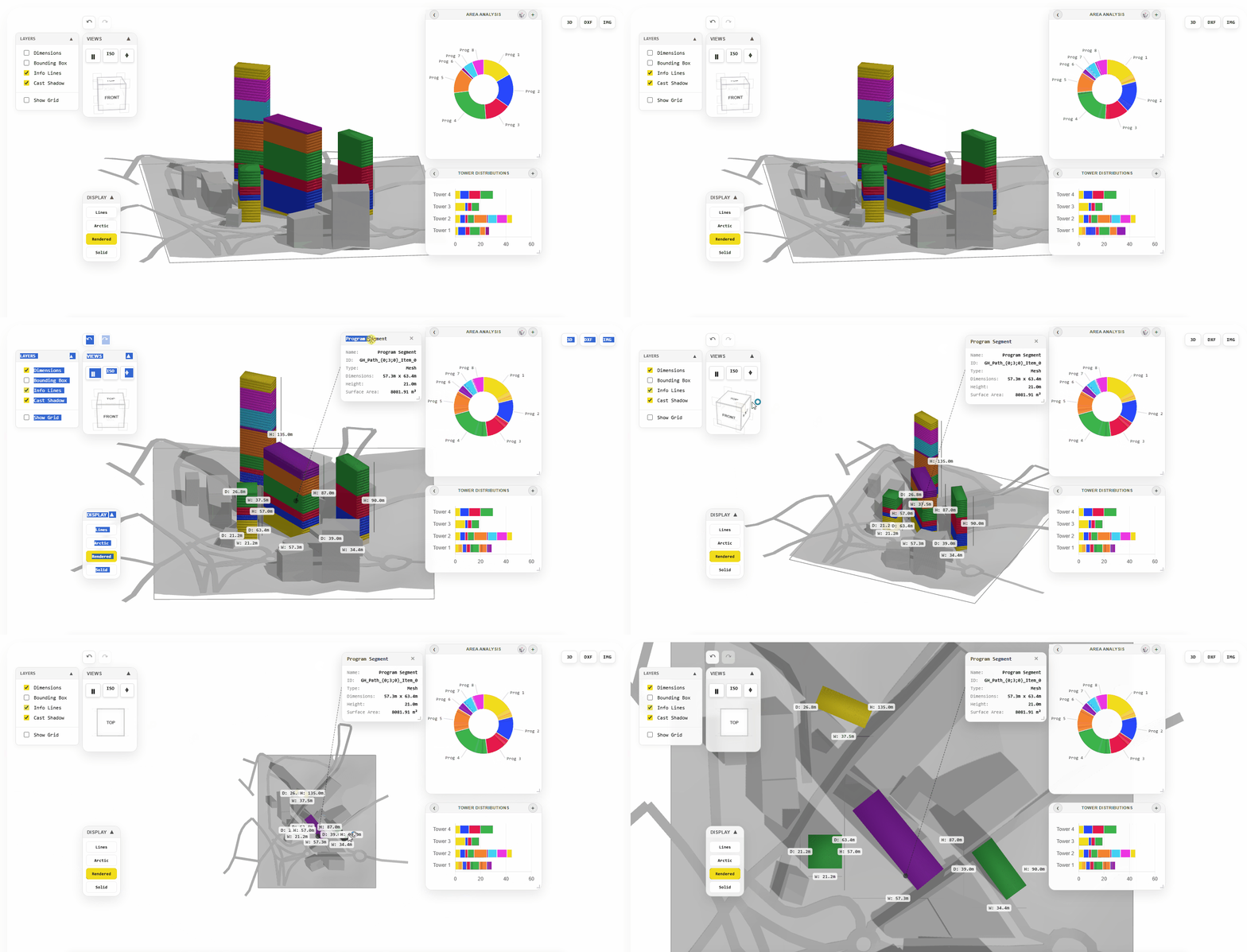
From Model to Metrics: Automating Program Analysis with Speckle
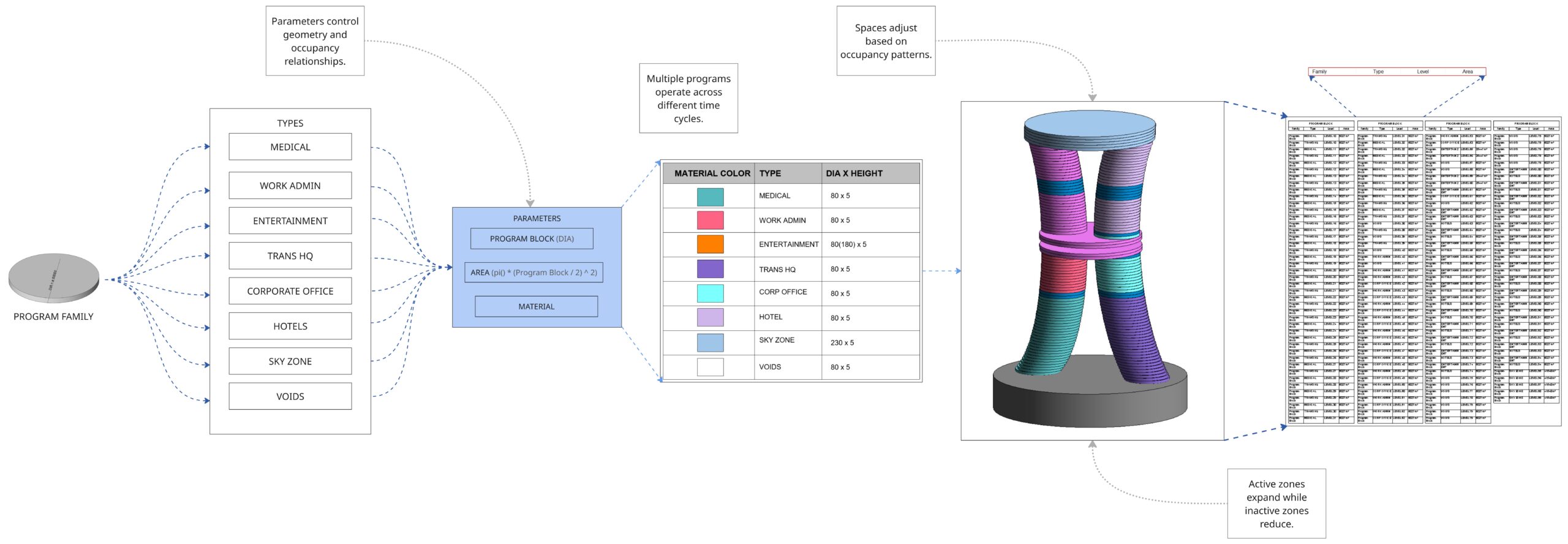
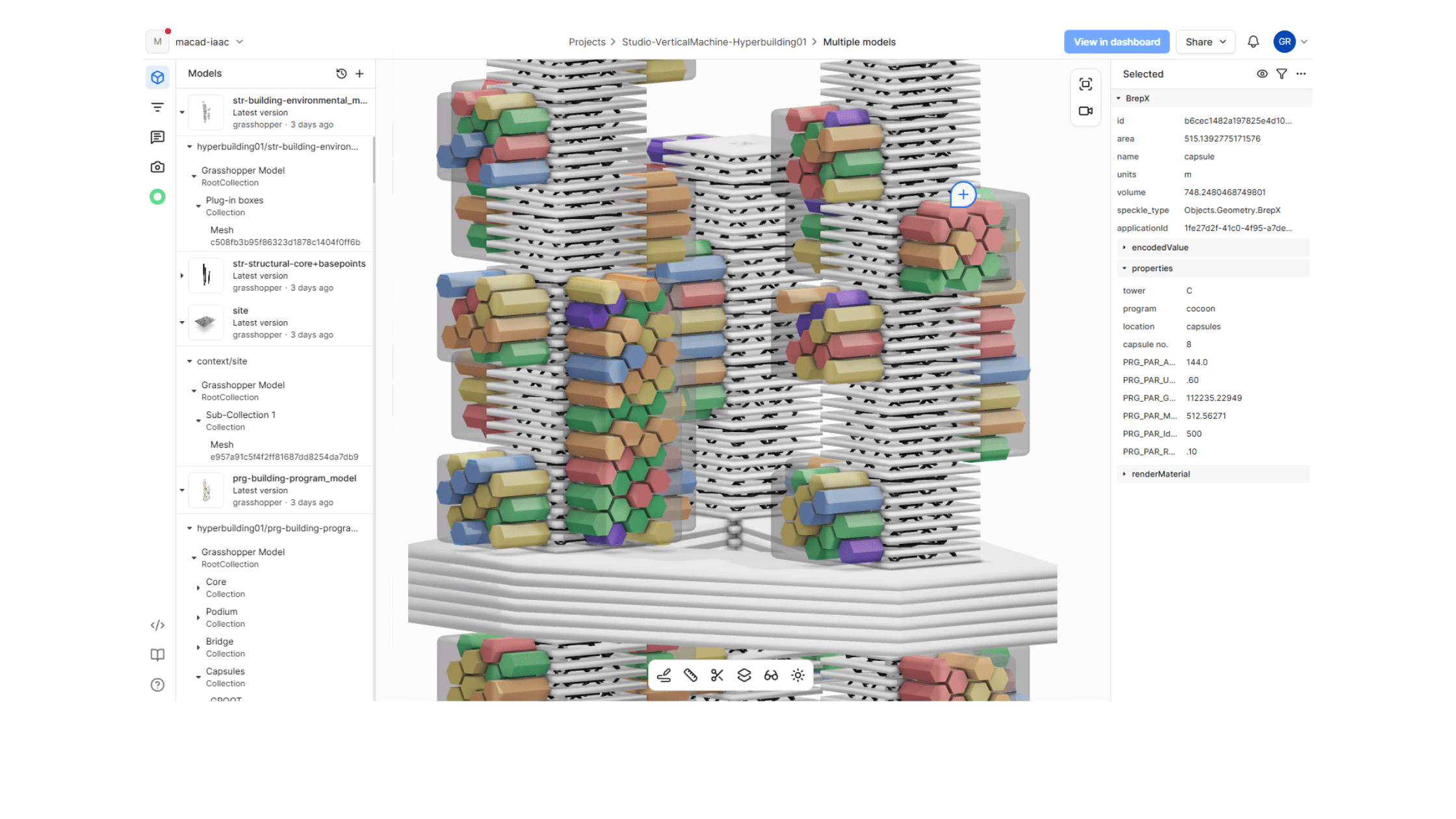
Problem & Context As Program team we faced a lot of challenges regarding data collection, data management and KPI monitoring which resulted in delayed and not efficient outputs we could present to our Data and Structure & Facade teams of our Hyperbuilding 02 Studio project. The manual data management proved to be time consuming and … Read more
ThrowForm: Pottery Configurator
A simple app that turns a draggable profile curve into a fully customizable pottery form and exports a 3D-printable shaping tool to bridge the gap between computational design and hands-on wheel throwing. Pottery is one of humanity’s oldest crafts, shaped by hand and refined through repetition. ThrowForm is a web-based tool that lets you sculpt … Read more
Automated workflow to extract KPIs from versioned models in Speckle
Automated Workflow for KPI Extraction from Versioned Models in Speckle Why KPI Tracking Breaks Down During Iterative Design In the current studio workflow, KPI extraction and performance evaluation depend on repeated manual operations across design iterations. This slows down feedback, introduces version mismatch risks, and disconnects analytical outputs from the model itself. This tool was … Read more
FluxFaçade
Our project is Flux Façade, a collaborative workflow for data-driven parametric façade design.The project was developed by Team 3.2 as part of the Collaborative Workflow Seminar in the Master in Advanced Computation for Architecture. Flux Façade focuses on improving how environmental analysis and façade geometry interact within the design workflow. Problem Statement In large architectural … Read more
Digital Tools for Collaborative Workflows – Structure/Facade-HB02
Problem Statement & Context Target User Proposed Solution How it works User Workflow Speckle Automation Demo Success criteria Limitations and future scope
Beyond Construction: BIM as a World-Building Tool for Real-Time Game Engines
Abstract This research investigates how Building Information Modeling (BIM) can be leveraged to generate structured and meaningful architectural environments for architectural visualization, video games, and animated films. It explores workflows between BIM tools and real-time game engines, focusing on the transfer and preservation of spatial logic and metadata. The study aims to demonstrate how BIM-based … Read more