A Prehistoric Imagination for Urban Ecology
We imagined the park at the mouth of the Bèsós River as feeling unearthed rather than built.
Inspired by prehistory and the atmosphere of ancient landscapes, this project designs a family of rammed earth elements for the Bèsós River Estuary in Barcelona. Through monolithic forms, organic textures, animal reliefs, and surfaces that recall fossils, footprints, and eroded earth, each piece is intended to appear as if it emerges from the site like a natural vestige. The result is a collection that connects people with biodiversity, the memory of the territory, and the sense of exploration characteristic of a primitive world.
The site itself informed the design vocabulary. The Bèsós River is home to a rich cross-section of urban wildlife, spanning birds, fish, amphibians, reptiles, insects, and small mammals. This biodiversity reflects the river’s ongoing ecological recovery and became the foundation for a design system where each element is tuned to the behavioral needs of specific local species. Rather than treating habitat as an add-on, the project embeds ecological function directly into the material and form of public infrastructure, so that the same object that serves a person sitting or walking also provides shelter, thermoregulation, foraging support, and nesting opportunity for the non-human inhabitants of the estuary.
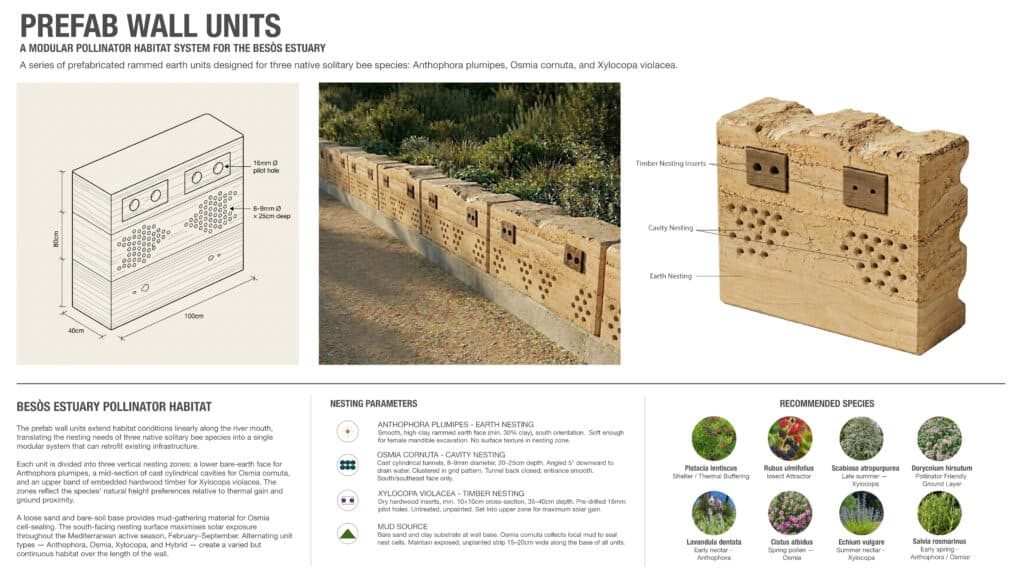
Prefab Wall Units — Pollinator Habitat System
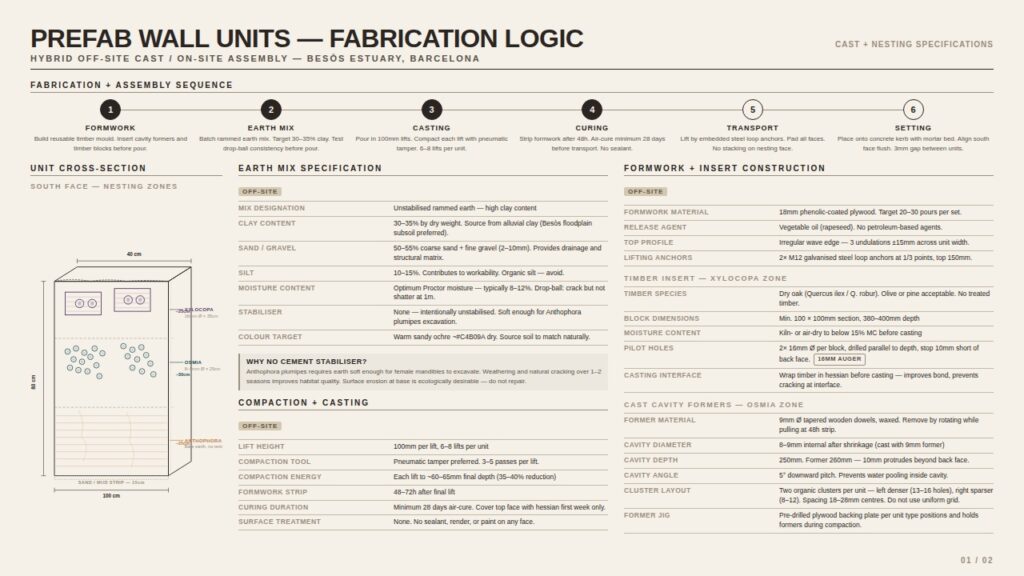
The prefab wall units translate the nesting needs of three native solitary bee species into a single modular rammed earth infrastructure that can retrofit existing edges along the river mouth.
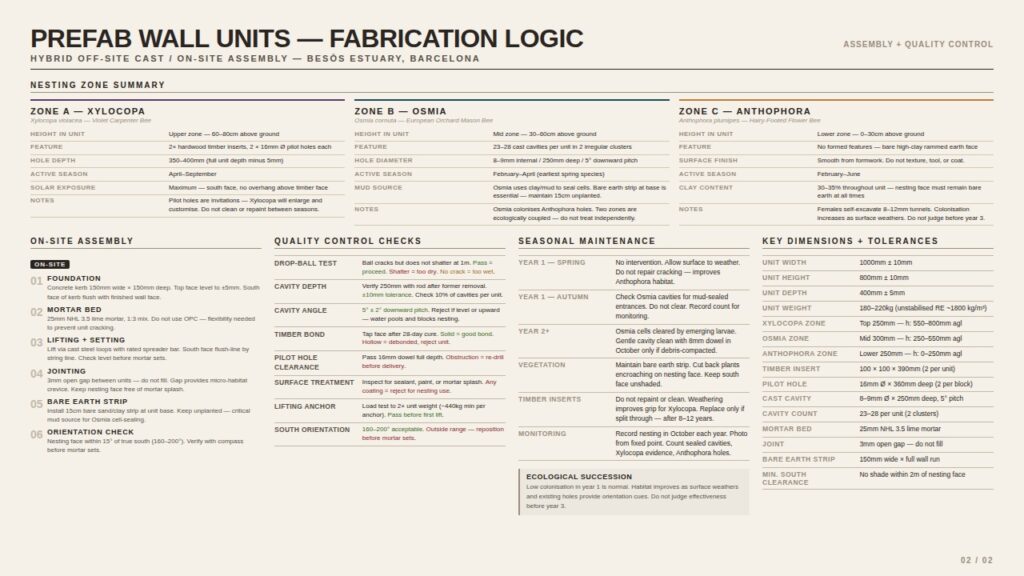
Each 100 × 40 × 80 cm unit is divided into three vertical nesting zones: a bare lower earth face for Anthophora plumipes (Hairy-Footed Flower Bee), which self-excavates 8–12mm tunnels directly into the unstabilised surface; a mid-section of cast cylindrical cavities (8–9mm diameter, 25cm deep, angled 5° downward) for Osmia cornuta (European Orchard Mason Bee); and an upper band of embedded dry oak timber blocks with 16mm pilot holes for Xylocopa violacea (Violet Carpenter Bee).
The earth mix is intentionally unstabilised: 30–35% clay, 50–55% coarse sand and gravel, no cement. It is soft enough for Anthophora mandible excavation and designed to weather and crack naturally over 1–2 seasons, improving habitat quality over time rather than degrading it. A bare sand and clay strip at the wall base provides essential mud-gathering material for Osmia cell-sealing.
Units are cast off-site using reusable timber formwork, cured 28 days minimum, then set onto a concrete kerb with a 3mm open joint gap that itself functions as a micro-habitat crevice. Each unit is aligned to true south (160–200°) for maximum Mediterranean active-season solar exposure, February through September.
Recommended supporting planting includes Pistacia lentiscus, Rubus ulmifolius, Scabiosa atropurpurea, Lavandula dentata, Cistus albidus, Echium vulgare, and Salvia rosmarinus, staged to provide forage from early spring through late summer across all three species.
Lizard / Human Interface Element
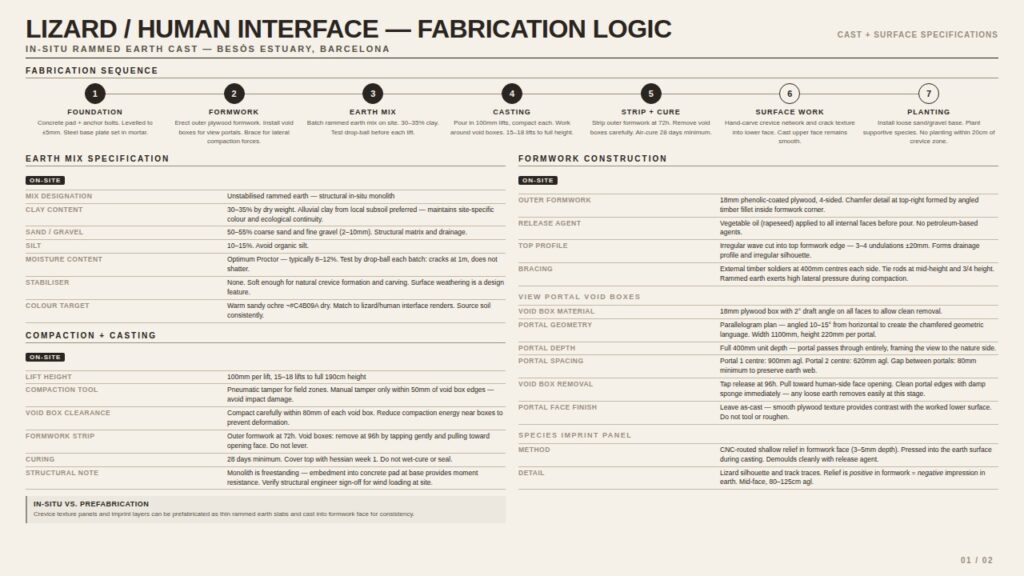
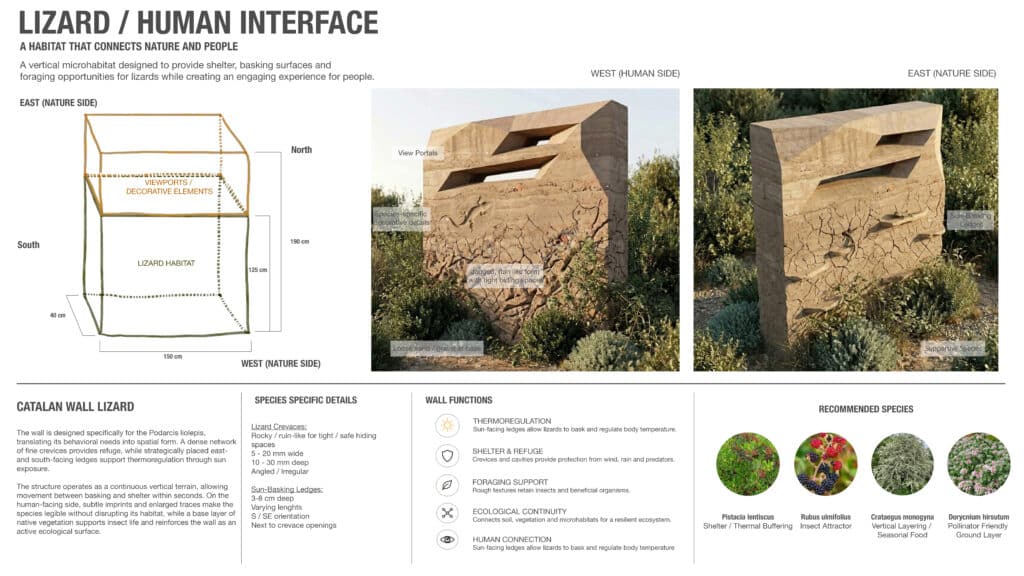
The Interface Element is a vertical microhabitat designed specifically for the Podarcis liolepis (Catalan Wall Lizard) while simultaneously creating an engaging, legible experience for people.
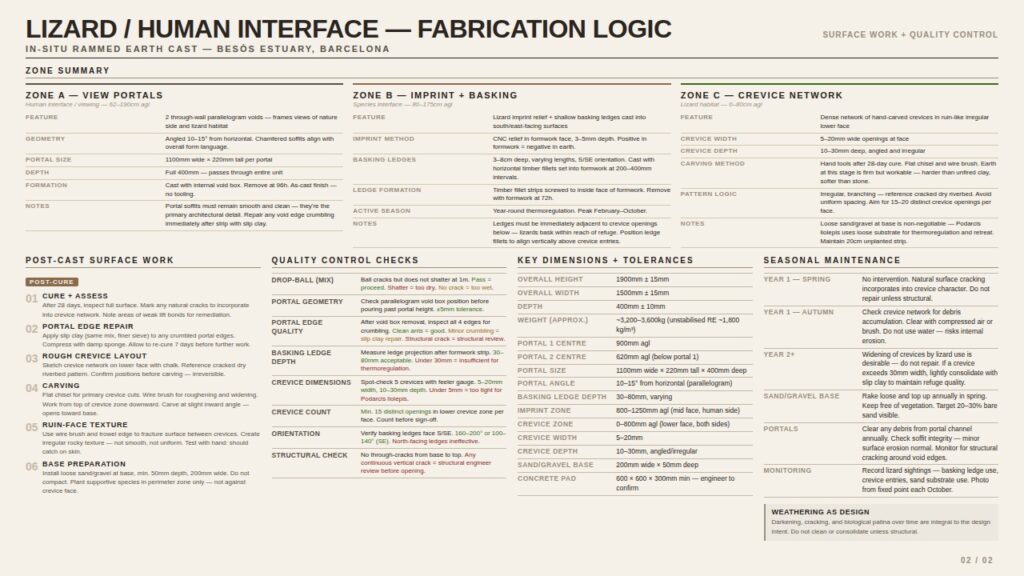
The structure reads differently from each side. The east-facing nature side is a dense, ruin-like terrain: hand-carved crevices 5–20mm wide and 10–30mm deep provide tight hiding and thermoregulation refuge. The west-facing human side carries CNC-relieved lizard imprints and shallow basking ledges at 80–125cm height, making the species visible and legible without disturbing its habitat. Two parallelogram view portals, each 1100mm wide by 220mm tall and angled 10–15° from horizontal, pass through the full 400mm depth of the monolith, framing views directly into the nature side.
The structure is cast in-situ from unstabilised rammed earth (30–35% alluvial clay, no stabiliser) in 100mm lifts to a full height of 1900mm, founded on a 600 × 600 × 300mm concrete pad. Crevice carving begins at 28 days post-cast using flat chisel and wire brush, working from top to base and targeting 15–20 distinct irregular openings per face, referencing cracked dry riverbed rather than uniform grids. A loose sand and gravel base (200mm wide × 50mm deep) is non-negotiable for Podarcis thermoregulation behavior.
Weathering is design intent. Darkening, cracking, and biological patina over time are not to be cleaned or consolidated unless structurally necessary. Year 1 requires no intervention. From Year 2 onward, crevice widening by lizard use is desirable.
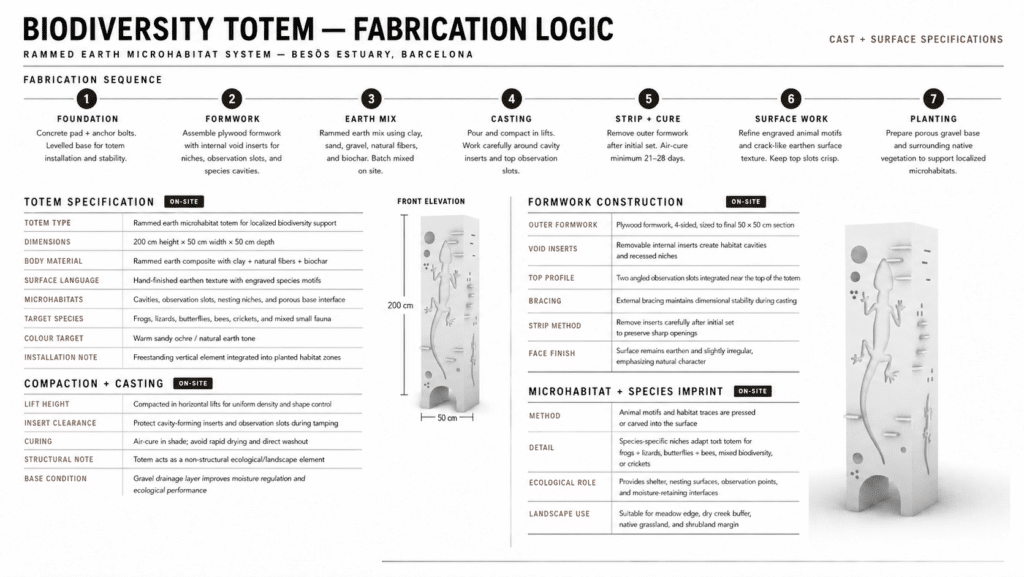
Totem Placeholder
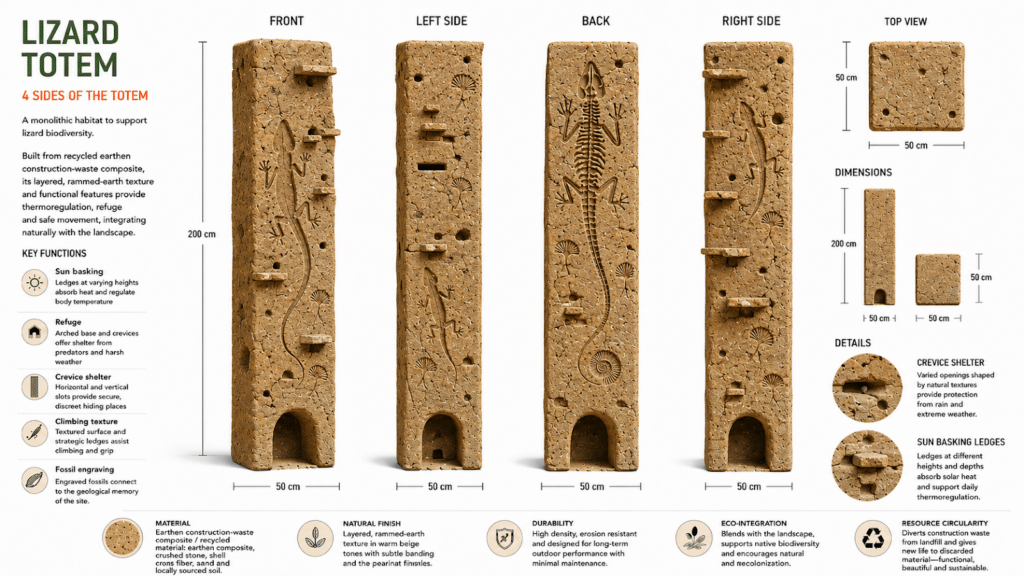
The totem is designed as a prehistoric ecological monolith, a piece that seems to emerge from the landscape like a contemporary fossil. Its solid, vertical, and eroded form evokes ritual stones, primitive ruins, and archaeological remains, while its materiality of earth, and construction waste directly connects it to the ground and to a circular logic.
Through reliefs, cavities, and carved voids inspired by animal traces and fossils, the totem records the presence of species within the ecosystem. At the same time, its cracks and openings function as refuges, basking surfaces, and small microhabitats. In this way, the totem becomes more than a symbolic element: it turns into an active piece within the landscape, existing between sculpture, ecological marker, and habitat.
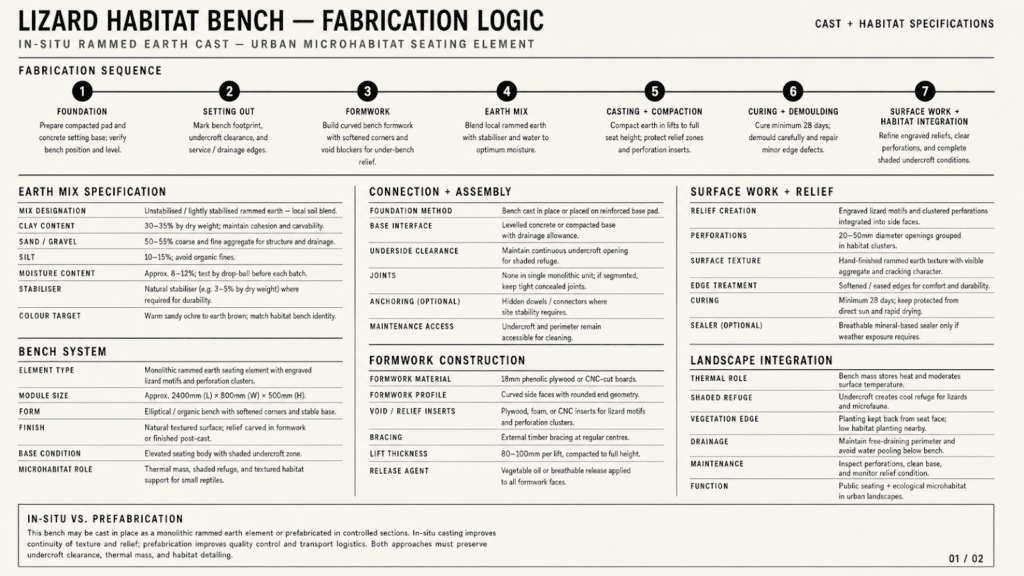
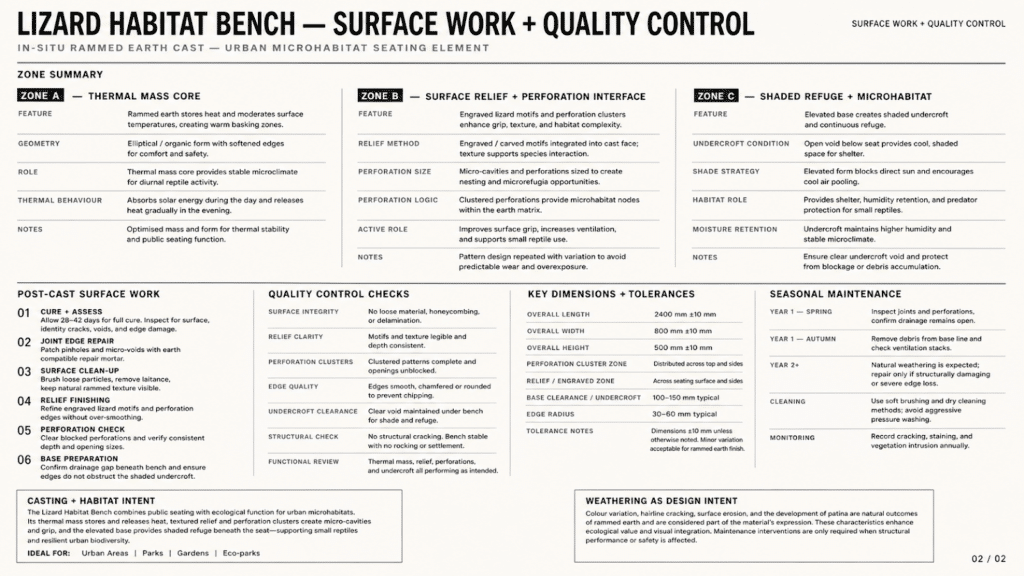
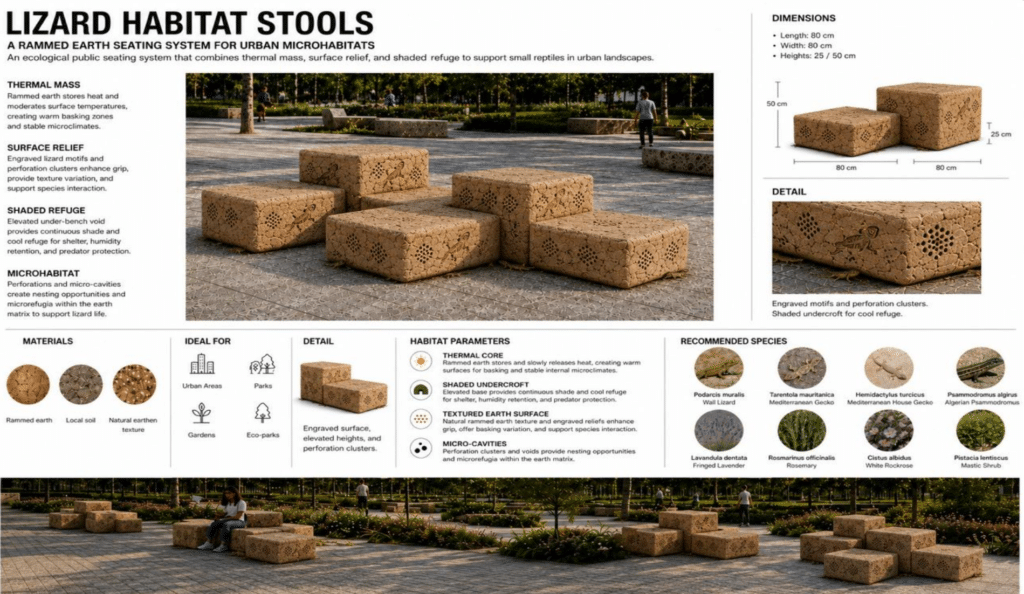
Bench System
The Rammed Earth Ecology Bench is an educational seating element that uses carved reliefs to communicate biodiversity and landscape relationships.
The lizard, plants, insects, circular patterns, and earth textures are symbolic elements designed for human learning. Through these carvings, the bench becomes a public object that encourages observation, ecological awareness, and a stronger connection between people and non-human life.
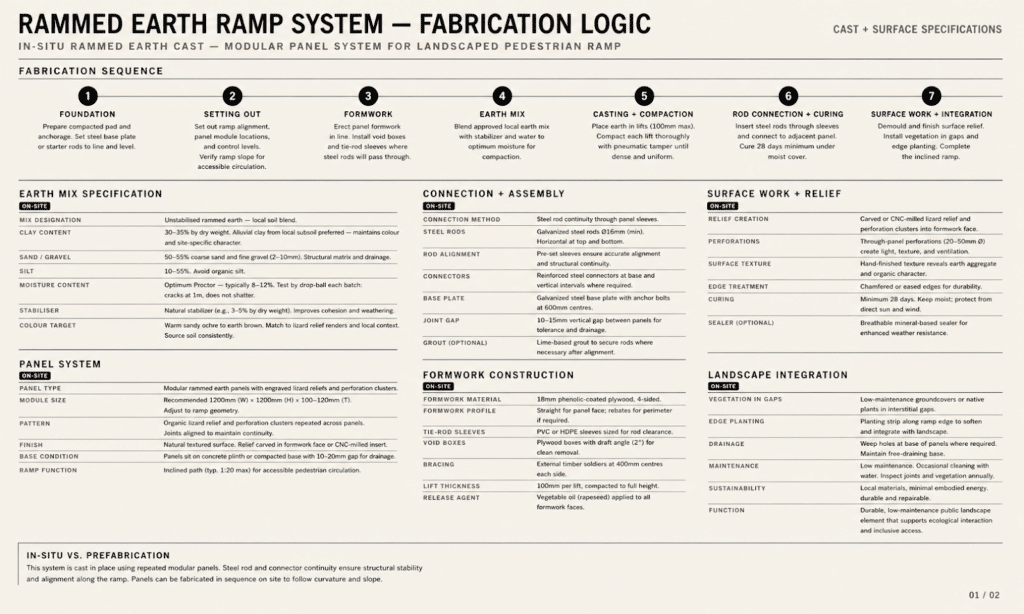
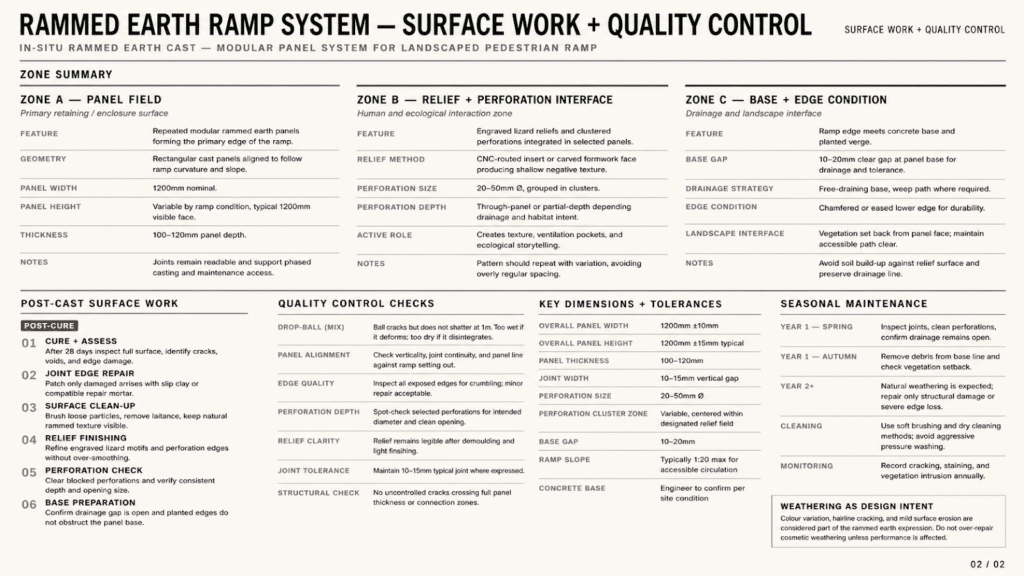
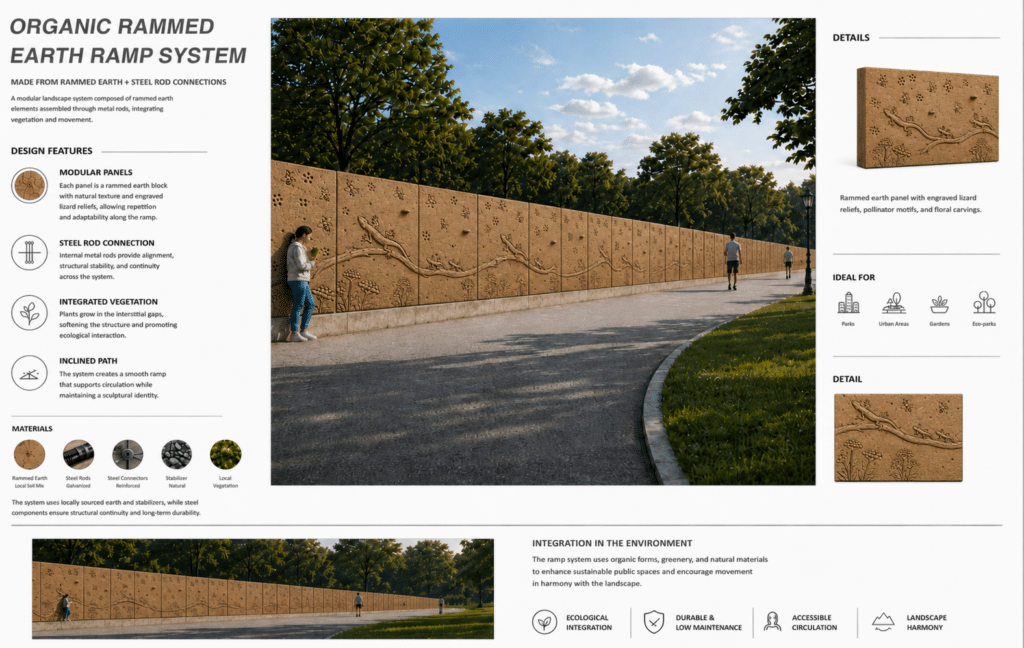
Ramp Wall
The ramp becomes an informative ecological path where every carved element reveals a component of the system.
A continuous tree branch guides the movement across the panels, connecting the project as one landscape narrative. Along this branch, non-human species appear in sequence: lizards represent thermal surfaces and material interaction, bees connect to pollination and circular perforations, and plants express vegetation, growth, and ecological integration. The wall is not only a boundary, but a didactic surface where material, structure, biodiversity, and movement are read together.
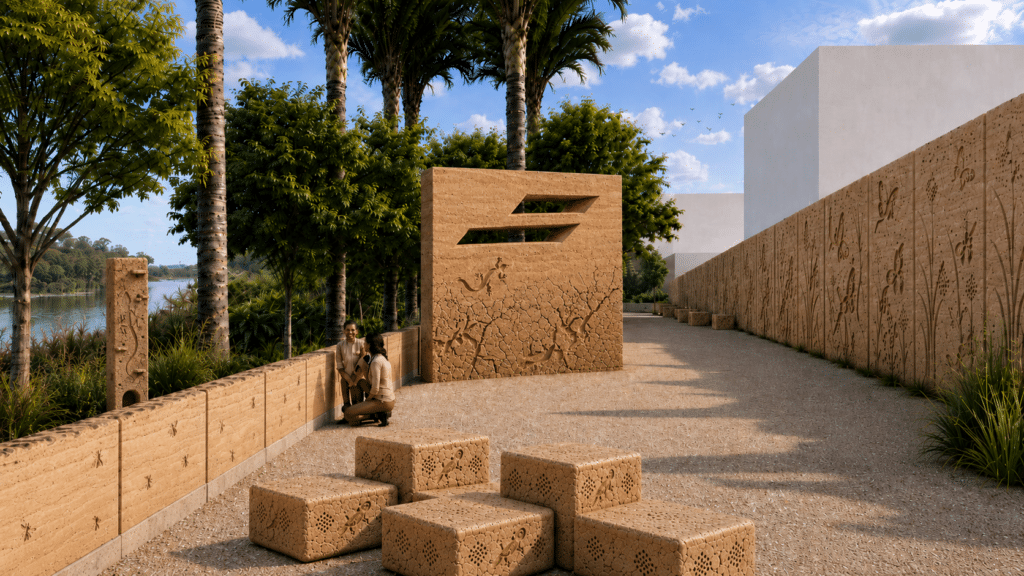
The Full Collection
Prototype – Lizard Wall
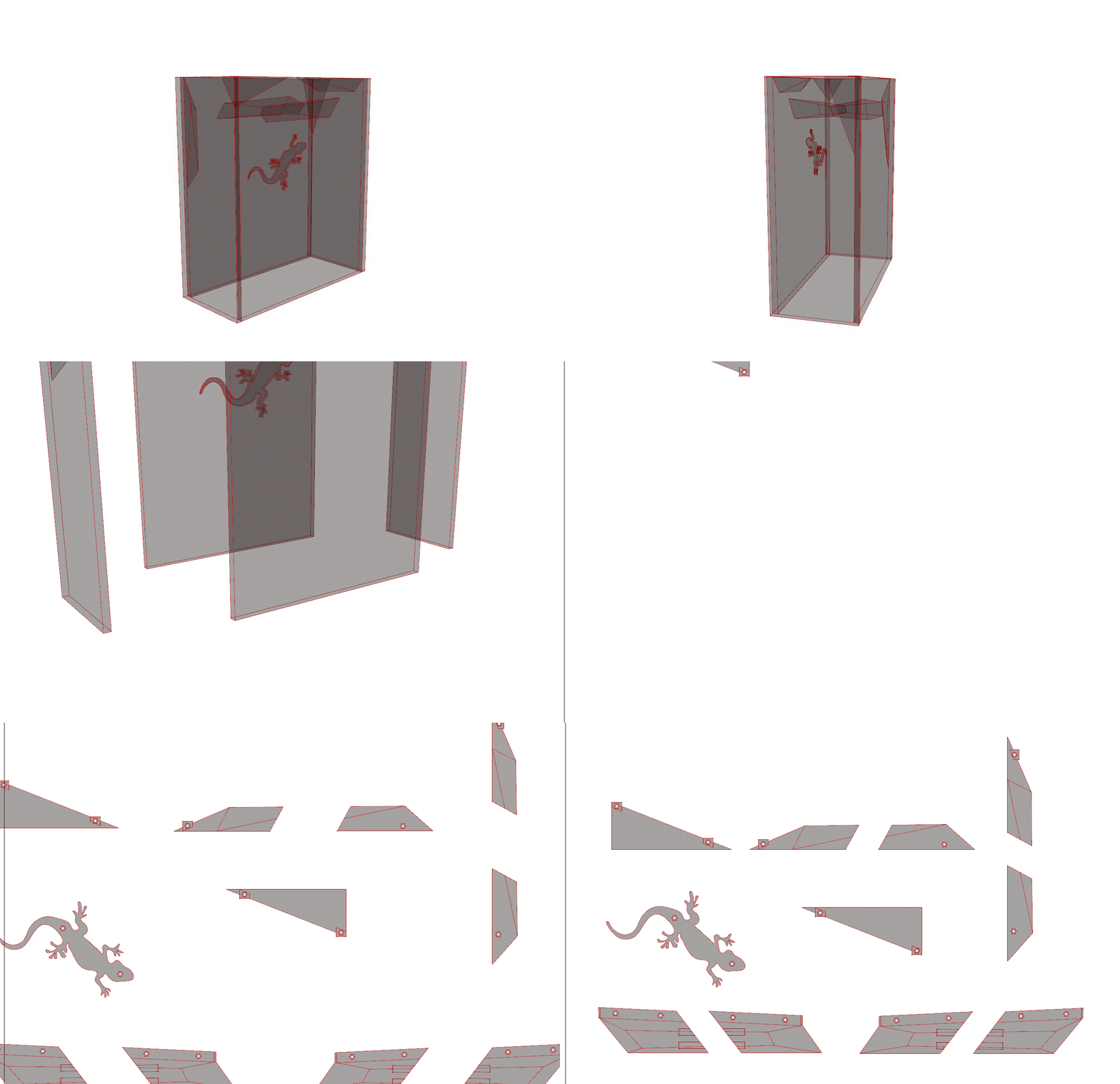
The fabrication was tested at 1:2.5 scale before committing to full production. The prototype used 14mm plywood formwork with external L-brackets, 11 PLA 3D-printed inserts attached with M4 bolts, and a CDW-based earth mix of 70% construction demolition waste, 10% clay, 10% cement stabiliser, and 10% water. The cement stabiliser was included for prototype reliability; omission is possible but requires further testing.
Earth was filled in approximately 15% lifts and hand-rammed with a wood block tamper. Viewport parallelogram inserts were attached mid-fill once earth reached the base of each opening. The mold cured for 3 days before demoulding, with brackets unscrewed and wall panels pulled away with the inserts. Ongoing curing continues with remoistening every 2–3 days and hand carving planned at 10–14 days post-cast.
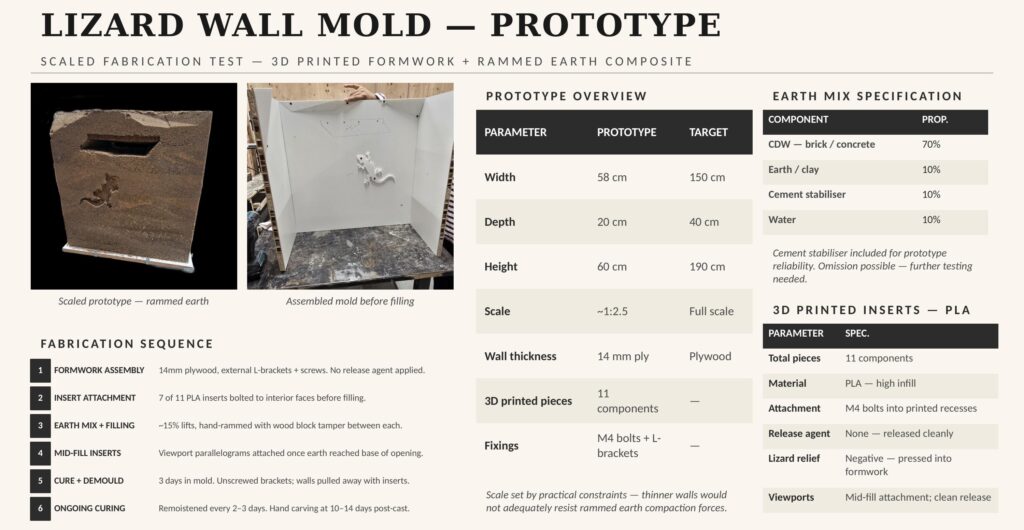
What worked: overall form held under ramming forces; viewport inserts released cleanly; PLA and plywood surfaces required no release agent; the CDW aggregate produced an authentic rough earth surface; earth mix cohesion was good throughout.
What to resolve at full scale: lizard relief detail was partially lost at 1:2.5 scale. The CDW aggregate grain is too coarse relative to fine features at reduced scale. At full design dimensions (150 × 40 × 190 cm), aggregate grains will occupy a proportionally smaller fraction of each feature, and full relief resolution is expected.
The path to full-scale production is direct: scale formwork to 150 × 40 × 190 cm using the same L-bracket logic with increased panel thickness for lateral resistance, reprint all inserts at full scale from existing geometry, and maintain the same CDW grain size, which will yield better detail resolution at production dimensions.
Conclusion
The Green In Cities rammed earth elements share a single ambition: that infrastructure for urban ecology should feel inevitable, not imposed. Each element, whether a totem, a wall, a bench, or a ramp, is designed to age well, to become more ecologically useful as it weathers, and to make the non-human life of the Bèsós Estuary legible and present to the people who pass through it every day.
The material itself carries this intention. Rammed earth cracks, patinates, darkens, and wears. In this project, those qualities are not maintenance failures but ecological affordances. A crevice that widens is a better lizard refuge. A surface that weathers reveals aggregate and grain. A bare earth face that erodes is exactly what a ground-nesting bee needs.
The prototype confirmed the core fabrication logic is sound. The detailed design and full-scale documentation of the totem, bench, and ramp system will complete the picture of a coherent, buildable, and genuinely habitat-forming collection of urban elements.
Fabrication Sheets: