Coral reefs are not just ecosystems — they are living, breathing cities built by millions of tiny architects working in harmony. Found in warm, clear waters from the Maldives to the Caribbean, these underwater kingdoms shelter a quarter of all marine life, despite covering less than 1% of the ocean floor. From fringing reefs that hug coastlines to barrier reefs stretching for hundreds of kilometers, each reef type carries its own story of evolution, resilience, and fragility. This guide dives into where these reefs thrive, how they differ, and why protecting them today is essential for the ocean of tomorrow.
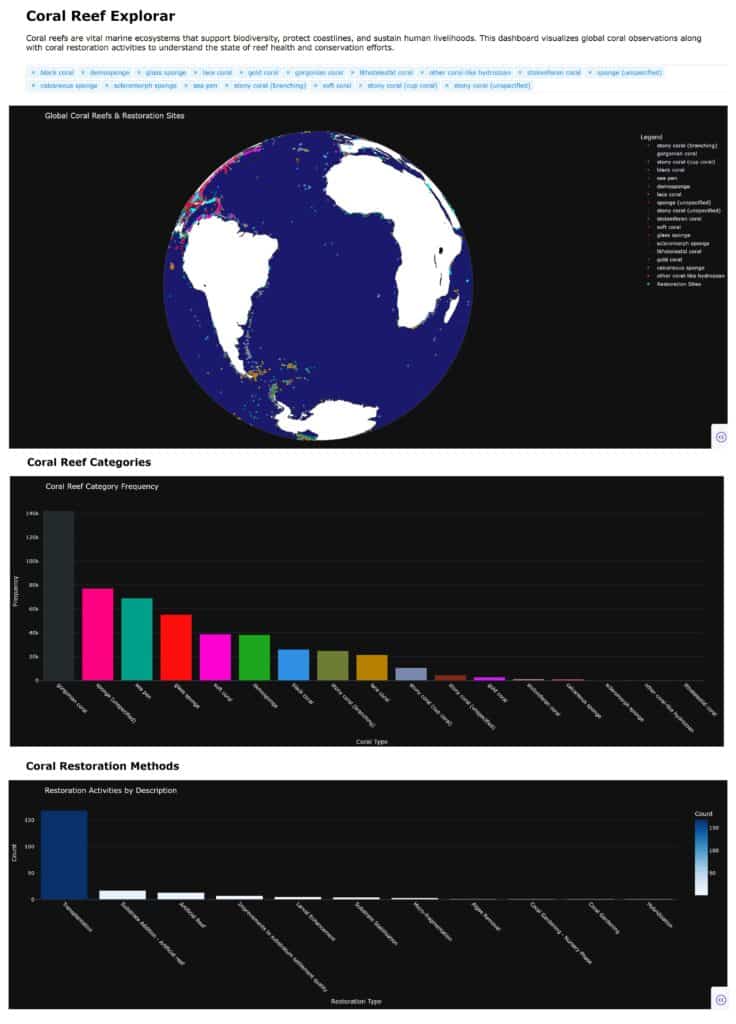
A global dashboard visualizing coral ecosystems, their distribution, and restoration efforts
Coral reefs are among the most biodiverse and fragile ecosystems on the planet. They support nearly 25% of all marine species, protect coastlines, and sustain millions of livelihoods. Yet they are also one of the most threatened environments due to rising sea temperatures, pollution, and destructive fishing practices.
We developed the Coral Reef Explorer Dashboard—a Python-built, interactive platform that maps global coral observations alongside coral restoration activities. This dashboard brings together spatial datasets to help researchers, planners, conservationists, and the public understand the current state of coral ecosystems and the efforts underway to protect them.
Visualizing Global Coral Reefs & Restoration Sites
The centerpiece of the dashboard is an interactive 3D globe that plots thousands of coral observations across the world’s oceans. Each point corresponds to a coral category—from stony coral to sea pens, soft corals, and sponges—making the scale and spread of coral ecosystems immediately visible.
Restoration sites are also displayed, allowing viewers to uncover where restoration initiatives are happening and how they overlap with natural coral habitats.
This visual layer answers critical questions:
- Where do major coral ecosystems exist today?
- Which regions show high coral diversity?
- Where is restoration activity happening, and how widespread is it?
Coral Reef Categories: What Types of Corals Dominate the Oceans?
The second section of the dashboard analyses coral categories based on frequency of observations.
From this visualization, key insights emerge:
- Stony corals (branching) and sponges (unspecified) represent the highest observations, highlighting their prevalence in global reef structures.
- Other types such as black coral, sea pens, and gorgonian corals show moderate distribution.
- Rare corals—though less frequent—indicate regions requiring deeper ecological study or targeted conservation.
This categorical breakdown helps users understand biodiversity within the coral world and where specific coral types are concentrated.
Coral Restoration Methods Across the Globe
Coral restoration is becoming essential as bleaching events and ecological degradation accelerate.
The dashboard includes a bar chart summarizing restoration activities reported worldwide—from transplantation and substrate stabilization to larval enhancement and coral gardening.
Early findings show:
- Transplantation is the most widely used restoration method.
- Techniques like coral gardening, nursery rearing, and substrate addition are gaining traction.
- Many restoration projects combine multiple approaches depending on site-specific ecological needs.
This dataset helps highlight trends in conservation strategies and where innovation in restoration is occurring.