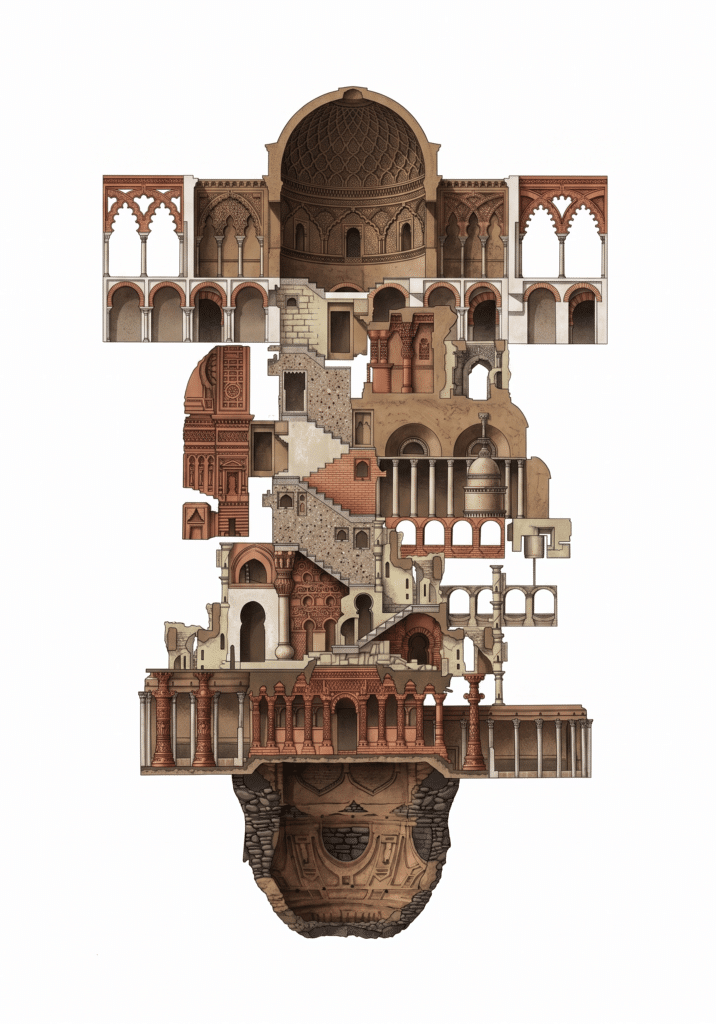
a methodology integrating artificial intelligence, geometry, structure, material, and assembly for heritage restoration.
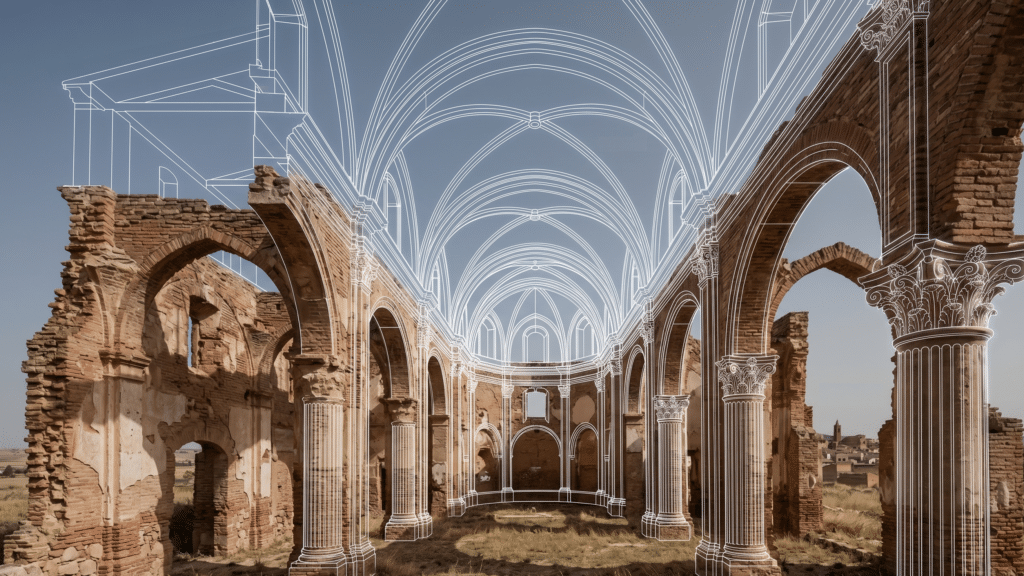
Historic buildings around the world are disappearing due to conflict, climate change, material degradation, urbanisation, and limited resources available for conservation. While digital documentation technologies have rapidly evolved over the past decade, restoration itself remains a fragmented process requiring specialists from multiple disciplines to manually interpret damage and propose interventions.
Ruins Reversed investigates how artificial intelligence can become a decision-support system for heritage conservation, not replacing architects or conservation experts, but helping connect documentation, structural understanding, material selection and intervention planning into a unified workflow.
The project proposes a methodology that combines AI with architectural knowledge to assist restoration decisions while respecting conservation principles.
why heritage needs better decision tools
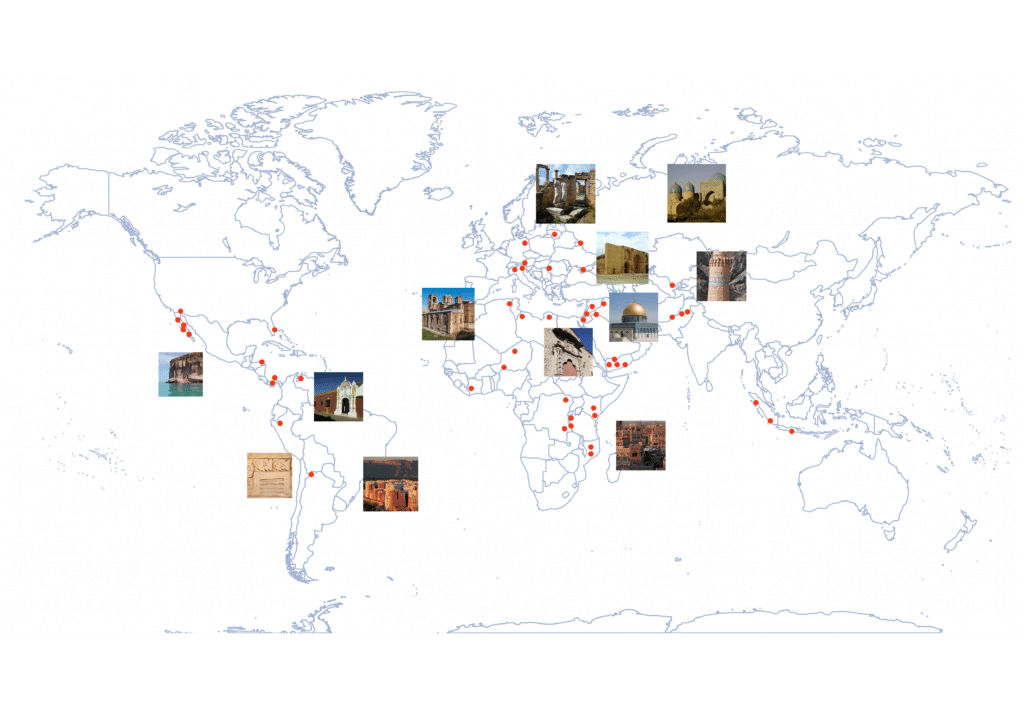
Across the world, more than 50,000 protected heritage sites, including over 1,200 UNESCO World Heritage Sites, face increasing risks from environmental degradation, conflict, urban development and natural ageing.
At the same time, Europe has invested heavily in heritage conservation through initiatives such as the European Heritage Label, the European Green Deal, New European Bauhaus and the European Heritage Hub. These initiatives demonstrate that conservation is becoming an important part of Europe’s cultural and environmental agenda.
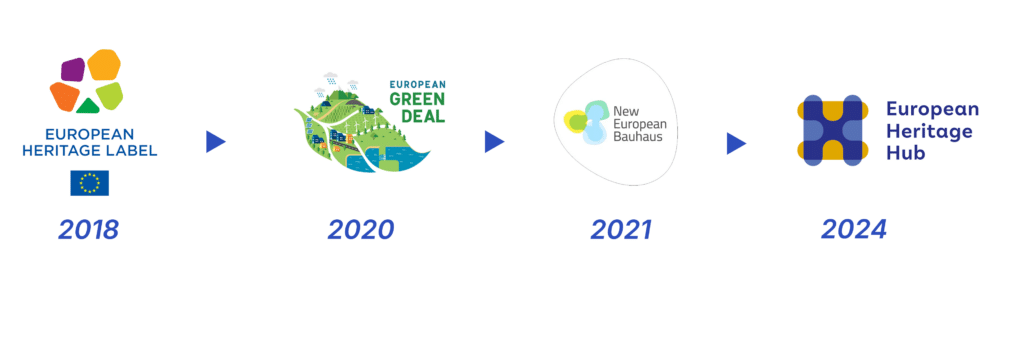
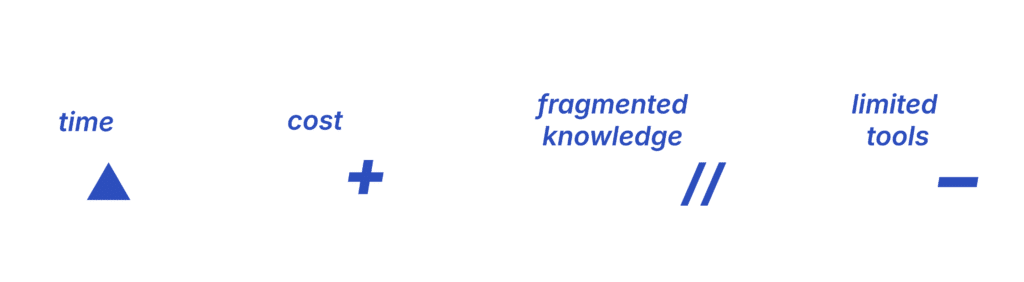
However, despite increasing investment, restoration workflows remain slow, expensive and highly fragmented.
current restoration practice

Traditional restoration follows a sequential process:
- Historical research
- Site survey
- Damage mapping
- Material analysis
- Structural assessment
- Intervention proposal
Although this workflow is well established, every stage depends heavily on manual interpretation and specialist expertise. Information often becomes disconnected between disciplines, making restoration both time-consuming and expensive.
problems faced and limitations
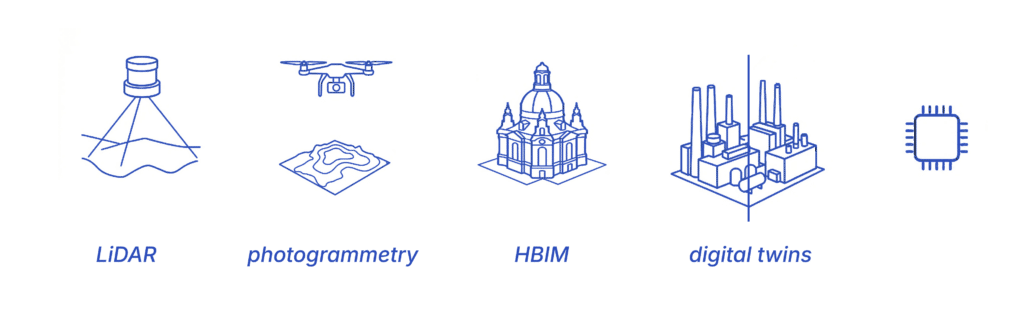
Digital technologies such as LiDAR, photogrammetry, HBIM and Digital Twins have transformed how heritage is documented.
Today’s tools are excellent at:
- scanning
- measuring
- modelling
- visualising
What remains largely missing is the ability to:
- interpret damage
- compare possible repair methods
- recommend interventions
- learn from previous restoration knowledge
the gap
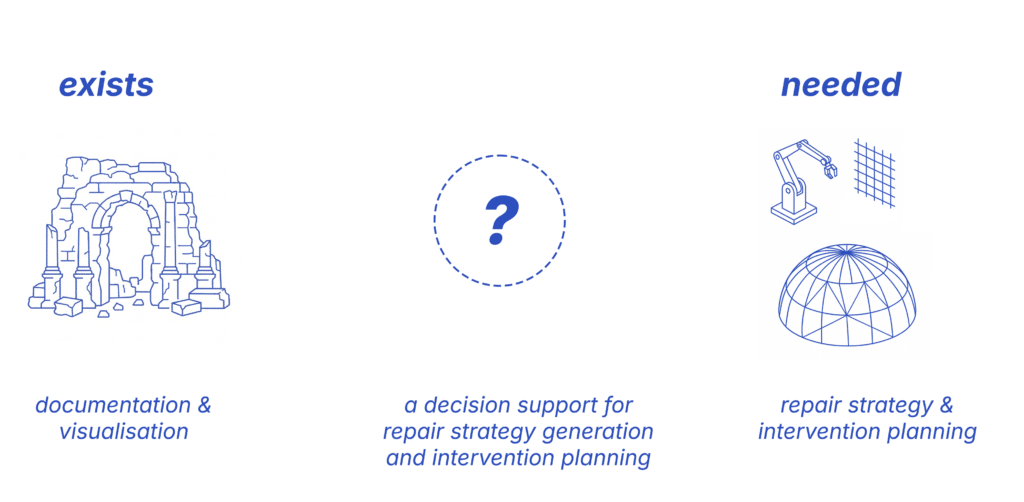
Documentation alone does not generate restoration decisions. This gap motivated the development of Ruins Reversed, a framework designed to bridge documentation and intervention planning.
the research question
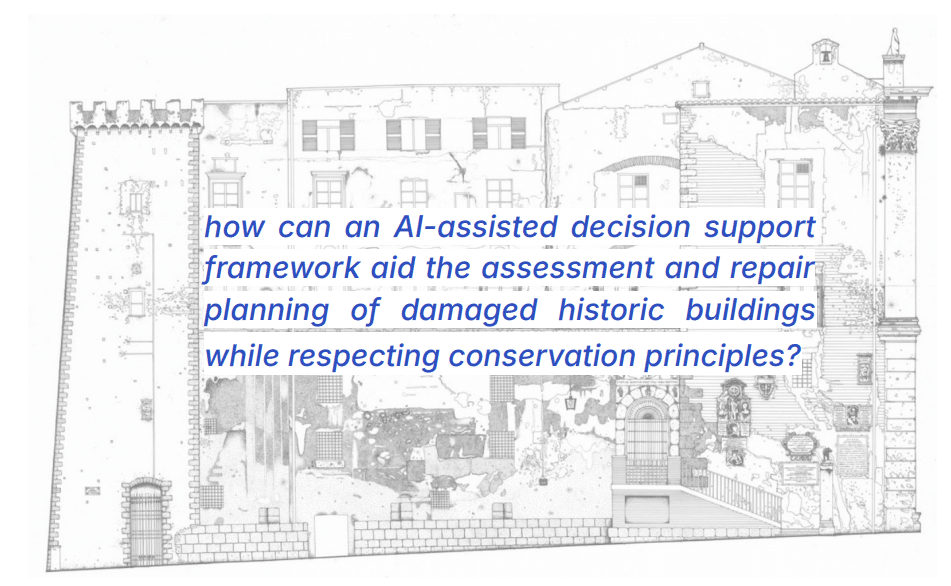
research hypothesis
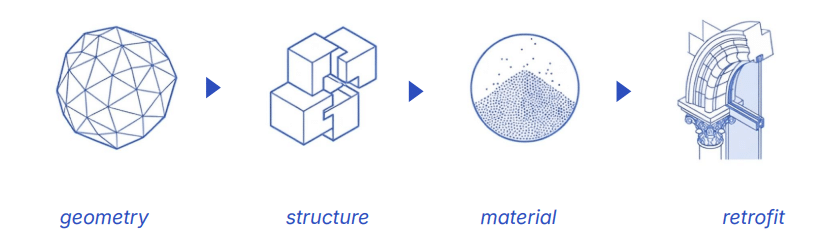
The project proposes that restoration decisions can be supported through a unified workflow connecting:
- geometry
- structural behaviour
- material systems
- retrofit strategies
Instead of treating these as separate analyses, they become part of a single decision-support framework capable of generating restoration recommendations informed by architectural knowledge.
understanding existing ruins
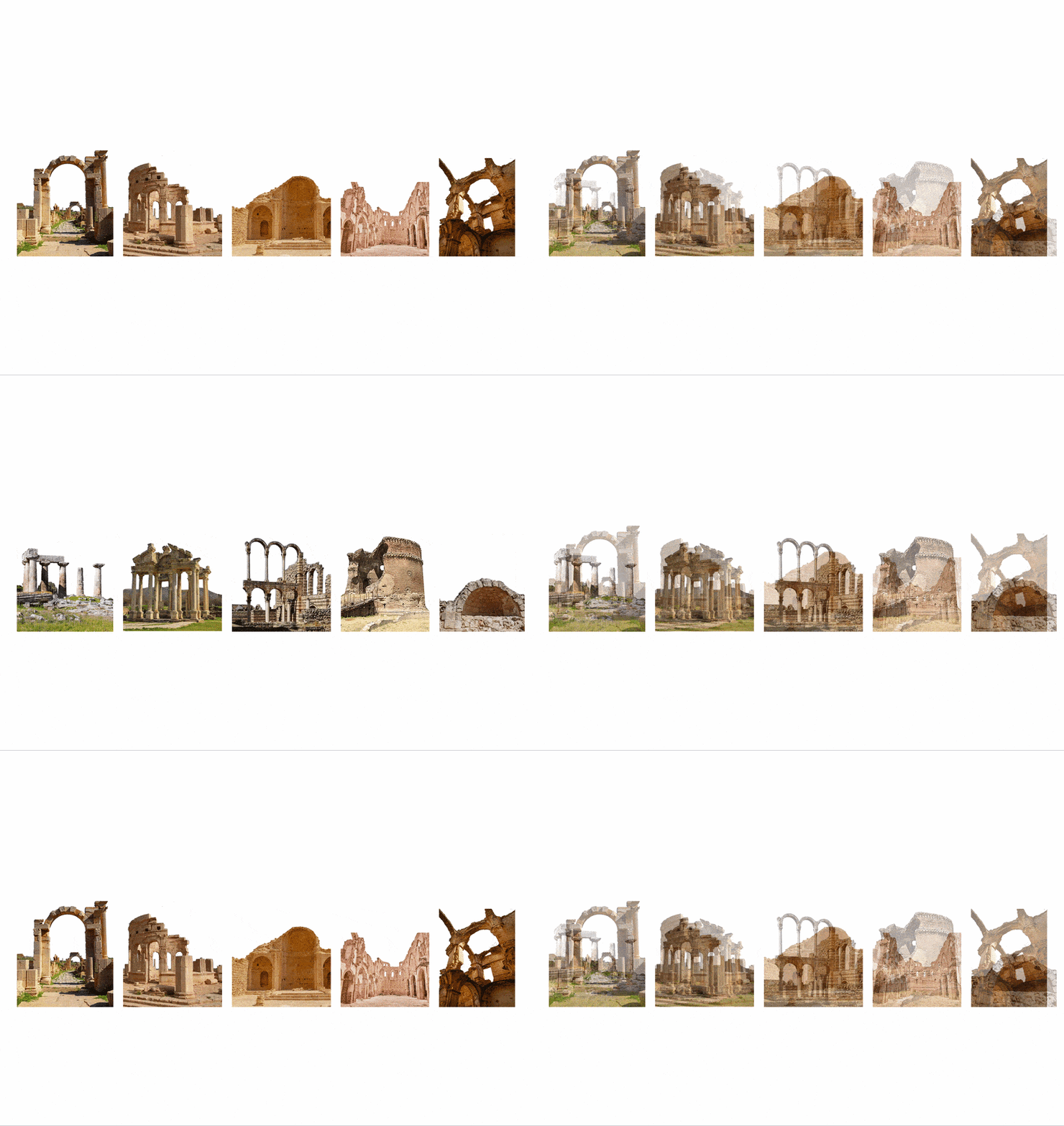
The first stage of the methodology investigates damaged architectural precedents.
Each ruin is analysed through:
- damage mapping
- extraction of underlying geometry
- identification of structural logic
- reconstruction of missing architectural information
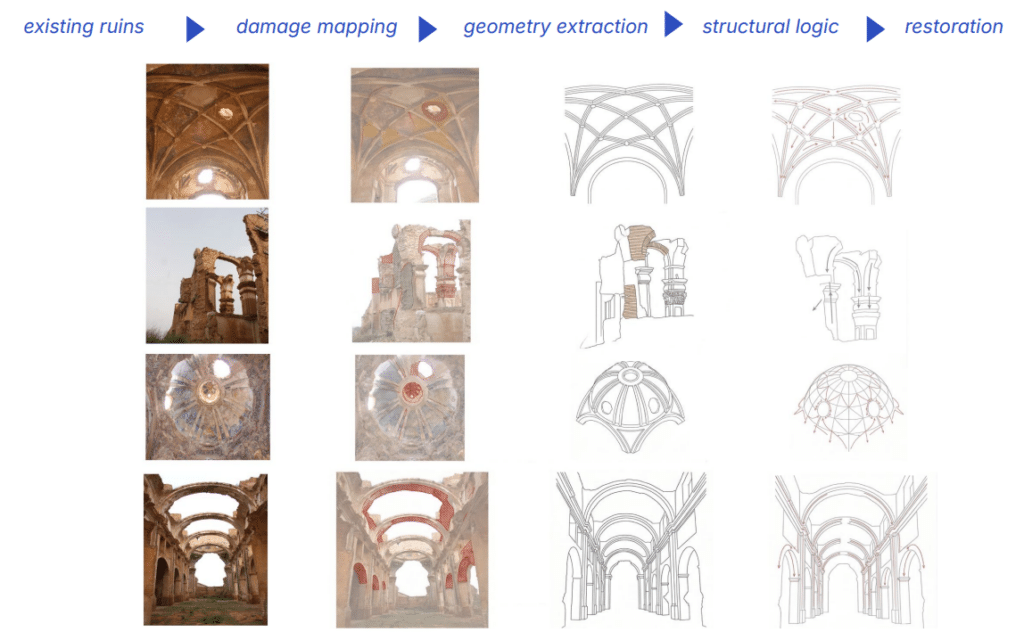
Rather than reconstructing buildings visually, the objective is to understand how they originally worked structurally, allowing future interventions to respect their architectural behavior.
building a restoration knowledge base
To support AI decision making, the project develops a structured architectural knowledge base linking five categories of information:
- architectural elements
- damage typologies
- assembly systems
- material systems
- restoration interventions
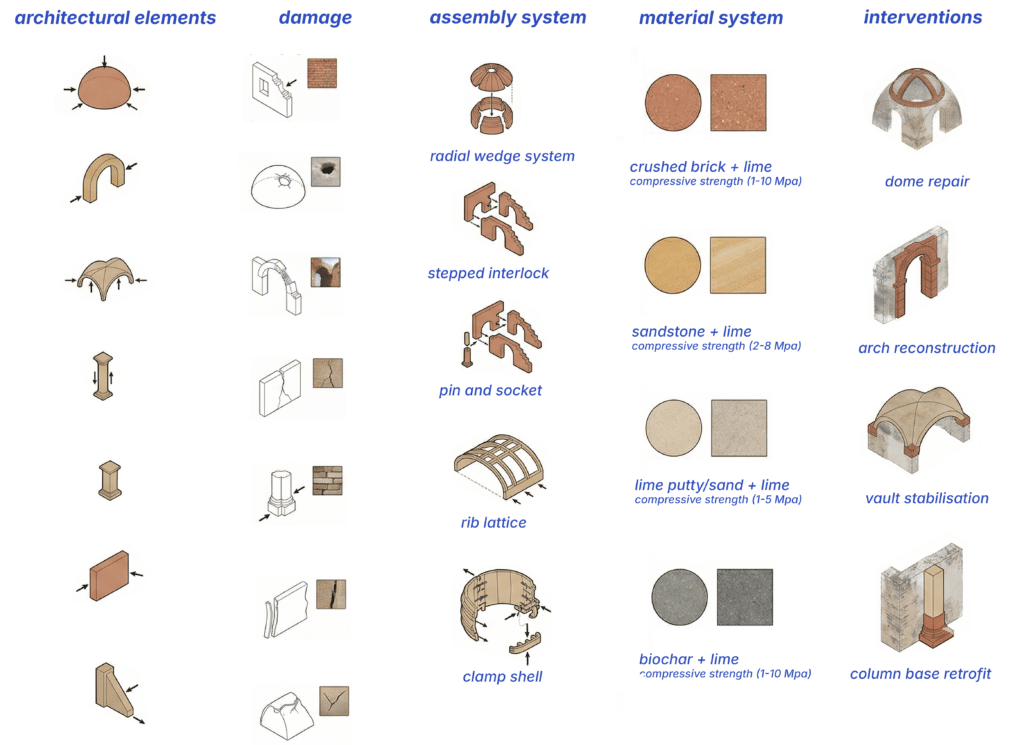
Instead of relying solely on image recognition, the system references relationships between structural behaviour, compatible materials and conservation strategies. This enables the framework to generate recommendations grounded in architectural knowledge rather than purely statistical prediction.
methodology
he proposed workflow combines architectural reasoning with AI-assisted analysis.
The process consists of:
- Damage identification
- Architectural element recognition
- Geometry extraction
- Material recommendation
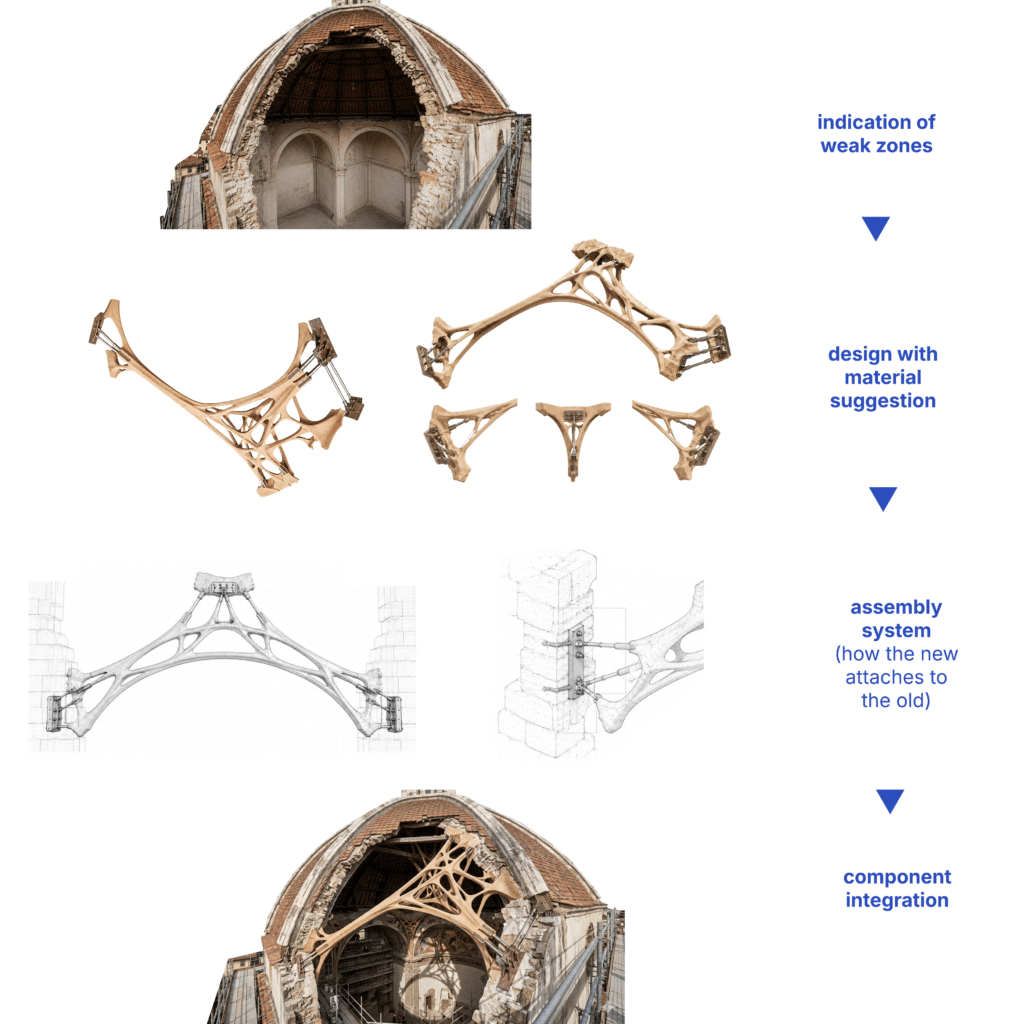
- Assembly logic generation
- Fabrication strategy
- Restoration intervention
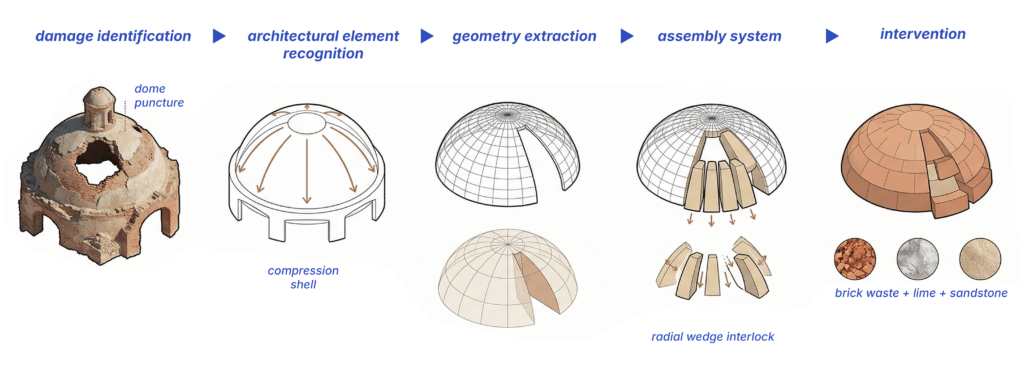
This sequence transforms raw documentation into actionable conservation proposals rather than stopping at digital recording.
developing the AI workflow
To implement this methodology, the workflow is divided into computational modules:
- Data acquisition
- Data processing
- Damage detection
- Material recognition
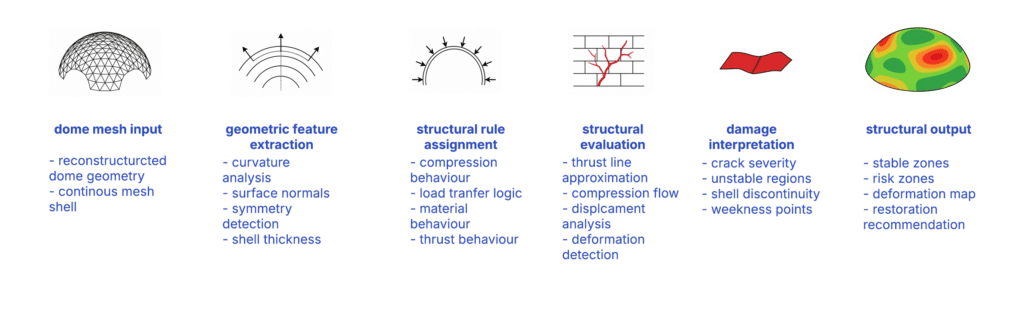
- Structural analysis
- Geometry reconstruction
- Decision making
- Intervention generation
- Assembly logic

Each module contributes information to the next, allowing the system to progressively transform scanned geometry into restoration recommendations.
the prototype
The outcome of this research is a prototype AI-assisted interface called Ruins Reversed.
The tool demonstrates how architectural scan data can be processed through the proposed workflow to generate:
- architectural element recognition
- damage identification
- structural interpretation
- geometry reconstruction
- intervention recommendations
- assembly strategies
- material suggestions
Rather than functioning as a replacement for conservation experts, the system acts as a decision-support assistant that accelerates analysis while maintaining human oversight.
results from the prototype
Following is the result comparison of two examples of domes.
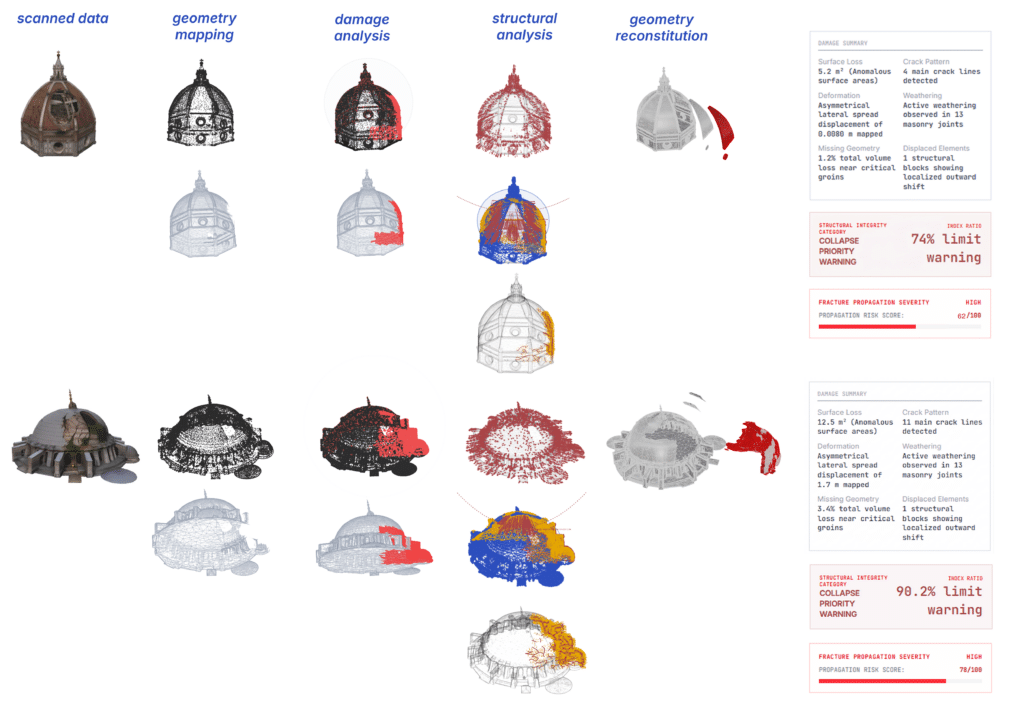
technical roadmap
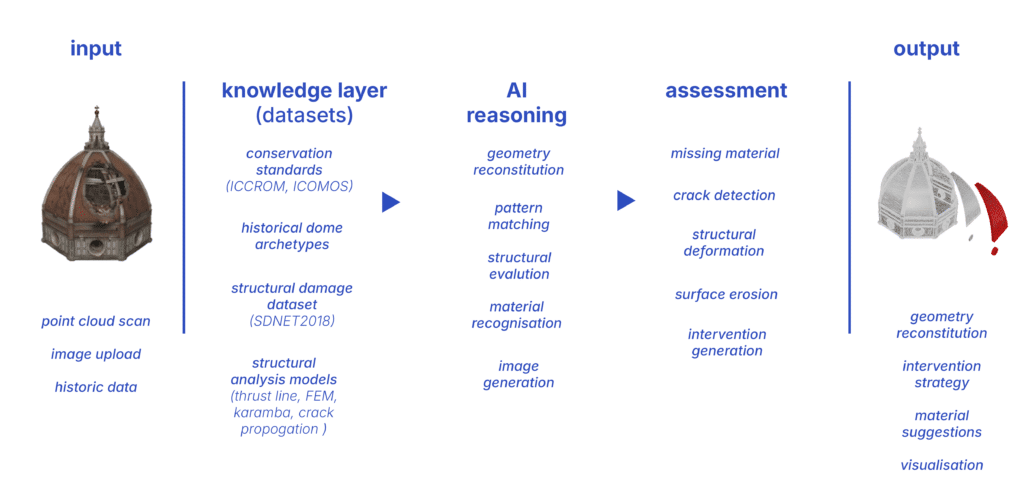
working of the system
The prototype processes digital survey data through multiple computational stages.
Beginning with LiDAR or point cloud data, the workflow performs:
- point cloud cleaning
- registration and alignment
- surface reconstruction
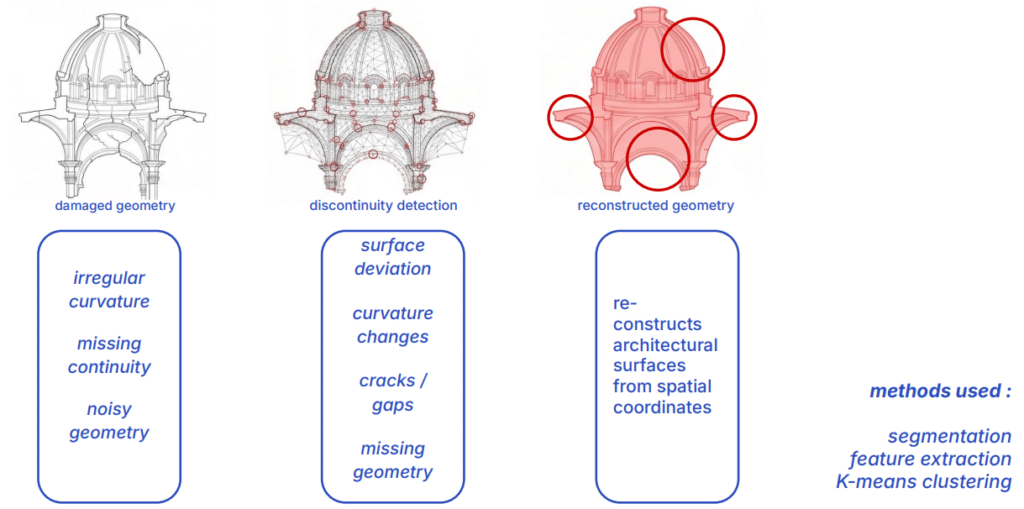
- architectural geometry recognition
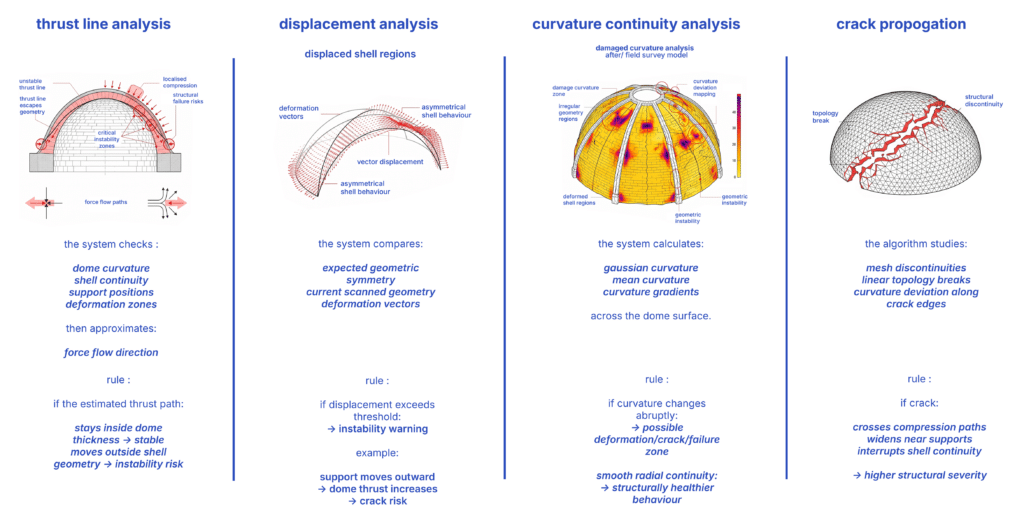
- structural analysis
- damage classification
- intervention generation
Methods such as Poisson Surface Reconstruction and Delaunay triangulation are explored for rebuilding architectural surfaces before AI-based reasoning generates restoration strategies.
Geometry recognition and mesh construction
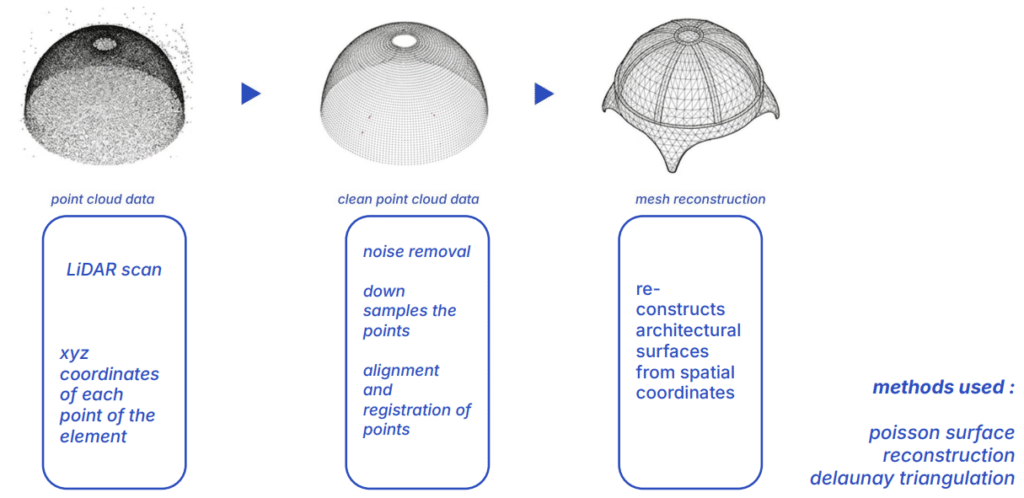
Damage detection
Rule-based structural analysis workflow
Geometric rules +Structural heuristics + Measurable parameters
future scope
Fabrication strategy
The proposed intervention is translated into modular, buildable components based on the reconstructed geometry and assembly logic. This enables precise fabrication while ensuring compatibility with the existing historic structure.
This prototype establishes the foundation for a broader restoration platform that could support conservation practice at larger scales.
Future developments include:
- Expanding the knowledge base to include additional architectural typologies beyond domes.
- Integrating real-time LiDAR and photogrammetry directly into the workflow.
- Training AI models on larger conservation datasets to improve recognition accuracy.
- Incorporating structural simulations and finite element analysis into the recommendation engine.
- Enabling comparative analysis between multiple restoration scenarios based on reversibility, material compatibility and environmental impact.
- Developing compatibility with HBIM and Digital Twin platforms to support continuous heritage monitoring.
- Applying the framework to archaeological sites and historic urban environments as a scalable conservation tool.
Ruins Reversed demonstrates that artificial intelligence can contribute meaningfully to heritage restoration when positioned as a collaborative decision-support system rather than an automated designer.
The research shifts the focus of digital heritage from documentation toward interpretation, connecting geometry, structural logic, materials and conservation knowledge into a unified workflow. By integrating architectural expertise with computational analysis, the framework proposes a more informed and efficient approach to planning restoration interventions while preserving conservation principles.