Research: Thermal Transmittance

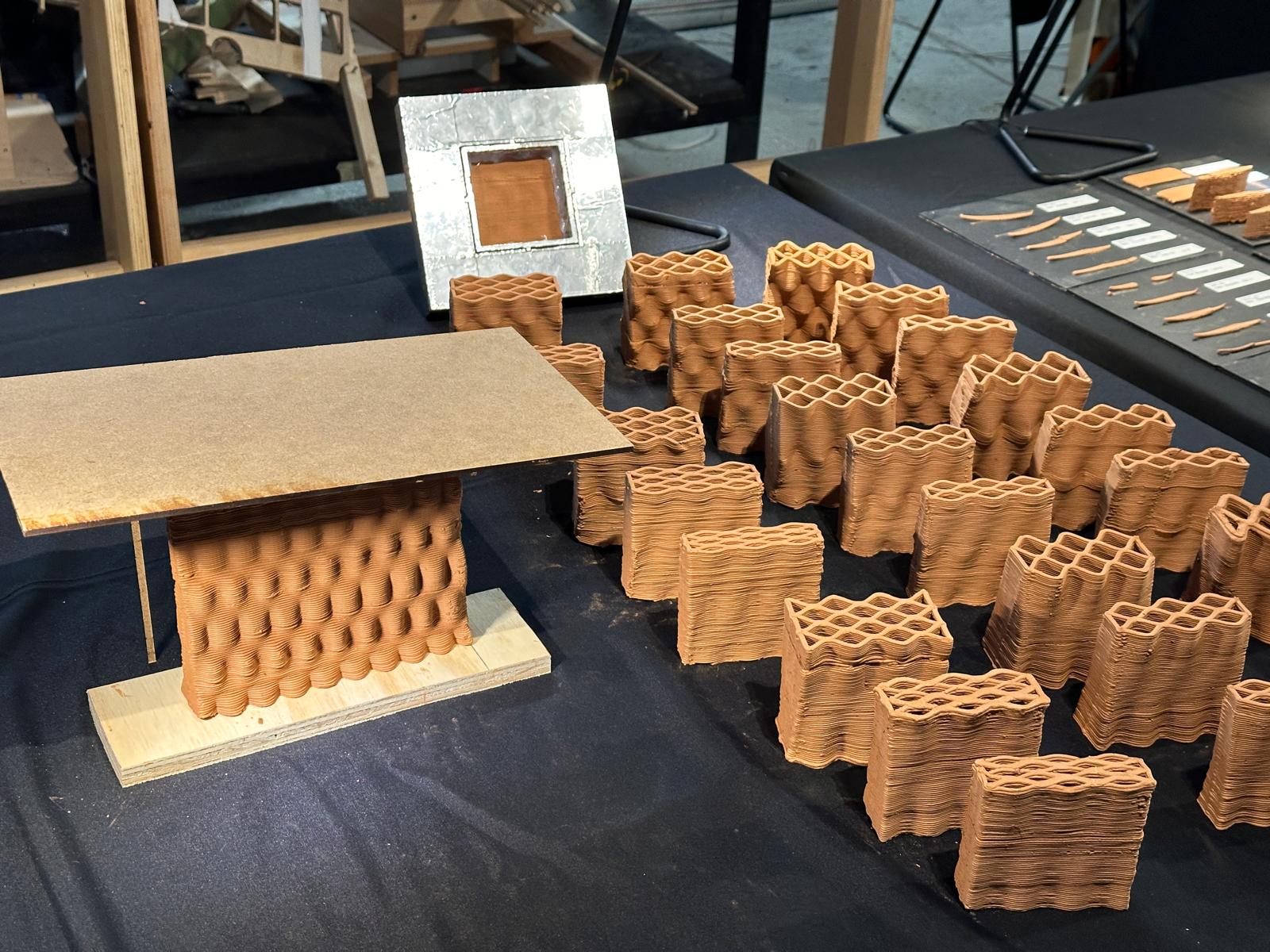
Introduction – Hypothesis How can we optimize the geometry of different sections of a 3D-printed wall to adapt to varying levels of solar radiation and insulation requirements, while also reducing material usage and printing time? By deforming the infill patterns of 3D-printed earth walls, it is possible to optimize the thermal transmittance of the walls, … Read more

Unmasking Digital Culture: Rethinking Progress, Equity, and Sustainability

Accumulation: A Mirage of Progress Imagine a minimalist workspace—a pristine desk, a single laptop, a small plant to complete the tableau. It’s serene, efficient, and modern. Yet, behind this simplicity lies a sprawling network of data centers consuming vast amounts of energy, hidden from view. This duality invites a deeper reflection: is our pursuit of … Read more

ROBOT-ASSISTED WEAVING + RAW MATERIALS / MRAC Workshop 1.2

Team member(s): Govind Chithrath, Santosh Shenbagamoorthy, Krystyn Kontos  , Aleksandra Kraeva and Lauren DemingModified by Lauren Deming on November 24, 2024 Ultimately, the goal is to develop more efficient means for harvesting and utilizing low-carbon footprint alternatives for construction. Course Objective Project Abstract Autonomous Weaving with Raw Materials explores the intersection between weaving automation and the use of raw materials. After analyzing … Read more

Navigating Digital Culture(s): Complexity, Imagination, and Responsibility

In a world of interconnected crises and rapid technological change, Digital Cultures provides a lens to explore how we interact with technology and respond to global challenges. The Digital Cultures class invited us to reflect on these dynamics, highlighting the importance of rethinking the narratives, metaphors, and values shaping our present and future. Central to … Read more

Reading Urban Planetary

This blog post reflects the lectures and exercises given by Professor Mariano Gomez-Luque, supported by readings from Katherine Hayles, Neil Brenner, David Harvey, and Benjamin Bratton. These texts provided a foundation for discussions on human cognition, social structures, ecological dynamics, and planetary computation. The lecture commenced with Katherine Hayles’ exploration of evolving reading practices, contrasting … Read more

CONVERGING FUTURES

“Planetary-scale computation is an example of what may be called, after the great Polish novelist Stanislaw Lem, an ‘epistemological technology.’ The most important social impact of some technologies is not just in what theyallow people to do, but in what they reveal about how the world works.”​ (Bratton, 3). We are currently experiencing a significant … Read more

Understanding Planetary Urbanization and Capitalism

“capitalism as a mode of production has necessarily targeted the breaking down of spatial barriers and the acceleration of turnover time as fundamental to its agenda of relentless capital accumulation” (David Harvey.) 01. The Evolution of Urban Reading Urbanization, much like the transition from print to digital media, reflects evolving modes of engagement. The shift … Read more

Transhistorical Urbanization

Key words: Neoliberalism/ Critical Urban Theory/ Spatiotemporality/ Planetary Urbanization The accelerated development of communication and technological systems, and more precisely of intelligent technologies, has significantly changed the ways in which human and non-human coevolution is shaping. Implications for theoretical frameworks include broadening definitions of consciousness beyond the human, reshaping cognitive boundaries in an assemblage between … Read more

Designed Realities

“The artificial refers not to the fake, but to what is deliberately created, designed with purpose, and capable of reshaping both human and planetary futures.” Benjamin Bratton In recent years, the notion of artificiality has evolved from being seen as an imitation of the natural, to an integral part of planetary and urban systems. Benjamin … Read more

HUMAN MACHINE NEXUS

“Language has been a bodily process; it now extends beyond the human, forming a porous boundary in the human-machine nexus.” (Class 2: How We Read) In the age of planetary urbanization and artificial intelligence, the HUMAN-MACHINE NEXUS emerges as a critical site of inquiry. The interconnection between human cognition, technological augmentation, and urban processes compels … Read more

READING, PLANETARY, URBANISATION, CRITICALLY FOR TERRAFORMING

Reading… involves interpreting the meaning of symbols, whether in the form of text, poetry, or even urban landscapes. Katherine Hayles’ exploration of combining human and non-human reading techniques offers new insights for understanding urban environments – emphasizing how cognitive shifts enable us to navigate the complexities of modern cities and urbanization. … Planetary … The … Read more

Can We Terraform Ourselves?

Abstract: This essay explores the intertwined transformations of digital literacy, urbanization, and intelligence in contemporary society. It examines how technological advancements, critical urban theory, and the concept of “planetary sapience” are shapinga complex reality demanding holistic and inclusive approaches into a sustainable planetary system. Contemporary society is undergoing profound transformations driven by the interplay of … Read more

A New Perspective on Urban Theory

“The field of urban studies has been animated by an extraordinary outpouring of new ideas regarding the role of cities, urbanism, and urbanisation processes in ongoing global transformations.” (Brenner & Schmid, ‘Planetary Urbanisation’) 01. Hyperreading the Urban Over the course of four intensive classes and making use of a digital HYPERREADING methodology, we were introduced … Read more

Urban Wind Flow Modeling with PINNs

Overview PaperLink WIP – This study specifically explores Physics-Informed Neural Networks (PINNs) and Computational Fluid Dynamics (CFD) to analyze pedestrian wind comfort. It aims to integrate these neural network models into a web application using Three.js and other tools. By utilizing data from OpenWeatherMap, and OpenStreetMap, the project aims to support real-time simulations and visualizations … Read more

Power, Potency and Possibility

How to think of the notion of Utopia when articulating the futures embedded within phygital urban environments? ACT 1 – POWER Scene 1: Phone call between Patrick and Carmen. Patrick is in his sleek, high-tech San Francisco apartment . Carmen sits in a park in Seoul, a city filled with the hum of rapid urban … Read more