
Santhosh Shyamsundar · IAAC / MAEBB02
reMIXED REALITY Seminar · Advanced Manufacturing 2025/26
Beyond the 28-Day Blind Spot
In contemporary construction, concrete quality is traditionally verified by “crushing cylinders” 28 days after pouring. This lag creates a critical information asymmetry: by the time a defect is confirmed, the material is already structural. MaOS Unity XR addresses this via the Epistemic Sensing Functor—a hybrid architecture that transforms a standard mobile phone into a physics-gated validation instrument.
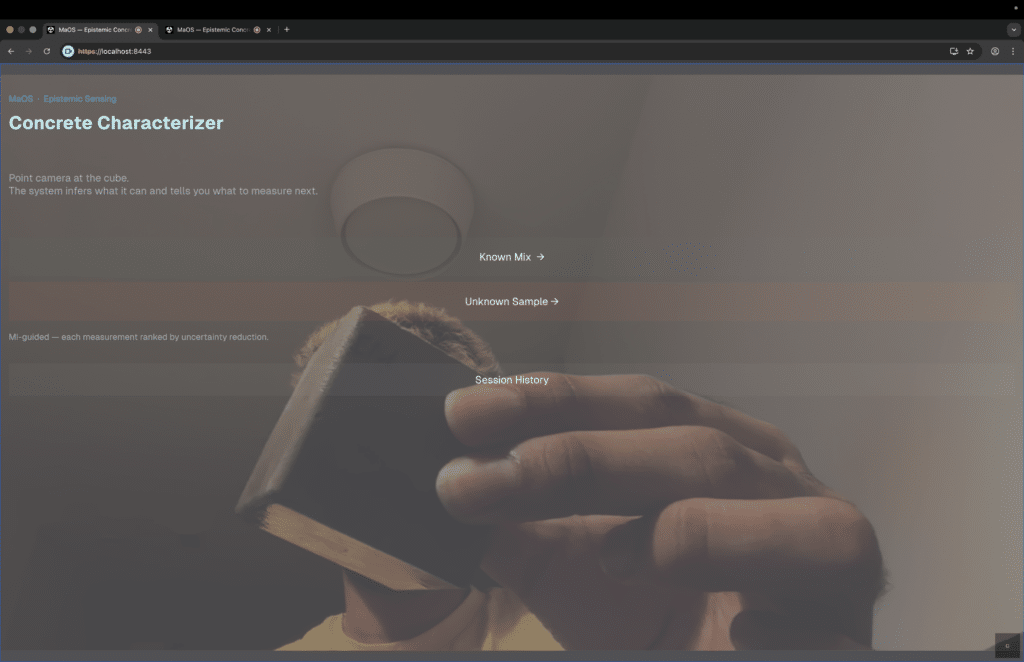

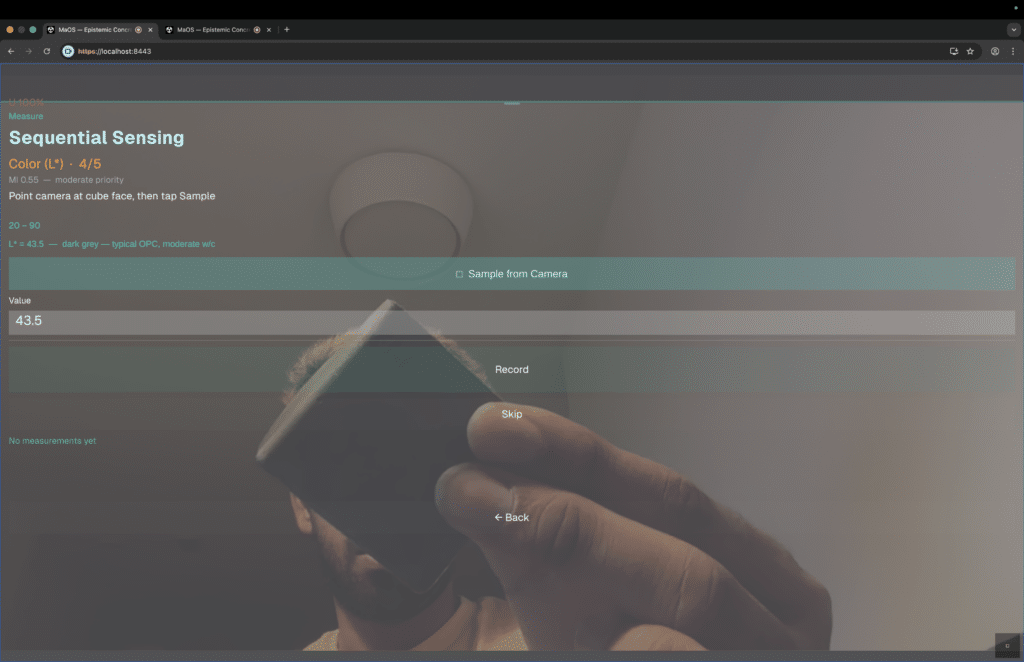
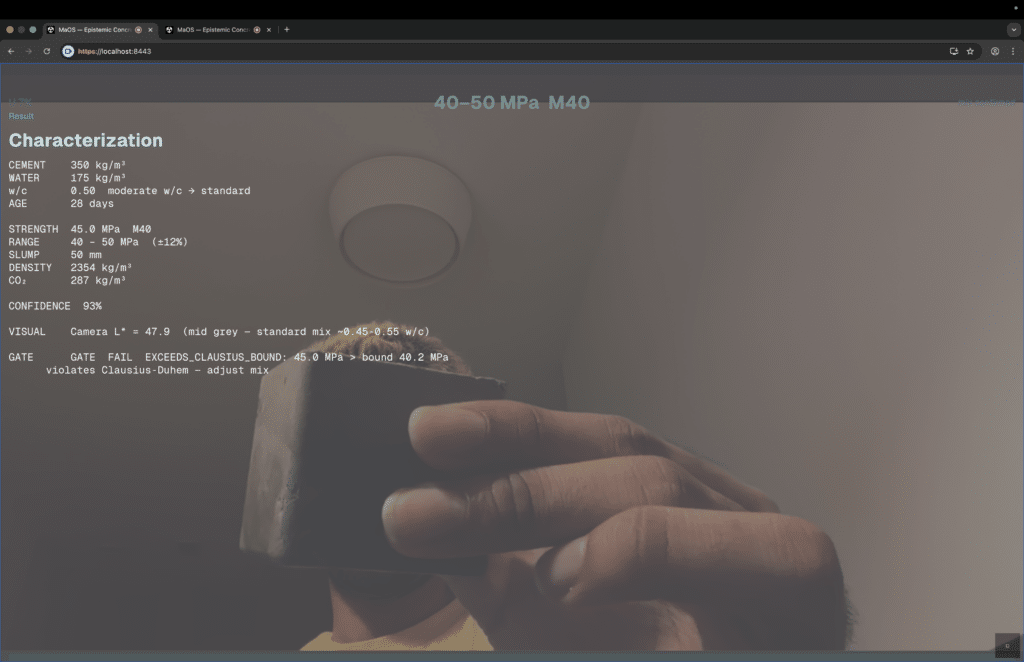
Figures 1,2,3&4: The MaOS mobile interface, overlaying glassmorphism data cards on a live AR camera feed.
Epistemic Sensing: Information-Theoretic Guidance
The core innovation of the project is the move from passive measurement to active epistemic guidance. Instead of simply recording values, the system solves an optimization problem at every step: “Which measurement will most effectively reduce my uncertainty about the material’s strength?”
Mutual Information (MI) Maximization
We operationalize this through Mutual Information maximization. The system ranks candidate proxies p based on their ability to minimize the conditional entropy of the unknown target property Y (compressive strength):
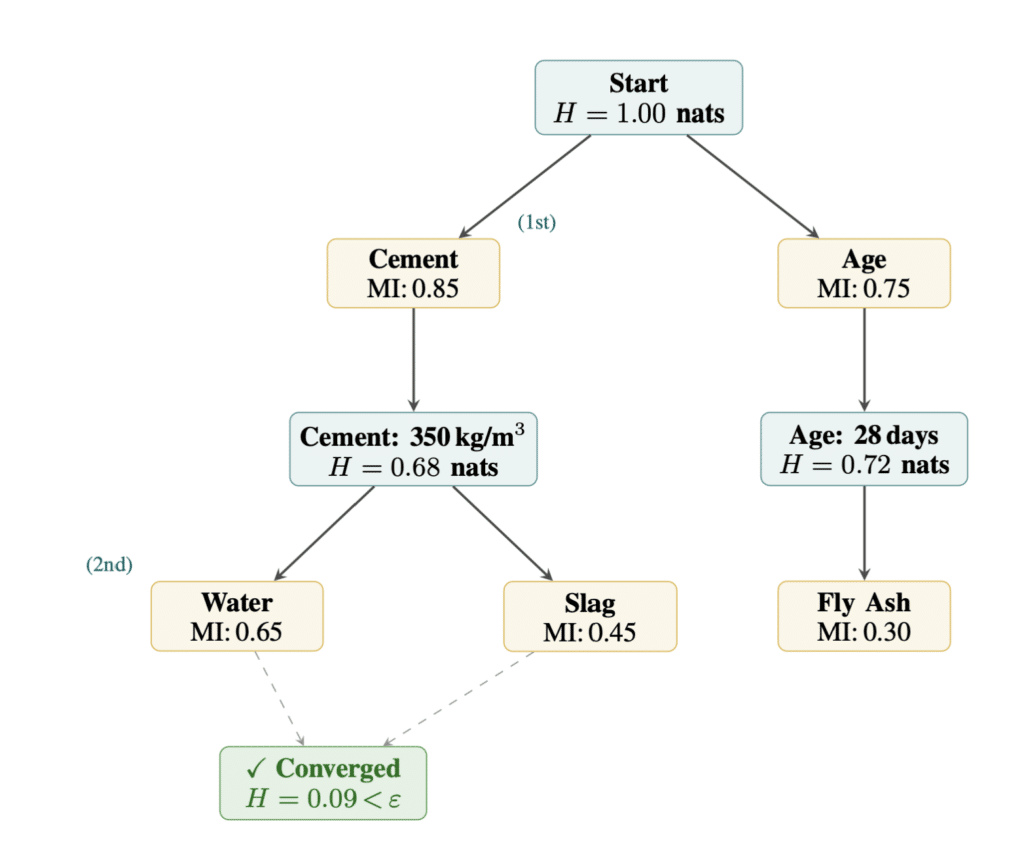
I(p;Y|R)=H(Y|R)−H(Y|R,p)
Where R is the set of already revealed results. For the UCI concrete benchmark, the system recognizes that not all data is equal: Cement Content (0.85 nats) and Curing Age (0.75 nats) are prioritized over lower-information proxies like superplasticizer dosage.
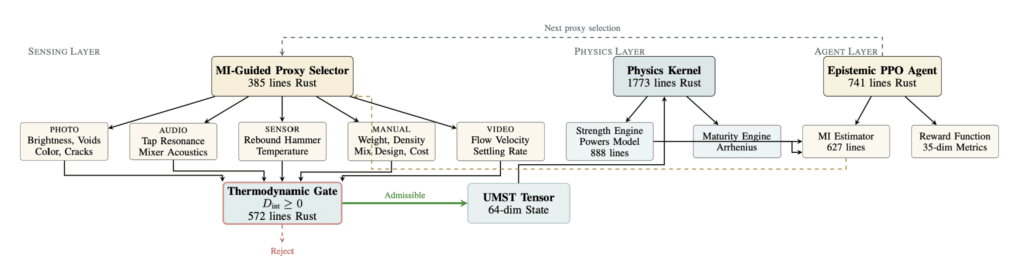
Figure : 5 Integration of active sensing with the thermodynamic gate, within the context of the larger MaOS Project.
Closing the Loop: The Thermodynamic Gate
While the AI guides the sensing, a Hard Physics Gate ensures that no physically impossible material state enters the world model. Every sensor reading is validated against the Clausius-Duhem Inequality, enforcing thermodynamic admissibility in real-time.
Figure 3: System Pipeline. Unity acts as the “Thin Client” for interaction, while a Rust-based physics kernel enforces rigor.
The Multi-Modal Proxy Stack:
- Computer Vision (OCR): Real-time text extraction from digital scales (Weight proxy) and curing labels (Age proxy).
- CIE L* Chromatic Sampling: Estimating water-to-cement (w/c) ratios directly from the concrete surface’s hydration signature.
- MI-Guided Manual Entry: Fallback for high-effort proxies (e.g. Slump test) when the digital twin requires higher confidence.
Results: Accelerated Convergence
By guiding the user toward high-MI proxies first, the Epistemic Sensing Functor achieves consistently faster convergence than random or round-robin measurements. In our experiments on over 1,000 samples, the system reaches a Trajectory Quality (TQ) of 0.6 in just 2.3 steps, compared to 4.2 steps for traditional methods—a 40% increase in characterization efficiency.
Conclusion: Spatial Computing for Material Sovereignty
MaOS demonstrates that the future of construction isn’t just “smarter” machines, but sovereign material audits. By placing a thermodynamic gate inside the architect’s pocket, we move the threshold of material admissibility from the lab to the site, enabling the safe use of highly variable, circular feedstocks (RAC, Earth, Bio-based).
Developed at IAAC as part of the reMIXED REALITY seminar. This project builds on the Unified Material-State Tensor (UMST) framework.
