

The lecture was conducted by Valentino Tagliaboschi, architect and building engineer whose career is situated at the intersection of computational design, digital fabrication, and robotics applied to architecture. Trained at the University of Pisa, his approach to the field is characterized by a methodology based on constant experimentation, iterative prototyping, and the intensive use of digital tools to translate ideas into concrete construction processes.
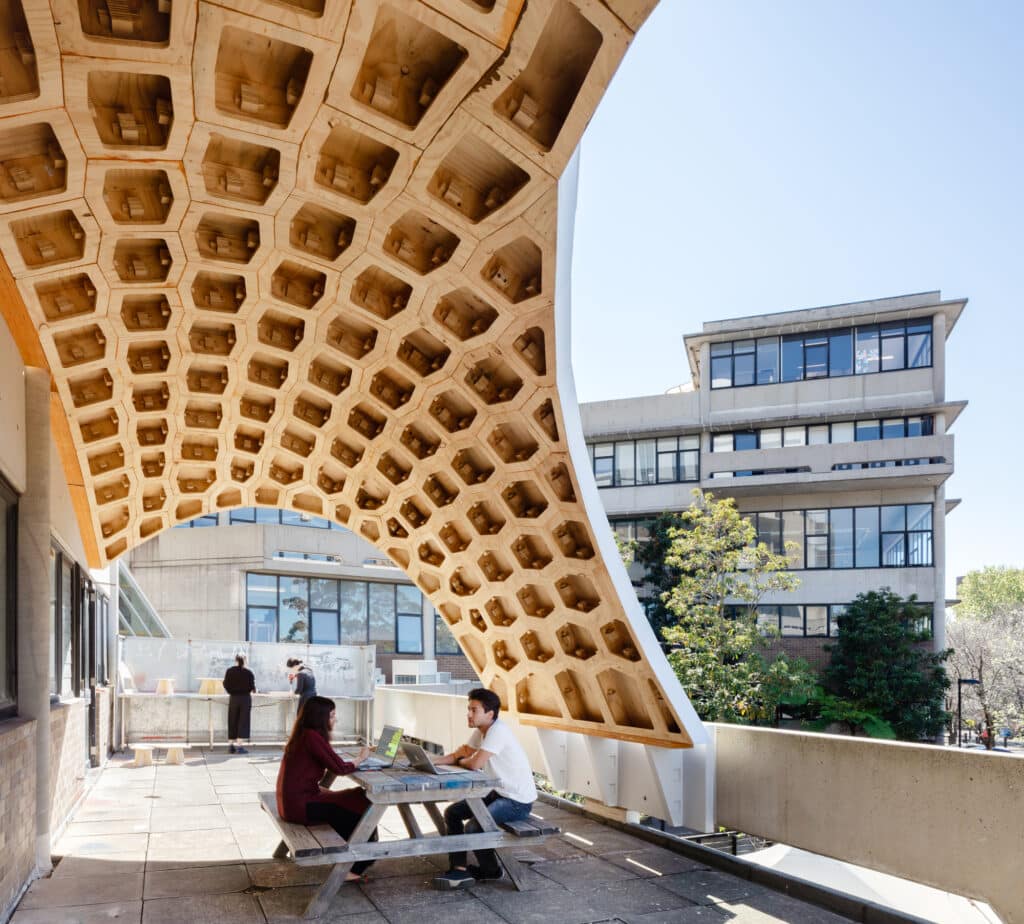
His early work focused on the development of a structural system fabricated using CNC machines and industrial robots: the HexBox Canopy, internationally recognized for its innovation in timber assemblies. Currently, as part of Aridditive, he is dedicated to the development of mortar 3D printing technologies, working on the integration of hardware, software, and the fabrication workflow for real construction applications. This stage complements his vision of digital fabrication as a process that goes beyond form: an ecosystem involving material mixing, trajectory control, tolerance calibration, and assembly logistics.
Through various projects developed with Matter Make and Aridditive, Valentino presents how digital fabrication transforms not only formal possibilities but also working methods, structural decisions, detail resolution, and the relationship between design and construction. Topics range from the engineering of assembly systems and the use of robotics in complex interiors, to additive manufacturing with concrete for urban furniture and architectural components. His presentation offers a direct look at the challenges and opportunities of contemporary digital fabrication, showing how professional practice and experimental exploration mutually inform the construction of new methodologies for architecture.
Q1 – Aridditive chose to develop a custom 3D printer rather than using an industrial robotic arm. What led you to make that decision, and what have been the main advantages and challenges compared to robotic systems?
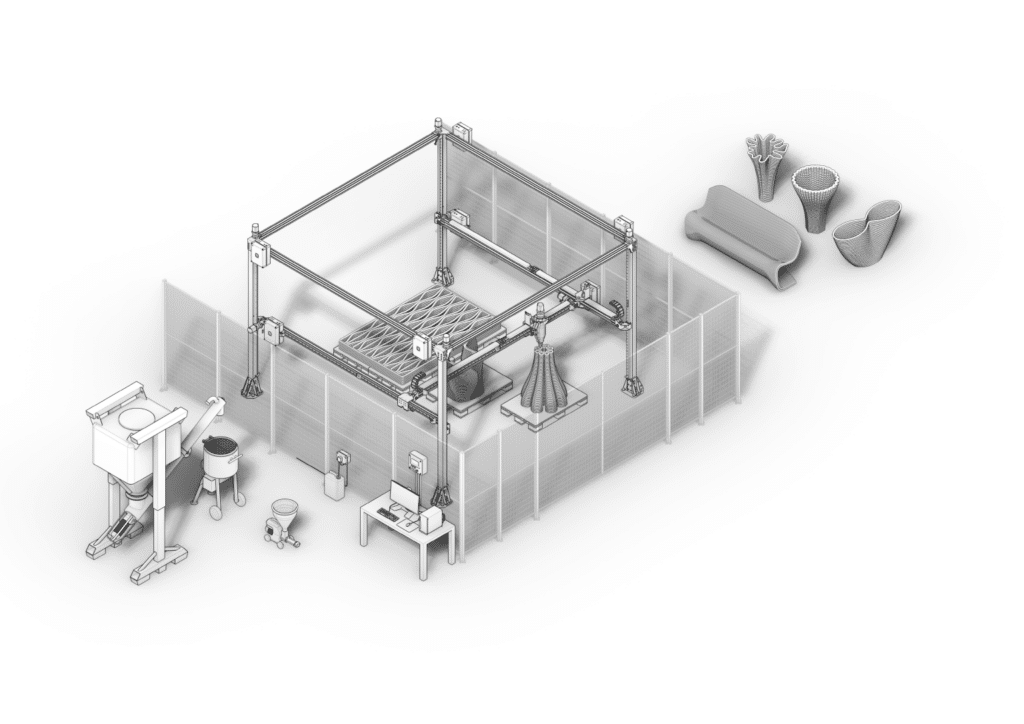
Aridditive chose to build a custom 3D printer due to the specific requirements of their projects and the type of components they aim to produce. While industrial robotic arms offer greater geometric freedom as multi-axis orientation and highly customized toolpaths, they require more preparation, simulation, and validation. In contrast, a Cartesian printer provides faster, more stable, and more repeatable motion, ideal for producing components at scale within a controlled 4000 × 4000 × 4000 mm working volume.
A dedicated printer ensures a fully controlled fabrication environment, optimizing material mixing, setting behavior, and extrusion consistency, all of which are critical for mortar printing. It also allows faster code generation, fewer operational failures, and longer uninterrupted printing cycles. Although this means sacrificing some geometric freedom, it results in a more efficient system for Aridditive’s goal: producing precise, consistent, and repeatable architectural components.
Q2 – In terms of precision and geometric control, what strategies do you use to ensure tolerances that allow the physical results to remain consistent with the digital design? Additionally, what post-processing methods or workflows do you apply to update, refine, or correct the design after printing?
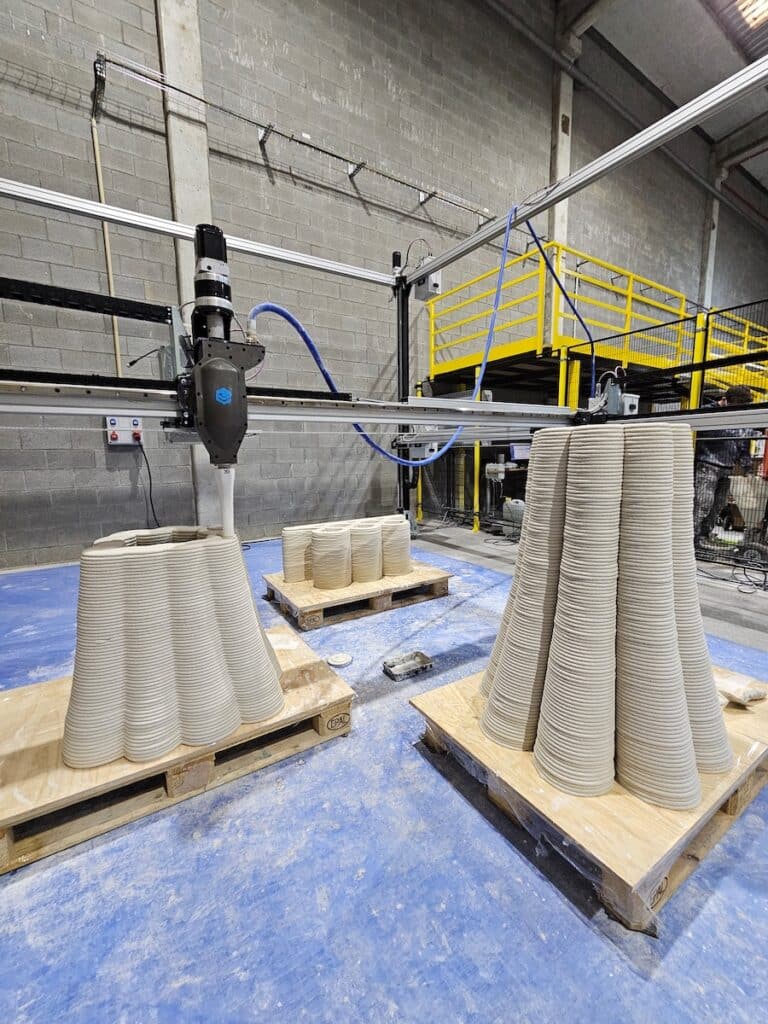
To maintain alignment between the digital model and the physical output, Aridditive works with tight tolerances, typically around 2 mm, and carefully controls layer thickness, which ranges between 35 and 38 mm depending on material behavior. Material shrinkage is also anticipated by incorporating predefined gaps such as 15 cm separations so that elements fit correctly once cured.
Post-processing strategies depend on the final application. For outdoor pieces such as planters or urban furniture, they apply water-resistant sealants or varnishes to improve durability. Additional methods include polishing or partial removal of layer textures to refine the surface. When necessary, adjustments after printing are made by comparing the printed piece to the digital model and performing local corrections through cutting, sanding, or adding material. The workflow operates as an iterative feedback loop in which fabrication informs design refinement, ensuring structural and geometric consistency.
Q3 – Regarding the Manufacturing as a Service model, how has the market responded to this form of digital fabrication, and what types of products or components are currently most in demand? Do you see real potential for scaling up toward highly customized elements in large engineering projects, such as infrastructure or bridges?
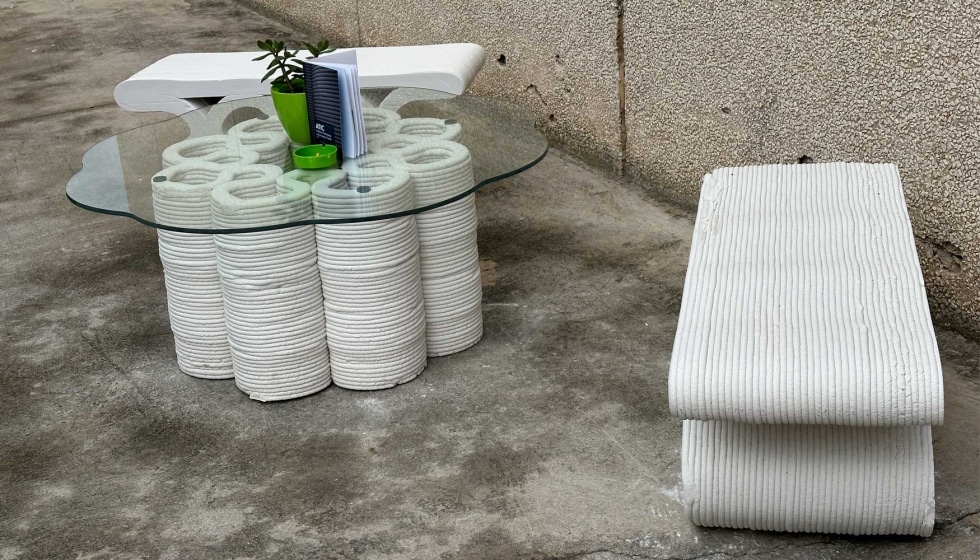
The manufacturing as a service model has been increasingly well received, especially in sectors seeking to reduce mold costs, speed up production, and work with non-standard geometries. Companies such as Escofet have adopted concrete-based 3D printing to develop new lines of urban furniture, leveraging the ability to produce customized pieces without dedicated molds. Current demand focuses on planters, benches, urban furniture, and architectural components, where 3D printing enables material optimization, weight reduction, and fully off-site fabrication in controlled environments.
There is clear potential for scaling toward modular construction, small housing units, and customized architectural parts. Although larger infrastructural applications still face regulatory challenges, the technology is evolving toward more stable, efficient and adaptable solutions, positioning 3D printing as a viable complement to traditional construction methods.
More info at:
