
Middle east, 1067 AC
scene 1:
Long before the word algorithm existed, a woman draws lines in the send. She is not an architect. The word does not exist yet either. She is simply someone who must decide where people sleep when the river floods.
She draws, erases, redraws.
She listens to the wind.
While She remembers which walls collapsed during last flood, still can’t remember what worked when she was a child
Someone beside her asks:
“Why do you keep changing the lines?” She answers:
“Because the river changes.”


London, 1985 AC
scene 2:
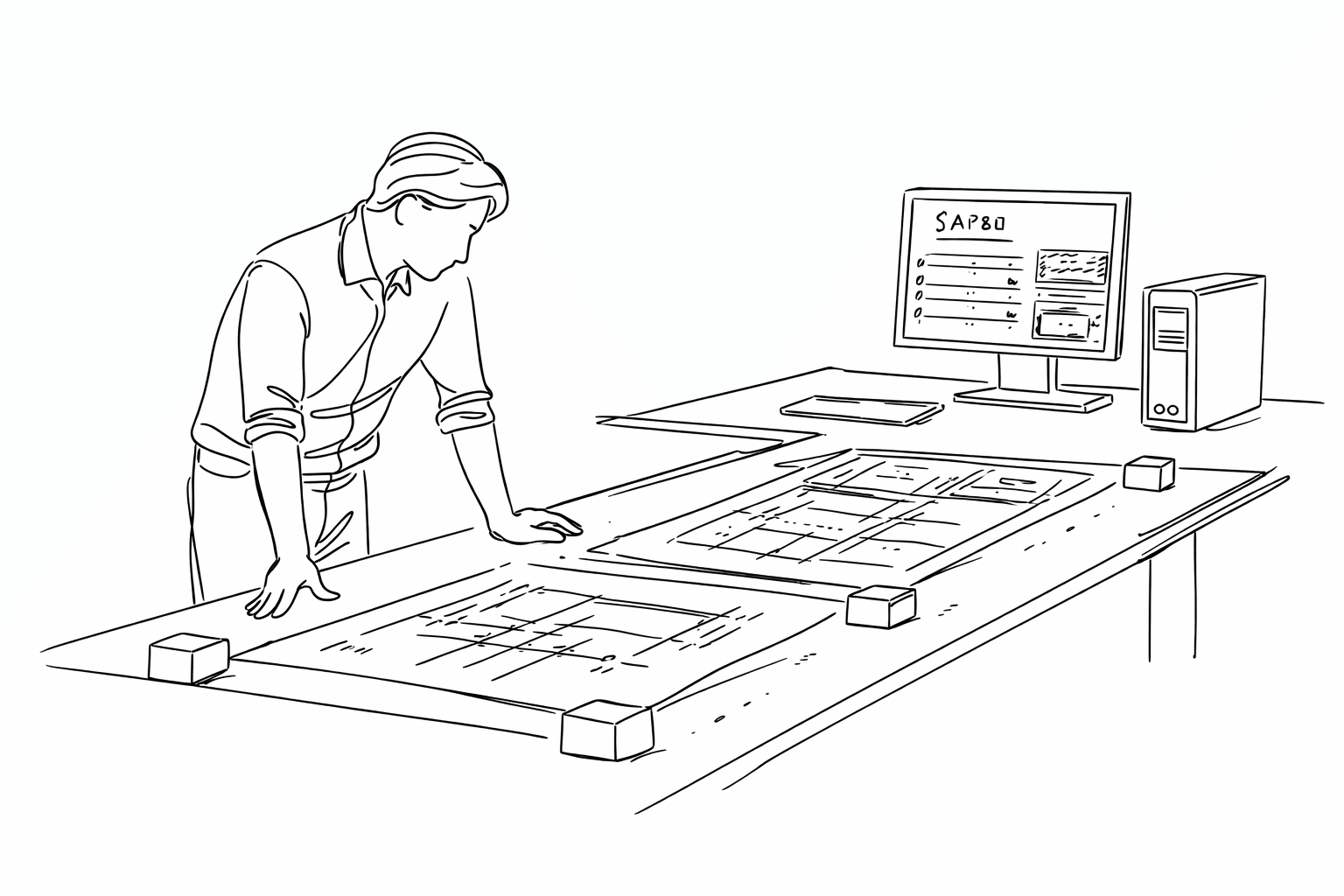
The room smells of printing paper and cigarettes. It is quiet in the way institutions are quiet— not peaceful, but disciplined. A man stands over a long table.
On the table: carefully ruled drawings, perfectly aligned, weighted at the corners with metal blocks.
Every line has a reason. Every reason has a number.
CAD drawings. SAP80 flashes green. Loads. Spans. Repetition.
Nothing is left to chance anymore.
Deformations are simulated, layouts are produced. Sections are aligned.
Everything is within limits. He signs the sheet, dates it, and places it on the stack.
Another project completed.

New York, 2026 AC
scene 3:
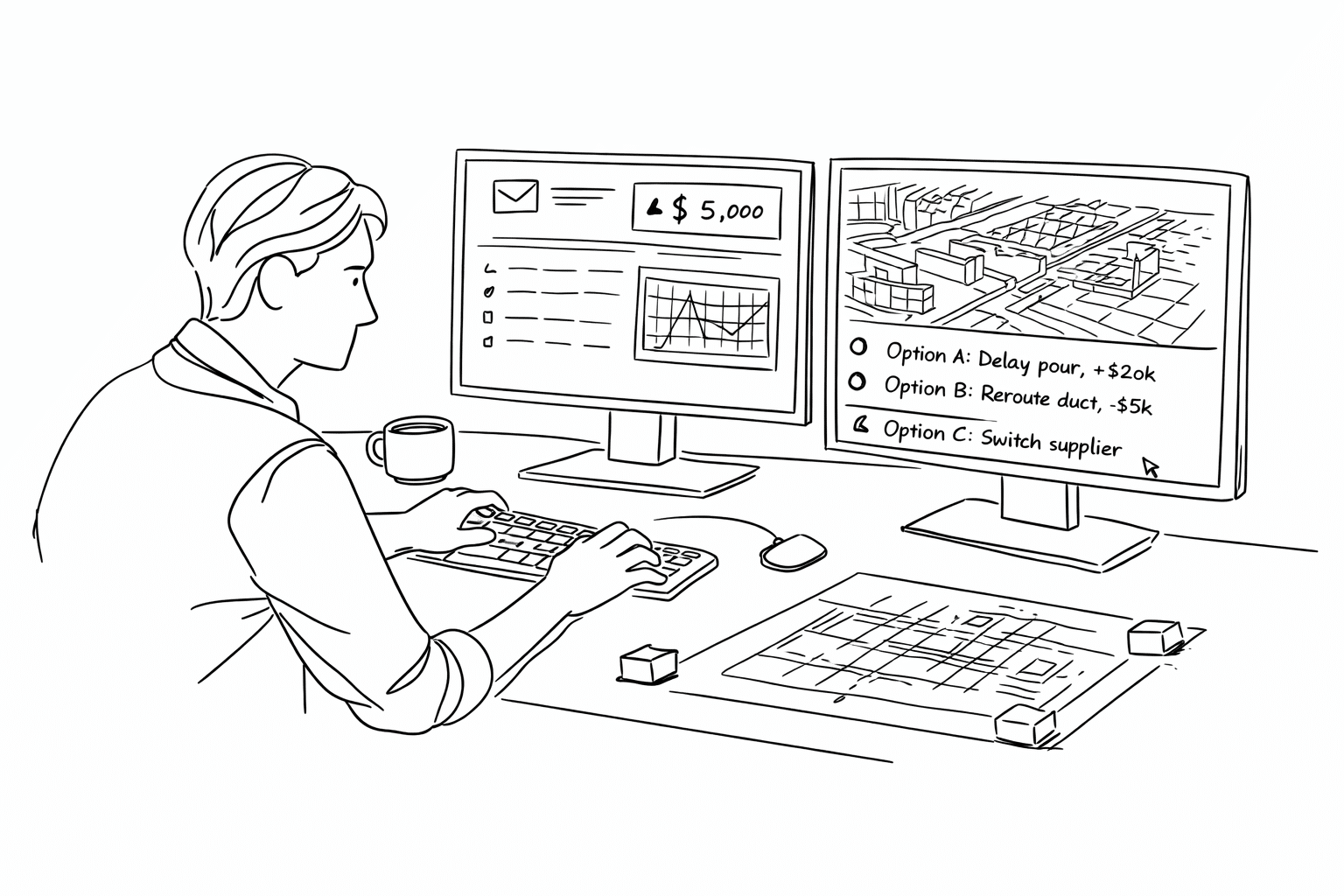
Marcus stared at the dual monitors, his coffee cold. The project was screaming. A supply chain disruption in steel delivery, a clash between the HVAC ducting and the structural beams on floor 40, and a client asking for a cost reduction of 5% by morning.
Twenty years ago, this would have required a team of ten and a week of panic.
“Analyze impact,” Marcus typed into the project plugin he created himself just for this project.
The AI didn’t just simulate physics; it simulated logistics. It crawled through thousands of emails, vendor contracts, and 3D BIM models. In seconds, it offered three paths.
- Option A: Delay the pour, cost increase $20k.
- Option B: Reroute the ducting (automatic layout generated), keep schedule, save $5k.
- Option C: Switch material suppliers (risk high).
Marcus clicked Option B. The AI immediately updated the drawings, sent notifications to the plumbing sub-contractor, and adjusted the GANTT chart. It wasn’t magic; it was the ruthless aggregation of data.
Yet, Marcus felt a twinge of unease. He hadn’t drawn the new duct route. The machine had. He was no longer just a creator; he was a curator of machine-generated options. He was the pilot, but the plane was flying itself.

Orbital Habitat 7, 2185 AAI
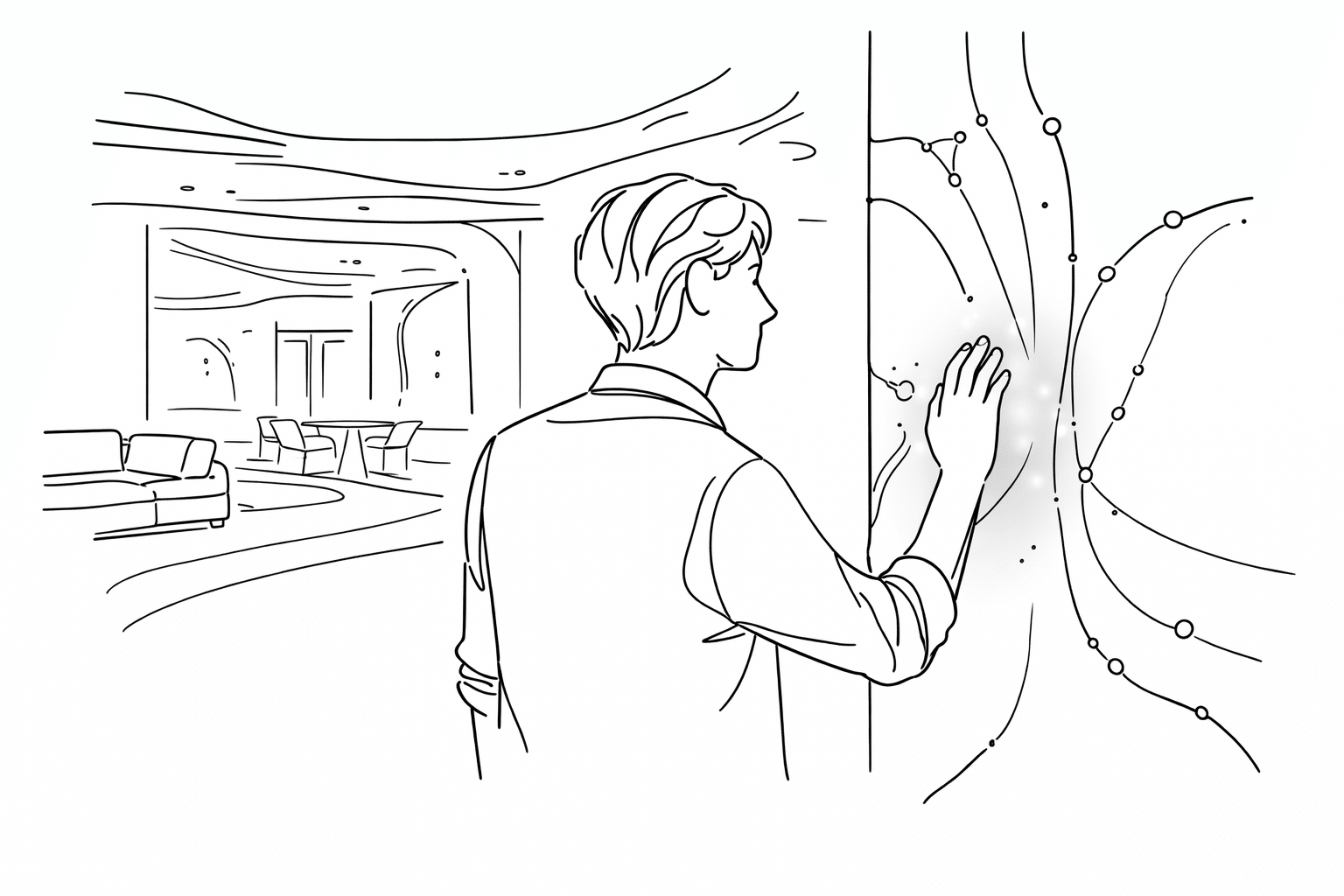
The structure didn’t have a name; it had a feeling. When Kael walked into the common room, the walls shifted perceptibly. The light warmed by a few degrees Kelvin—not because of a timer, but because the building sensed his circadian rhythm was drifting toward depression.
There were no architects drawing blueprints anymore, and no engineers calculating loads. The building was a living organism, its nervous system a decentralized AI woven into the metamaterials of the hull. It was constantly re-engineering itself. If a support strut felt micro-fractures, the AI redirected loads to adjacent members and initiated self-healing protocols, much like human skin heals a cut.
Kael touched the wall. It pulsed faintly. The distinction between the inhabitant and the habitat had vanished. The building was no longer a static container for life; it was a participant in it.

Buckminster Fuller thought 1:
“We are called to be architects of the future, not its victims.”1
Victim of the future:
- Chases every new AI tool
- Feels permanently behind
- Lets platform dictate aesthetics, speed and values
- Confuses productivity with intelligence
- Adapts reactively
Buckminster Fuller thought 2:
“When I am working on a problem, I never think about beauty…but when I have finished, if the solution is not beautiful, I know it is wrong”2
- Beauty is emergent
- Beauty as a test, not a goal
Buckminster Fuller thought 3:
“Dare to be naive”3

- Sieden, L. Steven. A Fuller View: Buckminster Fuller’s Vision of Hope and Abundance for All. Studio City, CA: Divine Arts, 2011. ↩︎
- MacHale, Des. Comic Sections: The Book of Mathematical Jokes, Humour, Wit and Wisdom. Dublin: Boole Press, 1993 ↩︎
- Fuller, R. Buckminster. Synergetics: Explorations in the Geometry of Thinking. New York: Macmillan, 1975. ↩︎
