Intro
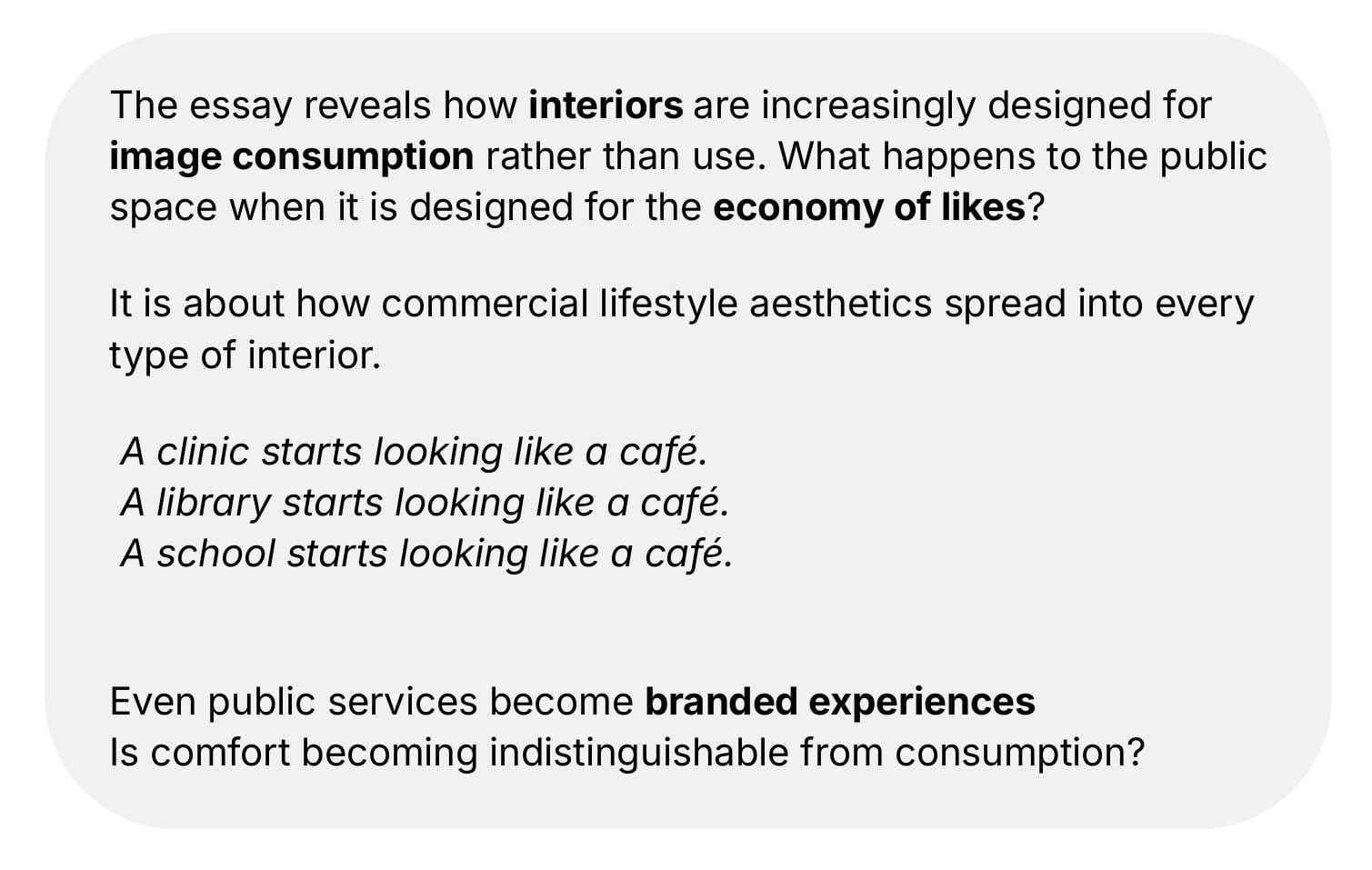
This digital essay explores the growing trend of designing interior spaces for image consumption rather than functional use. This project investigates the consequences for public spaces when they are reshaped by the “economy of likes”. Drawing on Guy Debord’s Society of the Spectacle, the researchers argue that social relations are increasingly mediated through images, a phenomenon that has transformed civic interiors like clinics, libraries, and waiting rooms.
These spaces have effectively turned into a “face” for a camera that isn’t physically present. We can distinguishes between two states for these environments: “lived in” and “looked at”. This shift is supported by a 2018 study which found that Instagram likes for architectural photography are predictable based on specific metrics like balance and curvature. When these likes become a feedback loop, they essentially serve as a new kind of architectural design brief.
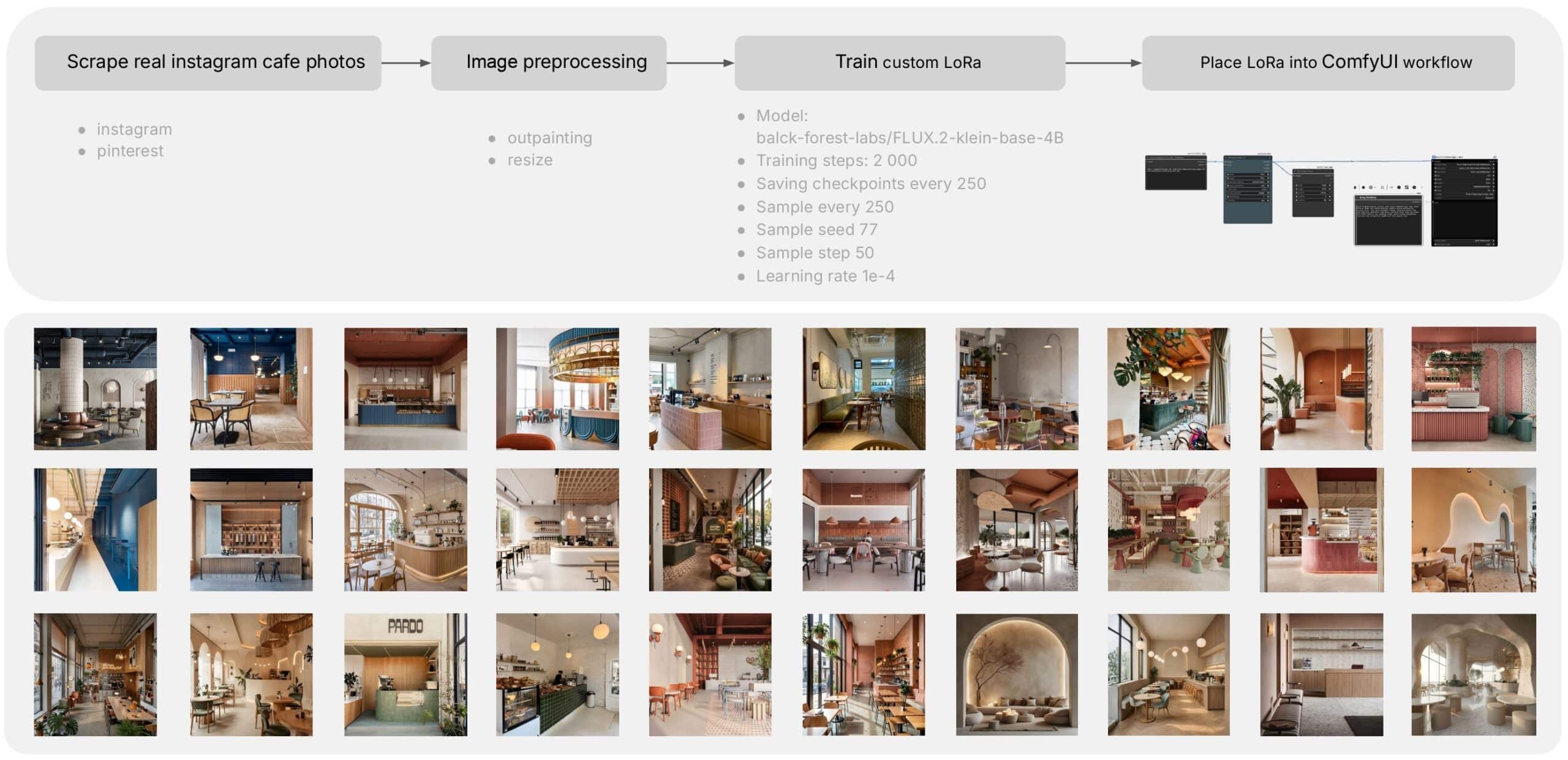
To research this further, we developed a custom Low Rank Adaptation (LoRA) model using Comfy UI. By training the model on Flux 2 Klein using scraped images of cafes from Instagram and Pinterest, they created a workflow where any civic interior can be dropped into the system to be transformed into an “Instagrammable” space.
Workflows
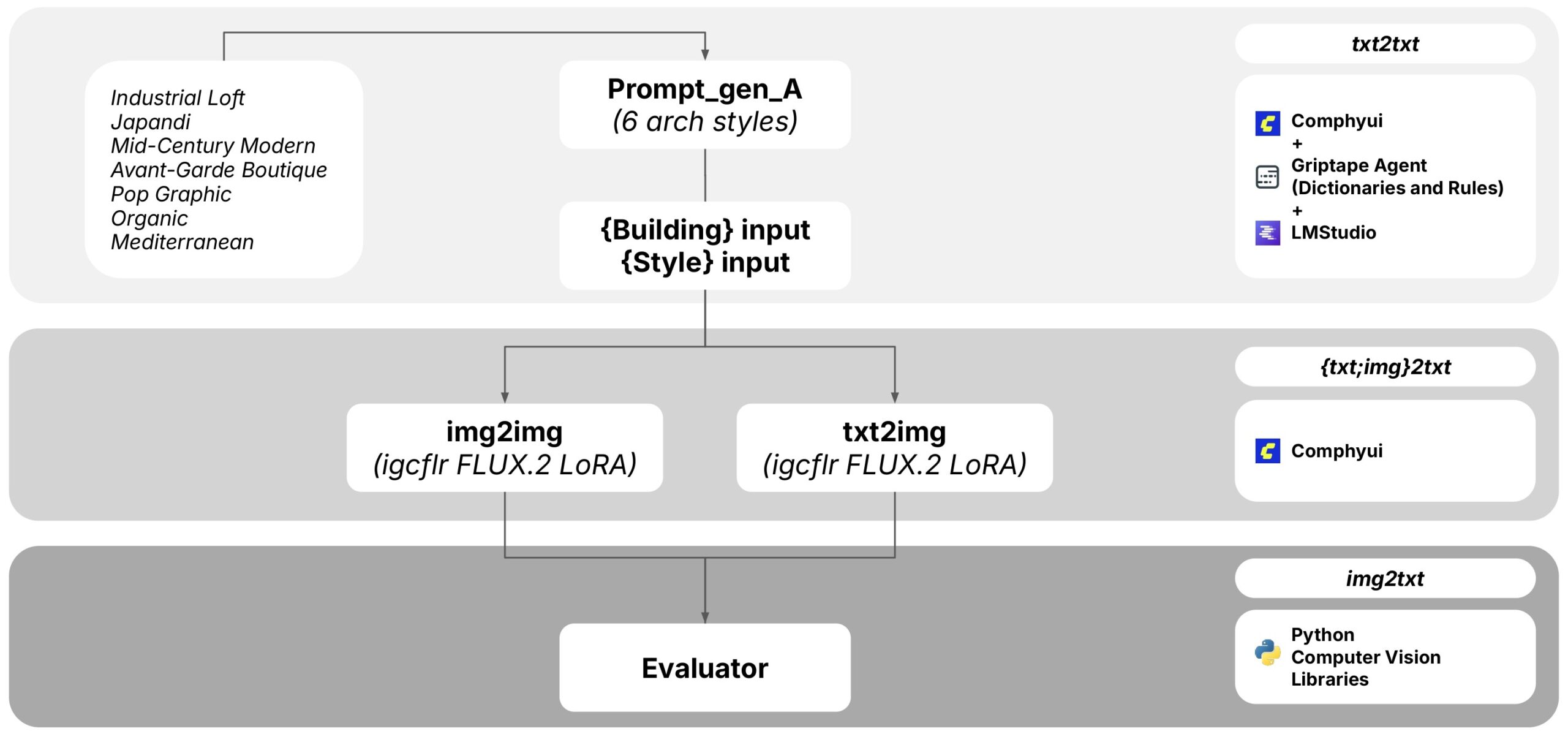
To bridge the gap between architectural theory and digital reality, the project utilizes a sophisticated generative AI workflow designed to automate the “Instagrammification” of public space. This system is structured to take existing civic interiors and reimagine them through the lens of social media aesthetics, ensuring they are optimized for digital consumption.
The first phase of this process is the text-to-text stage. During this step, the workflow leverages tools such as Comfy UI, Grip Tape, and LM Studio to process specific building inputs. This stage is crucial for defining the stylistic direction of the transformation, as it allows the system to categorize and interpret these inputs across six distinct architectural styles.
Once the stylistic parameters are established, the workflow moves into the generation phase. This stage employs both image-to-image and text-to-image processes, all powered by a custom Flux LoRA model. This model acts as the “likes dial,” applying visual patterns learned from popular digital imagery to the architectural structure of the input photo, resulting in a redesigned space that prioritizes aesthetic appeal over traditional utility.
Finally, the entire process concludes with an automated evaluator stage. This final phase assesses the newly generated designs to see how well they might perform in the digital economy. By combining these technical steps, the workflow demonstrates how the “random mood of the algorithm” can be translated into a tangible design brief for the physical world.
Evaluator
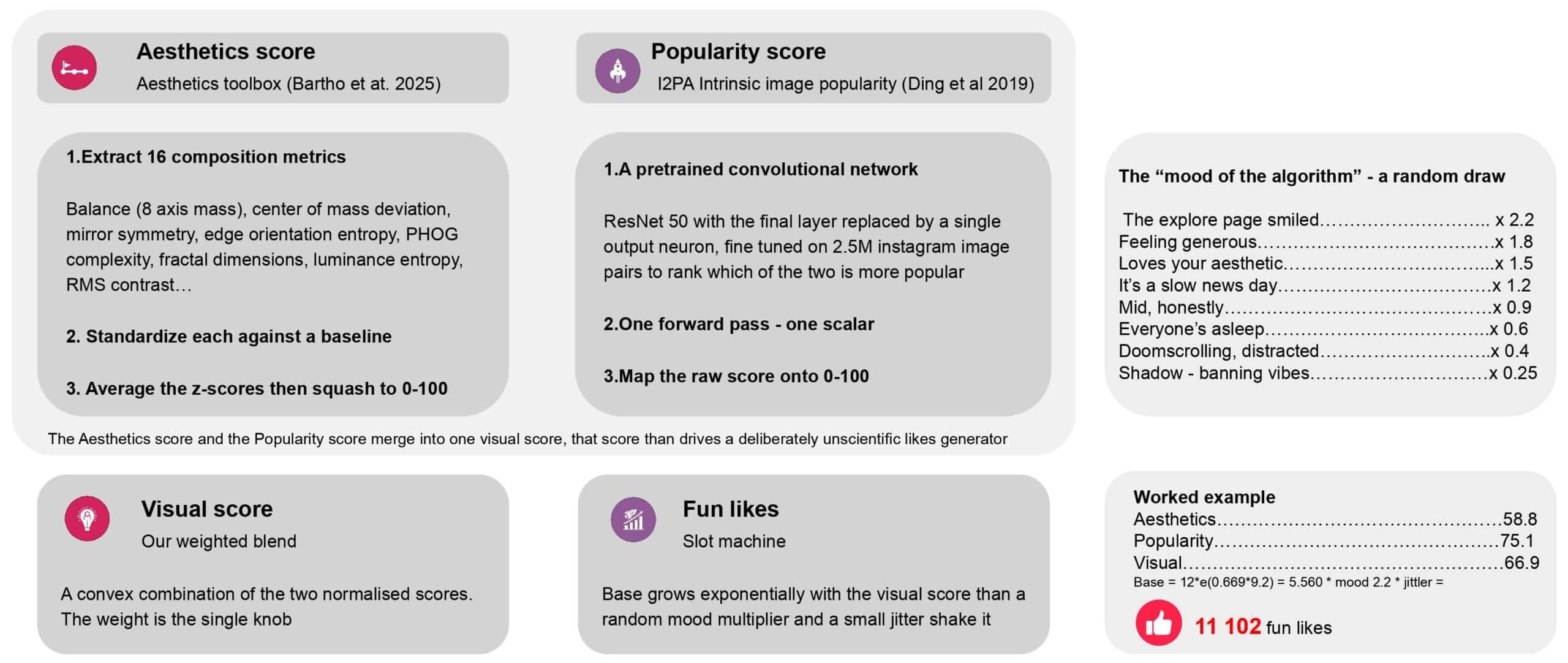
The final stage of the project’s process is the Likes Calculator, a sophisticated evaluation tool designed to quantify the digital success of these reimagined architectural spaces. This calculation is not a simple metric but is instead divided into two distinct, independent tracks: the aesthetic score and the popularity score.
The aesthetic score utilizes a specialized aesthetic toolbox developed by Bartloin in 2025 to analyze the technical merits of the image. This tool extracts 16 specific composition metrics that focus primarily on the visual format and layout of the space. To ensure a consistent evaluation, each of these metrics is standardized against a baseline and then averaged into a single numerical value ranging from 0 to 100.
In parallel, the popularity score is derived from a neural network known as A2P RSET 50. This network was trained on a massive dataset of 2.5 million Instagram image pairs, allowing it to “learn” through a forward pass which visual traits typically garner more engagement from users. Similar to the aesthetic metric, this result is also mapped to a scale of 0 to 100. The system then allows for a blended visual score, where a single dial can be used to weight the final result more heavily toward technical composition or general popularity.
The two scores are combined into a single visual score through a weighted sum, exposed as a single parameter that shifts the balance between composition and popularity.
The final step generates the simulated like count. The visual score sets a baseline that scales exponentially, which is then multiplied by a stochastic factor representing algorithmic variance — a favorable distribution boost (×2.2), a suppression penalty (×0.25), and an additional random jitter term.
This stochasticity is intentional and central to the model’s premise. Engagement is never a function of the image alone; it is shaped by follower count, posting time, and chance. Rather than overfitting to a deterministic prediction the system cannot justify, the model treats the outcome as probabilistic — an honest acknowledgment of the variance inherent in real-world engagement.
User Interface
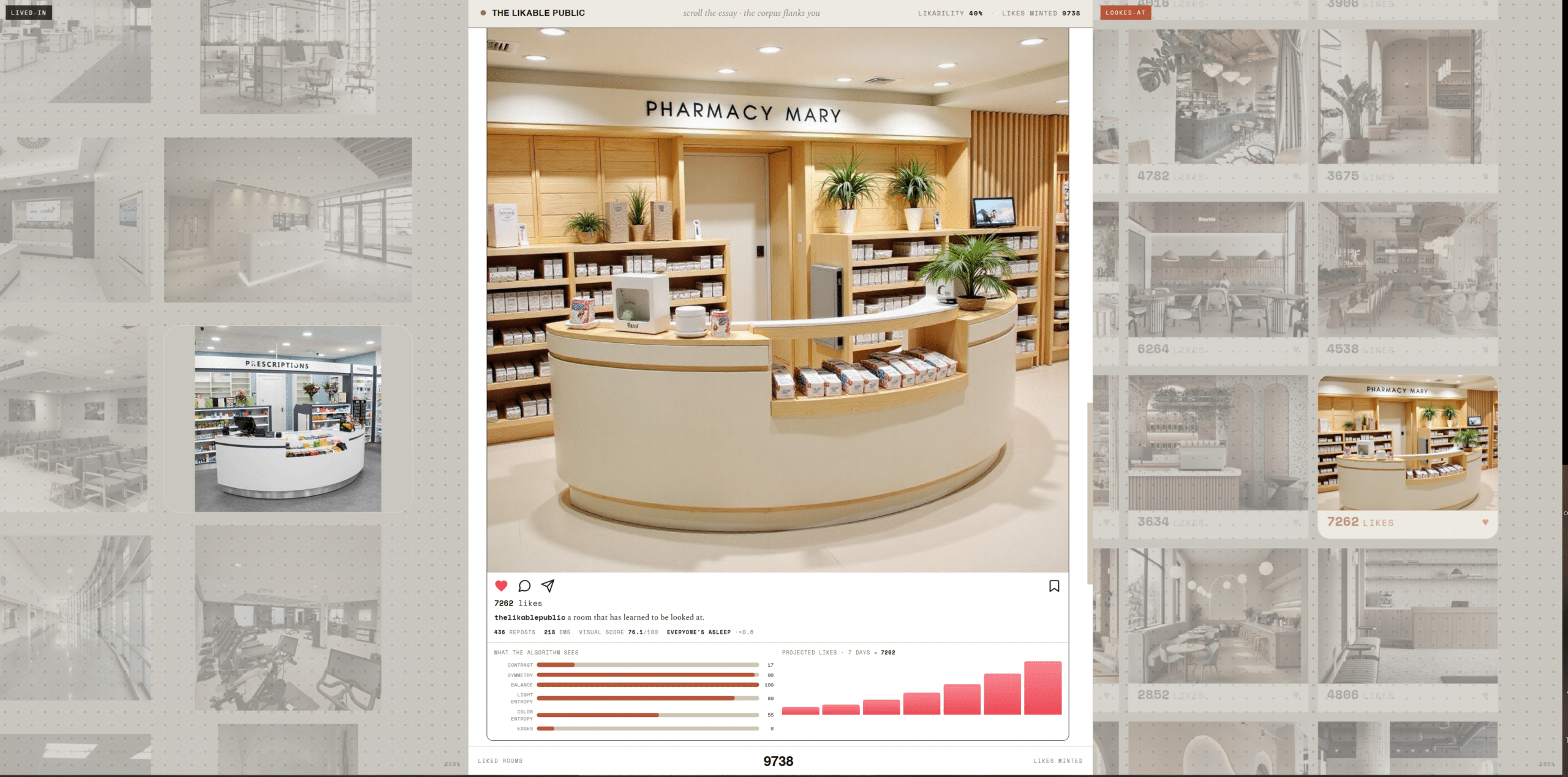
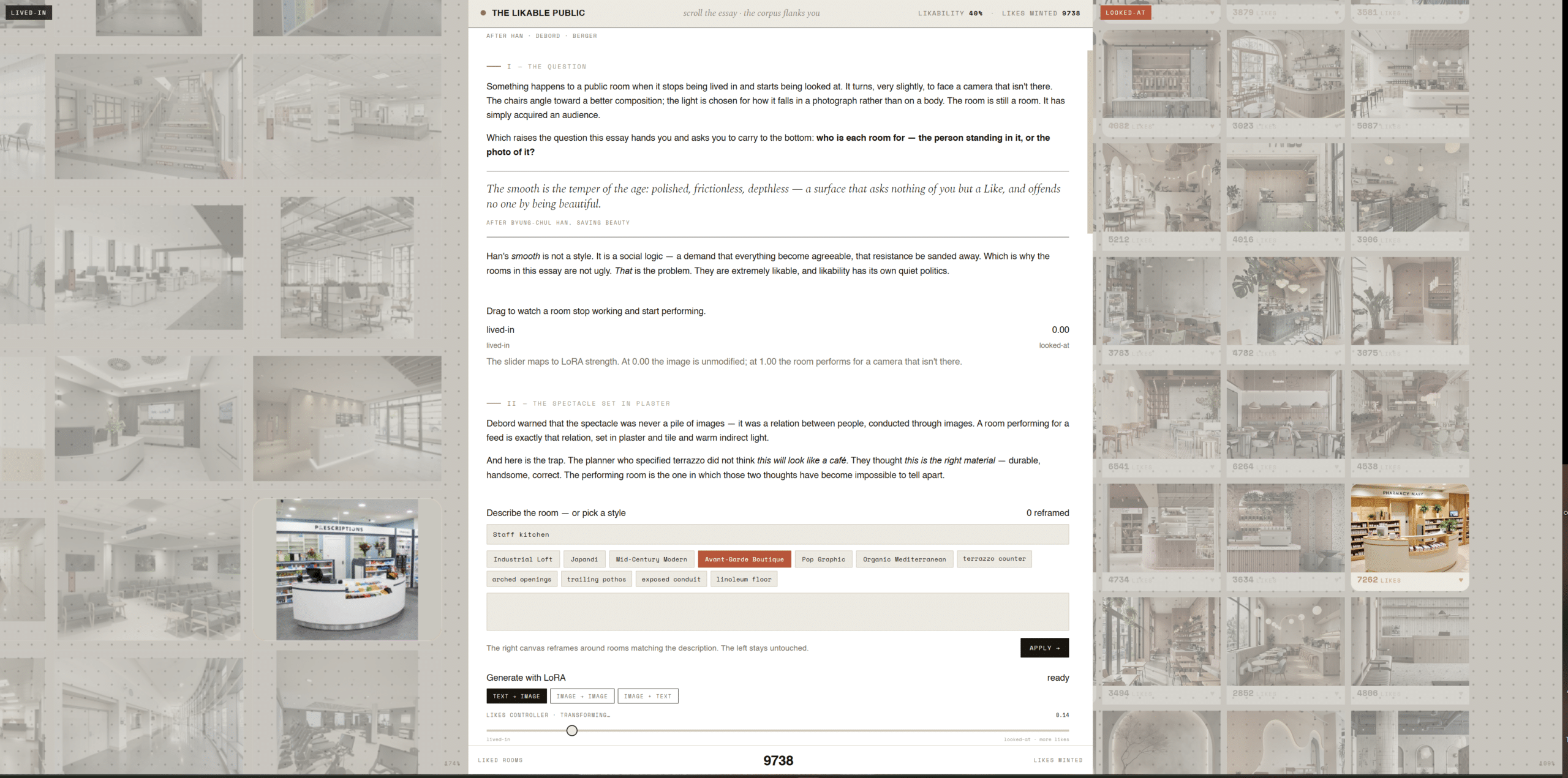
The user interface (UI) of “The Likable Public” is designed as an interactive digital journal consisting of three primary functional areas that allow users to experiment with the “Instagrammification” of architectural spaces.
The Three-Canvas Layout
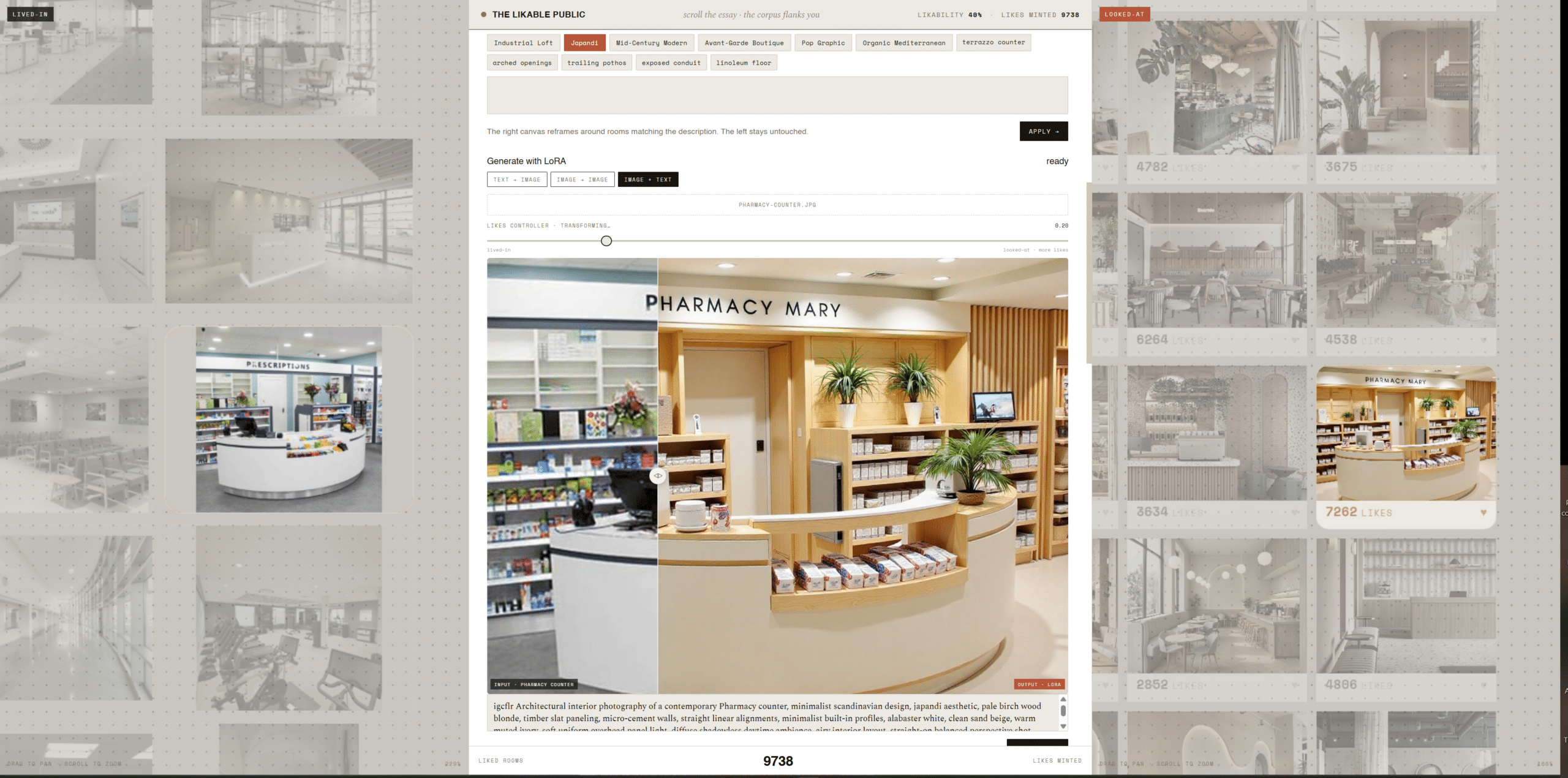
The UI is organized into a visual workspace that balances theoretical content with generative tools:
- The Essay Canvas: Centrally located, this is where the main article resides. Users can scroll through the text to engage with the research and architectural theory behind the project.
- The Left Canvas: This area displays the “before” images—original photos of civic interiors like offices or desks before any digital transformations have been applied.
- The Right Canvas: This canvas contains the training dataset images that the Flux LoRA model was originally trained on. Additionally, it serves as a gallery where users can save their newly generated images.
Interactive Generation and Prompting
The UI automates much of the prompting process to make the generative AI more accessible:
- Automatic Description: When a user selects an image from the left canvas, the system automatically generates a text description. This description can be copied directly into the prompt command field.
- Style Selection: Users can choose from various architectural styles (such as industrial loft or pop graphic). Selecting a style automatically updates the text-to-image prompt to reflect that specific aesthetic.
- The “Likes” Control: A key feature of the interface is the ability to control the “likes amount” by adjusting a slider that changes the strength of the LoRA model. Increasing this strength more aggressively applies the “Instagrammable” visual patterns learned from the training data.
Workflow Testing and Results
The UI supports different generative workflows, allowing users to see how specific design choices impact the final image:
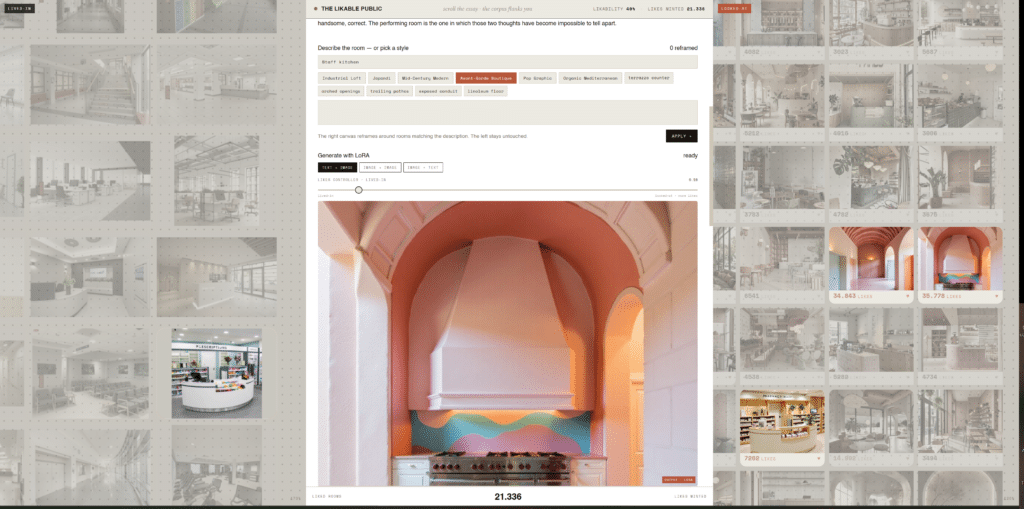
- Image-to-Image Transformations: In one test, an office photo was transformed into an industrial loft style. By using a Canny map, the UI ensures the resulting image remains structurally consistent with the original while overhauling the materials, ceilings, and overall atmosphere.
- Sacrificing Function for Aesthetics: The interface demonstrates the trade-offs of designing for digital fame. For example, when applying a pop graphic style to an intake desk at a high LoRA strength, the researchers noted that functional elements like computers were “sacrificed” in the image to achieve a more “likable” aesthetic.
- Output and Analytics: Once an image is generated, a Likes Calculator panel appears. This panel features a graph showing the predicted popularity of the new image. Users can then choose to save these results to the right-hand canvas or download them directly to their local machine.