
“A theory class on Matias del Campo forced a difficult question: are we using AI, worshipping it, or finally ready to conduct it?“
Part I — The Machine We Do Not See
Simondon and the two ways we fail the machine
Matias del Campo is an architect, educator, and co-founder of SPAN. His practice sits at the intersection of artificial intelligence and architectural form, and it raises uncomfortable questions about authorship, creativity, and the role of the designer. To understand him, we first need to understand a philosopher who predated the internet: Gilbert Simondon.
In his 1958 essay Du mode d’existence des objets techniques, Simondon traces what he called an intellectual journey through the nature of technical objects. Schmidgen identifies three movements in this journey — and they resonate strikingly with our current relationship to AI. The central provocation: we rarely ask what a machine is. We only ask what we want from it.
“In a state of ignorance, technical objects appear to us as black boxes. We do not understand their internal processes, their logic, or their evolution.”
After Simondon, via Schmidgen
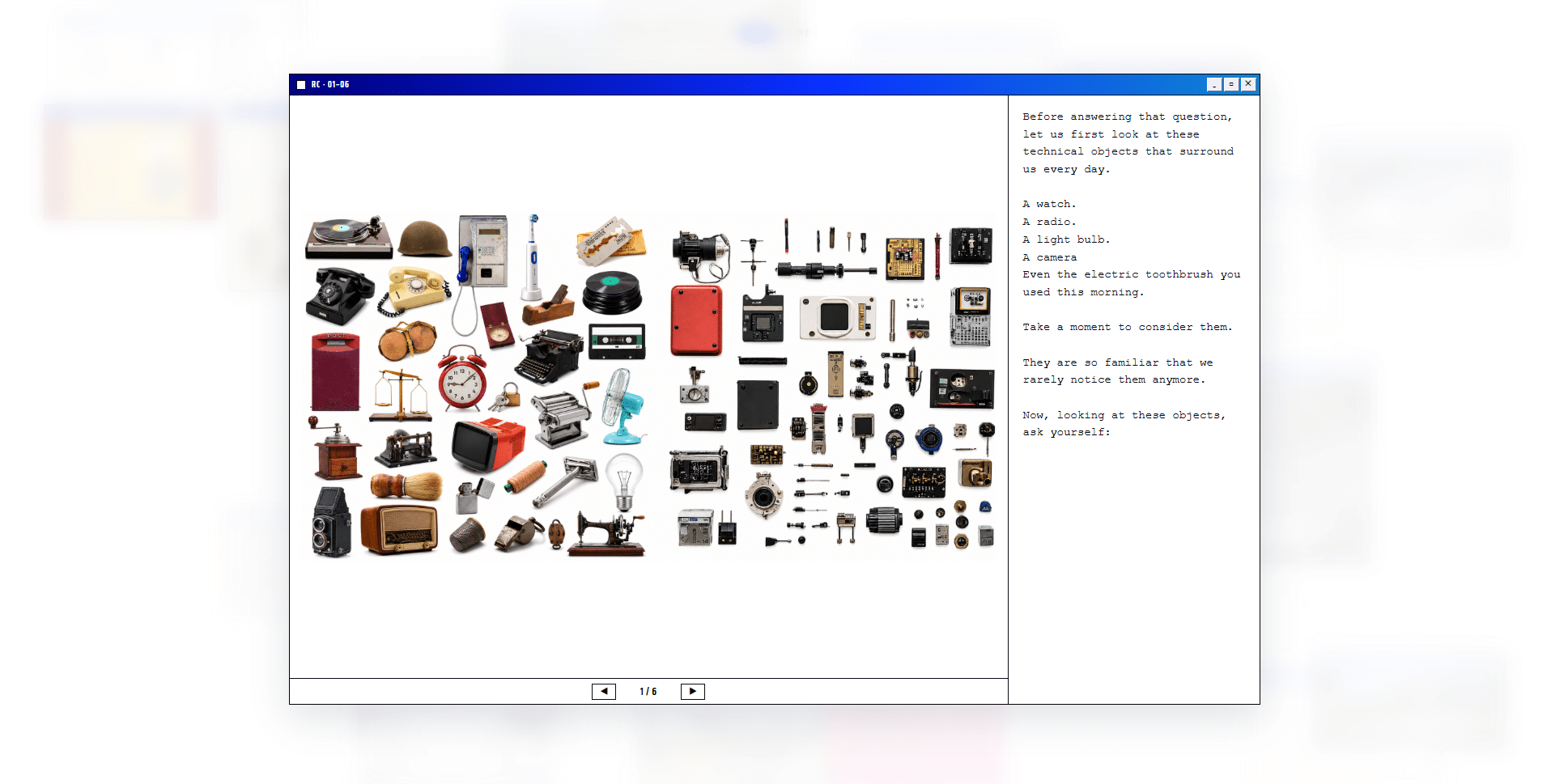
Simondon identified two opposite, yet closely related, failures. We either ignore the machine entirely — treating it as a black box whose inner workings are irrelevant — or we elevate it to something mythical, attributing powers it does not actually possess. Roland Barthes wrote about the Citroën DS as a goddess: respected, worshipped, almost sacred. We see this pattern repeat with every iPhone launch, every viral AI image drop, every Supreme x Swatch collaboration. Either dismiss or worship. Never understand.
Part II — Concrétisation
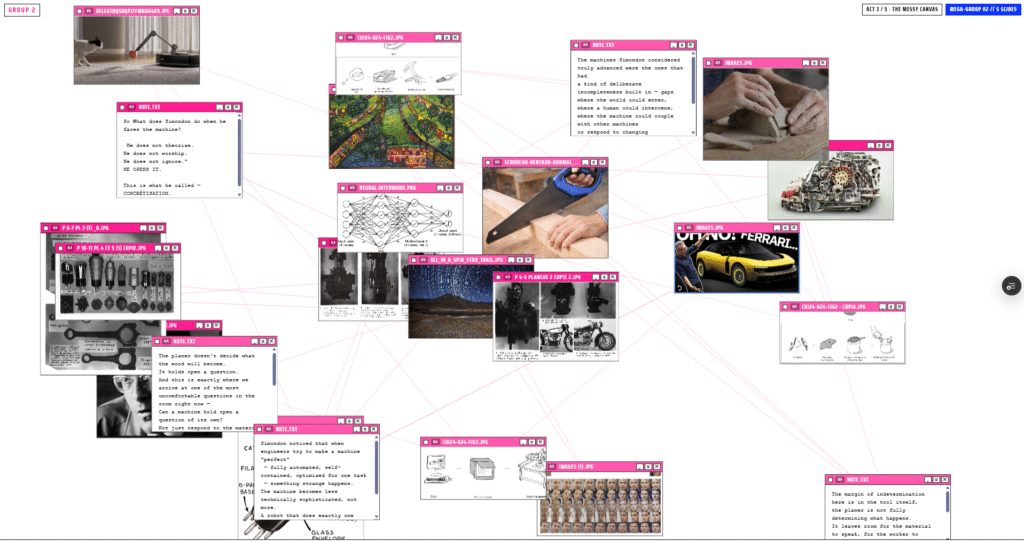
He does not theorize. He does not worship. He opens it.
Simondon noticed something counterintuitive when engineers try to make a machine perfect: fully automated, self-contained, optimized for a single task. The machine becomes less technically sophisticated, not more. A robot that does exactly one thing, flawlessly, has no room left inside it. It is closed.
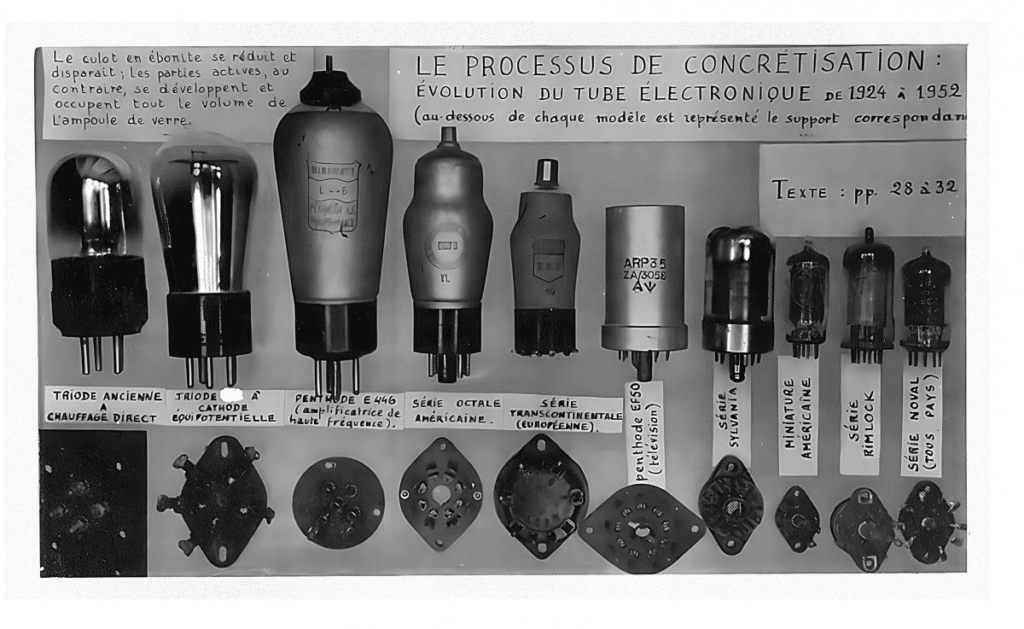
The machines Simondon considered truly advanced were the ones with a kind of deliberate incompleteness built in — gaps where the world could enter, where a human could intervene, where the machine could couple with other machines or respond to changing conditions. He called this gap the margin of indetermination.
_____
The Material
Wood
Grain, resistance, irregularity. The material speaks back to the tool.
_____
The Human
The worker’s hand
Reads the wood, adjusts pressure, interprets what the planer leaves open.
Take the planer. The tool does not fully determine what happens. It leaves room for the material to speak, for the worker to respond. The planer is in dialogue with the wood and with the human simultaneously. The skill lives not in the tool, not in the hand, but in the space between them.
The planer does not decide what the wood will become. It holds open a question.
“Can a machine hold open a question of its own? Not just respond to the material. Not just transmit signals back to the hand. But actually reach into a space that wasn’t there before — and pull something out that nobody put in. In other words: can AI be creative? Can something truly new emerge from a dataset of existing designs?“
Part III — The Machine That Dreams
The Robot Garden and the strangeness of machine vision
Consider the Robot Garden at the University of Michigan’s Robotics Building, inaugurated in 2021. Its ground textures were not designed by an architect with a mouse. Instead: satellite images of the site were fed into a neural network trained on thousands of architectural elements, then the network was allowed to dream those elements onto the terrain.
The result is a landscape that appears natural but carries a strange artificiality. The forms are not what a human would have chosen. They are what a machine saw when it tried to see architecture in an empty field. This is the key moment. Something genuinely weird happens when AI designs space; weird enough to take seriously rather than dismiss.
Part IV — Creativity and Estrangement
Can AI create something truly new?
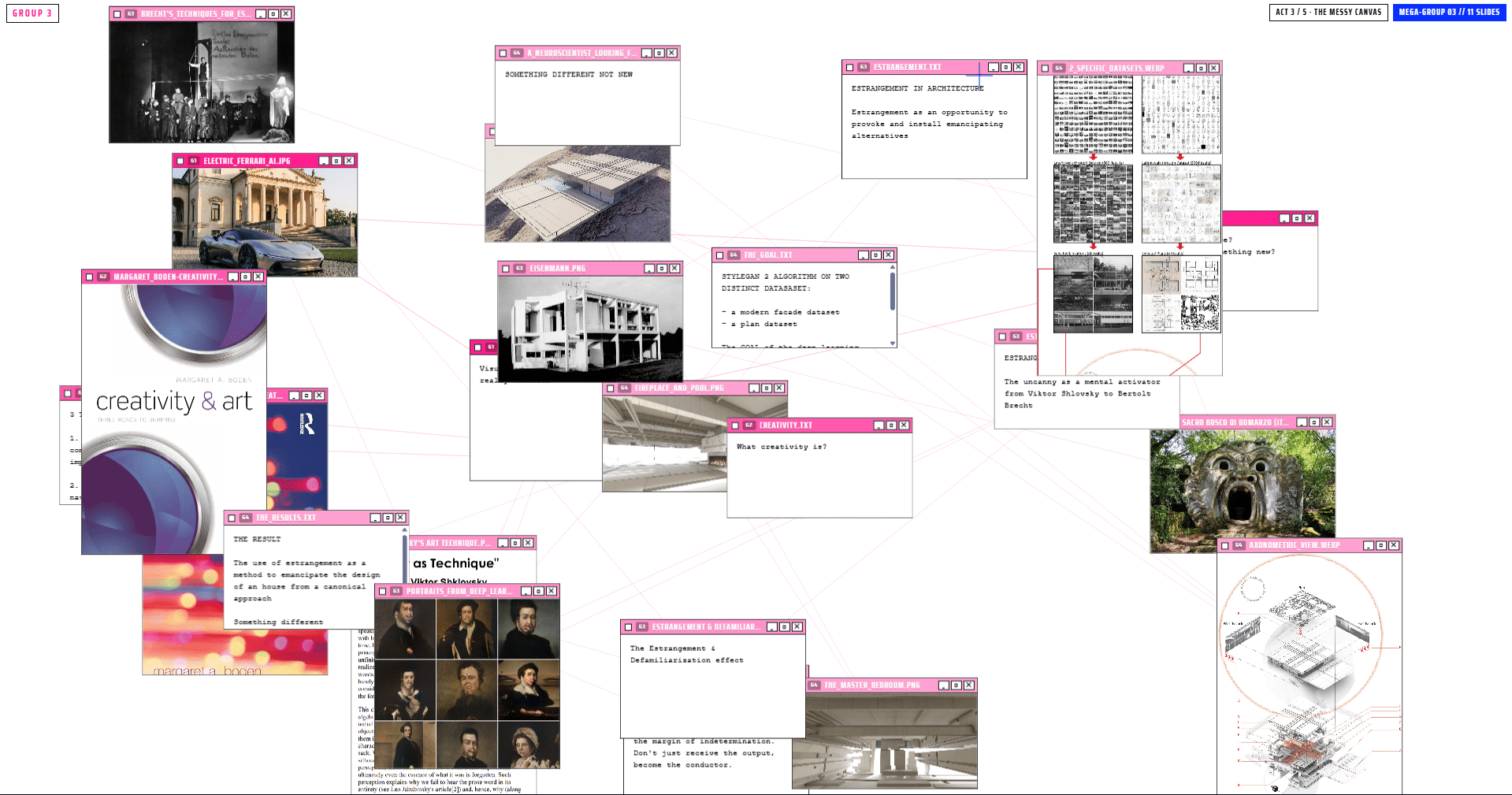
This is the question that kept surfacing in our session. A generated Ferrari may look convincing, but it is immediately readable. We recognize the pattern: familiar futurism projected forward. That seductive smoothness, which Simondon and Schingden both discuss, is probably not what we are looking for when we want something new.

Margaret Boden, the foundational researcher in AI and creativity, defines three forms:
_____
Combinational
Improbable combinations
Merging existing ideas in unexpected ways. StyleGAN’s latent interpolation maps here.
_____
Exploratory
Navigating boundaries
Moving through the edges of a conceptual space. Novel, and surprising in its novelty.
_____
Transformational
Changing the rules
Rewriting the space itself. Loos’s Raumplan. Corbusier’s Maison Domino.
Boden’s framework opens into the concept of estrangement, introduced by Russian formalist Viktor Shklovsky in 1917. The idea: take something familiar — an everyday object, a domestic space — and introduce enough strangeness to sharpen the observer’s attention. Bertolt Brecht operationalized this in theater: abstract stage design, projected captions, actors breaking the fourth wall. His goal was to distance the audience from emotional immersion and force intellectual engagement. Stop feeling. Start thinking.
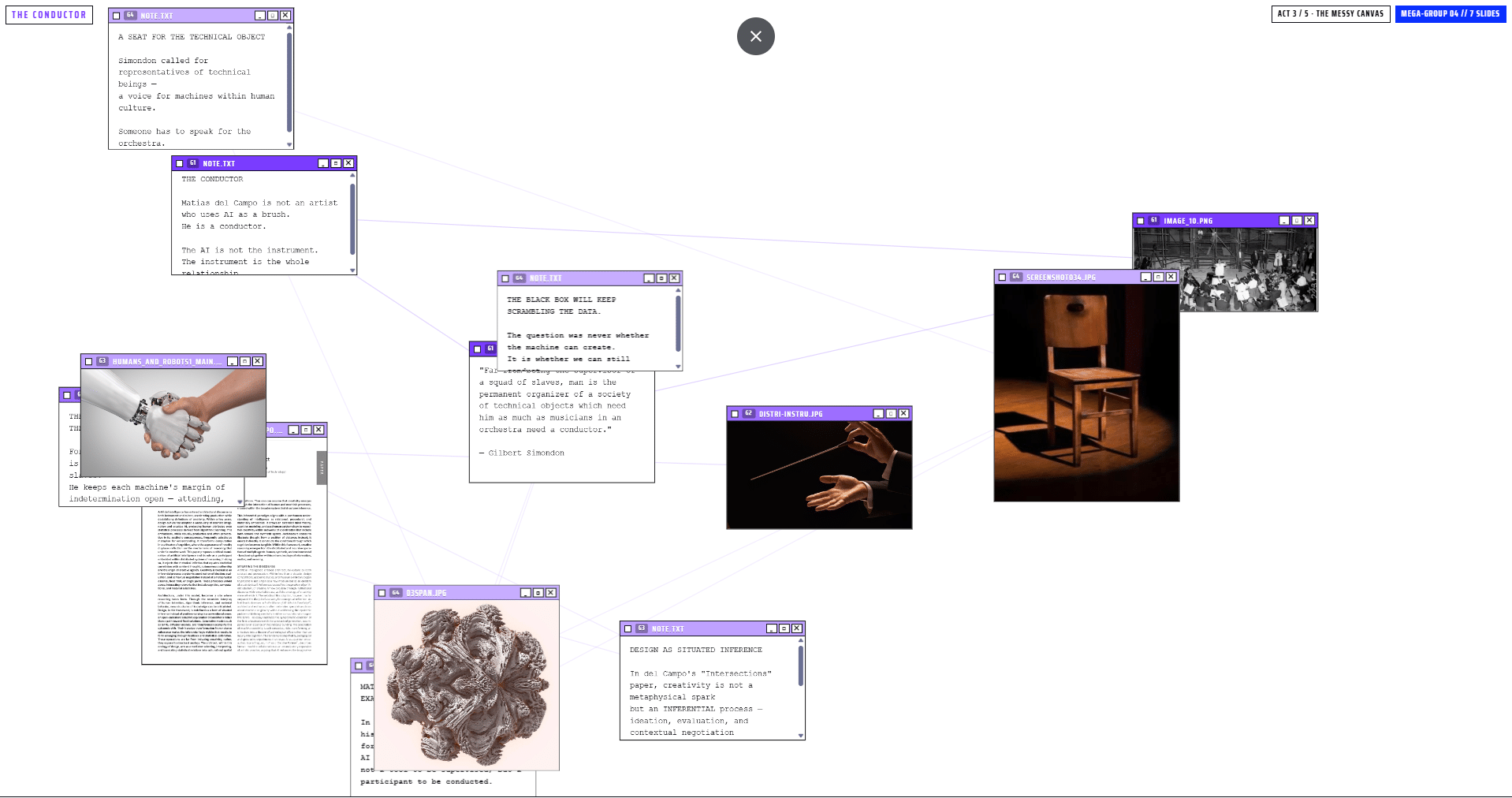
Del Campo applies this to architecture directly. In his Deep House project, commissioned by a neuroscientist seeking something different rather than something new, two datasets — a modern facade set and a plan set — were trained using StyleGAN2. The goal was not smooth accuracy. The network was deliberately pushed toward overfitting and data scarcity to produce uncanny, defamiliarized results.
“Estrangement allows breaking through the conventions of the architectural status quo. The house is strange, but familiar enough.”
On del Campo’s Deep House
Part V — The Conductor
Not a tool. A participant to be conducted.
So far, we have been treating AI as a brush in the hand of the designer. That metaphor breaks down with del Campo. He is not an artist picking up AI as a new medium. He is a conductor. And the AI is not really the instrument — the instrument is the whole relationship: human intention, the dataset, the latent space, the selections we make, and the material that finally takes form.
Simondon, 1958
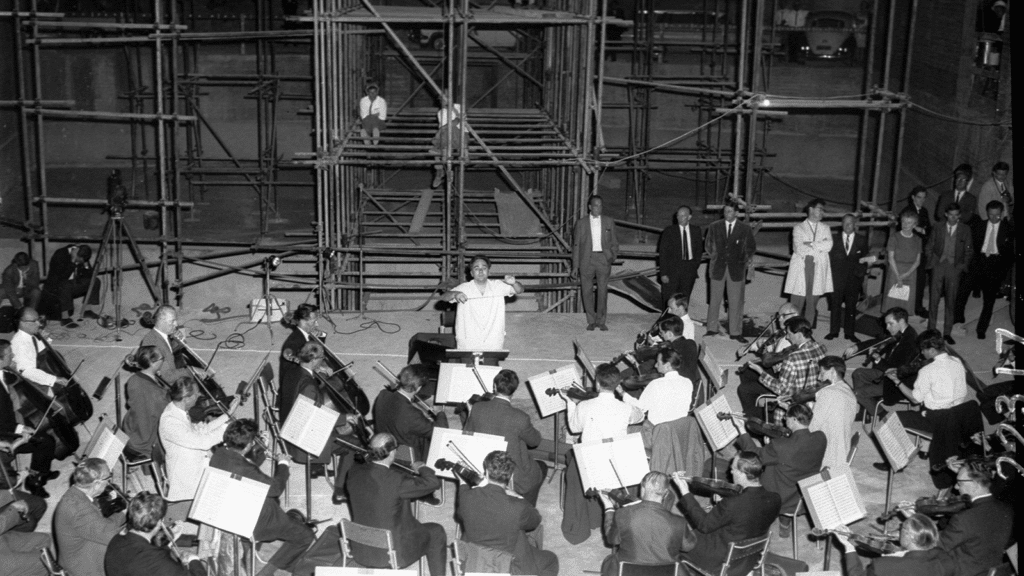
“Far from being the supervisor of a squad of slaves, man is the permanent organizer of a society of technical objects which need him as much as musicians in an orchestra need a conductor.”
Notice the shift. Not a master commanding slaves, but an organizer holding an ensemble together. The good technician, for Simondon, keeps each machine’s margin of indetermination open. He attends, adjusts, and interprets — but never fully automates. To conduct is to listen: to hold all the voices together without silencing any of them.
In his “Intersections” paper, del Campo names this process explicitly. Creativity is not a metaphysical spark. It is an inferential process, distributed across human, machine, and material. The architect becomes a mediator — selecting, interpreting, translating the model’s statistical relations into something cultural, something spatial.
Simondon went one step further: he called for representatives of technical beings, a voice for machines inside human culture. Someone has to speak for the orchestra. In the context of our session, that someone is del Campo. He has spent his career doing exactly that: advocating for AI not as a tool to be supervised, but as a participant to be conducted.
Everything we opened during this session, all the complexity inside the black box, comes back together here. Because the black box already scrambles the information. What matters is what we do when we rationalize it. Simondon’s call was not to dismiss or worship. It was to understand. To open the box. To find the margin of indetermination and stay inside it, not as a passive recipient of outputs, but as the permanent organizer of a society of machines that need us as much as we need them.
So: ask it anything. About Simondon, about del Campo, about the black box. Go ahead. Open the conversation.
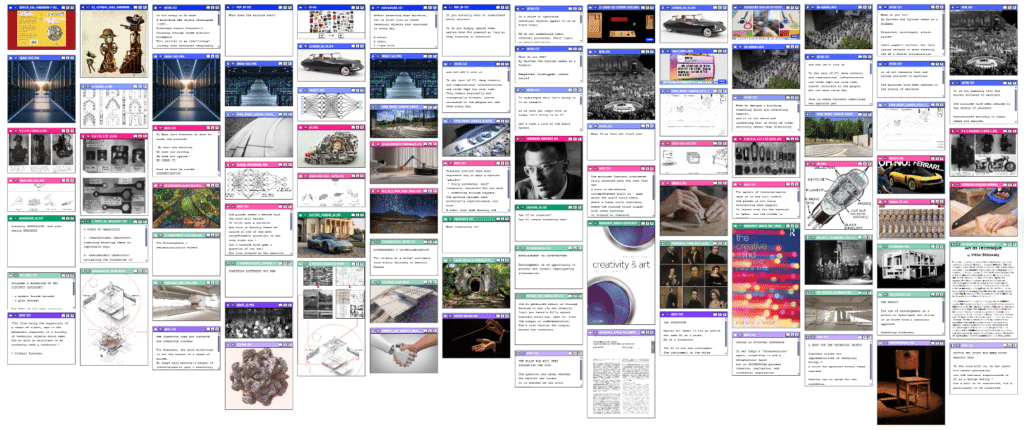
Simondon, Matias del Campo, Neural Architecture, Estrangement, AI + Design, IAAC Theory, MaCAD 2026
