
In what ways does opacity shape power in massively interconnected democracies?
Synopsis:
As artificial intelligence reshapes governance, the debate explores the tensions between visibility as protection and as control; opacity as a necessary right; the dangers of unaccountable systems; and the transformation of power beyond physical institutions.
Characters:
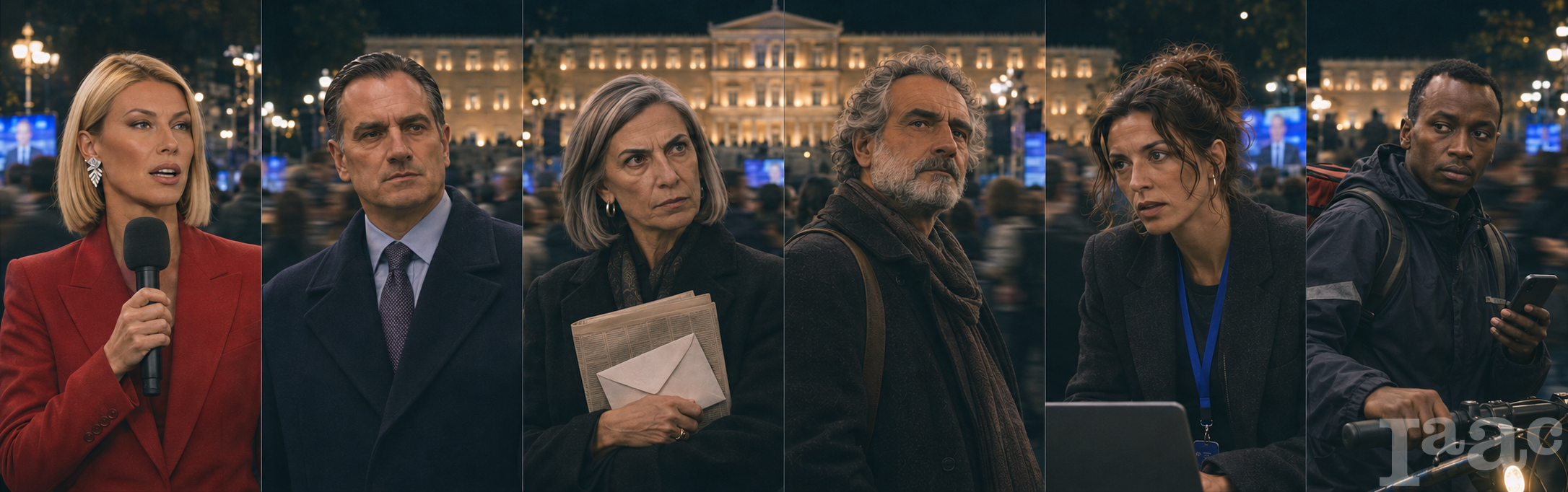
Sia Kossioni – TV presenter, Journalist
Adonis Georgiadis – The Digital Governance Advisor, Engineer
Dr. Maria Skiada – Constitutional law Professor
Anastasios Biris – Urban Architect
Stella Ioannidou – Content Moderator
Rafi – Delivery Rider
– THE VOTE –
Act I
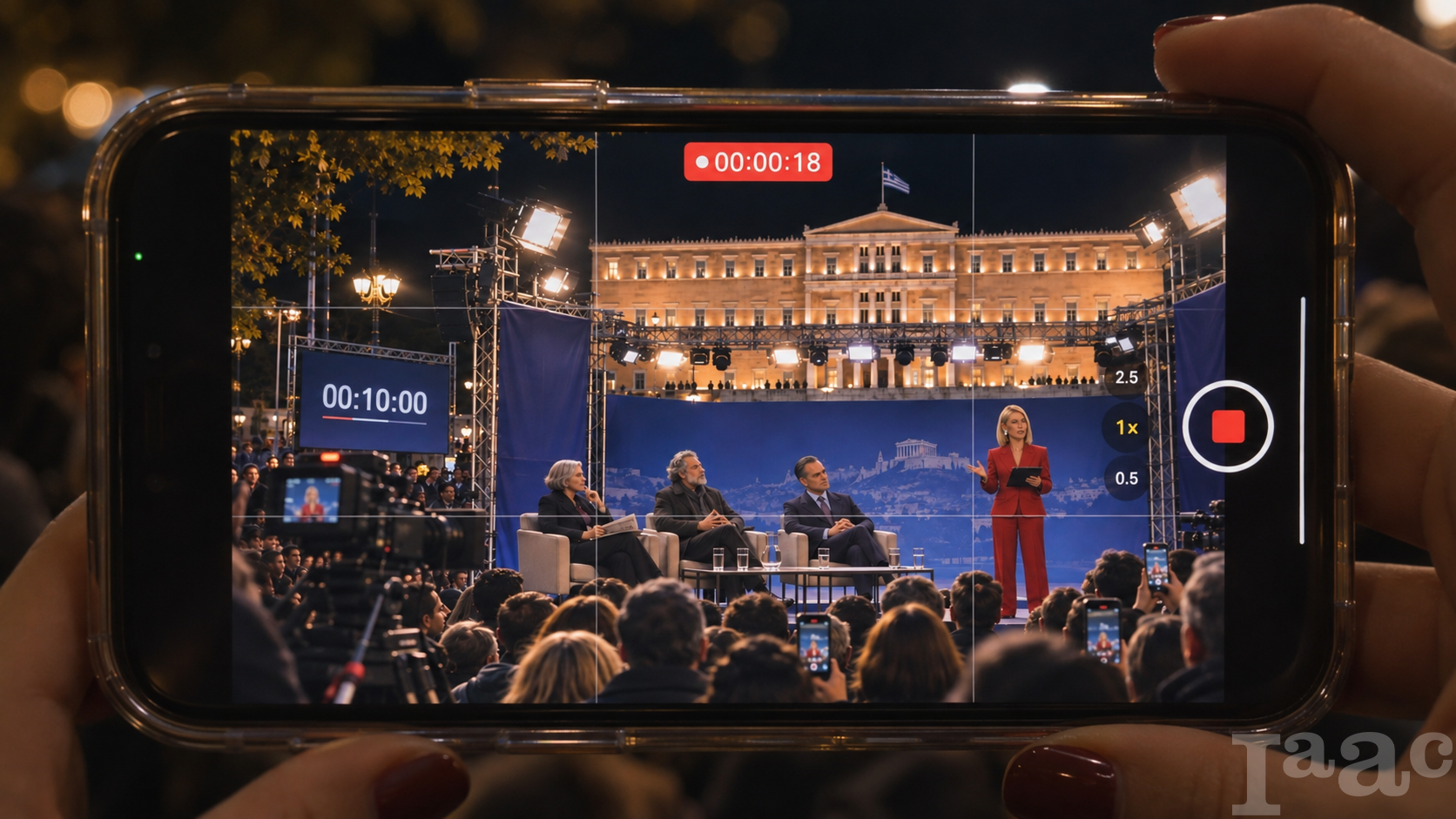
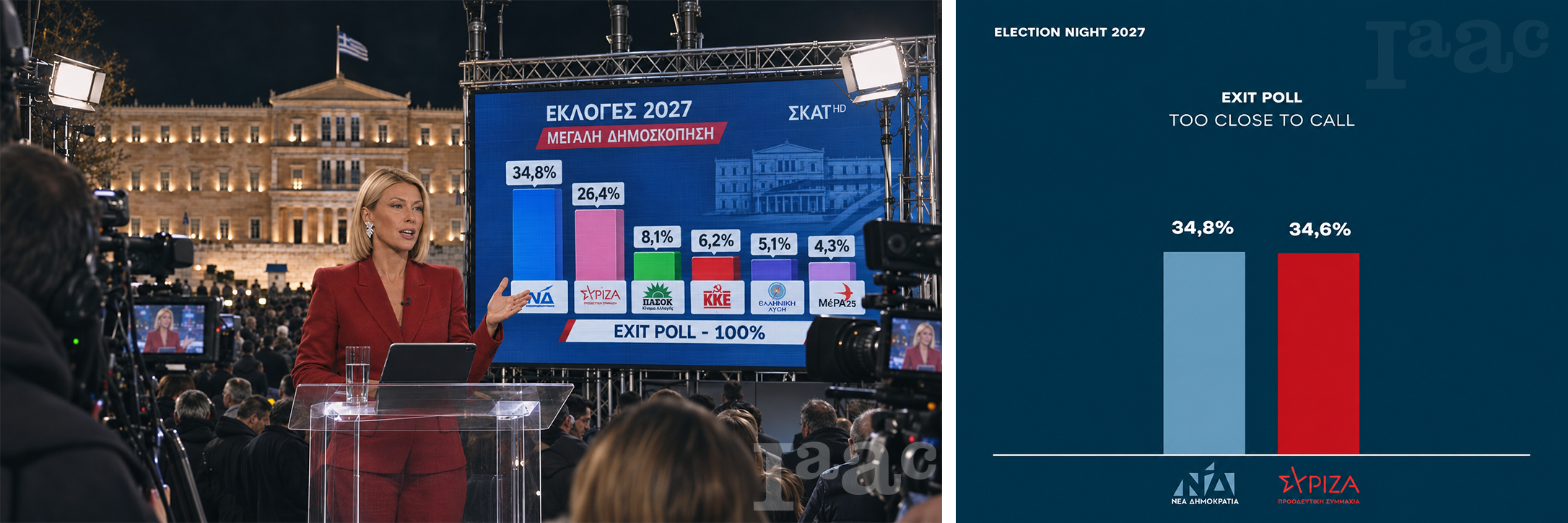
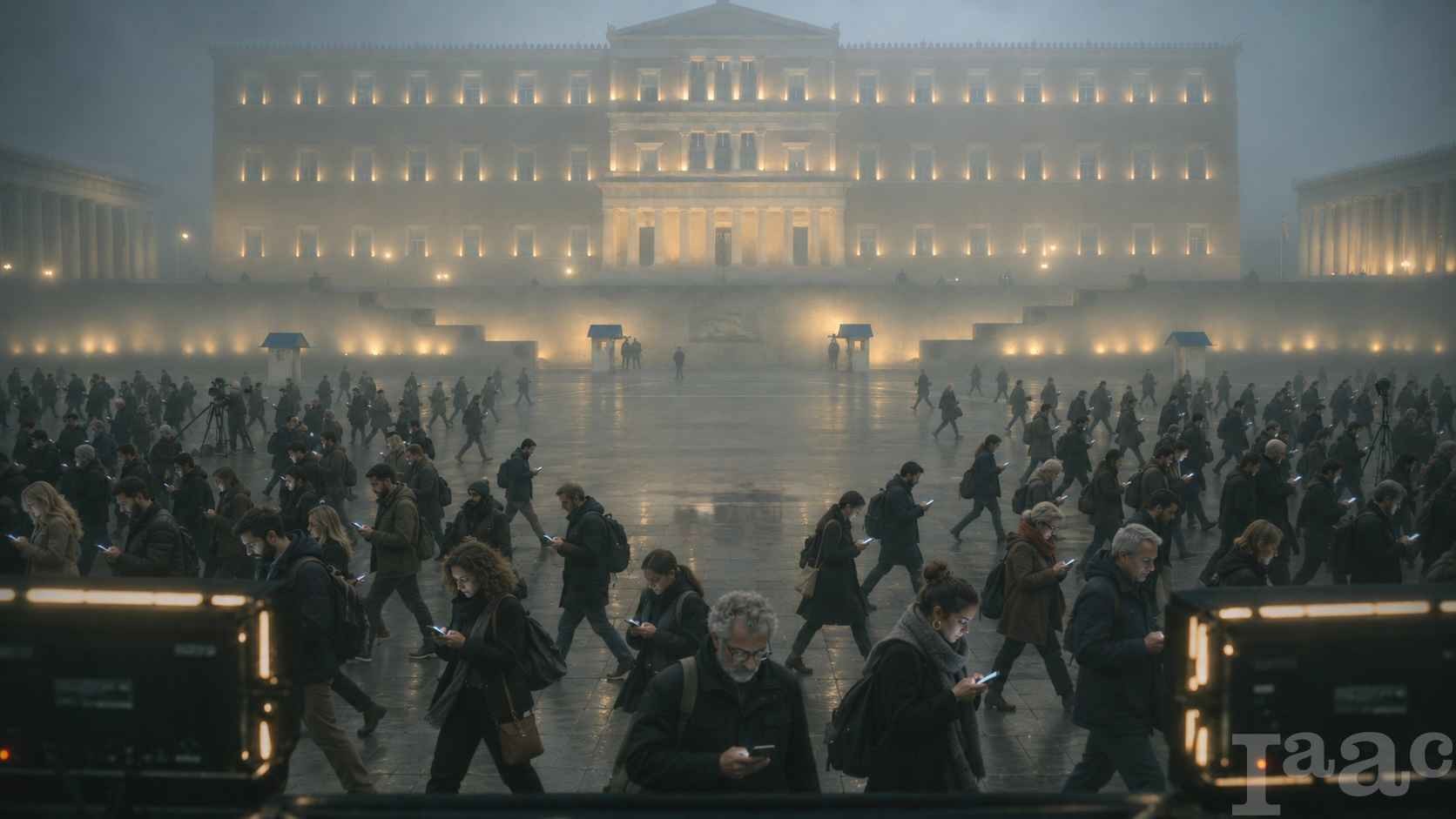
18:50. Syntagma Square, Athens. Spring 2027, election night. A live TV broadcast is about to go on air in front of the Hellenic Parliament. Behind a barrier, hundreds of people watch a giant screen counting down: 00:10:00. Almost everyone holds a phone.
On the set, the JOURNALIST faces the camera, joined by her guests: the DIGITAL GOVERNANCE ADVISOR, phone in hand; the LAW PROFESSOR, a folded newspaper under her arm and the only person in the square without a phone; and the CITY ARCHITECT, who redesigned this square. The LIVE light turns red.
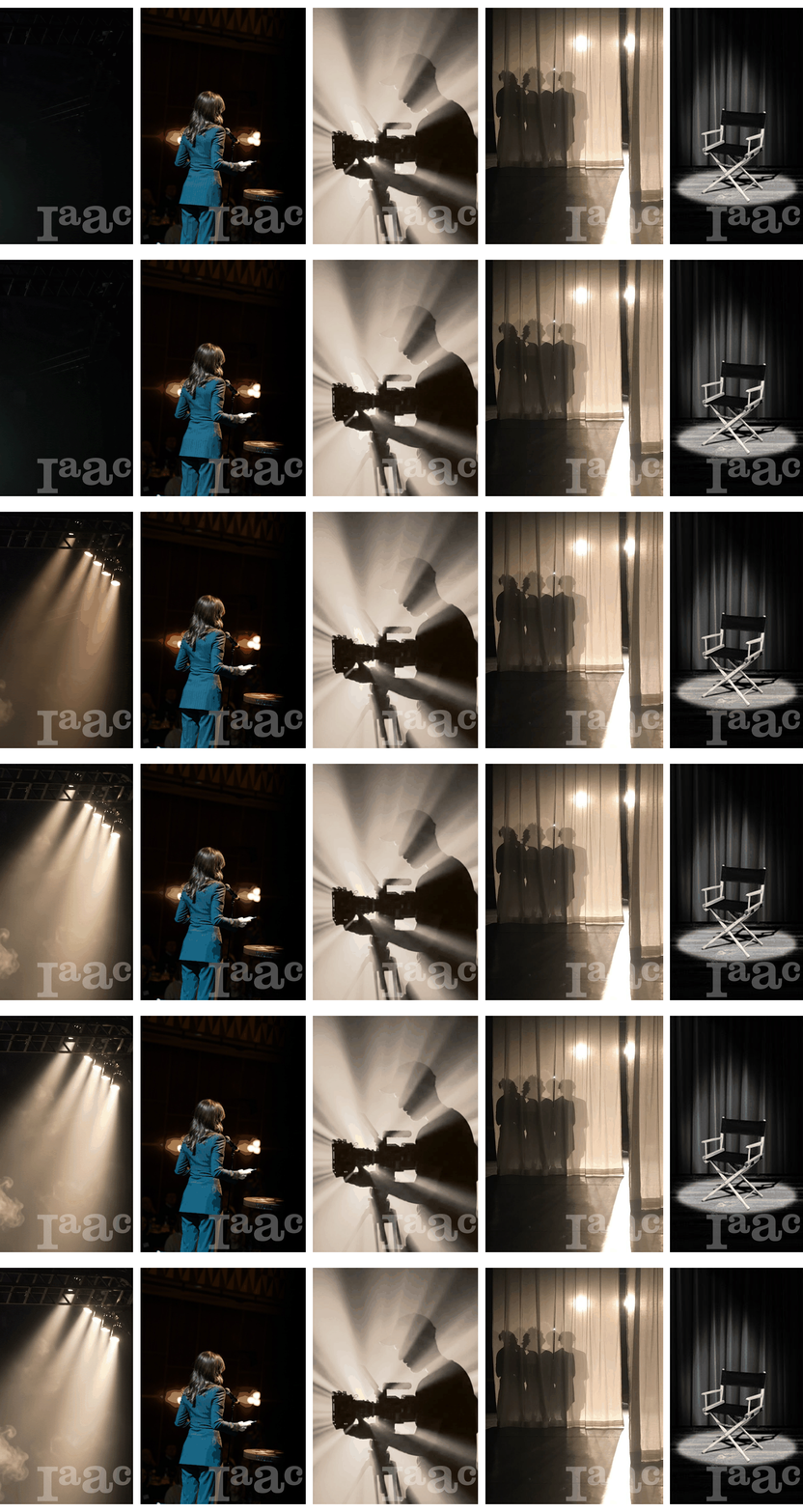
JOURNALIST:
Good evening from Syntagma Square. Polls close in ten minutes, and one video has dominated this election: a leaked recording of the opposition leader promising to reduce spending taxes. Millions have watched it. Nobody has confirmed it.
(Turns to the Advisor.)
Is artificial intelligence helping democracy… or destroying it?
ADVISOR:
“Entanglement is the baseline, not the exception.” (1) We cannot separate technology from politics anymore. AI can help us understand the systems we live in. (a)
LAW PROFESSOR:
Or it can convince millions of people that something is true simply because they’ve seen it enough times.
JOURNALIST:
You mean the tax video?
LAW PROFESSOR:
My students showed it to me multiple times today. But “more information does not necessarily lead to better decisions.” (2) How do we know this is true?
ADVISOR:
Would you prefer that people never saw it? Voters have a right to information. (b)
LAW PROFESSOR:
Information, yes. But “transparency and truth are not identical.” (3) And “the society of transparency is not a society of trust, but a society of control.” (4) (c)
JOURNALIST:
So should we have hidden the video?
LAW PROFESSOR:
I’m saying that “trust is only possible in a state between knowing and not-knowing.” (5) We cannot turn every suspicion into a public spectacle and call it democracy.
ADVISOR:
But refusing technology isn’t the answer either. “Laissez-faire vitalism … is not an option; it is a fairy tale.” (6) If we don’t design and govern these systems, they will shape our lives anyway. (d)
ARCHITECT:
(Looking toward Parliament.)
That’s exactly what happened to this square.
JOURNALIST:
What do you mean?
ARCHITECT:
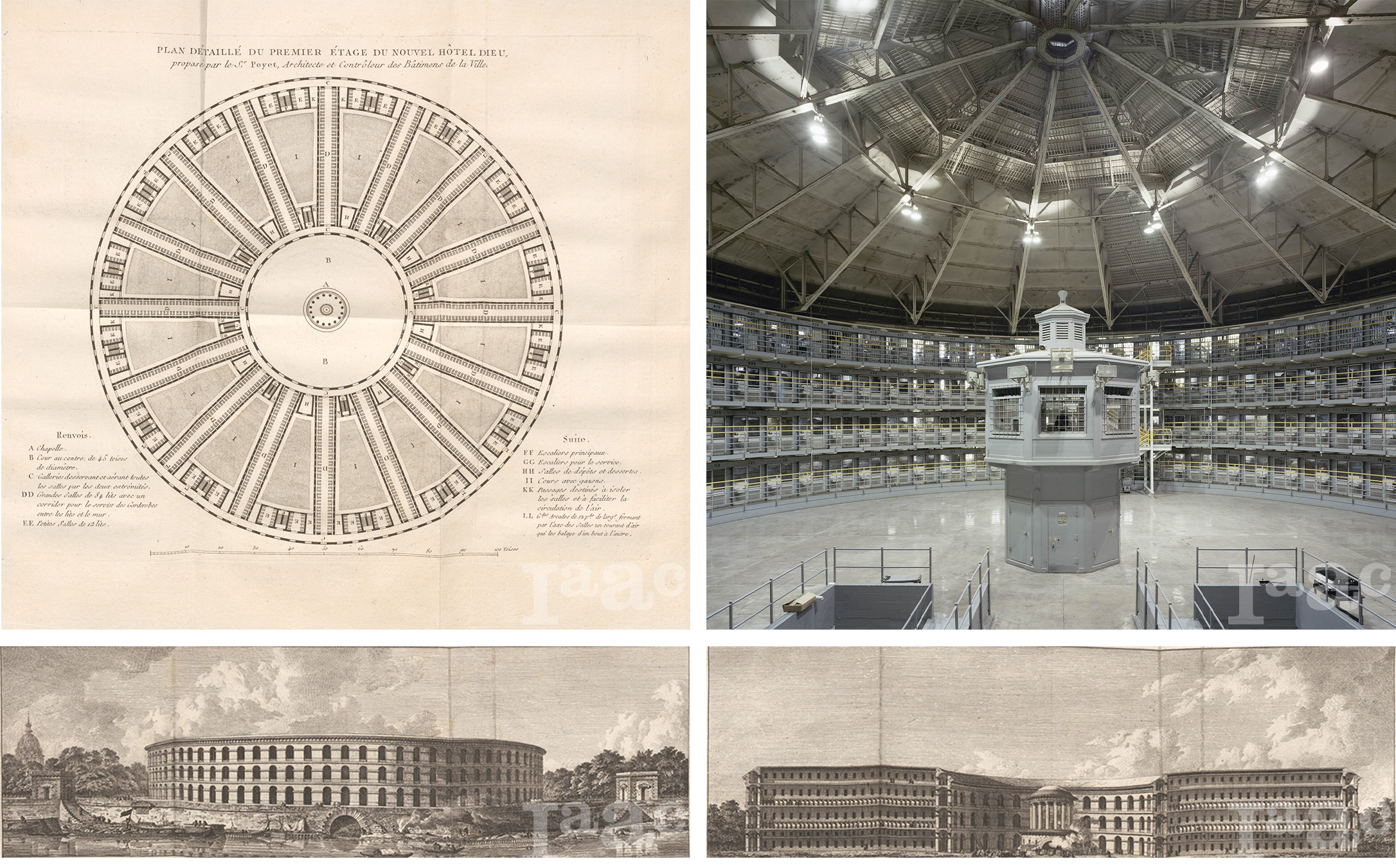
Look around you. This square was designed for people to gather, to protest, to confront political power. Architecture was made “to distribute in space” and “to order in time like in hospitals.” (7)
(Points toward Parliament.)
In 2011, during the protests, people knew where power was. They stood here and shouted at that building.
(Points toward the crowd’s phones.)
But now, everyone is here, and nobody is present. They’re looking at their phones.
ADVISOR:
And that’s a bad thing? People are more connected than ever.
ARCHITECT:
Connected, yes. But through what? We no longer need space to gather a crowd. A screen can do it.
LAW PROFESSOR:
Exactly. “The inhabitants of the digital panopticon think that they are free.” (8)
ARCHITECT:
And we become “dividuals.” (9) Not citizens standing together, but data moving through different systems.
ADVISOR:
Yet those same systems gave people access to information they might never have received.
ARCHITECT:
Access isn’t the same as freedom. Who decided which video reached everyone in this square?
(The Advisor is about to answer.)
19:00. The giant screen suddenly changes.
SCREEN:
EXIT POLL — TOO CLOSE TO CALL.
The crowd erupts. Phones rise into the air.
JOURNALIST:
Seven o’clock. The exit polls are in: too close to call. The tax video may have swayed the election.
ADVISOR:
Voters responded to information. That’s democracy. (e)
LAW PROFESSOR:
Or they responded to an image.
The architect looks at the crowd, then at the screen.
– CURTAIN –
– IT WAS NEVER REAL –
Act II
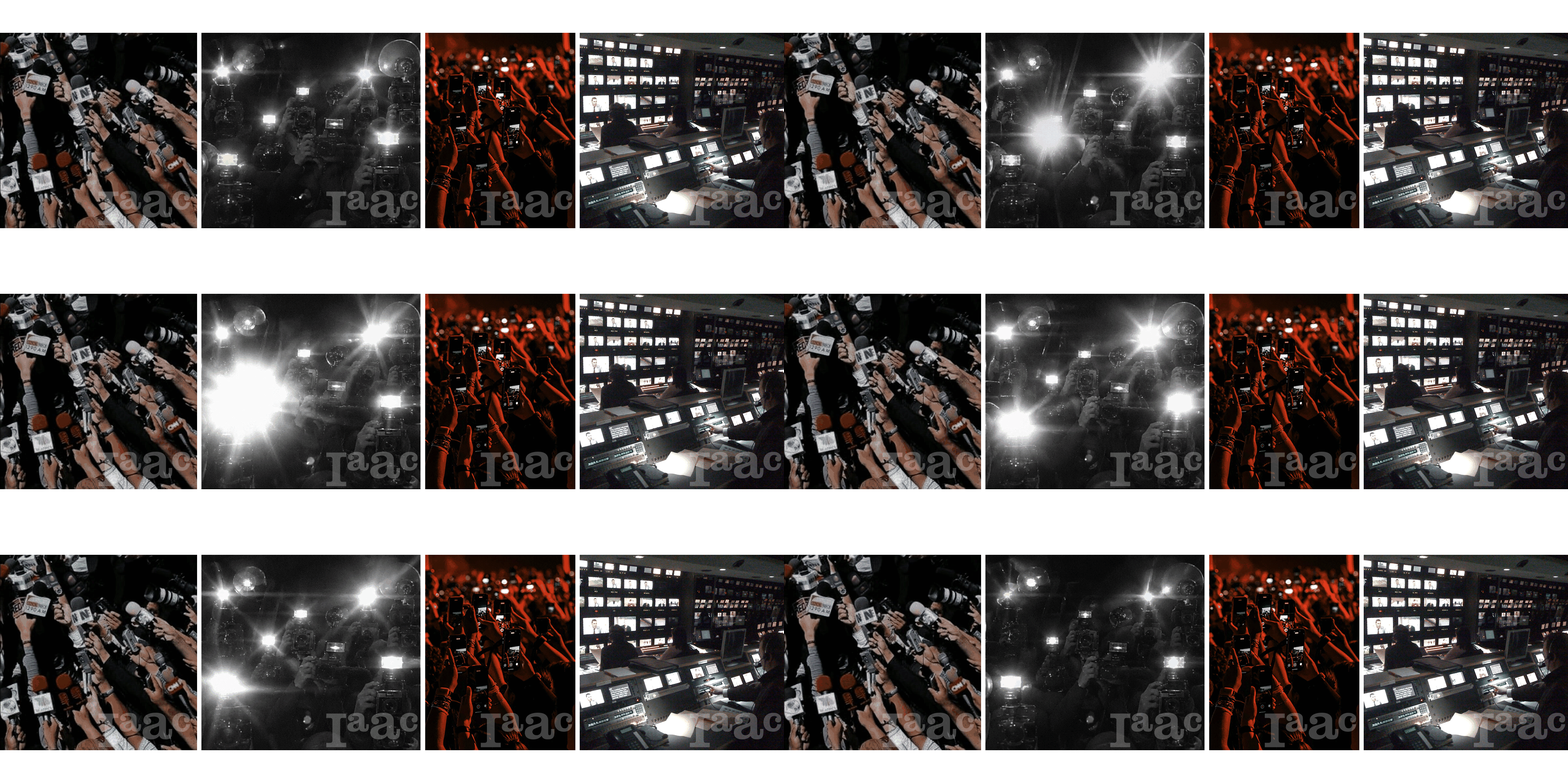
The lights return immediately. The journalist touches her earpiece. Her expression changes.
JOURNALIST:
Breaking news. The platform has just confirmed that the viral tax video was a deepfake. The opposition leader never made those statements.
(Silence. The crowd begins murmuring.)
LAW PROFESSOR:
(To the Advisor.)
All those views, all that information. “Hyperinformation and hypercommunication attest to lack of truth.” (10) And still, “an accumulation of information produces no truth.” (11) You called that transparency?
ADVISOR:
Okay I was wrong about the video. But that doesn’t mean we omit technology.
JOURNALIST:
Then what do we do?
ADVISOR:
We need to “let go of the idea that such a composition can emerge entirely on its own.” (12) “The stakes are too deep and too wide.” (13) These systems need deliberate governance.
ARCHITECT:
But who governs them? Look at this square. Thousands of people gathered here for an election, and a video controlled what they talked about.
LAW PROFESSOR:
“The end of secrecy would be the end of politics.” (14) Democracy needs judgment, not endless exposure. (f)
ARCHITECT:
And where can people make that judgment? We’ve built public squares, streets, and parliaments. But control is now “continuous and without limit.” (15) It’s a “variable geometry.” (16)
JOURNALIST:
Are you saying the square is useless?
ARCHITECT:
No. I’m saying the square is no longer enough. “Man is no longer man enclosed.” (17) We can gather physically, but the system still follows us.
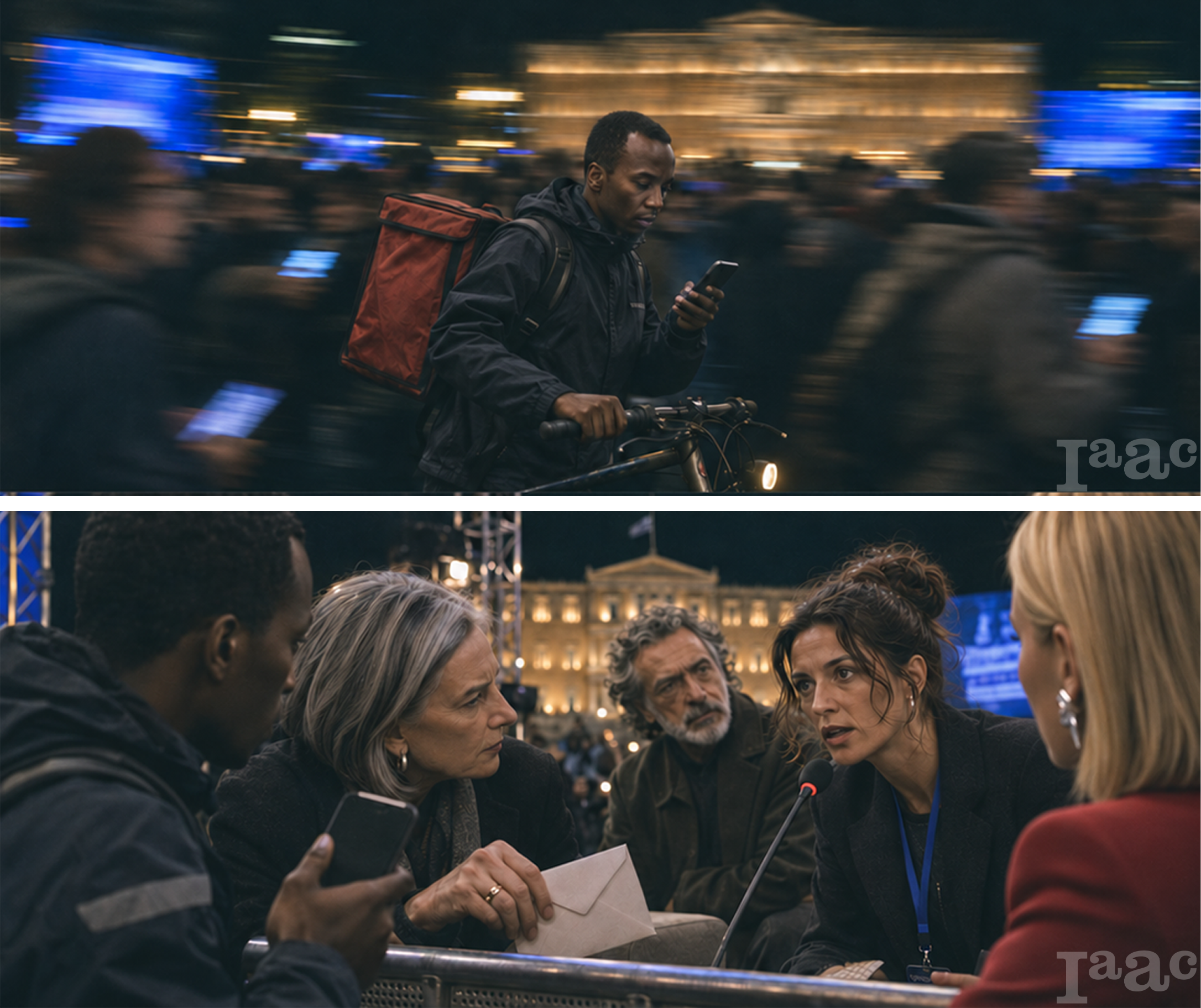
A DELIVERY RIDER struggles through the crowd with his bicycle. His phone vibrates repeatedly.
JOURNALIST:
Excuse me, sir. Did you see the tax video?
RIDER:
Many times. Everyone at work was talking about it. My colleagues voted today. I couldn’t.
JOURNALIST:
Why not?
RIDER:
I’m not a citizen. I deliver food here, I pay taxes here, but I don’t get a vote. And my residence permit is still waiting for approval. Every time I check, the system tells me to wait.
ADVISOR:
That’s exactly where better technology could help. If the government had access to the same data your delivery app collects-
RIDER:
(Interrupting.) My app already knows everything about me. Where I go. How fast I move. When I stop. But it doesn’t know who I am.
ARCHITECT:
You can enter this square, but you cannot enter the systems deciding your life.
RIDER:
Exactly. And why must I explain everything about myself to be accepted?
to “admit myself to existence, within your system.” (18) but “the opaque is not the obscure.” (19)(g)
LAW PROFESSOR:
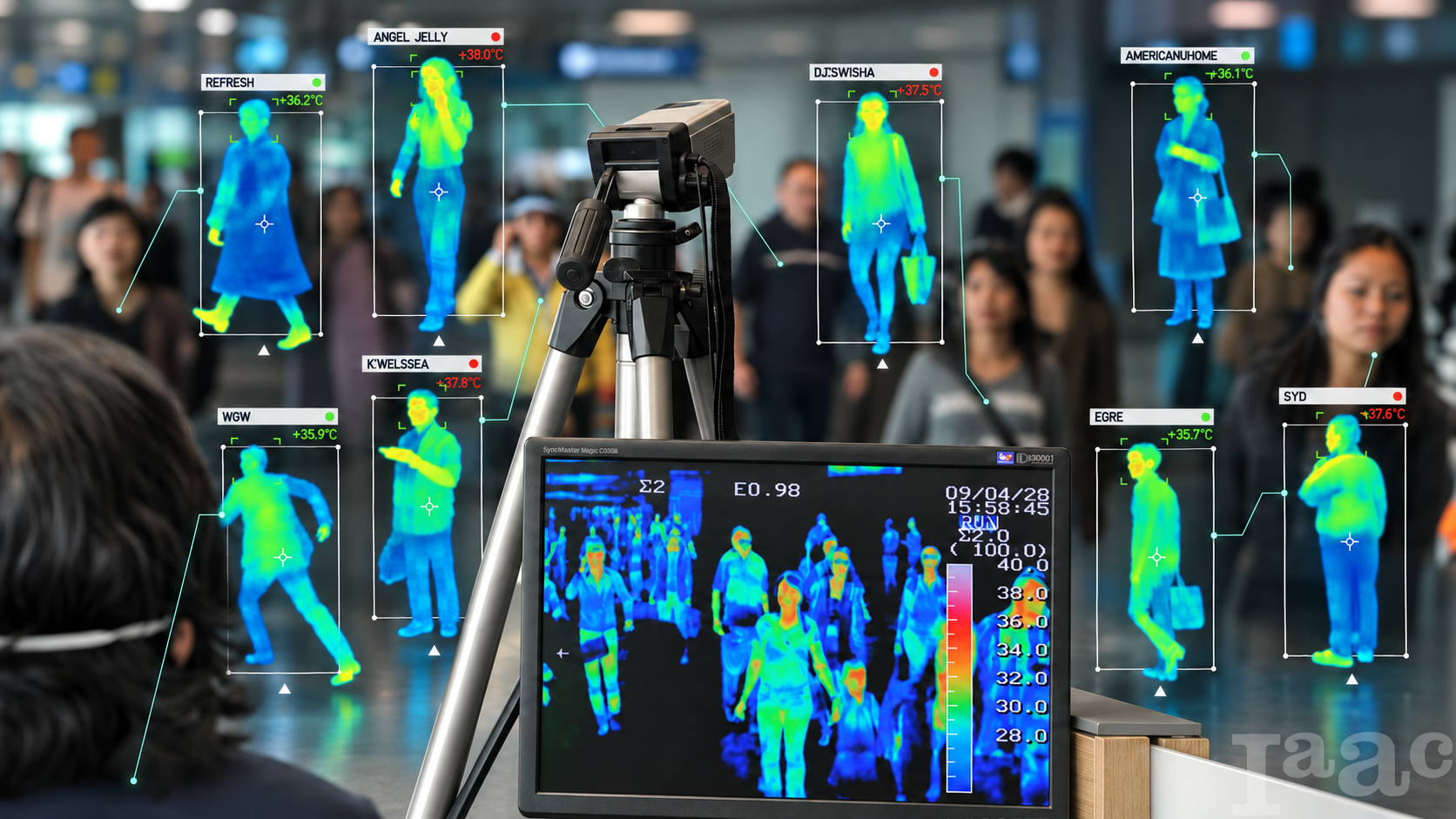
That’s exactly my point. “The society of transparency is a society of mistrust and suspicion.” (20)
RIDER:
Then why does nobody trust me unless I become completely visible?
“Agree not merely to the right to difference but, carrying this further, agree also to the right to opacity.” (21)
ADVISOR:
But governments still need information to make decisions. Without data, how do we know who needs what? It’s also very important in terms of safety like in airports.
RIDER:
“Everyone is a citizen and no longer a barbarian.” (22)
I shouldn’t have to surrender every part of myself to deserve recognition.
ARCHITECT:
(To the Advisor.)
And that’s the contradiction. We demand that he becomes transparent, but the systems that judge him remain opaque.
JOURNALIST:
(Raises her tablet.)
Then let’s ask the system. Shouldn’t technology be transparent too?
ADVISOR:
A neural network has weights, not reasons. You can inspect the data without always understanding the decision. (h)
LAW PROFESSOR:
So the citizen is glass, and the machine is a wall.
RIDER:
“We claim the right to opacity for everyone.” (23)
But there’s a difference between protecting a person’s identity and hiding who has power over them. (i)
ARCHITECT:
Maybe we need to rethink the public space. They are not just places where people gather anymore, but maybe they should become places where they can question the systems controlling them, explore “new weapons.” (24)
Maybe our next public square needs more than steps and monuments. It needs to adapt to the new abstract ways of governance. To interrupt the flow of control.
JOURNALIST:
Interrupt the flow? How?
A woman wearing a lanyard steps out from the crowd.
MODERATOR:
I can tell you what happens when nobody interrupts the flow.
– CURTAIN –
– DOESN’T REALLY MATTER –
Act III
The lights return. The content moderator steps forward.
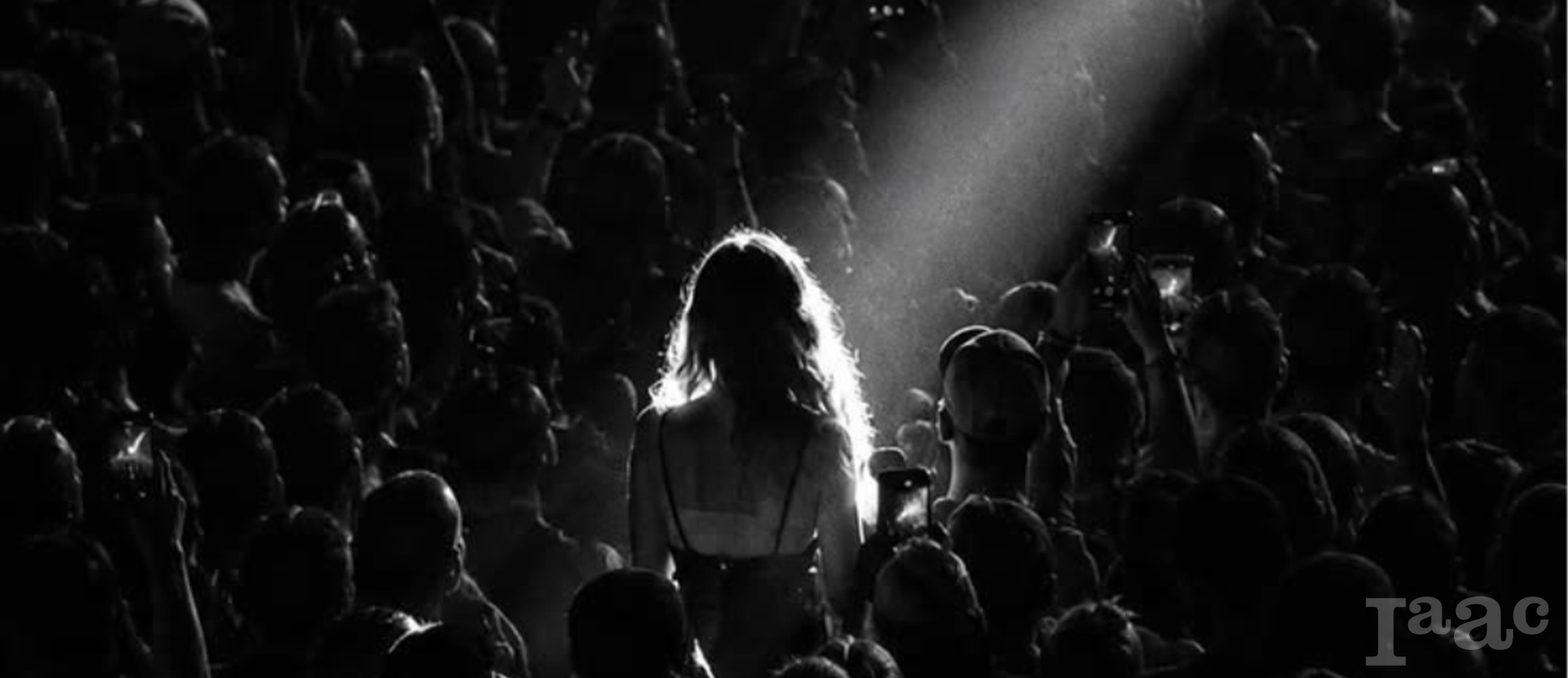
JOURNALIST:
What do you mean, interrupt the flow?
MODERATOR:
I flagged the tax video two days ago. The AI classified it as satire. It stayed online.
JOURNALIST:
Why didn’t you stop it?
MODERATOR:
“Human censors are too slow to be able to keep bad data out of the meganet.” (25)
And “AIs themselves are opaque” and independent. (26)(j)
ADVISOR:
Then we need better models, those with better regulation.
MODERATOR:
But “the problem is how to enhance discourse, not to eliminate it altogether.” (27)
ARCHITECT:
So the problem isn’t just what circulates. It’s how fast it circulates. In architecture, we design spaces where people can stop, gather and think. Why not do the same online?
MODERATOR:
“What is needed, rather, are structural interventions that temper the meganet’s intrinsic tendencies.” (28)
“Even a delay of a few minutes would slow down content propagation by several orders of magnitude.” (29)(k)
LAW PROFESSOR:
Because “the judgment of a ‘Like’… requires no sustained contemplation.” (30)
RIDER:
But slowing the system doesn’t solve my problem. My app knows everything about me, and I know nothing about who makes its decisions.
“To feel in solidarity with me or to build with me or to like what I do, it is not necessary for it to grasp me.” (31)
ADVISOR:
But again governments still need information to make decisions.(l)
RIDER:
“As far as my identity is concerned, I will take care of it myself.” (32)
ARCHITECT:
There’s a difference. For him, opacity protects freedom. But when institutions hide their decisions, opacity protects power.
JOURNALIST:
So what should change?
ARCHITECT:
The design of the system. People should control what they reveal, while institutions must explain the decisions that affect them.
LAW PROFESSOR:
Design won’t save us from the flood. “The mass of information and imagery offers fullness in which emptiness is still noticeable.” (33) We need to go back to slower ways of knowing: newspapers, journals, books. Things made by the effort of people, with a name on them, that end on the last page. (m)
ADVISOR:
And “whatever the outcomes, they are deliberate, by action or by inaction.” (34)
MODERATOR:
“If the system is not fixable, it can, with the right approach, be tamed.” (35)
JOURNALIST:
So opacity can protect our freedom, but it shouldn’t protect those in power from accountability.
For a moment, everyone seems to agree.
buzz. buzz. buzz.
Every phone in the square vibrates. People’s attention shifts from the stage and into their phones. The giant screen changes.
SCREEN:
BREAKING — LEAKED VIDEO OF POPSTARS’ SECRET AFFAIR.

JOURNALIST:
(Touching her earpiece.)
Another leaked video…Justin Bieber was seen leaving a hotel with his old flame, Selena Gomez. (She turns toward the camera.)
And now, our top story.
ADVISOR:
(Checking his phone.)
Is this real?
LAW PROFESSOR:
I wouldn’t be so sure.
MODERATOR:
“Velocity topples stability.” (36)
ARCHITECT:
(Leaning toward the screen.)
Wait, I recognize that hotel!
The Advisor and Architect rush toward the screen. The Moderator leaves to handle the new reports.
The Journalist follows the camera crew offstage.
The Rider’s phone vibrates.
PHONE:
YOU ARE 3 MINUTES LATE.
RIDER:
Six souvlaki. Two without onion.
He leaves.
The Law Professor stands alone. She looks at the crowd, hesitates, then exhales.
LAW PROFESSOR:
“Freedom turns out to be a form of control.” (37)(n)
She walks away. The stage is empty. Only the giant screen remains.
– FINAL CURTAIN –
Bibliography:
- Auerbach, David B. Meganets: How Digital Forces Beyond Our Control Commandeer Our Daily Lives and Inner Realities. New York: PublicAffairs, 2023.
- Bratton, Benjamin. The Revenge of the Real: Politics for a Post-Pandemic World. London: Verso, 2021.
- Deleuze, Gilles. “Postscript on the Societies of Control.” October 59 (Winter 1992).
- Glissant, Édouard. “For Opacity.” In Poetics of Relation, translated by Betsy Wing, 189–194. Ann Arbor: University of Michigan Press, 1997.
- Han, Byung-Chul. The Transparency Society. Translated by Erik Butler. Stanford: Stanford University Press, 2015.
References:
(1) Bratton, Benjamin. The Revenge of the Real: Politics for a Post-Pandemic World. London: Verso, 2021, p. 2.
(2) Han, Byung-Chul. The Transparency Society. Translated by Erik Butler. Stanford: Stanford University Press, 2015, p. 4
(3) Han, Byung-Chul. The Transparency Society. Translated by Erik Butler. Stanford: Stanford University Press, 2015, p. 8
(4) Han, Byung-Chul. The Transparency Society. Translated by Erik Butler. Stanford: Stanford University Press, 2015, p. 7
(5) Han, Byung-Chul. The Transparency Society. Translated by Erik Butler. Stanford: Stanford University Press, 2015, p.47
(6) Bratton, Benjamin. The Revenge of the Real: Politics for a Post-Pandemic World. London: Verso, 2021, p. 5
(7) Deleuze, Gilles. “Postscript on the Societies of Control.” October 59 (Winter 1992), p. 3
(8) Han, Byung-Chul. The Transparency Society. Translated by Erik Butler. Stanford: Stanford University Press, 2015, p.46
(9) Deleuze, Gilles. “Postscript on the Societies of Control.” October 59 (Winter 1992), p. 5
(10)(11) Han, Byung-Chul. The Transparency Society. Translated by Erik Butler. Stanford: Stanford University Press, 2015, p.8
(12) Bratton, Benjamin. The Revenge of the Real: Politics for a Post-Pandemic World. London: Verso, 2021, p.6
(13) Bratton, Benjamin. The Revenge of the Real: Politics for a Post-Pandemic World. London: Verso, 2021, p.4
(14) Han, Byung-Chul. The Transparency Society. Translated by Erik Butler. Stanford: Stanford University Press, 2015, p.7
(15) Deleuze, Gilles. “Postscript on the Societies of Control.” October 59 (Winter 1992), p.6
(16) Deleuze, Gilles. “Postscript on the Societies of Control.” October 59 (Winter 1992), p.4
(17) Deleuze, Gilles. “Postscript on the Societies of Control.” October 59 (Winter 1992), p.6
(18) Glissant, Édouard. “For Opacity.” In Poetics of Relation, translated by Betsy Wing, 189–194. Ann Arbor: University of Michigan Press, 1997. p.190
(19) Glissant, Édouard. “For Opacity.” In Poetics of Relation, translated by Betsy Wing, 189–194. Ann Arbor: University of Michigan Press, 1997. p.191
(20) Han, Byung-Chul. The Transparency Society. Translated by Erik Butler. Stanford: Stanford University Press, 2015, p.48
(21) Glissant, Édouard. “For Opacity.” In Poetics of Relation, translated by Betsy Wing, 189–194. Ann Arbor: University of Michigan Press, 1997. p.190
(22) Glissant, Édouard. “For Opacity.” In Poetics of Relation, translated by Betsy Wing, 189–194. Ann Arbor: University of Michigan Press, 1997. p.190
(23) Glissant, Édouard. “For Opacity.” In Poetics of Relation, translated by Betsy Wing, 189–194. Ann Arbor: University of Michigan Press, 1997. p.190
(24) Deleuze, Gilles. “Postscript on the Societies of Control.” October 59 (Winter 1992), p.4
(25) Auerbach, David B. Meganets: How Digital Forces Beyond Our Control Commandeer Our Daily Lives and Inner Realities. New York: PublicAffairs, 2023. p. 173
(26) Auerbach, David B. Meganets: How Digital Forces Beyond Our Control Commandeer Our Daily Lives and Inner Realities. New York: PublicAffairs, 2023. p. 141
(27) Auerbach, David B. Meganets: How Digital Forces Beyond Our Control Commandeer Our Daily Lives and Inner Realities. New York: PublicAffairs, 2023. p. 164
(28) Auerbach, David B. Meganets: How Digital Forces Beyond Our Control Commandeer Our Daily Lives and Inner Realities. New York: PublicAffairs, 2023. p. 161, paraphrased
(29) Auerbach, David B. Meganets: How Digital Forces Beyond Our Control Commandeer Our Daily Lives and Inner Realities. New York: PublicAffairs, 2023. p. 167
(30) Han, Byung-Chul. The Transparency Society. Translated by Erik Butler. Stanford: Stanford University Press, 2015, p. 13
(31) Glissant, Édouard. “For Opacity.” In Poetics of Relation, translated by Betsy Wing, 189–194. Ann Arbor: University of Michigan Press, 1997., p. 193 paraphrased.
(32) Glissant, Édouard. “For Opacity.” In Poetics of Relation, translated by Betsy Wing, 189–194. Ann Arbor: University of Michigan Press, 1997., p. 192
(33) Han, Byung-Chul. The Transparency Society. Translated by Erik Butler. Stanford: Stanford University Press, 2015, p. 41
(34) Bratton, Benjamin. The Revenge of the Real: Politics for a Post-Pandemic World. London: Verso, 2021, p 5
(35) Auerbach, David B. Meganets: How Digital Forces Beyond Our Control Commandeer Our Daily Lives and Inner Realities. New York: PublicAffairs, 2023. p. 16
(36) Auerbach, David B. Meganets: How Digital Forces Beyond Our Control Commandeer Our Daily Lives and Inner Realities. New York: PublicAffairs, 2023. p. 36
(37) Han, Byung-Chul. The Transparency Society. Translated by Erik Butler. Stanford: Stanford University Press, 2015. p 49
Footnotes:
(a) Bratton argues that humans, technology and society are deeply interconnected. The Advisor uses this idea to explain why AI cannot be separated from politics. Technology is no longer just a tool; it is part of the systems through which society functions.
(b) Bratton argues that society needs systems capable of sensing and understanding the conditions that affect collective life. The Advisor believes that access to information is necessary for people to participate in society. However, the scene also raises the question of whether information without verification can really support democracy.
(c) Showing everything is not the same as revealing the truth. When all information reaches us at once, we lose the means to decide which of it is true. Information becomes something we consume rather than understand: receiving everything does not mean we receive anything.
(d) Bratton rejects the idea that society can simply be left to organise itself during a crisis. He believes that deliberate governance and intervention are necessary. The Advisor applies this argument to artificial intelligence: if governments do not regulate digital systems, these systems will continue to shape society without public accountability.
(e) The Advisor initially assumes that access to information allows citizens to make democratic decisions. This reflects Bratton’s interest in how societies use information and knowledge to understand themselves. However, the deepfake reveals a limitation in the Advisor’s argument: information alone does not guarantee that people are making informed decisions.
(f) Power needs a little darkness. Transparency and power do not get along well: once people know everything about those in power, they can no longer be steered or shaped.
(g) Glissant argues that Western “understanding” requires transparency: to accept you, I measure you against my own scale, and so I reduce you. The right to opacity is not hiding. It is the right to an irreducible singularity. The Rider is legally invisible and digitally hyper-visible, which is the wrong combination of both. He is guarded and ironic, and he refuses to be explained.
(h) This line reflects a contradiction in digital governance. Although Bratton supports the use of computational systems, his discussion of modelling and simulation also raises questions about how societies understand and use these systems. The Advisor acknowledges that examining data does not necessarily mean understanding how a technological decision is produced.
(i) This is the central claim of our project. Opacity is not good or bad in itself; it depends on who holds it. A person’s opacity protects freedom, and a platform’s opacity protects power. Today the distribution is reversed.
(j) Auerbach describes meganets: networks so large and fast, and so full of feedback loops between users and algorithms, that nobody controls them, not even the companies that run them. The Moderator is the human in the loop, so she carries the blame for a system she cannot steer.
(k) Her answer is structural rather than censorship: slow the network down instead of deleting content. This links to the Architect, who designs spaces where people stop, and to Han, who asks for time to think. I agree that slowness is a design question, both in space and in networks. Friction can be a democratic tool. A delay of a few minutes is the digital equivalent of a public square.
(l) For Bratton, effective governance depends on the ability to understand society through knowledge, modelling and coordinated intervention. The Advisor insists that governments cannot make responsible decisions without information about the populations they serve. His position reflects the idea that data can become a tool for collective care, rather than simply a means of surveillance.
(m) Mass-produced information loses its meaning. When work is produced in bulk, the effort and energy behind it disappear: paintings become blank canvases, and photographs become mere set-ups. Being able to produce more does not mean we should lose the meaning behind what we make. Creativity can be multiplied in quantity, but not in quality.
(n) In a transparent society it is the citizen, not the platform or the algorithm, who becomes visible. Access to endless information creates an illusion of freedom, yet what each person sees has been selected, personalized and advertised to them by an algorithm.
Credits:
Angeliki Christina Magklara – Artemis Pantopoulou – Csenge Halász – Daniel Alejandro Veras – Manuel Romero – Saya Ashouri – Simge Nur Doruk – Zühre Ceren Altun
