
What function does authorship play when creative production is increasingly automated?
SYNOPSIS
As creative design becomes increasingly automated by artificial intelligence, this inquiry stages a debate among five competing perspectives to examine what function the human author serves. These perspectives are: the elevation of an author’s prestige, the emphasis on singular human genius, the usage of AI as a provocateur, the leveraging of collective intelligence, and the declaration of the author’s obsolescence.
CHARACTERS
Banksy – Grafitti Artsist
Luis Gemini – Content Creator
Mariana Silva – Journalist
Joanna Foster – Head Designer
Carlos Cano – Jr. Designer
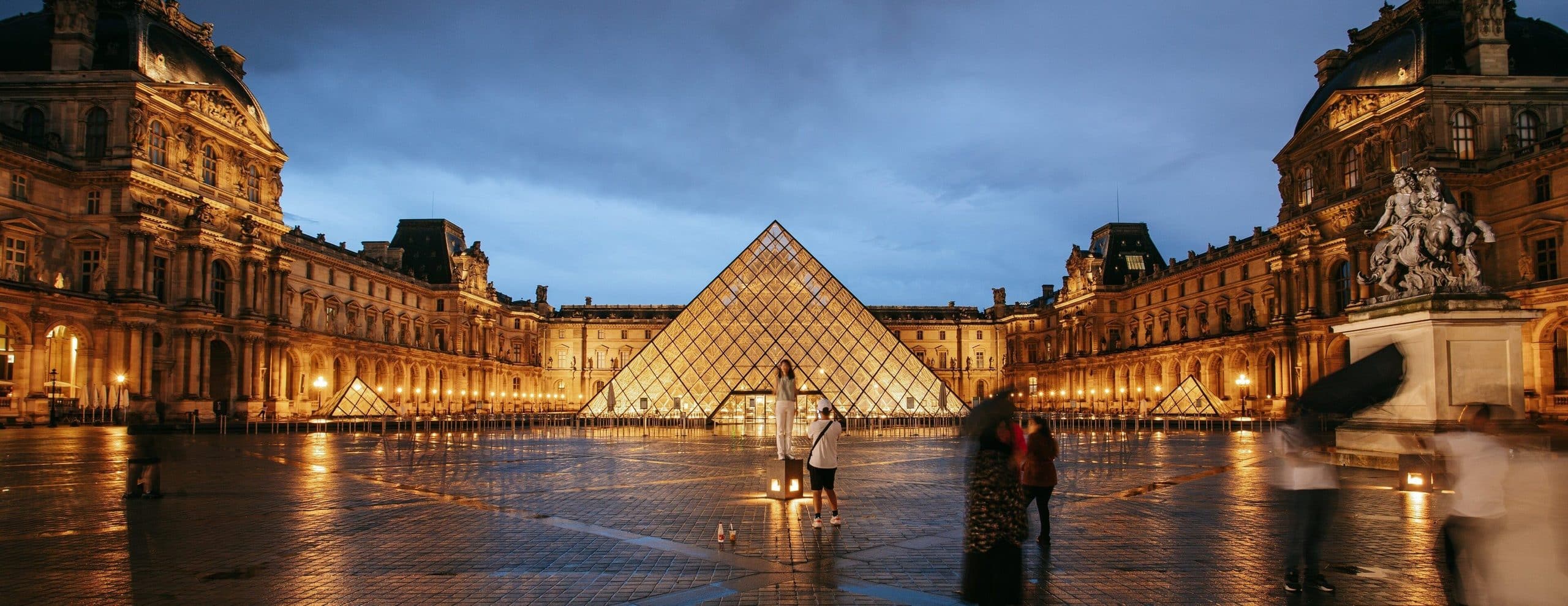
Act I
The Name and the Vision
Louvre Museum, Paris. 11:00 AM.
The gallery is in disarray. Wooden crates lie open, paintings remain wrapped, and workers rush to prepare the exhibition. Banksy’s works are slowly emerging from their boxes. Amid the chaos, something feels strangely out of place. The exhibition has yet to begin, but the mystery has already started. Mariana, a journalist, interviews Banksy while Joanna oversees Carlos constructing the exhibition.
MARIANA : Drawn by your prestigious name, thousands of people will visit this room to see your work. Your artistic alias (a) “Banksy” carries enormous fame in the art world, but why should an artist’s name determine a painting’s value?
BANKSY: An author’s name “is not a function of a man’s civil status, nor is it fictional. It exists beyond personal identity, giving rise to its own discourse and a distinct meaning (1)” That’s what Banksy represents: a name carrying prestige and authority, regardless of who I really am.
MARIANA: Some might argue however that “to give a text an Author is to impose a limit on that text” (2). Do you see your work as limited by the name “Banksy”?
BANKSY: Not at all. My name isn’t just a signature; “its presence is functional in that it serves as a means of classification” (3). It brings my paintings under one identity. Unlike ordinary, fleeting words,”Discourse carrying an author’s name isn’t simply consumed and forgotten; its status and its manner of reception are regulated by the culture in which it circulates” (4).
MARIANA: So yes, your work is widely recognized due to your name. Still, your paintings aren’t completely original; they borrow from existing ideas and symbols. What makes you their ultimate authority? Every work is “a tissue of quotations (b) drawn from the innumerable centres of culture” (5).
BANKSY: Anyone can paint a wall, but not everyone creates something culturally significant. I create art with intention, adding meaning into each piece. My “style is the physiognomy (c) of the mind” (6). “Every word, every touch of the brush, has a special purpose” (d) (7), and this premeditated vision makes these paintings uniquely mine.
MARIANA: Yet some argue a work’s identity lies “not in its origin but in its destination” (8) (e) ; so the audience may find meanings you never intended.
BANKSY: They can interpret my work however they like, but that doesn’t erase the genius behind it. Without my vision (f), there would be nothing to interpret.
MARIANA: Do these meanings connect from painting to painting? What are the common threads bringing all your works into a common narrative?
BANKSY: Well that’s Joanna’s job. I begin the conversation with each individual story, and she brings them together into a cohesive exhibition.
MARIANA: So put another way, she’s using your paintings as the words in her own story.
BANKSY: Sure… that’s true in a way. Yes, I decide what goes into each painting, and she decides how they speak to one another.
MARIANA: And if her story isn’t what you imagined?
BANKSY: (Pauses, looking toward Joanna) Well, that’s the risk of letting someone else tell your story.
MARIANA: (To herself) So is the author’s purpose to create or curate?
( Mariana turns toward Joanna, who is arranging the final artwork. )
End of Act I
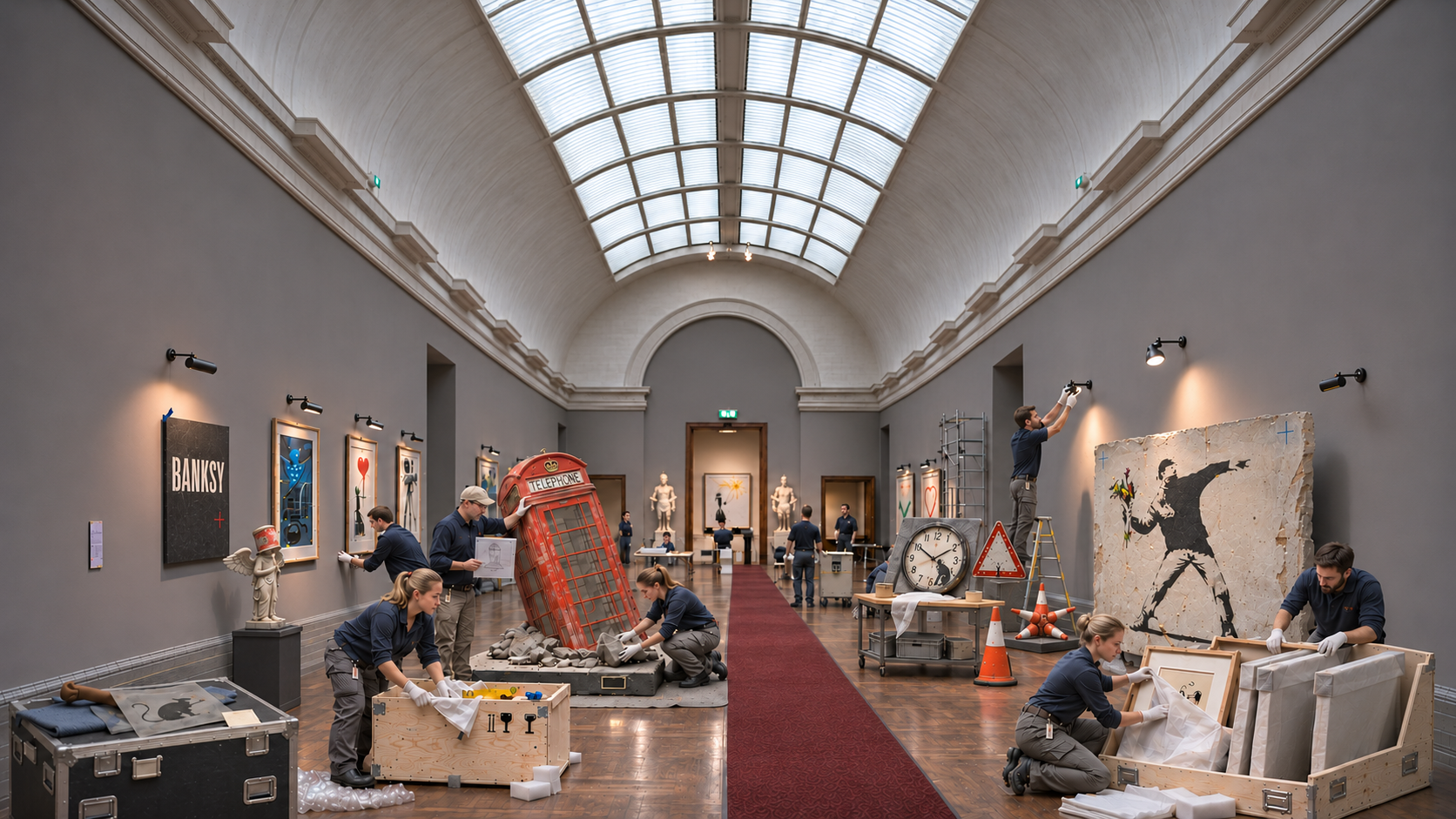
Act II
The Blueprints and the hands
The gallery is under construction. Carlos adjusts a light while Joanna examines her sketches.
JOANNA: Carlos, this gallery must be the paper upon which Banksy’s paintings tell their story. Please follow what I told you this morning; everything has to tie together..
CARLOS: I’m trying. I want to move the light so people can see the painting better. If you stand here maybe you can see what I mean; this is where visitors will stand.
(Joanna steps beside him. Carlos adjusts the light.)
JOANNA: Yes, great – good move. Let’s change the others also.
CARLOS: Okay I will do that..
JOANNA: Keep working, I’ll be back soon. We need this back-and-forth to finish the design, combining your practical skills with my overall vision. Even the materials and the space influence what we create together.
CARLOS: Exactly. I do more than simply follow your vision. (g) The traditional approach treated “the material process of making, [although] carried out by human hands” as “devoid of all human intentions” (09). But my decisions on-site change the design itself. I’m not just following a blueprint.
JOANNA: And those collaborative discoveries shape the exhibition. I’m here to coordinate the team.
CARLOS: Authorship isn’t just about one person’s vision. It’s “a collective endeavour (h), where … actors collaborate within a broader network of material agencies (i)” (10). The materials, the space, and our decisions all shape the final design.
JOANNA: True, but let’s work together – please keep me updated. I need to be sure the exhibit flows nicely as a single narrative.
(They examine the revised arrangement.)
(Luis enters.)
LUIS: Yo hey, sorry, uh, I’m Luis – I do AI digital artwork, and I’m big into Banksy’s work.
JOANNA: Excuse me sorry, how did you get in? Why are you here?
LUIS: Yea I talked to someone out front who let me in… I think his name was Carlos?
CARLOS: Bro I am Carlos.
LUIS: Uh… yea I don’t remember his name but he said I could promote the exhibition as I have a large following on social media for my AI art content. “Rather than purely exhibiting the art here at the Louvre, I can bring it to a global audience through social media.” (11)
CARLOS: But if AI is generating the entire artpiece, what is your role?
LUIS: Dude no, I don’t just use the first thing chat makes. “Sometimes an image from a machine-generated artifact [is] a point of departure that mobilizes, or a catalyst (j) that propels, a larger creative process.” From there I select, interpret and develop it further (12).
JOANNA: But the machine changes your original idea?
LUIS: Exactly. “with ChatGPT, the penetration of AI into writing and thinking practices has gone considerably beyond this kind of assistance into genuine collaborations,” (13) where humans and machines are codependent.
CARLOS: Then your ideas evolve through a process, just like ours.
LUIS: Yea, and with digital art, there’s another layer of “where does it come from; how is it circulated; who controls it?” (14) I’d love to explore how these paintings could reach people beyond the gallery.
JOANNA: You can look around, but we discuss anything before it’s published. Some paintings haven’t been revealed. No photographs or recordings of the artwork.
LUIS: Yea of course! Super happy to just hang out.
(Joanna turns back to Carlos.)
JOANNA: Okay I’ll be back in a bit Carlos, keep going.
(They return to work. Luis approaches an open shipping container holding Banksy’s unrevealed paintings. He takes out his phone.)
End of Act II
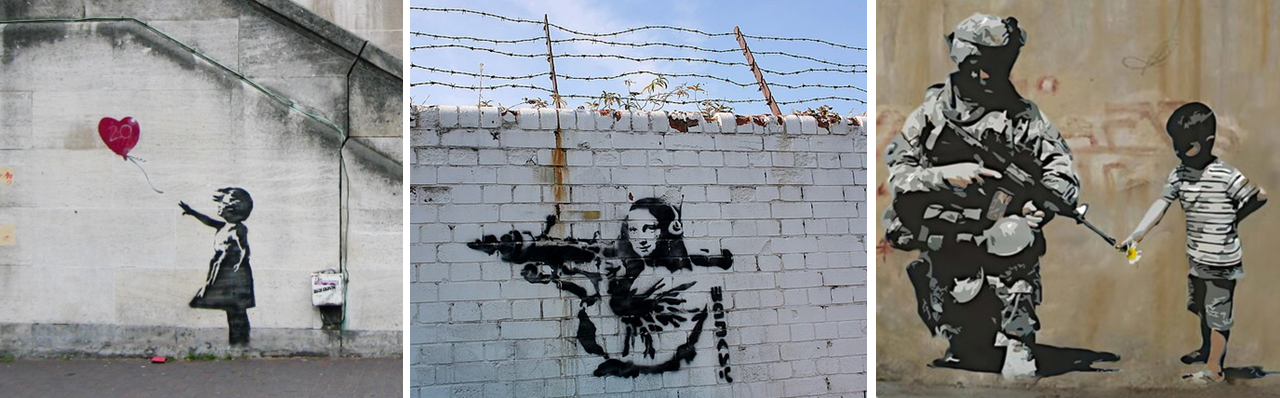
Act III
The Heist and the digital preview
Luis wanders close to the storage container. While the others are occupied, he discreetly photographs the unreleased paintings.
LUIS: (To himself, looking at Banksy’s paintings.) Oh my god, this Banksy dude is cracked. I love these subjects – super creative. Lowkey though the graphics are kinda understated; should they have an explosive graphic style increasing their impact? What if the act of authorship expands beyond human-centred narratives (15)?
(Carlos notices him taking photographs.)
CARLOS: Hey – hey! We agreed, no photographs. We haven’t released those paintings yet!.
LUIS: Oh sorry – sorry, I was just collecting some references to experiment with.
CARLOS: No bro, you have to go. Leave. NOW !
(Outside, Luis uploads the photographs into an AI image generator and enters a prompt.)
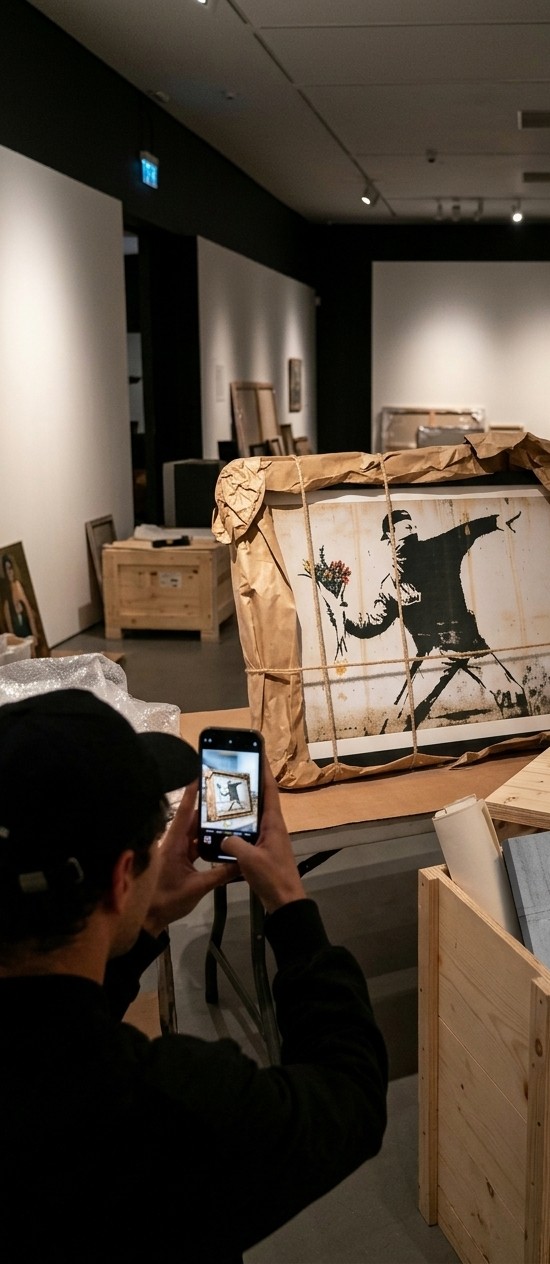
Luis photographing Bansky’s unreleased artwork
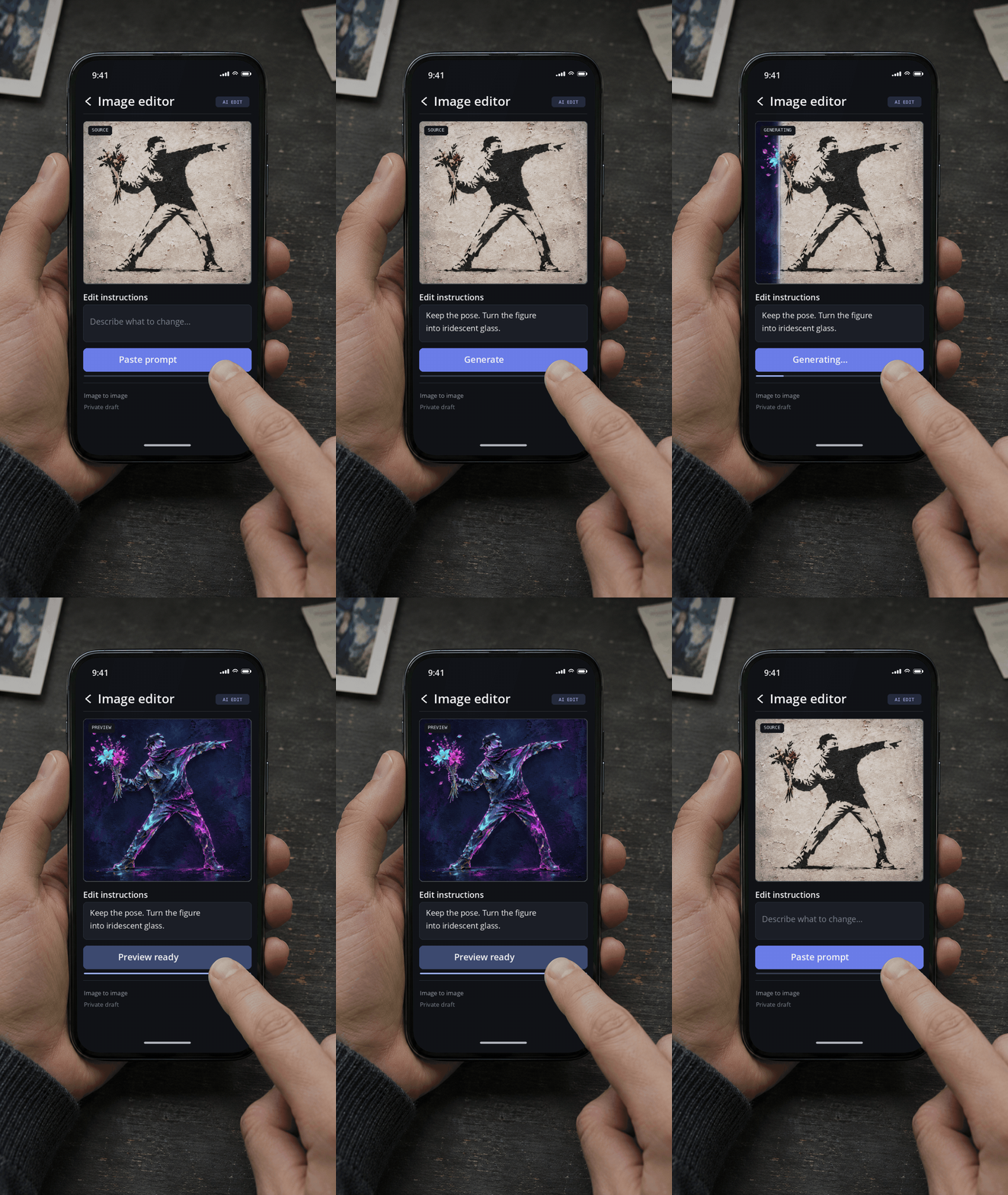
Luis AI editing the image
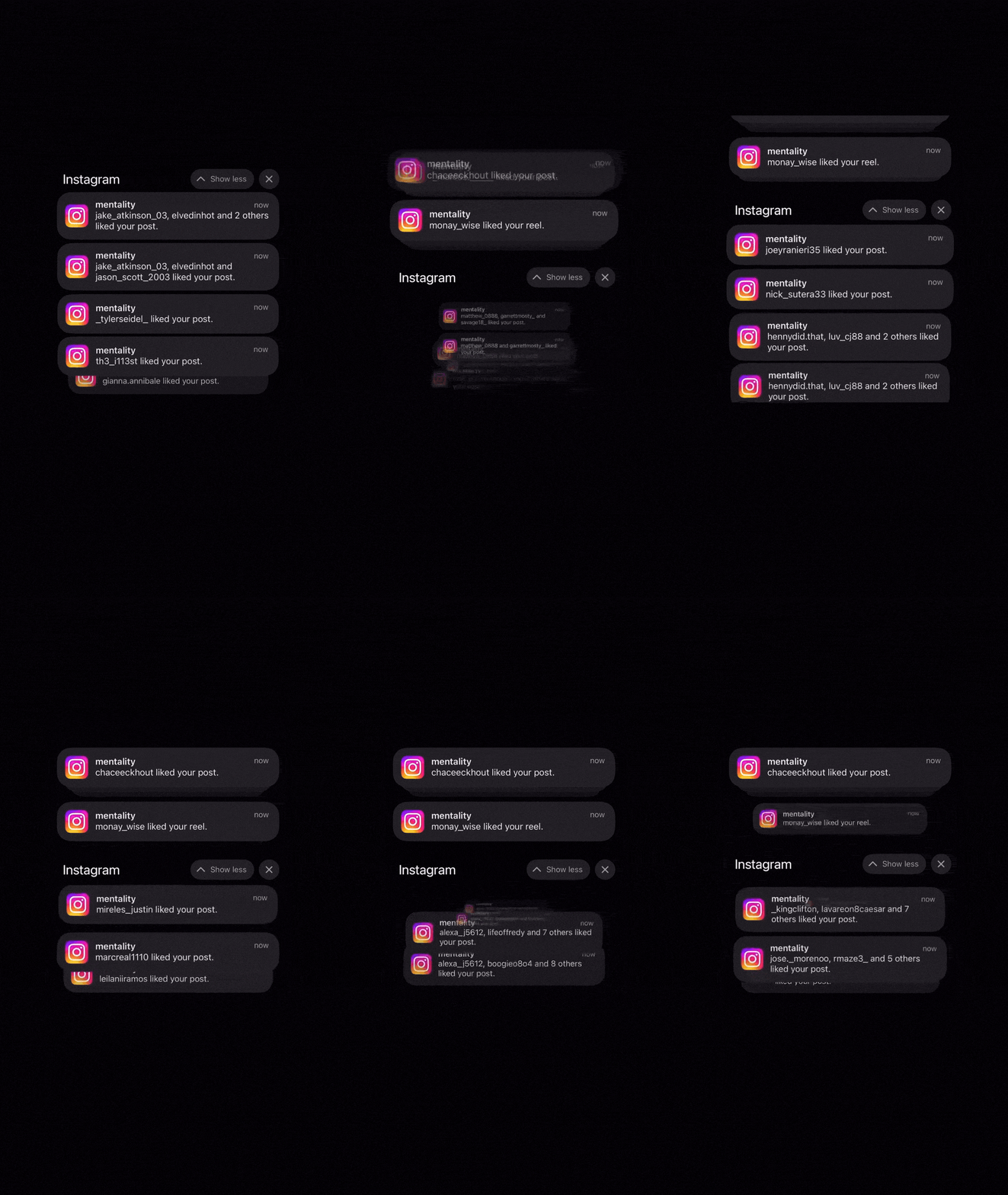
Instagram flooring with reactions to his post
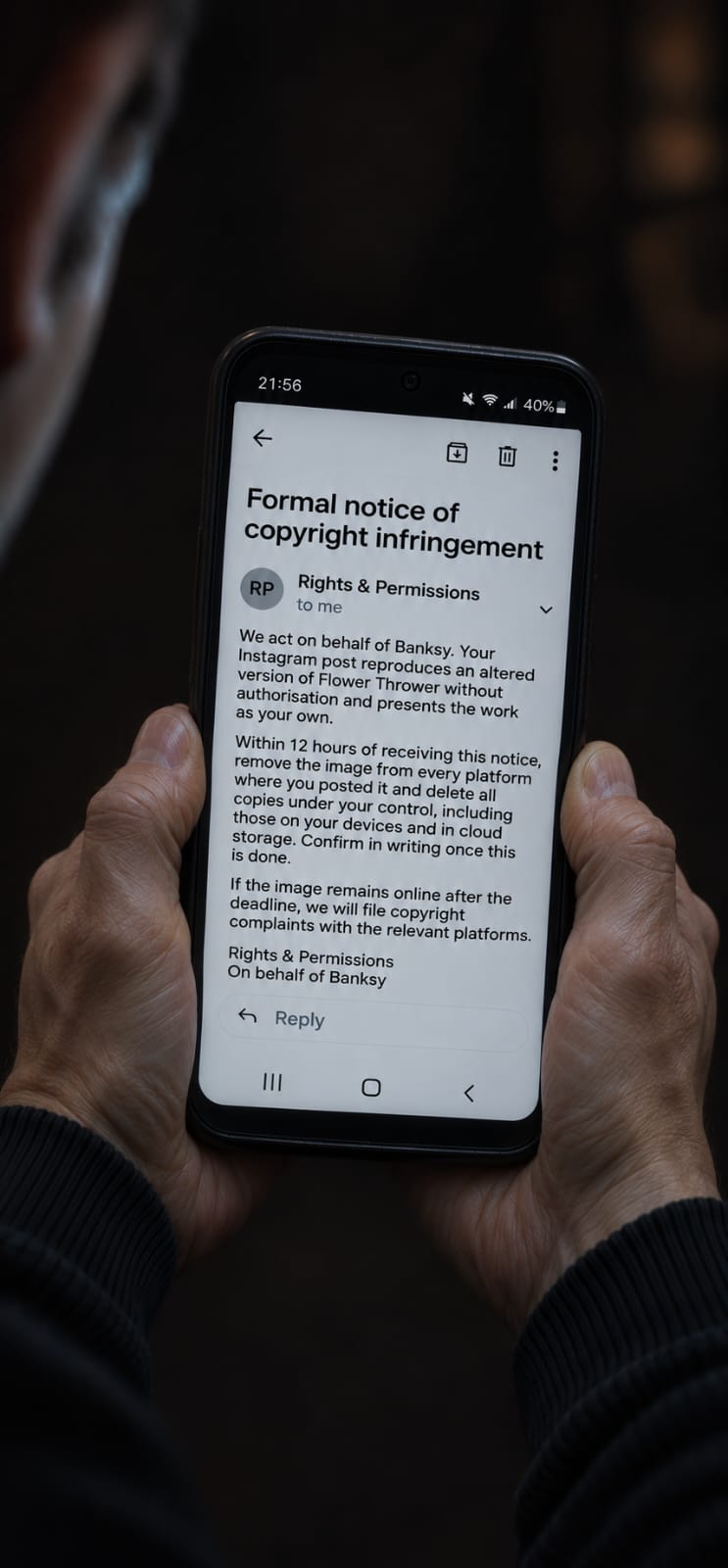
Formal notice of copyright infringement
LUIS: Now that the art is off the canvas and digital, it no longer must remain fixed. These “digitally supported texts, music, and pictures can now start to drift again (k), as they did before the … mechanical age.” (16) Why should the creative process end with Banksy’s intention?
LUIS: Okie dokie chat, what’re you going to give me today chat…
(The image is generated.)
LUIS: Hmm not quite what I was hoping you would do…
(Another variation appears.)
LUIS: Oh interesting… that’s unexpected. Yea… let’s keep that part… Not quite where I want them but getting there…
(He selects a variation and continues editing.)
LUIS: Oooh yeaa… I didn’t imagine this result…
(Luis prepares an Instagram post identifying the images as AI-assisted reinterpretations after Banksy.)
LUIS: Banksy’s art shouldn’t stop in the gallery. “The internet’s global reach has allowed art to continue evolving beyond gallery walls.” (17). Aalrighty let’s post this and see what people think…
(He publishes the images. Notifications begin appearing.)
LUIS: A thousand shares already? Oh my god they’re everywhere!
(Projected comments appear.)
COMMENT 1: Is this the new Banksy collection?!
COMMENT 2: These are so different from his other work!
LUIS: (He watches the reposts multiply.) Haha this is awesome – the physical exhibition hasn’t even opened and I’ve started a digital one. And my versions are the center of the conversation.
End of Act III
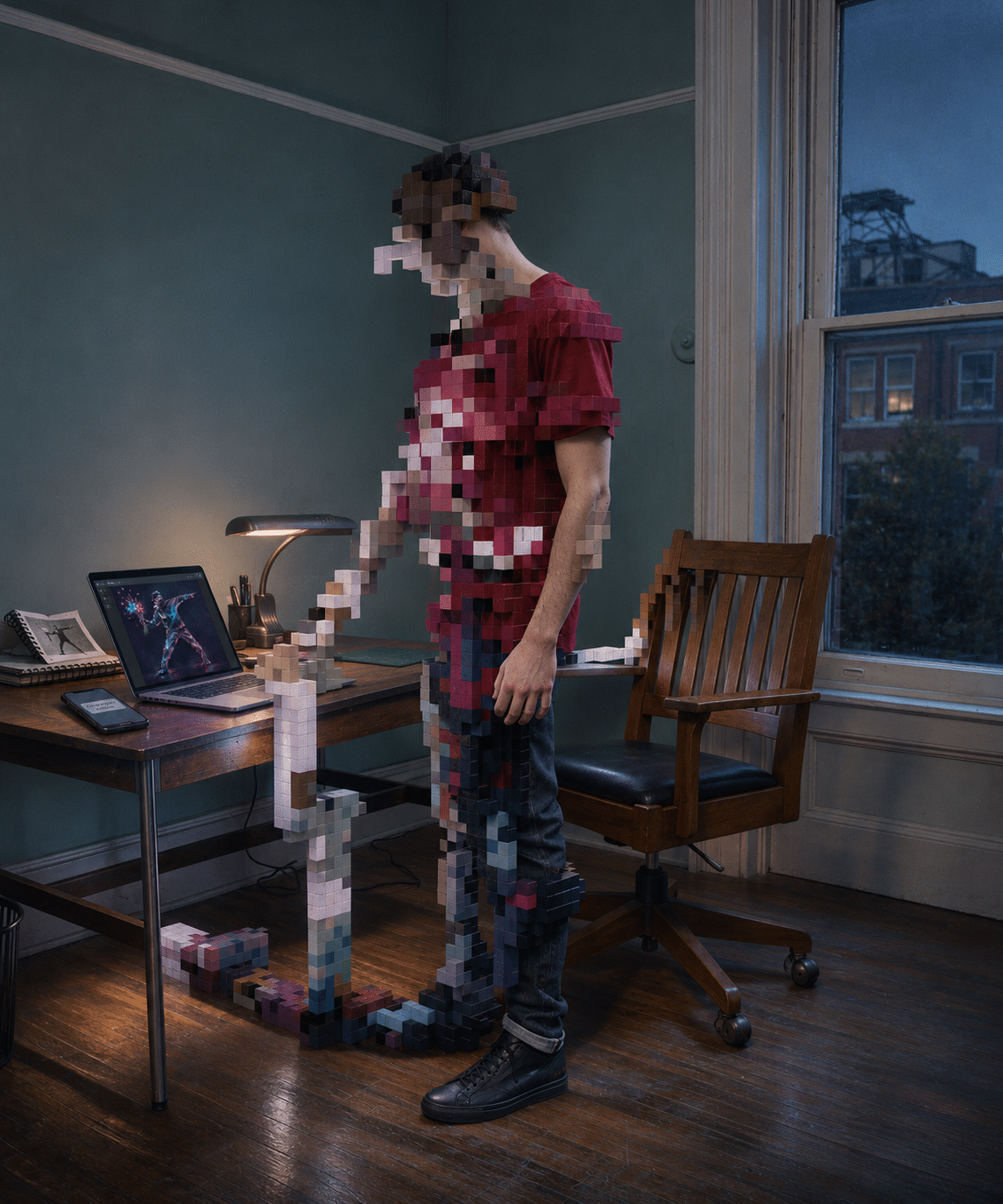
AI as a provocator
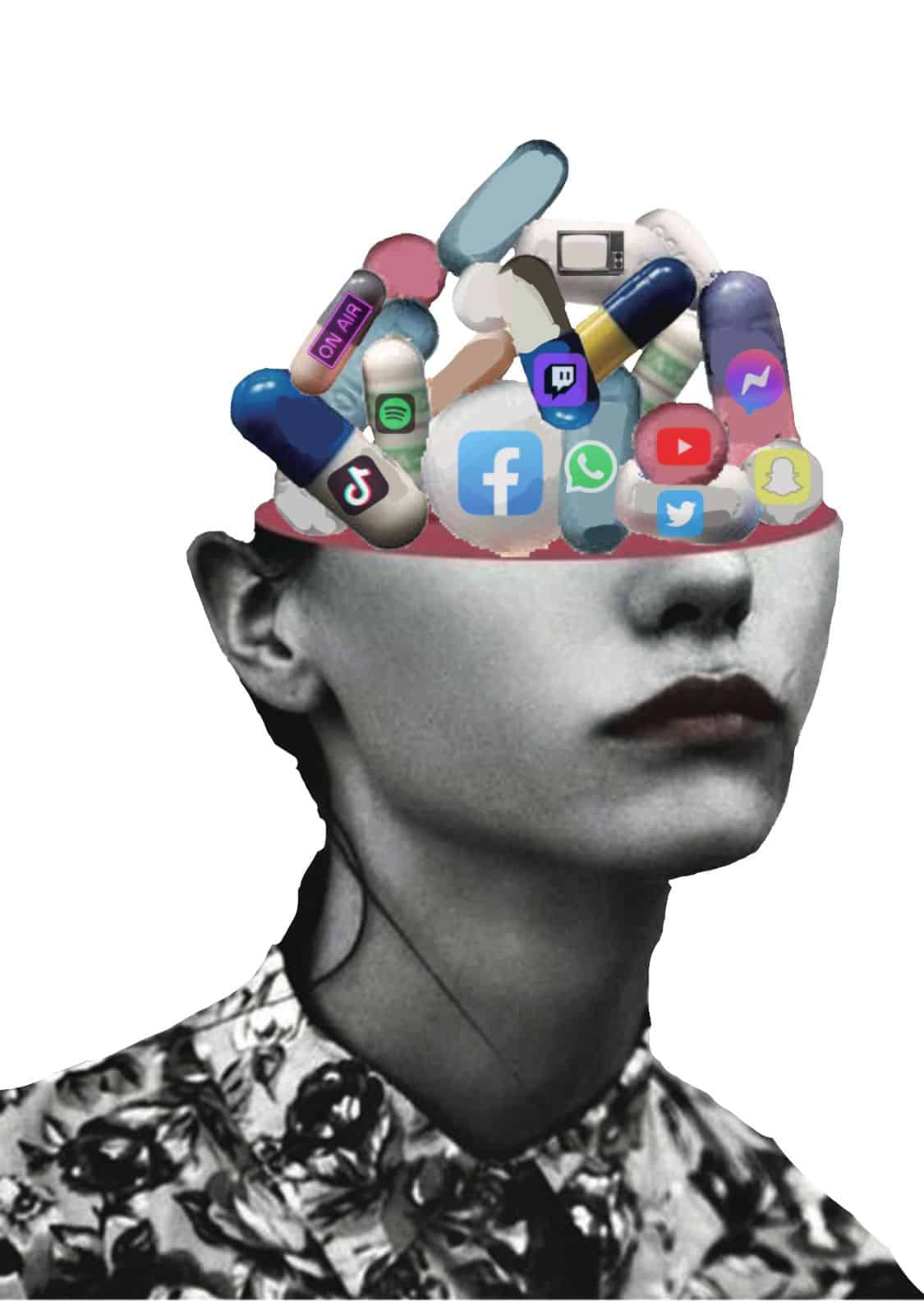
Social Media and Digital Addiction
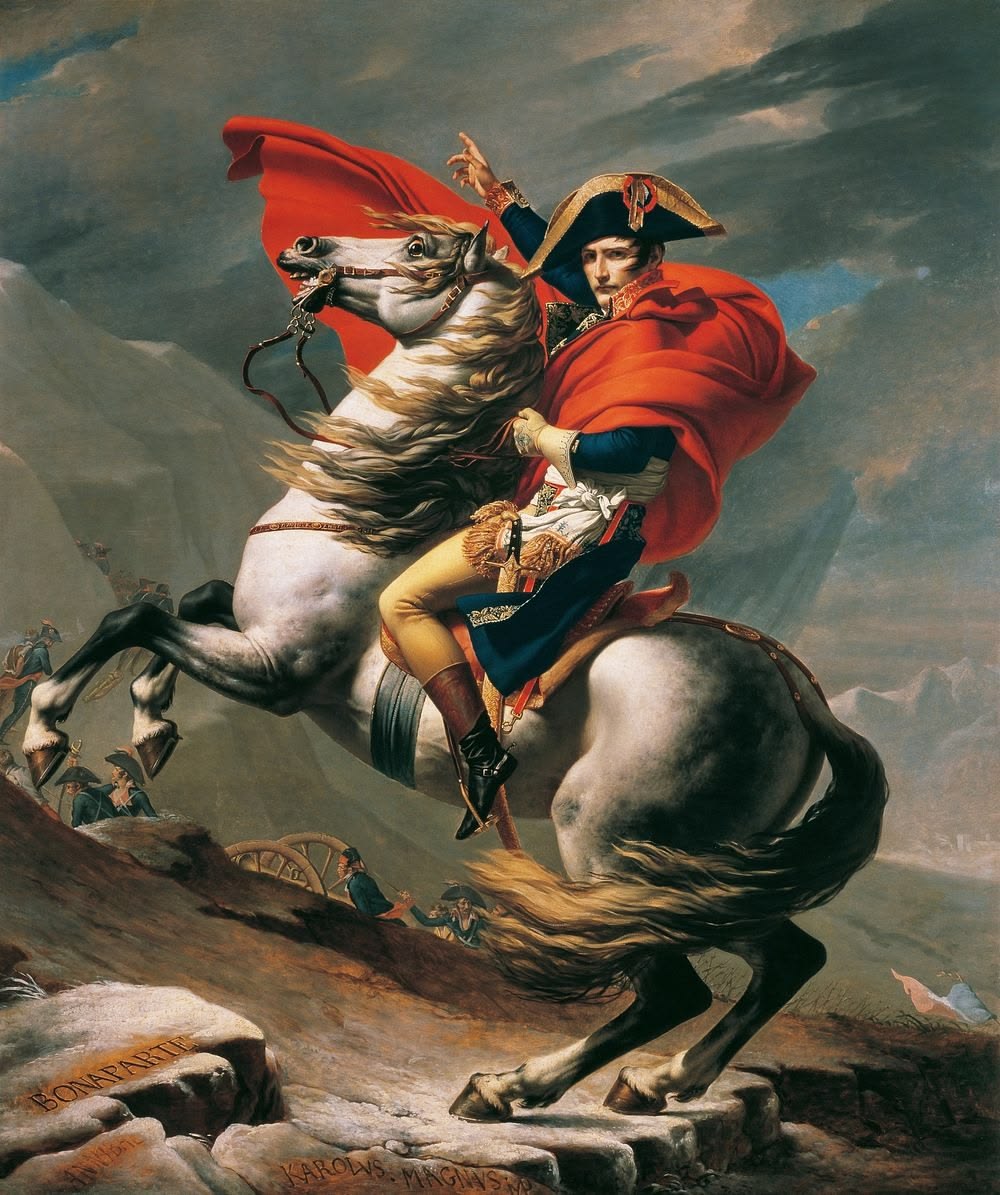
Prestige and honour
Act IV
The Confrontation and the profiferation
The gallery is being prepared for the exhibition. Mariana discovers Luis’s viral AI remixes and approaches Banksy, who is inspecting his paintings. Meanwhile, Luis is at home watching his posts gain attention.
(Mariana approaches Banksy with her phone).
MARIANA: Banksy, come here you need to see this. Someone’s posted AI versions of your unreleased paintings. They’re already going viral.
BANKSY: (Looking at the phone.) What? How did he even get these? He’s completely changed their meaning! Contact him. I want them taken down immediately.
(Banksy’s representatives send Luis a formal takedown demand.)
LUIS: (Reading the message.) Bruh he’s calling it imitation without even looking at my process of making it. “In my view, one goal should be transparency about who contributed what, with attention given to identifying the contributions of the AI and acknowledging its help” (18), and highlighting the collaborative effort.
LUIS: (Luis shares a screenshot of the demand.) Also, Banksy, half the time you’re just transforming existing images in provocative ways. Your claim that the process should end with your paintings is arbitrary.
(The post gains attention. Banksy’s team issues a public statement.)
BANKSY: There’s a difference between originality and imitation. “The mind of genius is among other minds what the [ruby] is among precious stones: it sends forth light of its own, while the others reflect only that which they have received” (19) (l). A true artist creates rather than merely reflecting another’s genius.
LUIS: Much of your work draws on existing ideas and images, just like mine. Neither of us is creating purely from our own imagination. AI is just a massive collection of information, and “Collective intelligence (m) is not new” (20).
BANKSY: Using a machine to reproduce someone else’s work doesn’t make you a creative.
LUIS: Yea but I didn’t just reproduce it. I worked with my boy chat and created variations on the ideas of the art. With ChatGPT, “The penetration of AI into writing and thinking practices [has] gone considerably beyond these kinds of assistances into genuine collaborations” (21). Chat provided provocation, but I still made the creative decisions.
(Back at the gallery, Mariana watches the controversy spread.)
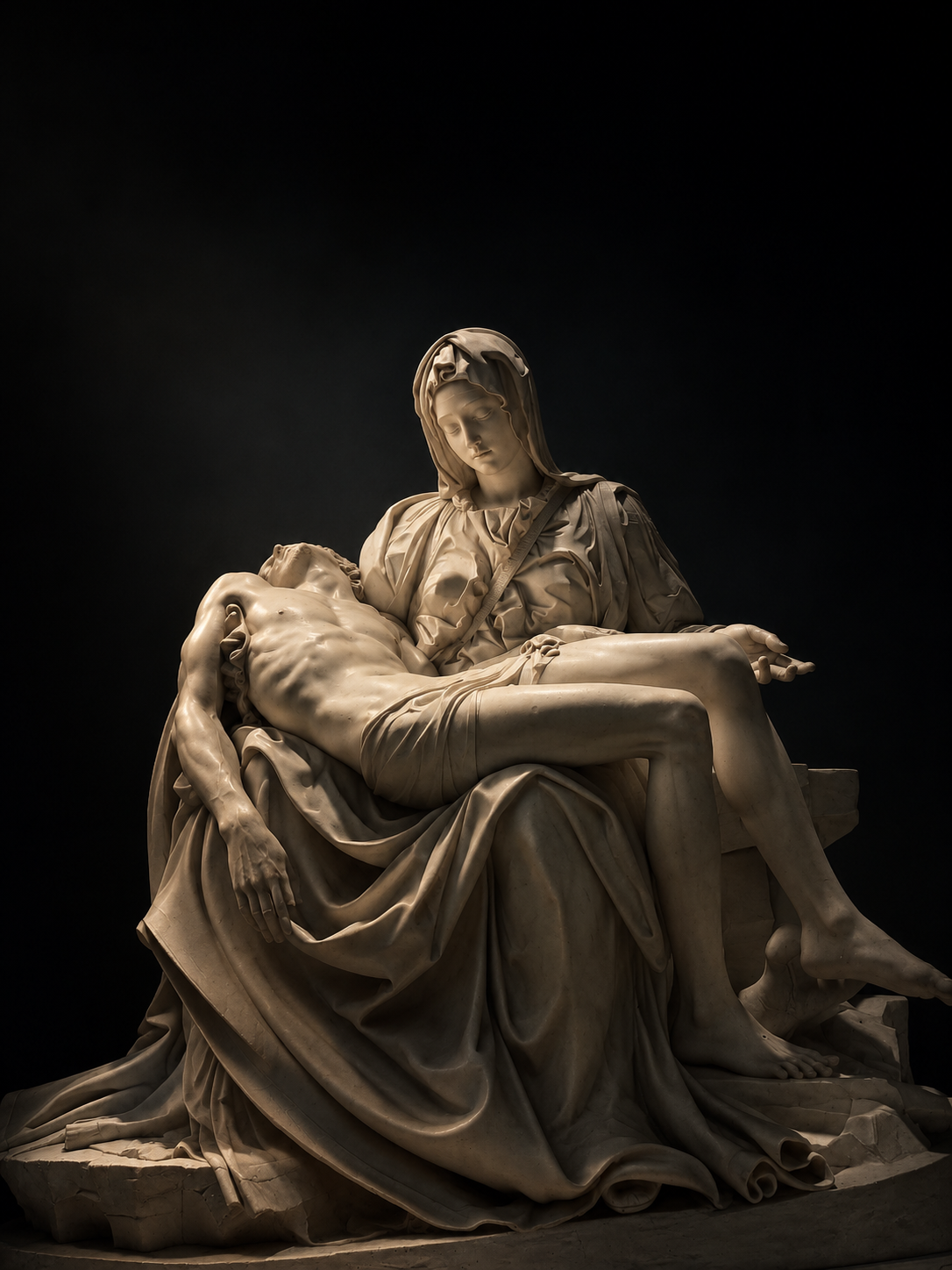
Pieta – The genius artwork
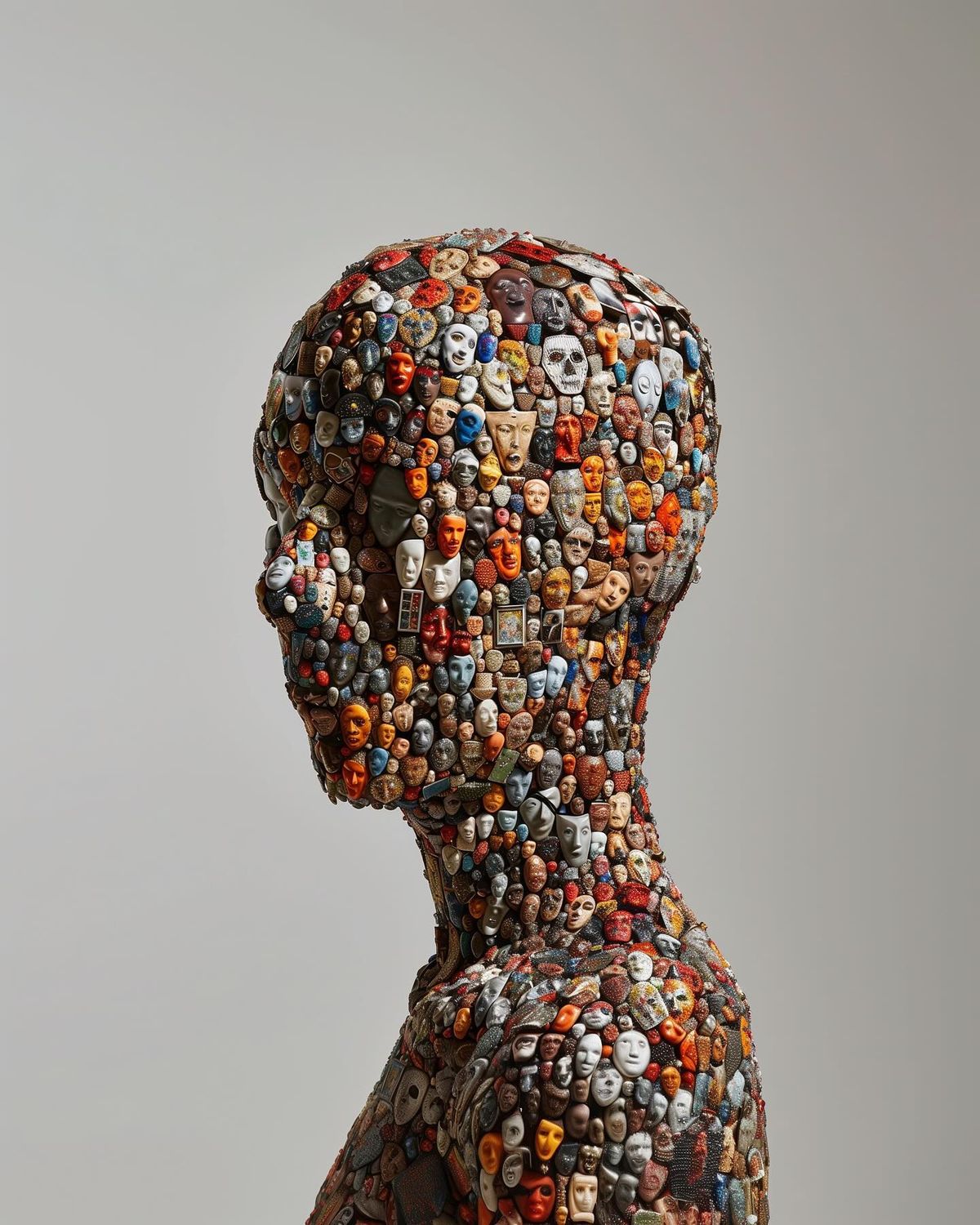
Collective intelligence
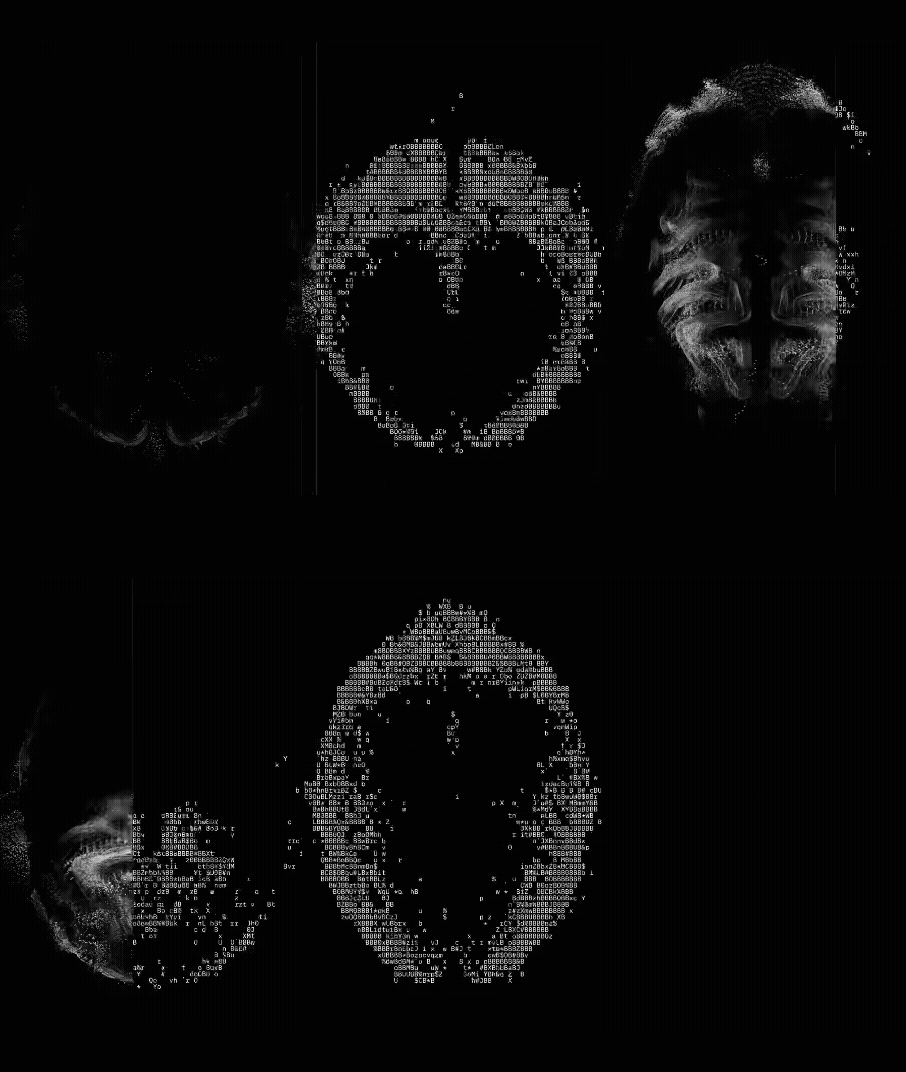
Collective intelligence
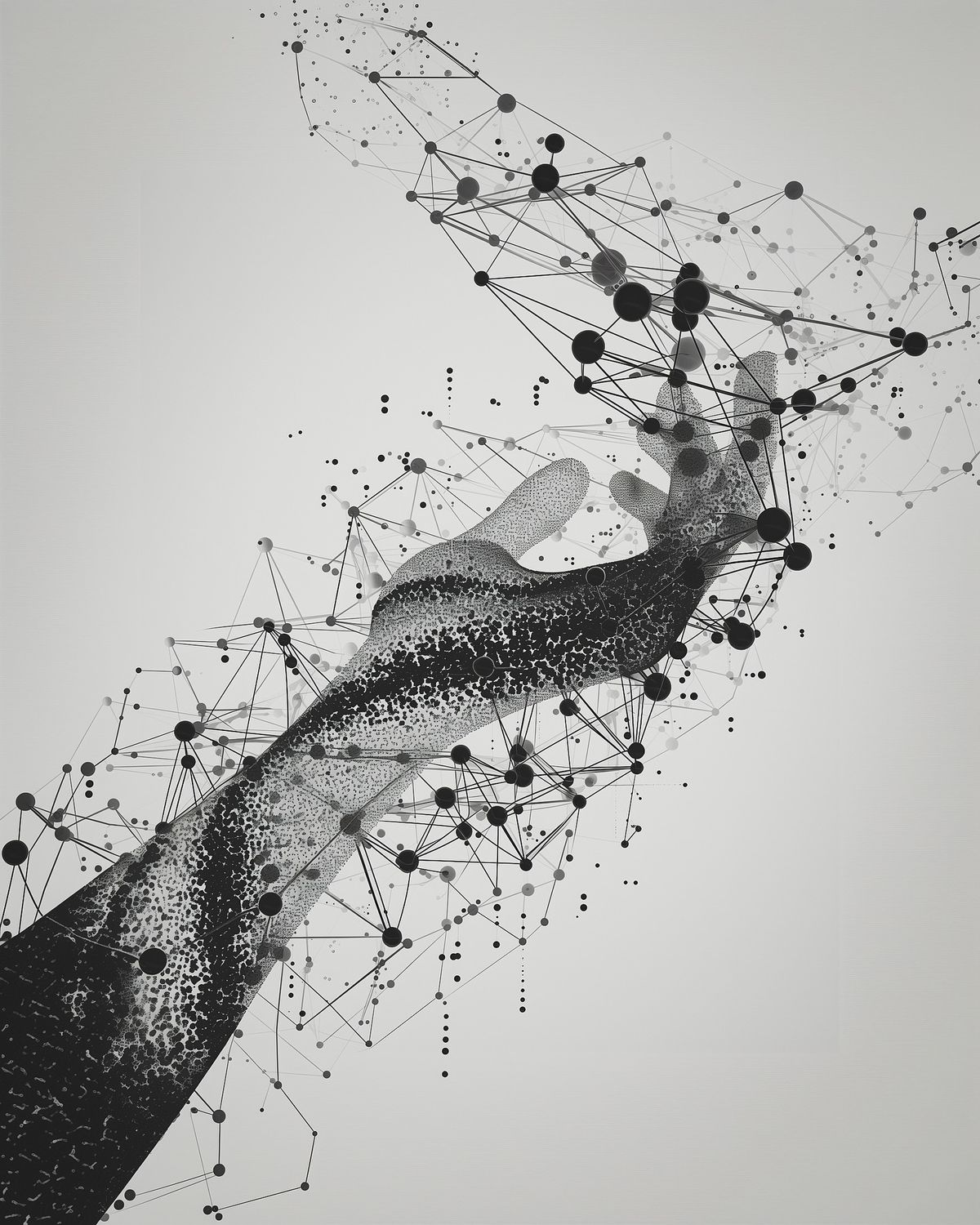
Human – creative director for AI
MARIANA: Look, people are creating their own versions now. Neither of you controls what these paintings mean anymore.
BANKSY: But that’s not what I intended!.
MARIANA: That’s precisely the point. While you two are fighting over whose process is legitimate, the audience has already decided what the artwork means; perhaps “the birth of the reader must be at the cost of the death of the Author” (22) (n)
End of Act IV
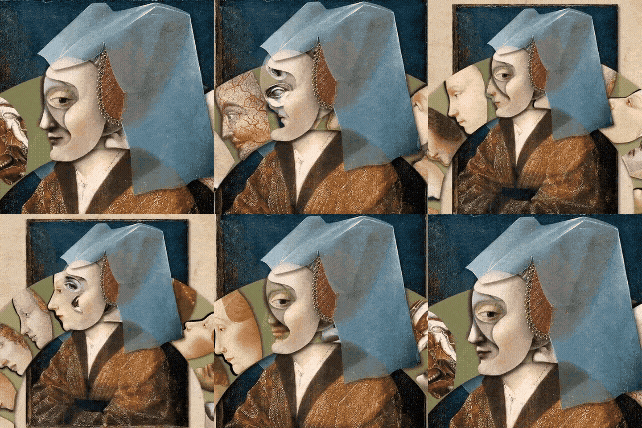
The Bipolar, Authorship through Shifting Perspectives
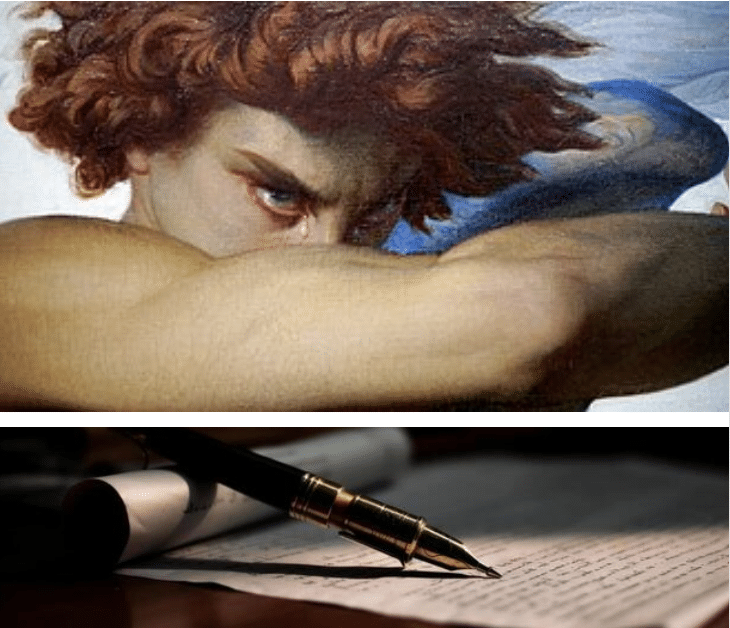
The Fall of the Rebel Angels — Peter Paul Rubens (detail)
Fig. 19
Human Authorship and Creative Expression
Act V
The Death and the Author
The gallery, shortly before the opening: Banksy is furious about the leaked paintings. Joanna and Carlos are frustrated that their collaborative work has been overshadowed. Luis follows the attention online while Mariana observes, taking notes.
BANKSY: This was supposed to be my exhibition! My paintings, my message. And now everyone’s talking about some guy using AI!
LUIS: (Recording an Instagram story.) One million views! From the few images I posted, hundreds more have been made by my followers!
BANKSY: These people don’t even understand what my paintings were supposed to mean!
MARIANA: (Looking at her phone.) Well, they’re certainly finding their own meanings. Exactly! My original intents have been lost! (Quietly taking notes.) Yes… Interesting… (Mariana moves away and opens her unfinished article, titled “Behind the Mask: The Artist Called Banksy.” She deletes the draft and begins writing.)
MARIANA: (To herself.) They’re all fighting to control the meaning (o) of the artwork. [But giving a work an author is also placing limits on it, as though the creator alone can decide its final meaning (23). Why should an artwork’s interpretation end with its creator’s intention.
(Mariana reads some of the Instagram comments).
COMMENT 1: I actually like some of the AI versions better. They say something different.
COMMENT 2: Who cares which one’s original? Art means different things to different people.
COMMENT 3: I made my own version too. Isn’t that what art is about?
MARIANA: The reader becomes the space where different ideas, experiences and interpretations come together, without any being lost. A work’s unity lies not in its origin, but in its destination (24). Perhaps art’s meaning belongs not just to its creator, but to everyone who experiences it.
(Mariana looks toward the arguing characters and Luis’s posts.)
These modified images are circulating beyond anyone’s control. “Behind all these questions we would hear little more than the murmur of indifference: ‘What matter who’s speaking?’” (25) Perhaps we should ask what the images are doing now, rather than expect their creator’s name to explain everything.
(She continues typing. Her article remains hidden from the audience.)
LUIS: (Online.) This shouldn’t just be about whose name appears beneath the image, and it’s not about the author’s original intention.
(Luis begins revising his caption.)
(Mariana finishes writing and clicks publish.)
(The gallery lights dim. Phones begin buzzing. Everyone turns toward the projected screen.)
BREAKING: MARIANA’S ARTICLE
THE DEATH OF THE AUTHOR
The meaning of a work no longer belongs exclusively to its creator, but to those who interpret it.
“We know that to give writing its future, it is necessary to overthrow the myth: the birth of the reader must be at the cost of the death of the Author.” (26)
– By Mariana
BANKSY: (Reading the headline.) The death of the author? After everything that’s happened, this is what she’s written?
JOANNA: She’s turned our entire exhibition into her own story.
CARLOS: And look whose name is at the bottom.
(The spotlight falls on the byline.)
(Everyone stares at the screen. Mariana, who has just declared the death of the author, has claimed authorship of the story herself.)
Final curtain

BIBLIOGRAPHY
Barthes – The Death of the Author (1977)
Mario Carpo – The Alphabet and the Algorithm (2011)
N. Katherine Hayles – Bacteria to AI : Human Futures with our Non human Symbionts (2025)
Arthur Schopenhauer – Essays of Arthur Schopenhauer (1851)
Matias del Campo – Everything can be an Author : Rethinking Agency in the Age of Artificial Intelligence (2023)
Michael Focault – What is an author? (1969)
Kyle Steinfeld – Significant Others (2021)
FOOTNOTES
(a) Artistic alias (Banksy) An alternative name used by an artist instead of their real identity. Banksy’s anonymity allows his artistic name to become a recognizable identity independent of the person behind it.
(b) Tissue of quotations (Roland Barthes). The idea that no creative work exists entirely independently. Every work draws upon existing language, images, cultural references and ideas, challenging the notion of absolute originality.
(c) “Physiognomy” means a person’s face or features, read as a sign of character. Style reveals the mind, the way a face reveals a person.
(d) In Banksy’s mind, intention is the first step in art; every part of the process has a purpose behind it.
(e) Regardless of the amount of though put into a pieces, the audience will interpret it as they see fit. A more prestigious name carries more weight, but doesn’t guarantee the author’s narrative will be communicated.
(f) Banksy contents without creative genius, no content is created. However with generative AI, this is not longer true.
(g) The Puppet, Authorship through Hidden Labour Carlos represents the invisible contributors whose physical labour materializes creative visions, questioning why authorship is attributed to those who direct rather than those who execute.
(h) Collective endeavour The idea that a creative work is not necessarily produced by one individual. Instead, authorship can emerge through the combined contributions, decisions and knowledge of several participants.
(i) Material agency The idea that materials and physical conditions actively influence the design process. In this exhibition, the walls, lighting, frames and spatial limitations shape the decisions made by Joanna and Carlos, rather than simply responding to their instructions.
(j) AI becomes the team of Carlos’s, working out the wrinkles of 2D media. This democrotizes Joanna’s position of curator.
(k) Digital drift Refers to the way digital images can be altered, remixed and reinterpreted repeatedly rather than remaining fixed in one final, stable form. Once a work becomes digital, it can continue evolving through new versions.
(l) It is true that AI merely reflects, without any creativity of its own. However, might not the reflection of a trillion human thoughts shine brighter than a single original thought?
(m) Collective intelligence (N. Katherine Hayles) Intelligence that emerges through the combined contributions of multiple participants rather than a single individual. In Luis’s argument, AI-assisted creation builds on existing human knowledge and involves interaction between human and machine capabilities.
(n) The Death of the Author (Roland Barthes) The idea that an artwork’s meaning is not exclusively determined by its creator’s intentions. Once the work reaches an audience, viewers can produce different interpretations based on their own experiences, challenging the artist’s authority over its meaning.
(o) The Bipolar, Authorship through Shifting Perspectives Mariana represents the fluid nature of authorship, questioning how interpretation and storytelling reshape meaning, and whether the observer becomes an author by constructing the narrative.
CREDITS
İris Cömert
Priscila Dohler
Matthew William
Atreya Saha
Sama Asif Hodekar
Anish Batta
Gautham Lakshmanan Agoramurthy
Jorge García
***
Read it on Readymag : https://readymag.website/6653392
