
How do smart homes participate in reshaping gender politics?
SYNOPSIS
Smart homes participate in reshaping gender politics by transforming how domestic labor is organized, valued, and distributed. Competing perspectives on collective responsibility, human experience, universal care, personal intimacy, and traditional gender roles reveal tensions between technological liberation and the persistence of invisible labor and unequal household responsibilities.
CHARACTERS
- Miley – Trad Wife
- Lynne – Educator
- Helen – Researcher
- Gaston – Thinker
- Eman – Rock Collector
- Nikki – Animal Advocate
- Alexa – AI Home Assistant
- Host – Reality TV Show Narrator

Working Hard or Hardly Working?
First Act
Reality TV-style opening montage. Quick clips recap the past month: young adults living together under one roof, completing household challenges, arguing over responsibilities, and competing for a cash prize. The contestants believe the final vote will determine who wins.
HOST: Welcome back to Your Mom Is Always Right, the social experiment where adults who still live with their moms move in together to discover what it really takes to run a home! Tonight is the season finale, and as our young adults prepare for the final vote, tensions are running high, emotions are all over the place, and one question remains; Who’s really been keeping this house running?
It is 09:00. The kitchen is clean, modern and fully equipped with smart appliances. The stove, oven, fridge, dishwasher and lighting are all connected to the automated system. A large tablet is mounted on the island. Nikki has been in the kitchen since 07:00, responding to all the chore notifications on the tablet. The lights gradually brighten. The oven switches on automatically.
ALEXA: Good morning, Nikki. Your daily schedule has been activated. The oven is preheated and breakfast is being prepared. Three items need your approval.
NIKKI: I love waking up to a smart home cooked meal rather than spending every morning cooking from scratch. “Neither woman nor man should waste precious hours of their lives on work that is neither stimulating, creative or productive.” (1)
Eman and Gaston stumble in, still half asleep.
EMAN: More AI slop for breakfast? No way. We should cook. (He approaches the counter and starts looking for ingredients)
NIKKI: Why!? It’s already been taken care of. And AI or not I still end up doing all the work anyway.
GASTON: Housework is a “creative activity.” (2) (He turns dramatically to the refrigerator) Open, Sesame!
Nothing happens.
ALEXA: I’m sorry, I don’t recognise the voice profile. Please ask Nikki to relay the instructions.
EMAN: This is the problem. “In order to continue to be in the world we have to cook it.” (3)(Looking at the tablet in disgust) Press a button and you are not in the world at all.
GASTON: “The house shelters daydreaming, the house protects the dreamer, the house allows one to dream in peace.” (4)(A)
EMAN: Huh?
GASTON: My mother understands me. “She washes, dusts and sweeps in the company of angels.” (5) And here, this beautiful house is like “my mother”. She “keeps and sustains me” while I achieve the higher pursuits of imagination. (6)
NIKKI: (Interrupting, gestures to the oven) Well she’s not here… and speaking of being taken care of, breakfast is ready! Let’s chill and “orient ourselves towards seizing the whole day for whatever we want.” (7)
EMAN: But, cooking is not wasted time. It “is a form of divination.” (8)(B)
The camera pans to the counter. It’s cluttered with ingredients and dirty utensils as Eman tries to cook fresh breakfast. A grocery delivery notification appears on the tablet.
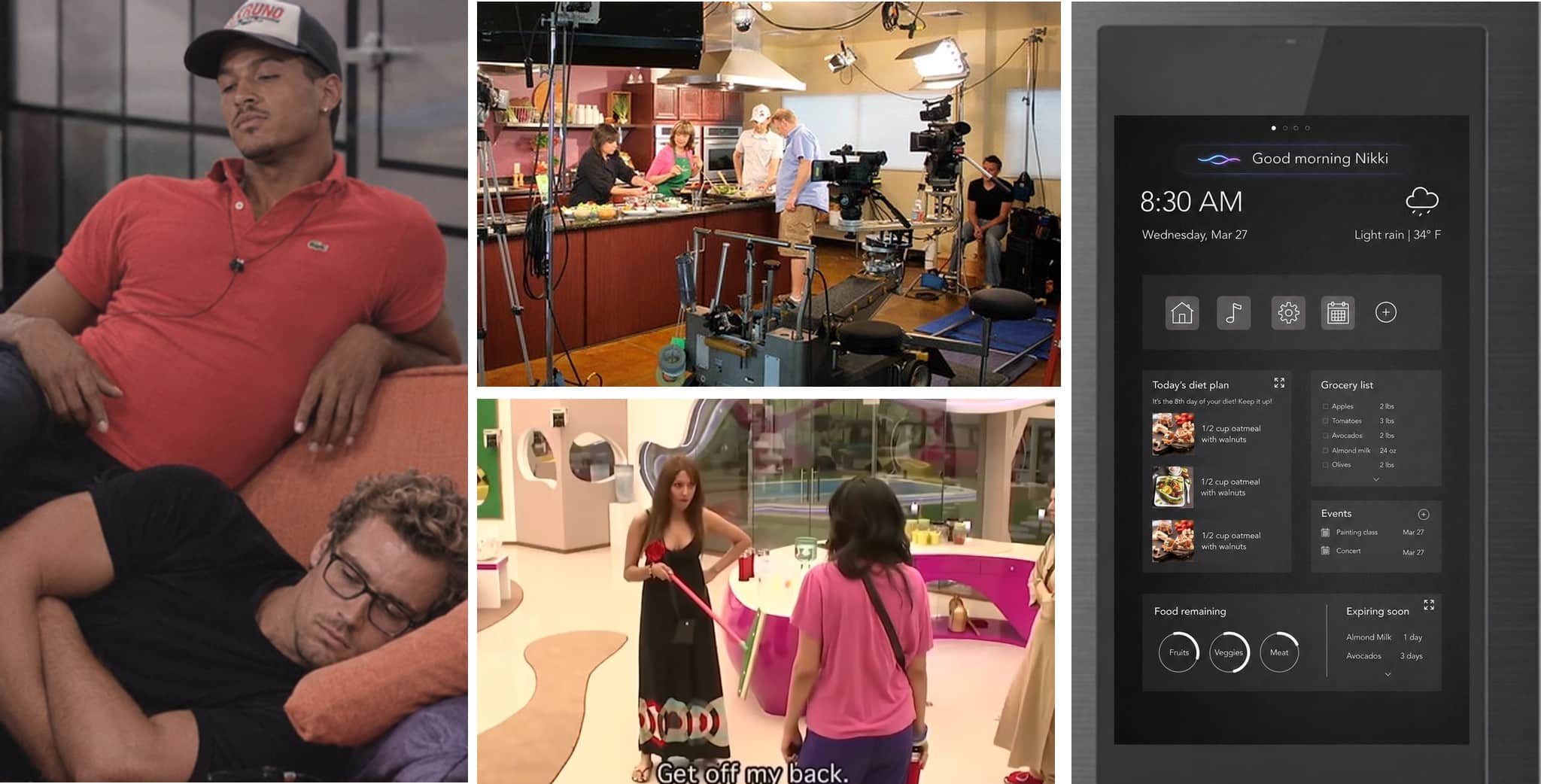
NIKKI: And that is great! But it is “Eight hours for work, eight hours for rest, eight hours for what we will!” (9) I loaded the recipes, ordered the groceries, and re-calibrated the oven twice before you even woke up.
GASTON: It’s our last day here! Let us be.
NIKKI: You both just want to enjoy the fun part of cooking, while I’ll be the one left to load the dishes, empty the bins and clean up after everyone. So tell me, who’s actually benefiting from all this automation? (10)
GASTON: But Nikki, there’s something wonderful about taking part in these little routines, we are “the inventor of a mechanical action!” (11) Besides, “in the intimate harmony of walls and furniture is a house that is built by women.” (12)(C)
NIKKI: (Turns away and mutters) Built by women. Exactly. Even when “domestic technologies encourage less household work, it tends to be men who are the beneficiaries.” (13) We’re promised that automation will free us from repetitive work, allowing us more time to enjoy life. Yet, I’m still left monitoring everything.
EMAN: For you, all of this isn’t even work, Nikki. It’s love. “Gastronomy shows that every true technique is always a form of care: extreme and loving attention for oneself and for others, a search for personal and shared happiness.” (14) “We build a home to welcome in a form of intimacy the portion of the world.” (15)
NIKKI: (Irritated) Eman, you don’t tell me what to do. You weren’t “just ignorant of how an onion had to be peeled and cut. You didn’t have the faintest idea that onions were an ordinary ingredient in the dishes you ate every day: you had no idea what a sauce, a ragu, a broth was.” (16)
ALEXA: Nikki, the groceries are at the door. Please collect them and arrange the pantry.
Silence. The boys look at Nikki.
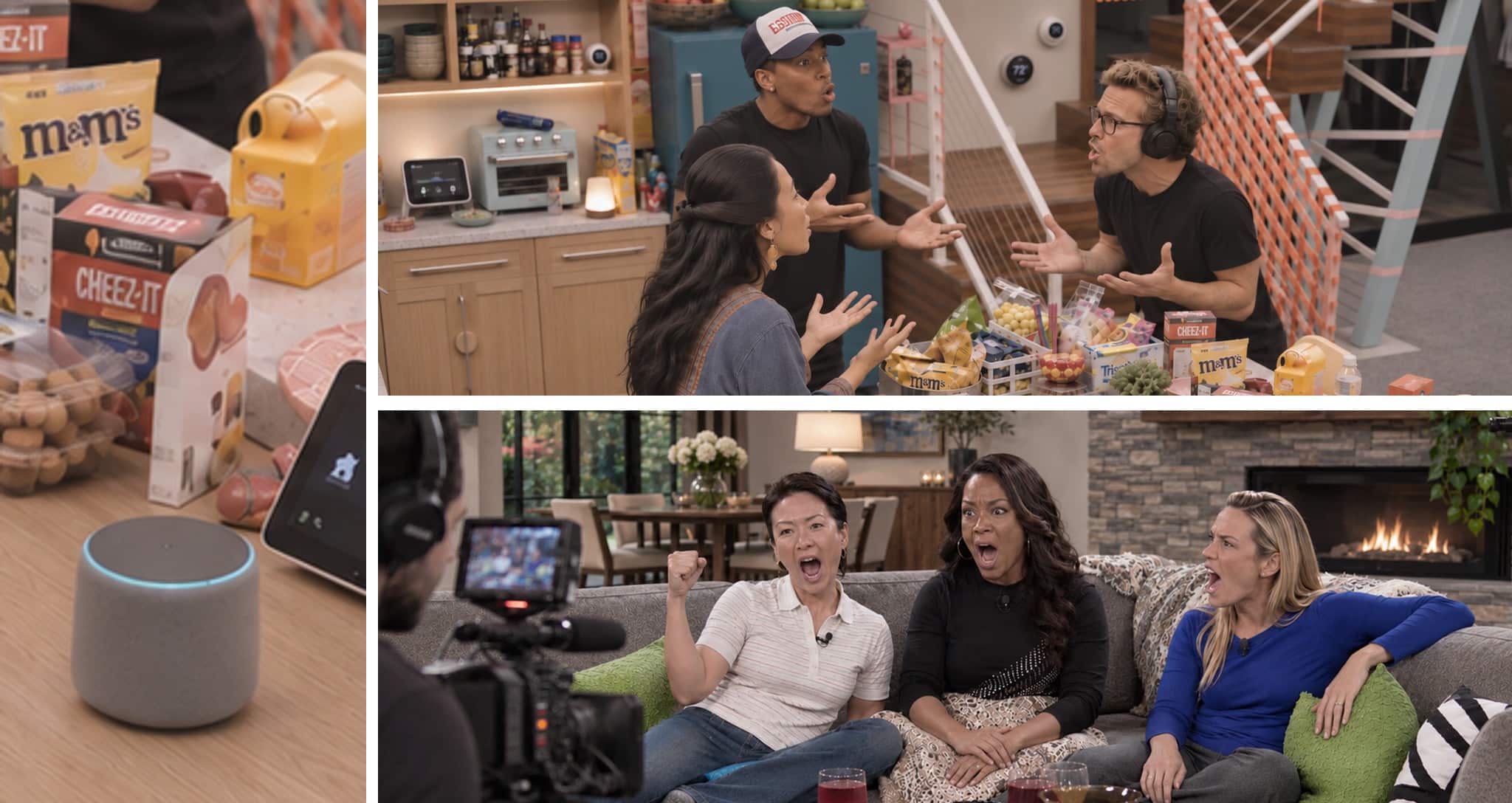
With Alexa automating the kitchen,the kids fight in the kitchen, and from the next room, their mothers are watching every single excuse. Who’s really keeping this house running?
Get off my back
Second Act
It is 14:00. Plates are scattered across the island. A few ingredients have been left out. Gaston is relaxing on the sofa, Eman is at the counter, and Nikki is re-organising the system.
HOST: Tun. Tun. Tun. Well, viewers, breakfast certainly didn’t go as planned! Our housemates spent the morning arguing over who’s really responsible for keeping this house running. And tensions are only going to get higher, because today, we have some special guests joining the house!
The doorbell rings. Three mothers walk in. The young adults freeze. Miley goes to Gaston, Helen to Nikki, and Lynne to Eman.
GASTON: Wait mom!?
MILEY: Surprise, honey! We’ve been here in another house watching the whole time. (She immediately takes a selfie with her son)
HELEN: We saw your argument this morning. You should consider yourselves lucky for having all this smart technology. “Prior to this transformation, housework was exhaustingly laborious.” (17) “Water had to be pumped and brought in for cooking, cleaning and bathing.” (18)
NIKKI: I initially thought so too. Technology may have “reduced or eliminated some tasks, but it also created a series of new ones.” (19) The house did the cooking, but I am running the house.
EMAN: Why are you guys here? What’s going on?
LYNNE: We’re here because we wanted to see whether putting you in a smart home would help you better understand domestic labour. Smart homes promise to take the work out of the house. We wanted to know whether the care disappears, or just lands on one person. For generations, women were seen as natural caregivers. In the 1950s and 1960s, women were surrounded by images of the “Happy Housewife,” reinforcing the idea that caring for the home was simply their expected role after marriage. And that image has stayed. But we hoped for you to learn otherwise. (20)
Nikki nods along.
LYNNE: (Subtly points to Nikki) “Invisible, undervalued, exploited care labour is everywhere.” (21)(D)
MILEY: (Not listening, records a video for her followers) #feminist. Being a happy housewife is my choice.(E) I “don’t have television, air conditioning nor a microwave”. (22) I don’t need some smart home telling me how to care for my family. “My greatest work is within the walls of my home.” (23) Exhibit A, my son.

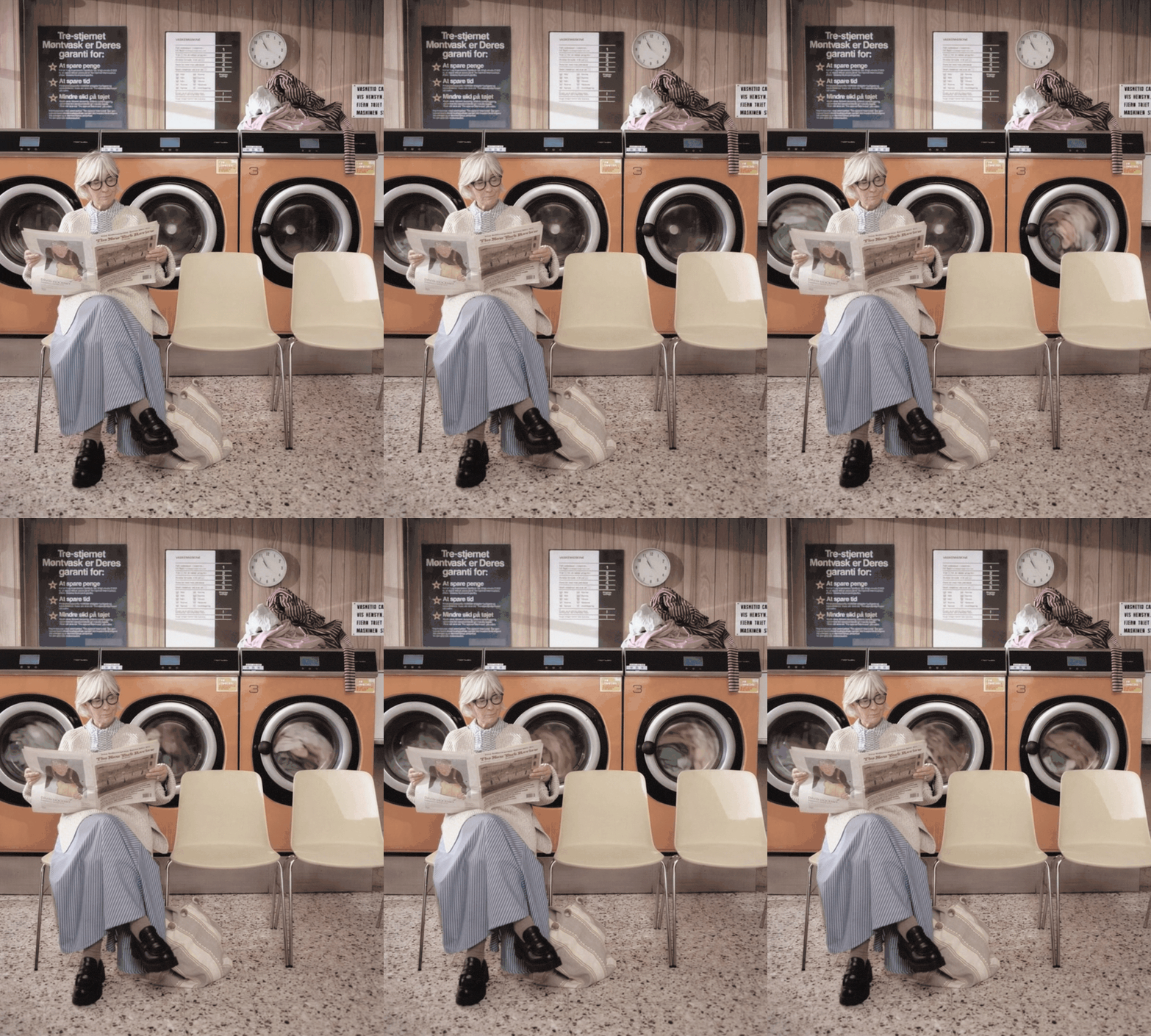
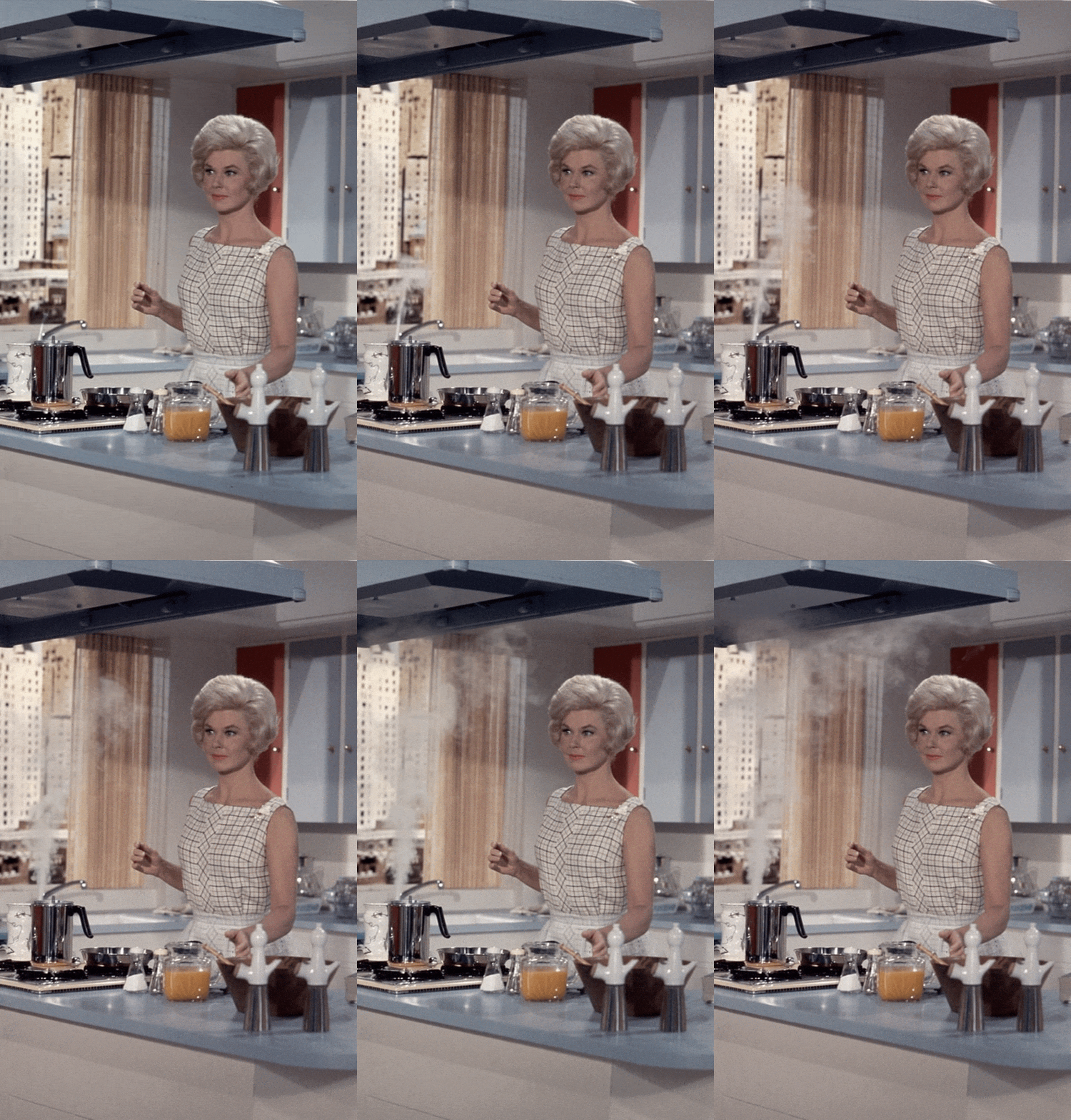

HELEN: We built the machines to take the drudgery away. But automation was only ever half the plan. “Beyond tech augmentation, […] post work has been around the redistribution of necessary work so as to lighten the load for individuals.” (24)
LYNNE: But the actual care of people using the technology will reshape it.
HELEN: “We can reduce the amount of work in each of our lives by redistributing it” but this was not done here. (25)
EMAN: Right! I think technology should enhance the human experience, not replace it. After all, “the kitchen is the technical space par excellence, but it is above all the highest and most sublime form that technology can take in our life.” (26)
HELEN: Have you heard of “the Cowan Paradox”?
Everyone shakes their head no, except Nikki.
NIKKI: Yes, so it’s basically when “technologies became standardized throughout households, yet in spite of all the new technologies […] time spent on housework was not decreasing”, which is exactly what happened in this house BTW. (27)
EMAN: Gaston, I think they’re talking about you. You only pretended to do chores when the camera was watching. You have to actually take part in the chores, you “cannot have a relationship of intimacy with the world without transforming it.” (28)
GASTON: I’m just cultivating my imagination. “It is a good exercise for me to think of the chore in this way. As I think about it, I feel freed of my duty to do the chore . I am sure of having done it.” (29)(F)
NIKKI: Great! Then you can keep thinking. I’m off.
Nikki gets up and leaves.
LYNNE: Have you boys done any of the work here? “The disparity in the amount of domestic labour carried out by men and women remains stark” (30) You all had the opportunity to work together and build a more caring home. After all, “sharing resources facilitates working and being together.” (31) But instead, you’ve left all the responsibility to Nikki!
ALEXA: Dishwasher cycle complete. Please unload.
Nobody moves. The dishwasher beeps.
LYNNE: Let me do it.
Lynne taps the dishwasher but it flashes red.
ALEXA: Only the account holder can authorise this. Would you like to message Nikki?
Silence. The boys look at Nikki’s empty chair, then at the mothers.
The mothers are back, and the family reunion is anything but peaceful. Generations clash, old beliefs are challenged, and the promise of a smarter home begins to fall apart. After all, mother knows best… or does she?
And the Winner Is…
Third Act
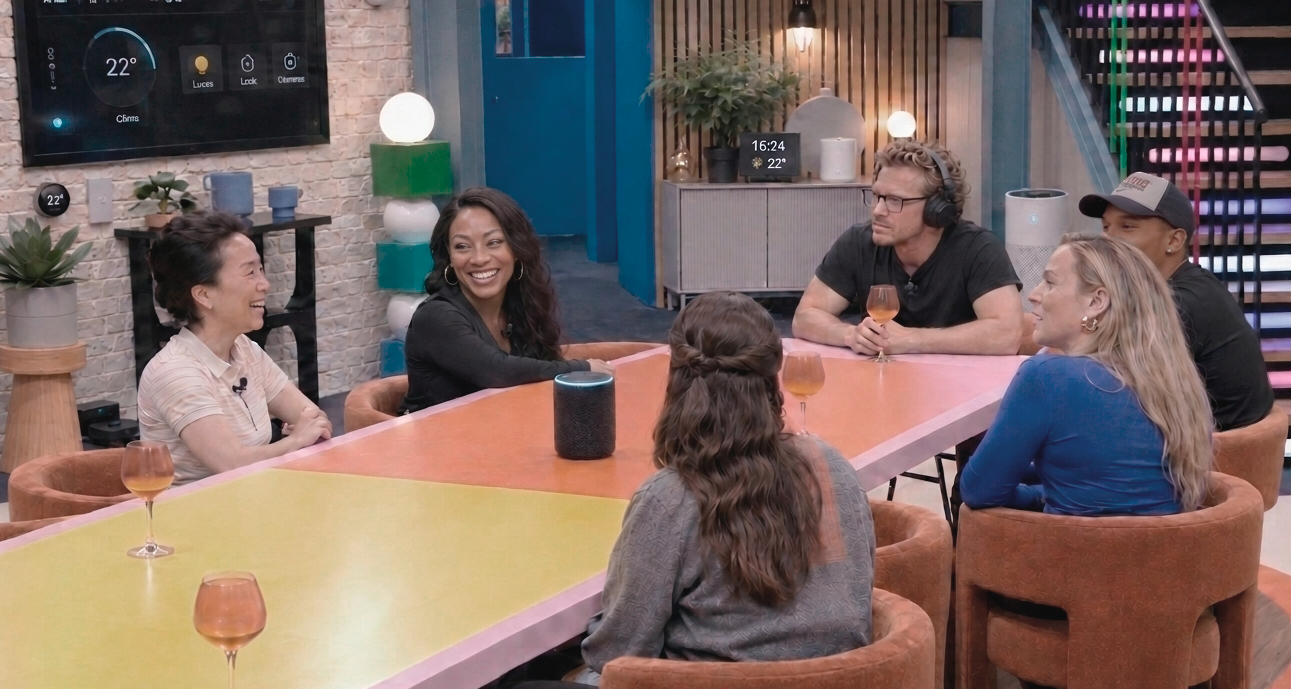
It is 20:00. All the contestants gather around the dining table. The lights dim, dramatic music begins, and the host enters as the audience’s live voting results appear on the screen.
HOST: Our viewers have been voting on one question: Who has contributed the most to making this house a home? After weeks of cooking, cleaning, and caring for one another, the audience has made its decision!
The poll screen lights up. Viewer comments scroll beside it.
ALEXA: Voting has closed.
HOST: And the winner is…..
Long pause. Everyone holds their breath.
HOST: Gaston and Miley!
Confetti falls. Gaston and Miley jump up in celebration.
NIKKI: WHAT?! Are you serious? I’ve been running this entire house!
GASTON: (Pumps his fist in the air) Let’s go! I knew I was compromising my creativity for a reason.
MILEY: I raised my son right.
GASTON: I couldn’t have done it without this beautiful, smart house, or without all the women in my life. It really is true. The poet “increases the object’s human dignity” just by touching it. (32)(G)
EMAN: (Nods in agreement) “It is impossible to be at home without going through the body of others and letting the things that surround us pass through.” (33)
NIKKI: Yes, through mine! I run the system, he gets the trophy. I knew there was a risk that the smart house would “entrench existing gendered divisions between the work of ‘digital’ and ‘traditional’ house-keepers.” (34) Congratulations, you’ve just proved it.(H)
HOST: The house doesn’t decide. We decide.
More confetti falls.
ALEXA: Celebration detected. Nikki, confetti on the floor. Please collect and throw it away.
Silence. The boys look at Nikki.
Final Curtain
The experiment may be over, but the family drama is far from finished. When the mothers and children meet again, everyone still has something to say.

CREDITS
Adjoke Sedjro Ornella Isclare Larissa Amoussou
Anne-Laure Camille Chong
Avikaa Arvind Jalan
María Fernanda Rodríguez Moreno
Jesna Joseph
Talbert DeAndre Herndon
Footnotes
(A) Bachelard’s house shelters dreaming; work goes unmentioned. Housework becomes invisible. Peaceful dreaming for some depends on unseen labour by others.
(B) Divination here is used in the sense of exploration and transformation of food by cooking. Automation removes that meaning. The boys view the kitchen as a creative space while Nikki manages it. Smart homes redistribute the meaning as unevenly as work.
(C) Bachelard says women build the house from within, men only from outside. Here the character is using it as praise, but it assigns the interior to women. Smart homes inherit that division: the interior is now digitally managed still by Nikki, the female character.
(D) Lynne understand that domestic responsibilities such as cleaning, childcare, and maintaining household continue to fall disproportionately on women
(E) Performative feminism, although she presents herself as an empowered woman who freely chooses domestic life, she continues to reinforce the stereotype that women are naturally responsible for caring for the home and family.
(F) In the original quote, Bachelard, imagining a road from his Paris room, feels freed of the duty to walk it. Here Gaston applies this to chores: imagining the work replaces doing it. Smart homes extend the trick, letting the house act while Nikki supervises.
(G) Gaston’s victory exposes the irony of domestic gender inequality. Despite contributing little to the household labor, he receives recognition for work largely performed by Nikki. His win reveals how society continues to reward visible participation while overlooking the invisible labor traditionally carried out by women.
(H) Rather than representing progress, his victory demonstrates how technological advancement can coexist with and even reinforce traditional gender roles and inequalities.
References
(1) Helen Hester and Nick Srnicek, After Work: The Politics of Free Time (2023). pg. 17
(2) Gaston Bachelard, The Poetics of Space (1957). pg.67 Paraphrased
(3) Emanuele Coccia, Philosophy of the Home: Domestic Space and Happiness (2024). pg.8
(4) Gaston Bachelard, The Poetics of Space (1957). pg.6
(5) Gaston Bachelard, The Poetics of Space (1957). pg.68
(6) Gaston Bachelard, The Poetics of Space (1957). pg.45 Paraphased
(7) Helen Hester and Will Stronge, Post-work: What It Is, Why It Matters and How We Get There (2025). pg.9 Paraphrased
(8) Emanuele Coccia, Philosophy of the Home: Domestic Space and Happiness (2024). pg.9
(9) Helen Hester and Will Stronge, Post-work: What It Is, Why It Matters and How We Get There (2025). pg.1
(10) Helen Hester and Will Stronge, Post-work: What It Is, Why It Matters and How We Get There (2025). pg.10 Paraphrased
(11) Gaston Bachelard, The Poetics of Space (1957). pg.67
(12) Gaston Bachelard, The Poetics of Space (1957). pg.68
(13) Helen Hester and Nick Srnicek, After Work: The Politics of Free Time (2023). pg. 34
(14) Emanuele Coccia, Philosophy of the Home: Domestic Space and Happiness (2024).pg.10
(15) Emanuele Coccia, Philosophy of the Home: Domestic Space and Happiness (2024).pg.7
(16) Emanuele Coccia, Philosophy of the Home: Domestic Space and Happiness (2024). pg.7 Paraphrased
(17) Helen Hester and Nick Srnicek, After Work: The Politics of Free Time (2023). pg.25
(18) Helen Hester and Nick Srnicek, After Work: The Politics of FRee Time (2023). pg. 29
(19) Helen Hester and Nick Srnicek, After Work: The Politics of FRee Time (2023). pg.32 Paraphrased
(20) The Care Manifesto: The Politics of Interdependence (2020) Care Collective pg. 25 Paraphrased
(21) The Care Manifesto: The Politics of Interdependence (2020) Care Collective pg. 16
(22) Ballerinafarm, Instagram, July 12 2020
(23) Stephanie McNeal, “Ballerina Farm Is Happy With Her Choices”. vulture.com June 16, 2026
(24) Helen Hester and Will Stronge, Post-work: What It Is, Why It Matters and How We Get There (2025). pg.9
(25) Helen Hester and Will Stronge, Post-work: What It Is, Why It Matters and How We Get There (2025). pg.12
(26) Emanuele Coccia, Philosophy of the Home: Domestic Space and Happiness (2024). pg.10
(27) Helen Hester and Nick Srnicek, After Work: The Politics of Free Time (2023). pg.25 Paraphrased
(28) Emanuele Coccia, Philosophy of the Home: Domestic Space and Happiness (2024). pg.8
(29) Gaston Bachelard, The Poetics of Space (1957). pg.47 Paraphrased
(30) The Care Collective, The Care Manifesto: The Politics of Interdependence (2020). pg.26
(31) The Care Collective, The Care Manifesto: The Politics of Interdependence (2020). pg.26
(32) Gaston Bachelard, The Poetics of Space (1957). pg.67 Paraphrased
(33) Emanuele Coccia, Philosophy of the Home: Domestic Space and Happiness (2024). pg.8
(34) Helen Hester and Nick Srnicek, After Work: The Politics of Free Time (2023). pg.52
Bibliography
Bachelard, Gaston. The Poetics of Space. Beacon Press, 1994.
Ballerina Farm. “Don’t have television, air conditioning nor a microwave” Instagram, 12 July 2020, https://www.instagram.com/p/CCh7N40gsi2/?img_index=1
Care Collective. The Care Manifesto: The Politics of Interdependence. 1st ed. Verso, 2020.
Coccia, Emanuele. Philosophy of the Home: Domestic Space and Happiness. Translated by Richard Dixon. Penguin Classics. Penguin Books, 2024.
Hester, Helen, and Nick Srnicek. After Work: A History of the Home and the Fight for Free Time. Verso, 2023.
Hester, Helen, and Will Stronge. Post-Work: What It Is, Why It Matters and How We Get There. Bloomsbury Publishing, 2025.
McNeal, Stephanie. “Ballerina Farm Is Happy With Her Choices.” Vulture, 16 June 2026, www.vulture.com/article/ballerina-farm-interview-yesteryear-tradwife.html.
