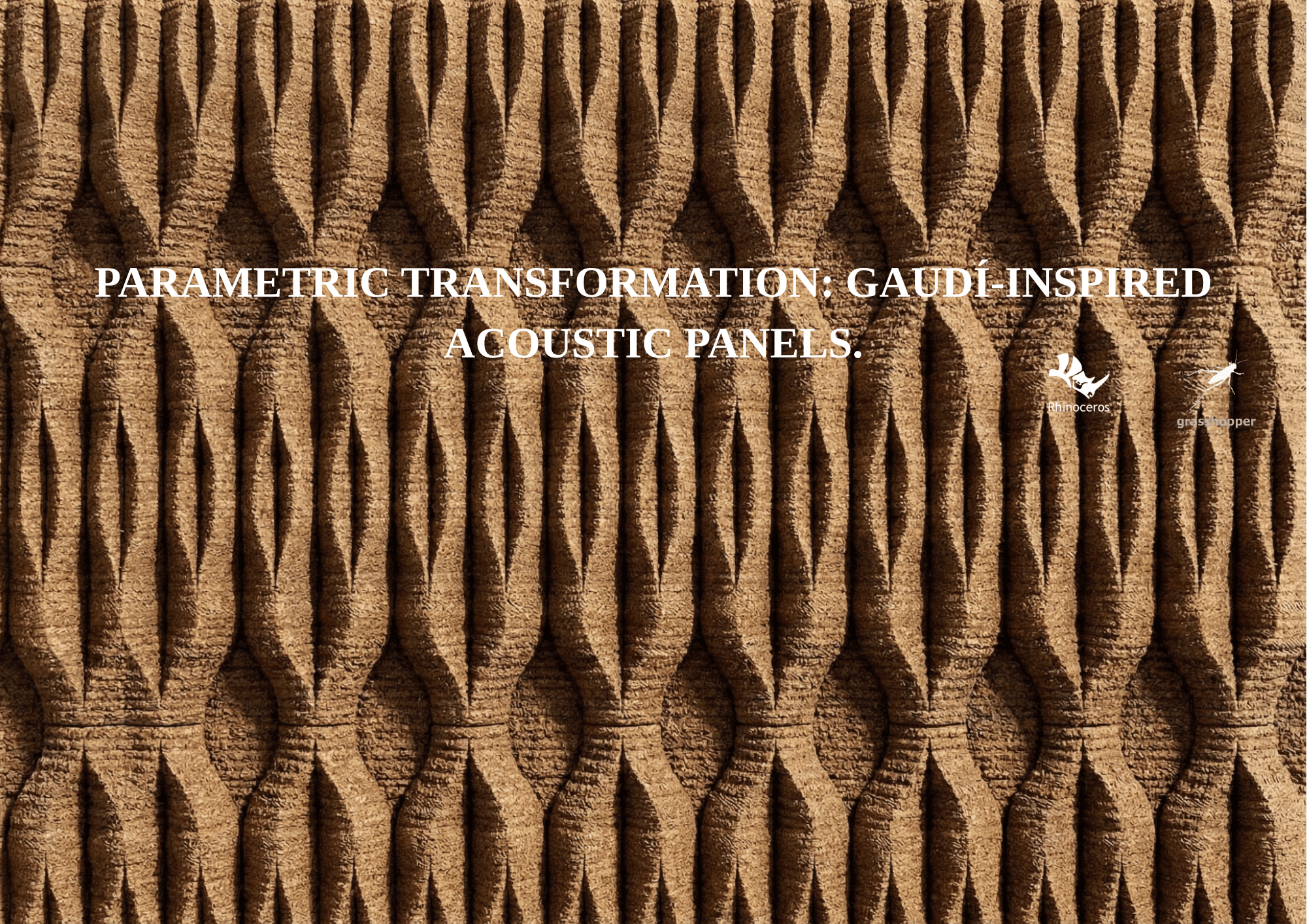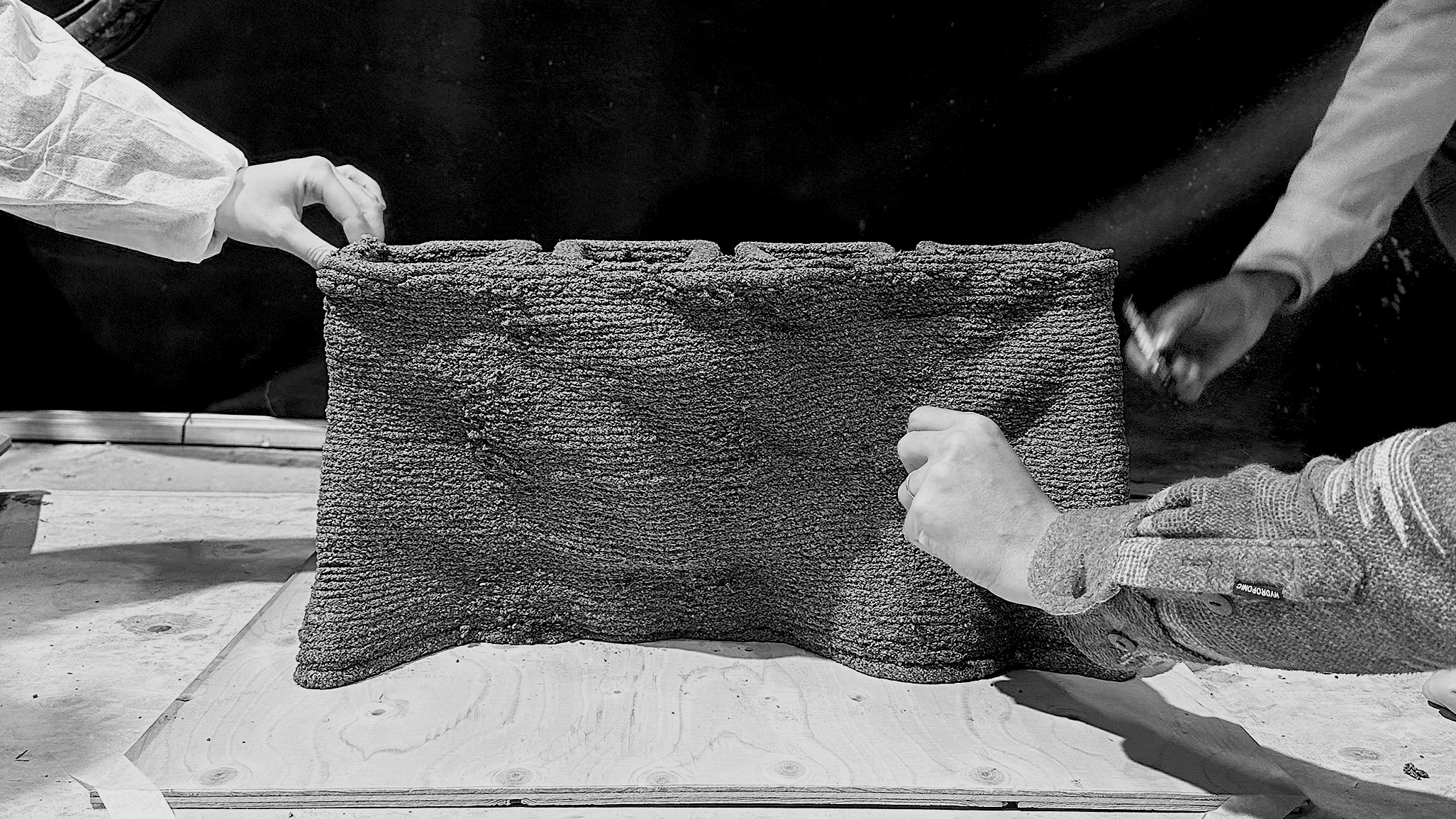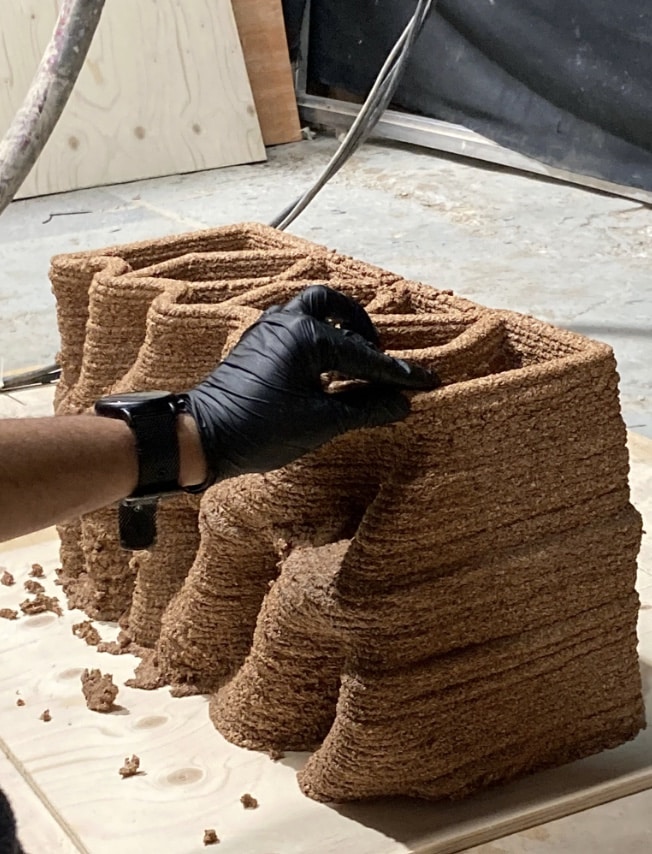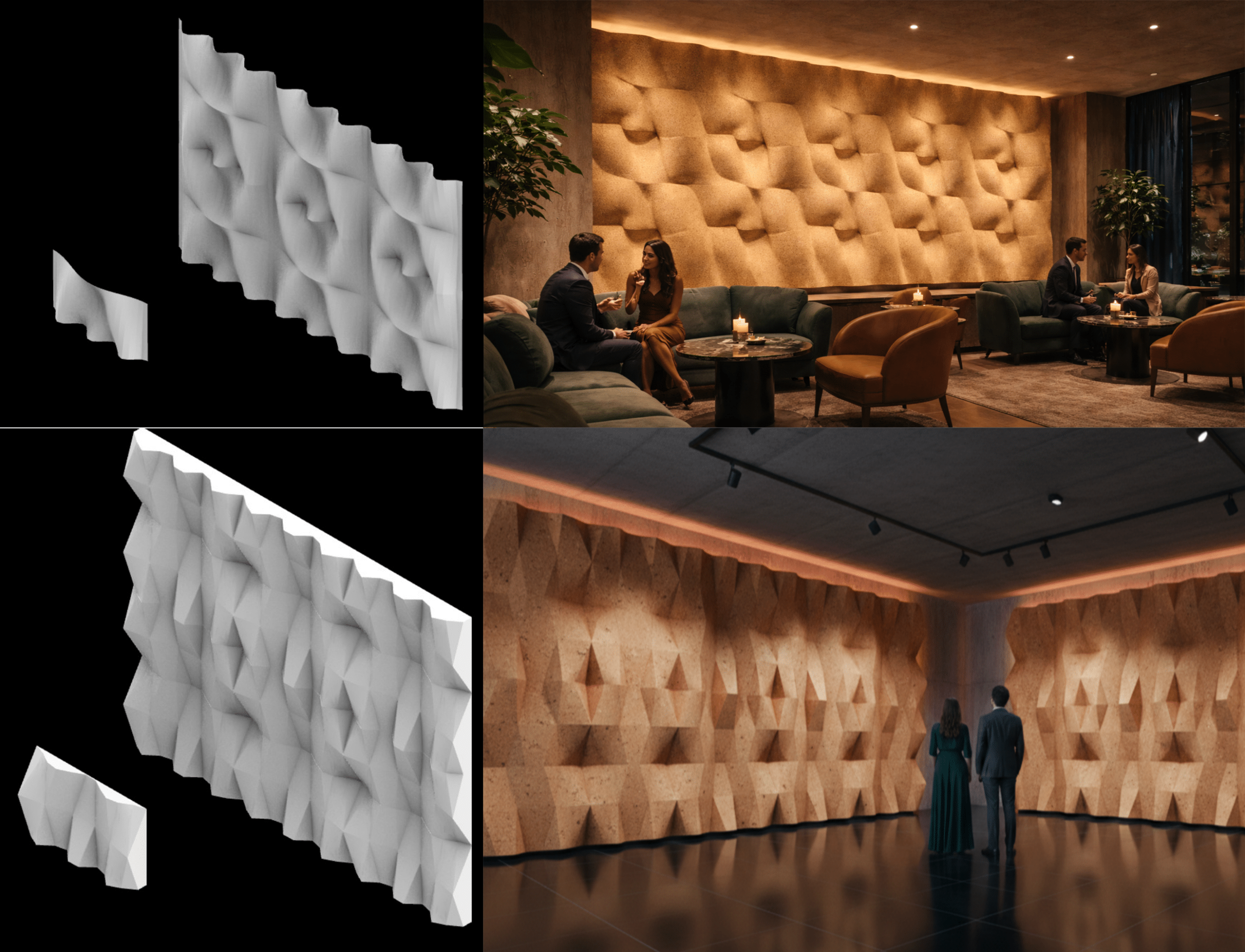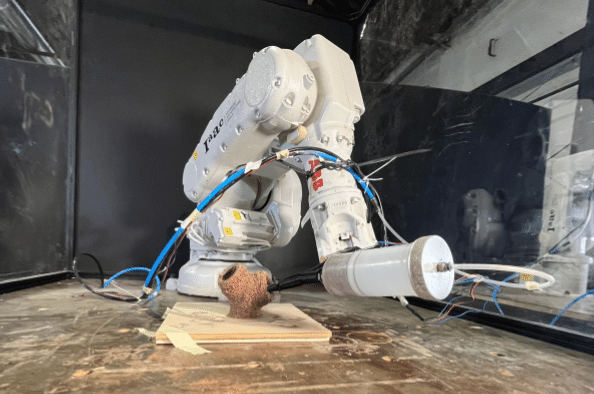
Credits: 2324 MAA01 Introduction to Robotics seminar, IAAC 2024
Buildings are currently responsible for 39% of global energy related carbon emissions: 28% from operational emissions, from energy needed to heat, cool and power them, and the remaining 11% from materials and construction (World Green Building Council, 2019). Modern buildings should operate with renewable energy and other technologies to ensure comfort while minimising the emission of carbon dioxide. Considering these significant reductions in operational energy, the focus is increasingly turning to embodied energy in the total sustainability assessment. In this context, additive construction offers tremendous potential, as it promises efficient material use (Dilenburger, 2022) and can provide new approaches to fabrication, beyond a single one, in a plethora of methods that respond to multi-layered skills in a building to answer various construction tasks and the individual local context.
The workshop invites students to explore new materials, additive processes and new fields of applications through robotic 3d printing, taking advantage of the potential of the 6-axes of the robotic arm. The introduction of robotic arms in additive manufacturing enables scaling up of three-dimensional (3D) and new path geometries. As a result, novel design potential is unlocked by having control over the layered configuration of paths in the object, and 3D printing becomes viable for architectural applications.
Building in this context, currently, the majority of large-scale 3D printing in architectural applications is carried out by cementitious printing and FDM printing with plastic materials. However, robotic printing explores the potential of using machines with five or more degrees of freedom by attaching the extruder or print base to a robotic arm opening the field of exploration to advanced possibilities and new biomaterials.
During the workshop, students will focus on the use of 3D Printing techniques with cork-based bio-composite materials from recycled stoppers, taking advantage of the great potential of this material and its innovative applications. Then, students will have the opportunity to develop a parametric system that exhibits a File-to-Factory workflow, capable of integrating fabrication constraints, robotic kinematics, assembly logics, and architectural goals. By the end of the workshop, students should propose a performative architectural facade system adapted to the robotic manufacturing of additive construction. The system will be evaluated on :
- Efficiency (ratio of used material vs waste)
- Stability (capacity to support self-load and external loads)
- Lightness (ratio of empty space vs material volume)
- Design (additional performance or strength)
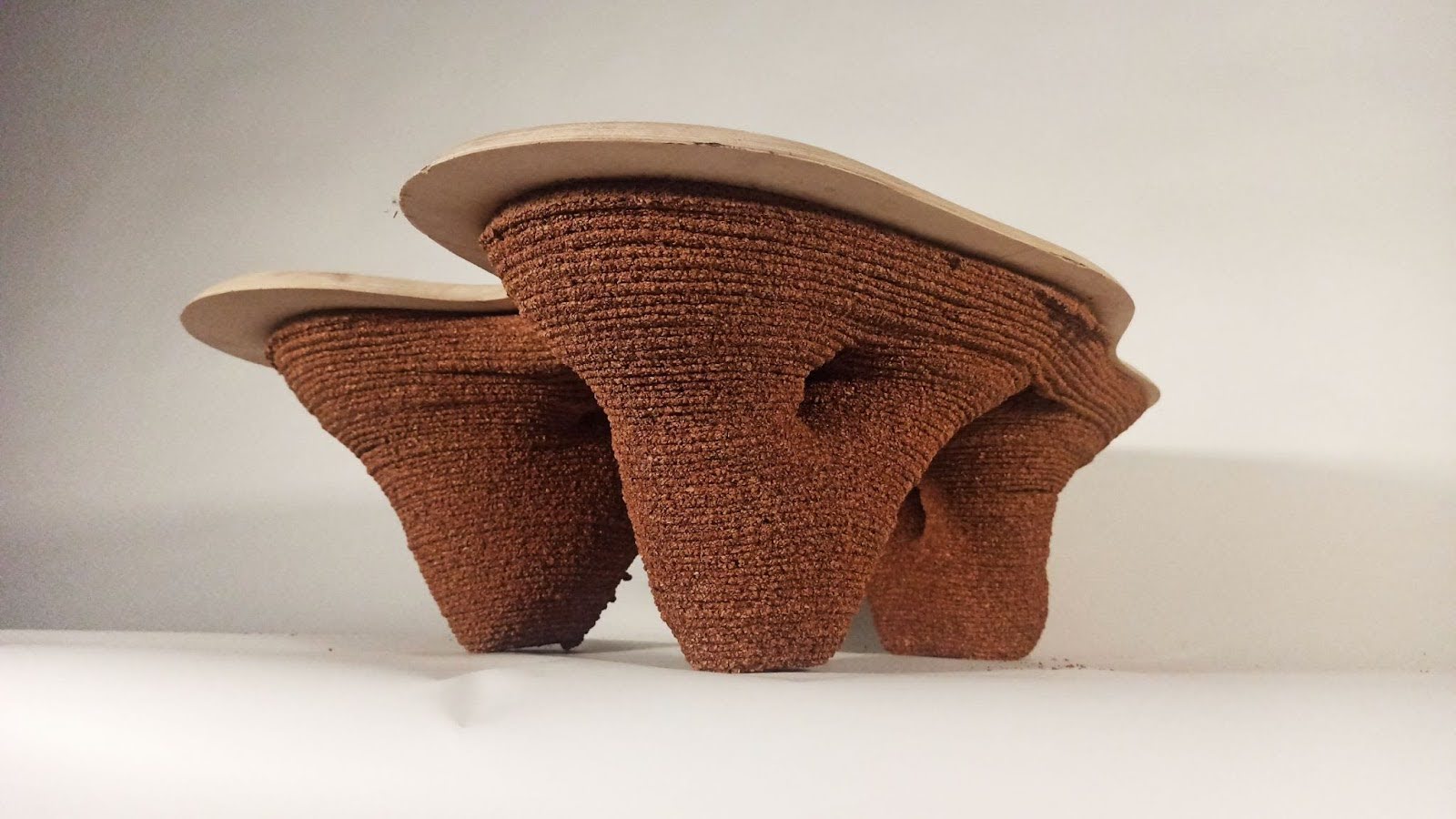
Credits: 2425 MRAC Additive Bio Manufacturing workshop, Optimized Table, IAAC 2024
Large Scale 3D Printing Workshop X CiD Innovation Alliance
This workshop is part of the Continuous Education Programme of the Circular Design Innovation Alliance (CiD), an Erasmus+ co-funded project by the EU Commission. CiD focuses on developing innovation in research and training in urbanism, architecture, and product and service design. Its key themes include a new vision of design within the circular economy, urban transformation towards climate neutrality, and bio-based innovation for the renovation wave. Through collaborations between 11 partners across Europe and institutions such as IAAC, Leibniz University Hannover (LUH), and University of Genoa (UNIGE), the project aims to redefine sustainable design education and research.
As part of CiD, this workshop contributes to a network of transversal learning activities, including contributions from both industry stakeholders and project partners, such as masterclasses on biomaterials led by Materiom, design-for-disassembly strategies, and career guidance sessions by ARCES with industry experts. Participants will get the chance to be part of the CiD European innovation ecosystem, exploring how digital fabrication and bio-upcycling can lead to regenerative architectural practices.
Learning Objectives
The objective of the workshop is to prototype, fabricate and explore new possibilities in material through robotic additive manufacturing. With an overview of the state of the art in the syntax of additive manufacturing geometries and its influence on material capabilities. Discuss the practical implementation of custom end effectors, and brainstorm to later produce the most performative model with this technology. At course completion, the student will learn:
- Understand the fundamentals of 3D printing, extrusion technologies, Robotic Manufacturing and their applications in architecture.
- Explore the potential of utilising bio and upcycled materials for sustainable architectural design.
- Gain practical experience in designing 3D printed facades through using 3D modelling tools, parametric design principles and digital simulation.
- Delve into material research and develop empirical skills in material preparation and testing.
- Understand holistic strategy for construction, including origins and life cycle of the materials/products, circular economy models, manufacturing, user-centric design and climate-responsive architecture.
- Have an overview of the possible robotic additive manufacturing processes available for architects and designers.
- Understand the basics of robotic kinematics, robotic simulation and robotic control.
- Communication between the ABB arm robot and the custom end effector.
- How to calibrate/adjust end-effector tools and possible modifications to them.
- Be capable of generating the robotic simulation and production files to produce a prototype.
- Be capable of integrating the limitations and opportunities of a specific robotics process into a final architecture design.