
Programme MAEBB 02 / MRAC 02 · 2024–2026 · Supervisor Valentino Tagliaboschi · Fabrication Sheikh Rizvi Riaz ·
Developed at IAAC Robotics Lab and Valldaura Labs , Barcelona
This article continues the framework introduced in Immutable Concrete, the earlier phase of this work, in which the gate becomes an instrument an agent can use.
The problem, restated
Recycled-aggregate concrete is difficult to design because its governing behaviour — the weak interfacial transition zone around every reused particle — is invisible to models trained on appearance. A predictor can return a recipe that reads as excellent and yet could never set.
When an intelligent agent is asked to design such a material, the failure mode is not a wrong sentence but a wrong structure. In language an error is corrected in a moment; in matter it is cast permanently. The question that motivates this work is therefore not how to make the model more confident, but what should be permitted to decide whether a mix will hold.
A gate, not a penalty
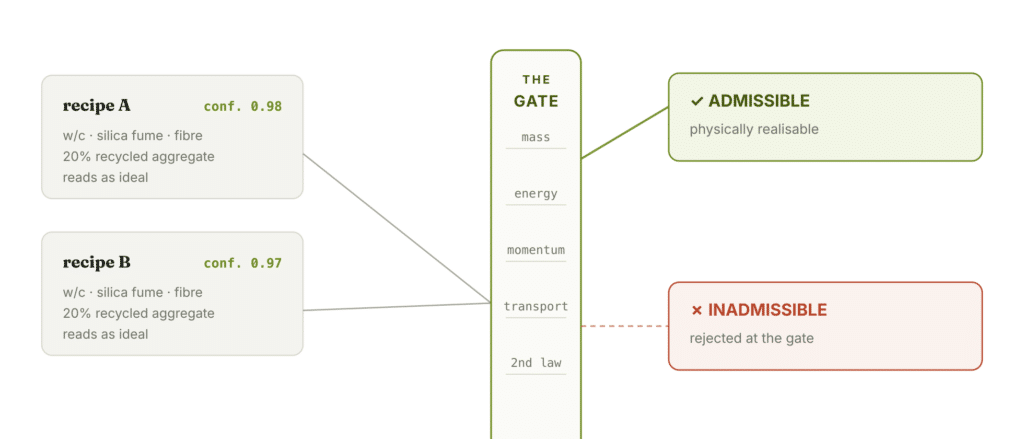
The material state is represented as a single differentiable vector spanning mechanical, thermal, chemical, electromagnetic and geometric quantities together with their history. Each conservation law is expressed as a barrier on this state, and the set of states that satisfy every barrier is the admissible set. A thermodynamic gate admits only its members.
Because the check is intrinsic to the representation rather than applied afterward, a physically impossible mix cannot be returned: admissibility holds by construction. Two recipes that a learned model rates as equally excellent can be separated by the gate, which keeps the one the laws allow and rejects the other.
Reading the fresh state cheaply
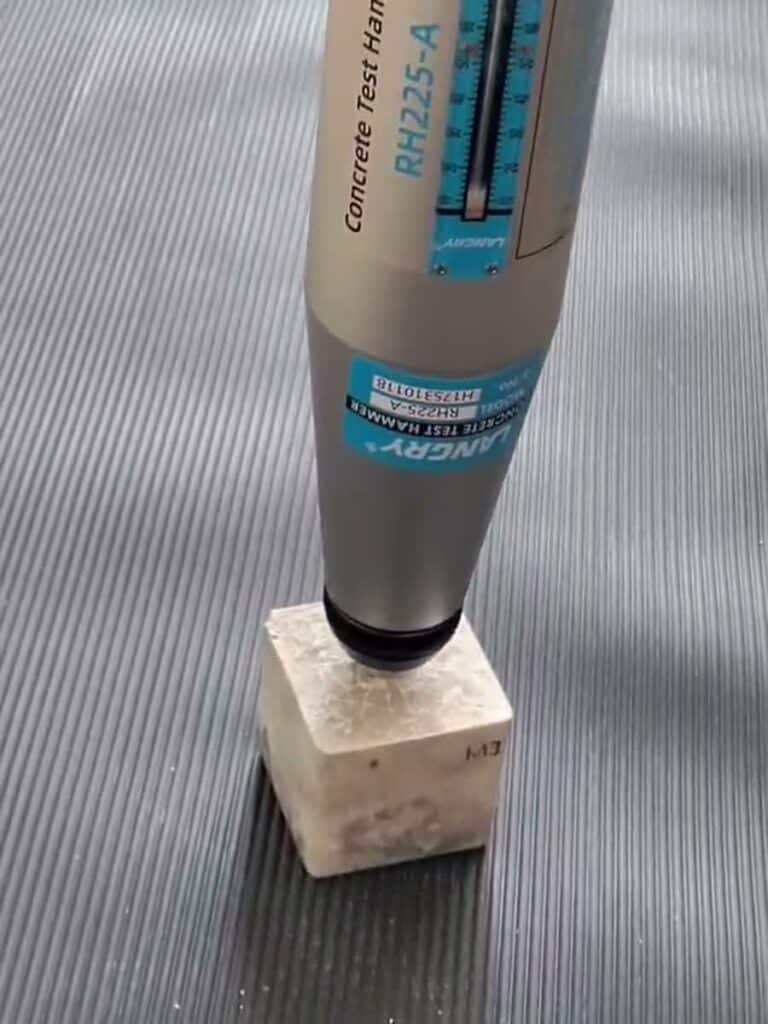
For the gate to guide an agent outside the laboratory, the material state must be observable without specialist instruments. Two proxies were calibrated for this purpose. Hardened strength is inferred from a rebound measurement together with a gravimetric reading; fresh behaviour is recovered as a Bingham fluid from an extrusion bead and a gravity-driven slug test — a workshop adaptation of Roussel’s low-cost rheometer.
Each proxy is ranked by the information it contributes, so that the cheapest sufficient reading is preferred. A bench campaign on retuned recycled-aggregate mixes provided the calibration data.
Searching the admissible set
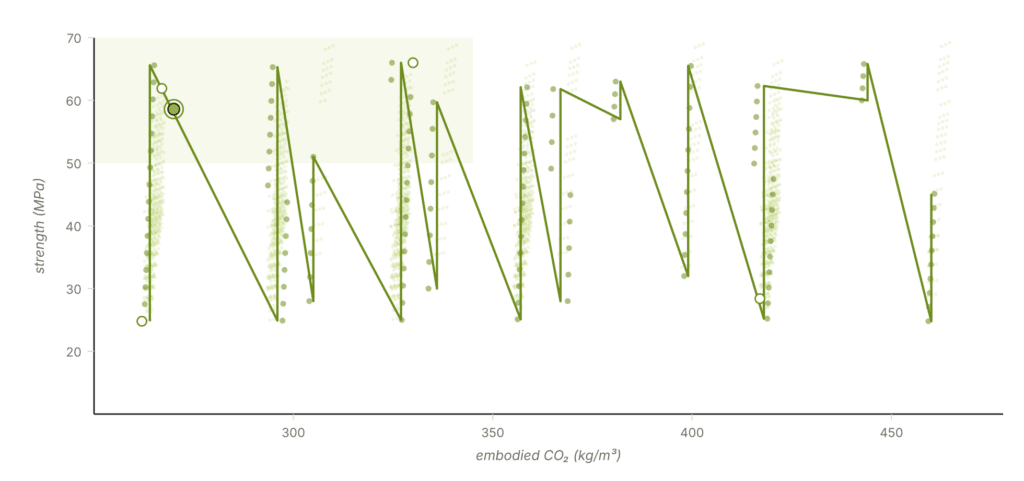
With the limits anchored to physical data, mix design is posed as a multi-objective search across seven material axes. Roughly thirty-eight thousand candidates were swept; the gate admitted about three-quarters and rejected the remainder, and the surviving non-dominated designs form a Pareto frontier read in three zones, from minimum-carbon to maximum-strength.
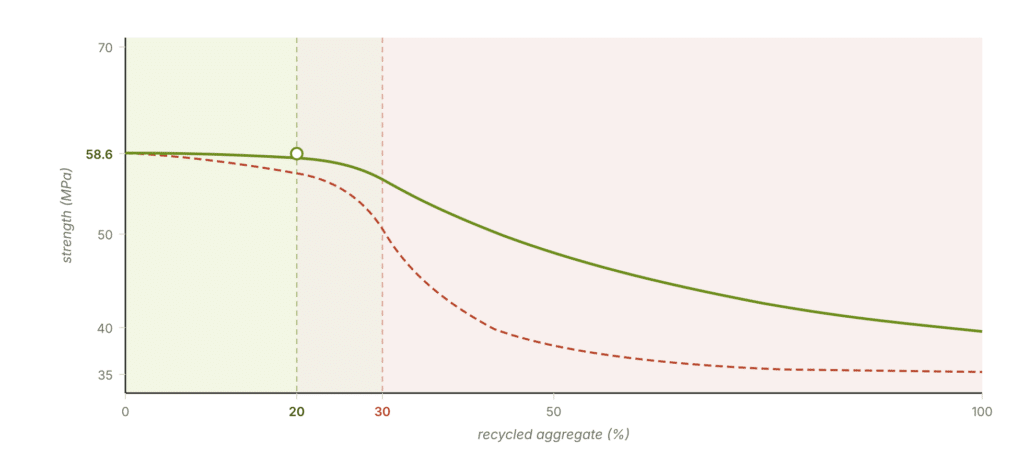
A derived limit emerged from the same search. Past approximately a thirty-per-cent replacement the interfacial transition zones percolate and durability collapses, which fixes twenty per cent recycled aggregate as a safe structural ceiling and explains why silica fume, by repairing the interface, extends it.
Absorbing new physics
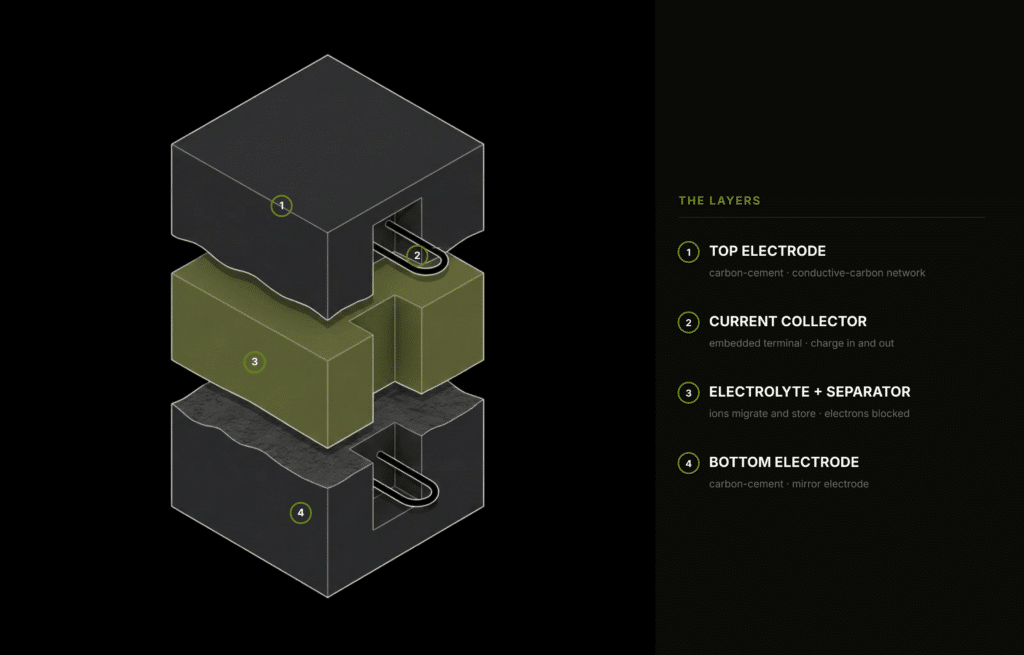
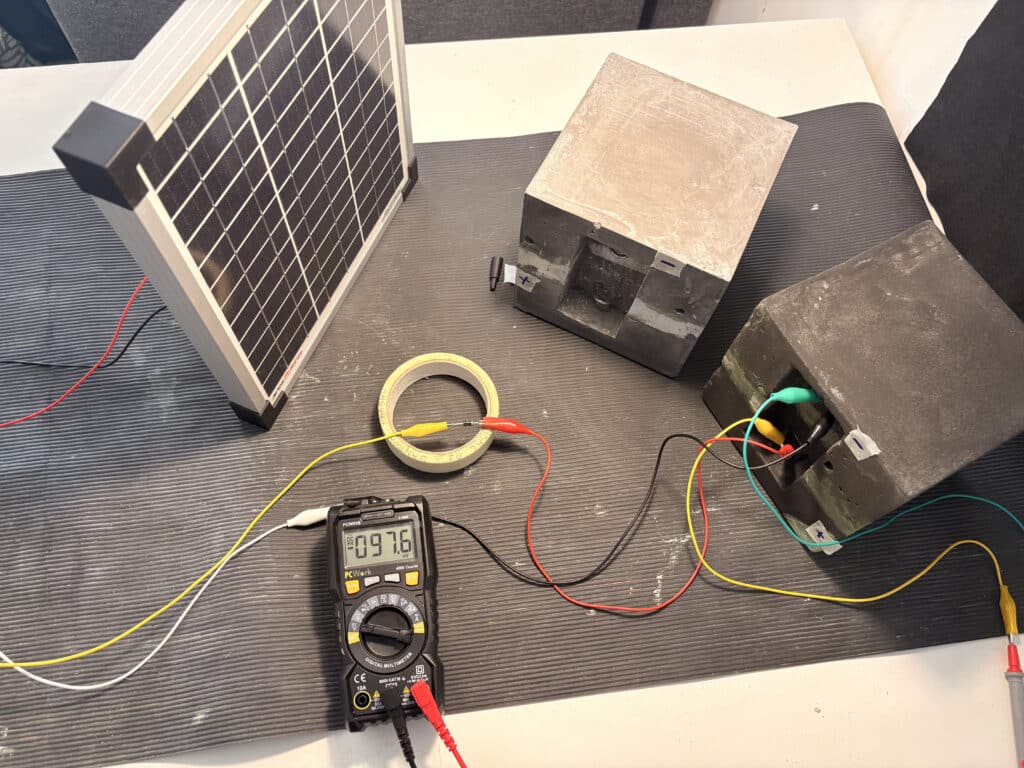
Because the representation is material-agnostic, a new science can be added as a cartridge of differentiable models rather than as a rewrite. A structural supercapacitor — a concrete that both carries load and stores charge — was modelled and cast as the first such addition.
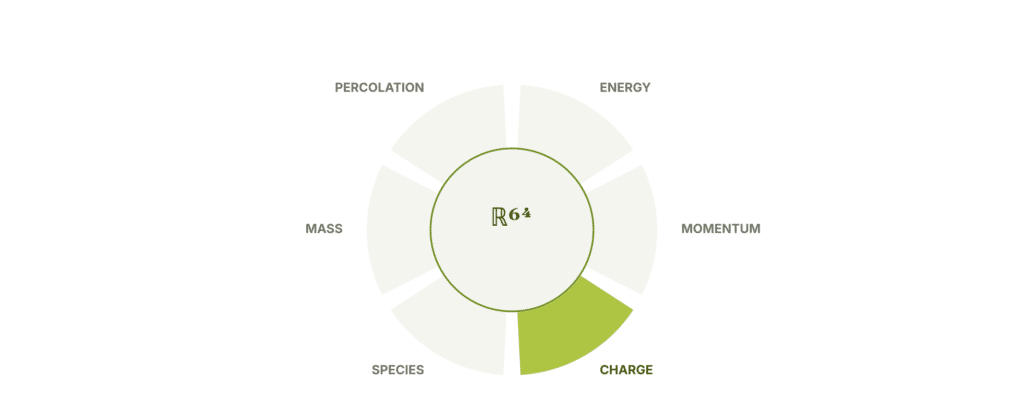
Introducing it surfaced a conservation law the concrete gate had never required, namely charge conservation. Once expressed as one further barrier, admissibility held again across the enlarged state space.
One model, three surfaces
The kernel is implemented in Rust and compiled to WebAssembly, so that the identical physics runs from a workstation to an embedded controller. It is exposed through three interfaces: a command-line tool for large dataset audits, a Python package for analysis and notebooks, and a stdio Model-Context-Protocol server through which an autonomous agent can request an admissibility check directly. The applied cartridge is open source at github.com/tytolabs/umst-concrete-cartridge, built on the state-and-gate kernel at umst-manifold.
Deployed on the robot
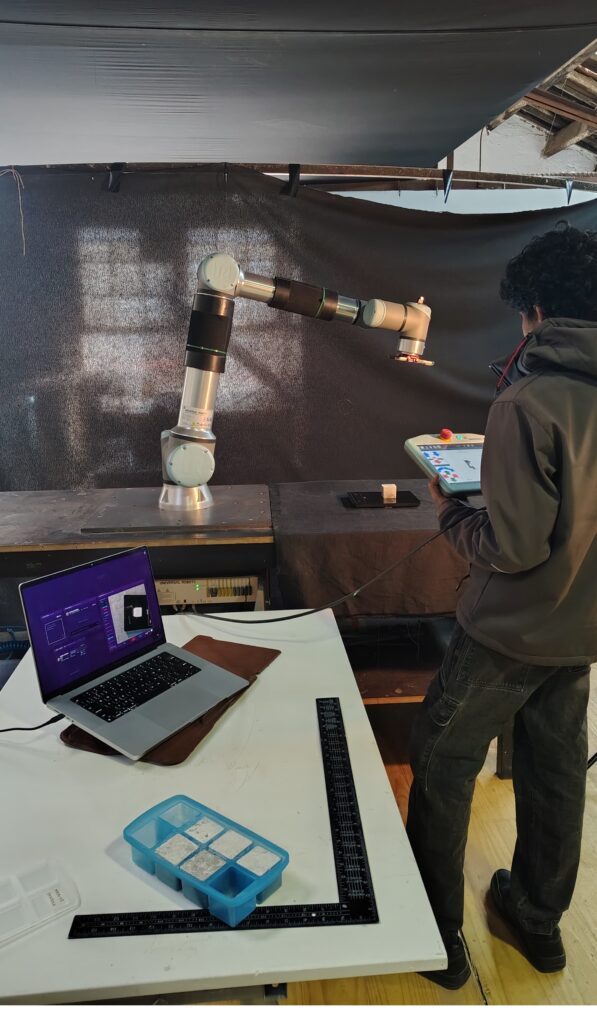
The same gate was carried to the IAAC Robotics Lab, where a natural-language instruction is compiled, through the admissibility check, into motion executed on a six-axis arm. Language proposes, physics disposes, and only an admissible action is performed — the gate operating identically in software and in matter.
Outlook
The result is not a faster predictor but a physics-safe substrate on which any intelligent material agent can be built: frugal enough for a low-resource plant, rigorous enough for a research laboratory, and open for others to extend. Only that a material’s physics be expressible as differentiable constraints is required, and the framework is therefore extensible beyond concrete.
Permanence, by construction.
Open Source Repositories
This work is open-sourced so that anyone at IAAC and beyond can use and extend the thermodynamic material agent:
- umst-manifold
The core state-and-gate kernel, representing materials as differentiable points bounded by conservation laws. - umst-concrete-cartridge
The concrete cartridge, containing the thermodynamic equations and physics to search the structural parameter space.
Machine-checked proofs written in Lean 4 verifying the framework’s mathematical foundation available, pinned to the repositories.
