Kontravoid is a virtual reality authentication environment developed as part of a thesis on data-driven architectural interfaces. The project uses real-time EEG, ECG, and EMG data to verify identity through continuous physiological patterns rather than static inputs. Within an immersive VR space, biometric signals dynamically influence spatial elements such as light, geometry, and sound, creating a feedback loop between body and environment. Authentication emerges as a temporal process based on signal coherence, reframing identity as embodied and continuously performed within responsive digital architecture.
Kontravoid is a virtual reality (VR) authentication environment developed as an extension of a broader thesis investigating data-driven architectural interfaces informed by physiological signals. The project explores how biometric data—specifically real-time EEG (electroencephalography), ECG (electrocardiography), and EMG (electromyography)—can be leveraged not only as passive inputs for adaptive environments but as active identifiers for user authentication. In this context, Kontravoid reframes identity verification as an embodied, continuous, and spatially mediated process, rather than a discrete, screen-based interaction.
Conventional authentication systems rely on externalized tokens—passwords, PINs, or devices—that are fundamentally detached from the body. Even biometric systems such as fingerprint or facial recognition operate as momentary checkpoints rather than dynamic processes. Kontravoid challenges this paradigm by proposing a model in which identity is verified through the user’s ongoing physiological state, captured and interpreted in real time. This approach aligns with the thesis’s broader ambition to position the human body as both the generator and validator of data within responsive architectural systems.
The VR environment serves as a testing ground for this concept, enabling the simulation of immersive spatial feedback loops between the user’s internal biological signals and external digital conditions. Within Kontravoid, users enter a controlled virtual space where their EEG, ECG, and EMG data streams are continuously collected via wearable sensors. These signals are processed and translated into a unique biometric signature that evolves over time, reflecting both stable identity markers and transient physiological fluctuations. Authentication is achieved not through a single input, but through pattern recognition across these overlapping data streams.
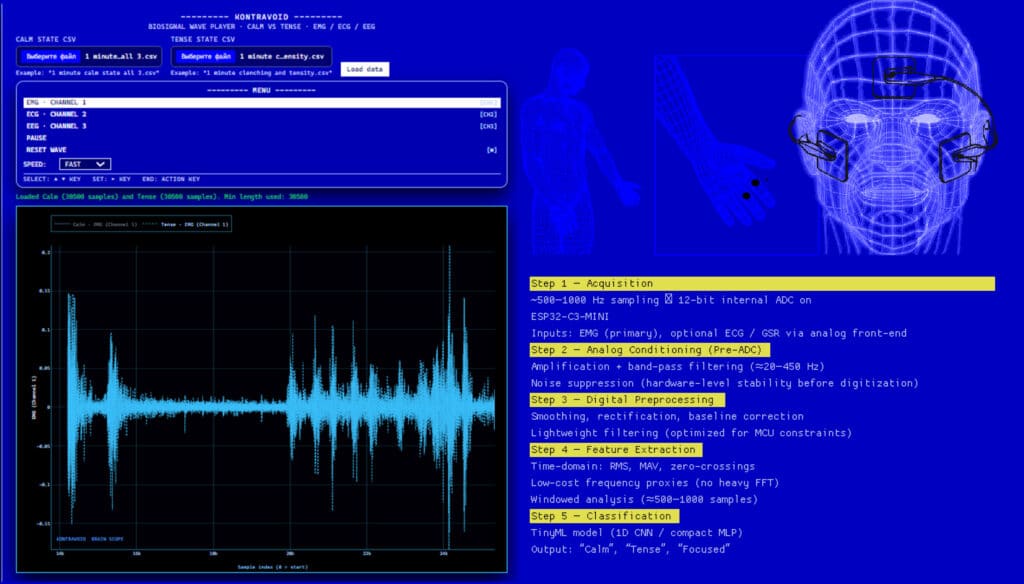
The design of the VR environment is intentionally minimal yet reactive, emphasizing perceptual clarity and data legibility. Spatial elements—such as light intensity, geometric deformation, and ambient sound—respond dynamically to the user’s physiological signals. For example, variations in heart rate (ECG) may modulate spatial pulsation, while muscle activity (EMG) influences structural tension or distortion within the environment. Brainwave patterns (EEG), associated with cognitive states such as focus or relaxation, drive higher-level transformations in spatial configuration. Together, these responses create a feedback system in which the user becomes acutely aware of their own biometric presence as a form of spatial agency.
Authentication in Kontravoid occurs when the system detects a sufficient match between incoming real-time data and a pre-registered biometric profile. However, unlike static biometric systems, this matching process is probabilistic and temporally extended. The system continuously evaluates signal coherence, stability, and interrelation across EEG, ECG, and EMG inputs. This introduces a threshold-based model of identity, where access is granted not at a single moment, but through sustained physiological alignment. As a result, authentication becomes an experiential duration rather than an instantaneous event.
A critical aspect of the project is its exploration of ambiguity and noise within biometric data. Physiological signals are inherently variable, influenced by emotional state, fatigue, stress, and environmental conditions. Rather than treating this variability as an error to be minimized, Kontravoid incorporates it into the authentication logic. The system distinguishes between acceptable ranges of fluctuation and anomalous patterns that may indicate a different user. This approach reflects a shift from rigid identity verification toward adaptive, context-aware recognition systems.
Technically, the project integrates real-time data acquisition through Arduino-based sensor systems, with signal processing pipelines that filter and normalize incoming data streams. These are then mapped into the VR environment using game engine software, enabling low-latency interaction between physiological input and spatial output. The synchronization of multiple biosignals presents both a challenge and an opportunity, requiring calibration across different temporal resolutions and noise profiles, while also enabling richer multimodal authentication.
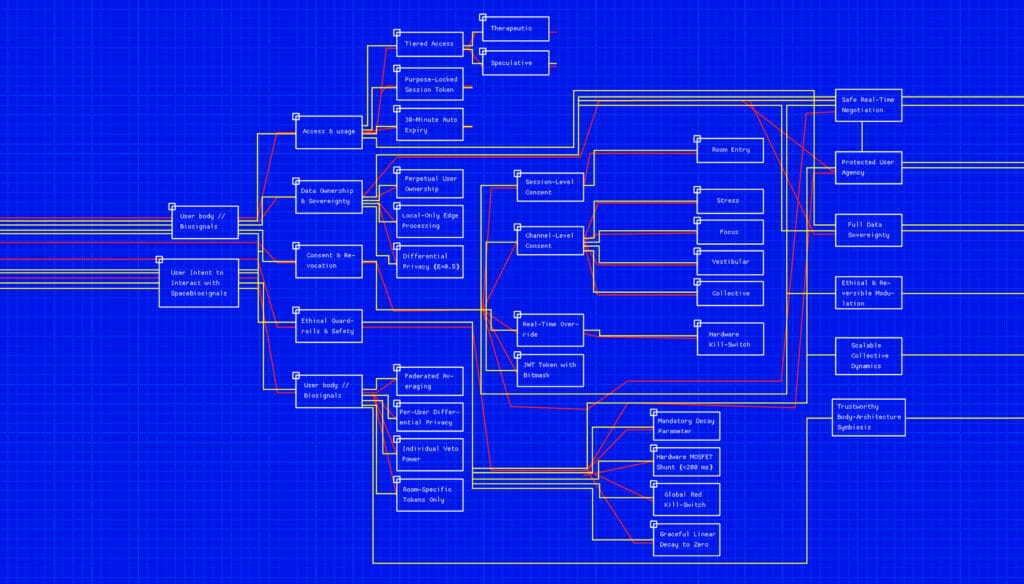
Beyond its technical implementation, Kontravoid raises broader questions about privacy, authorship, and the boundaries of the body in digital environments. By using internal physiological data as an authentication mechanism, the project foregrounds the intimacy of biometric information and the ethical implications of its use. At the same time, it suggests new forms of interaction where identity is not something entered or declared, but something continuously performed and sensed.
Within the context of the thesis, Kontravoid operates as a prototype that bridges speculative architectural systems and tangible user interaction. It demonstrates how VR can function as an intermediary platform for testing bio-integrated design strategies before their deployment in physical environments. Ultimately, the project positions authentication not as a security layer applied to architecture, but as an intrinsic property of spatial experience—where access, identity, and environment are co-constructed through the living data of the human body.