Abstract
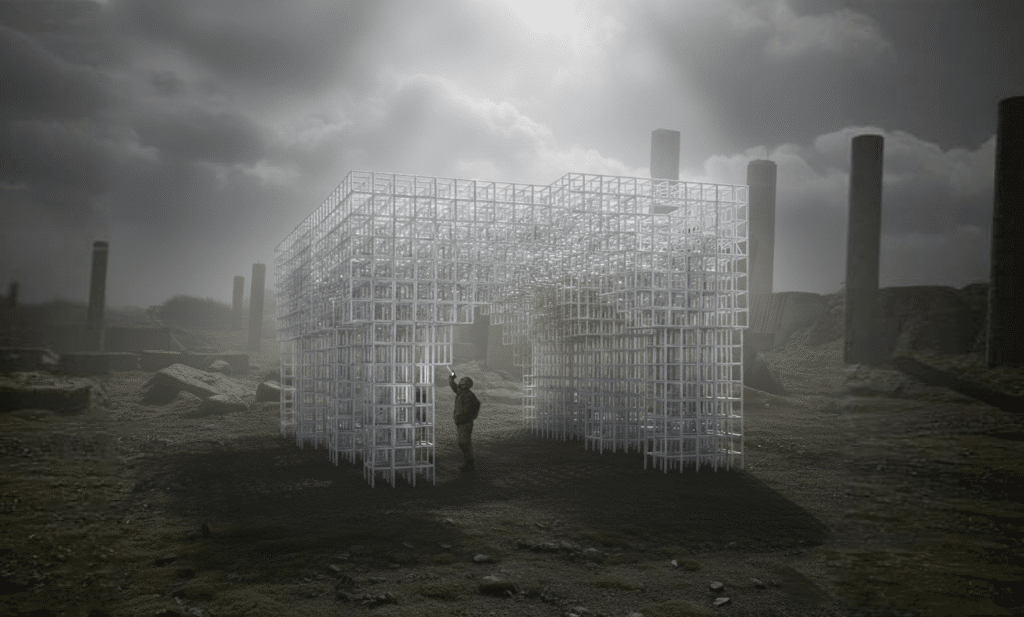
Architecture is often defined by mass, weight, and permanence. But what happens when we design for the memory of a building rather than the building itself?
Materia Assente explores the intersection of poetic parametric design and rigorous structural integrity. The project seeks to answer a complex question: How can we create a structure that feels like a “ghost”—evoking ancient forms—while maintaining the structural stability required for a real-world pavilion?
The Concept: Absent Matter
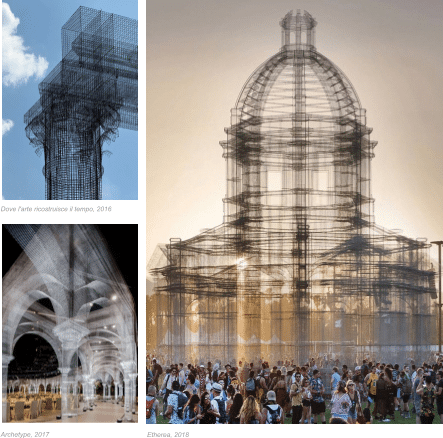
The core philosophy of the pavilion is “Absent Matter.” Rather than blocking the view with solid walls, the design utilizes complex lattice structures to reconstruct the volume of architectural forms.
The resulting wire mesh transparency acts as a filter for the surrounding landscape, allowing light and sky to interact dynamically with the geometry. While the concept is poetic, the execution is purely mathematical. Parametric tools were essential to optimize this lattice, translating an ethereal concept into a physical structural reality.
The Computational Workflow
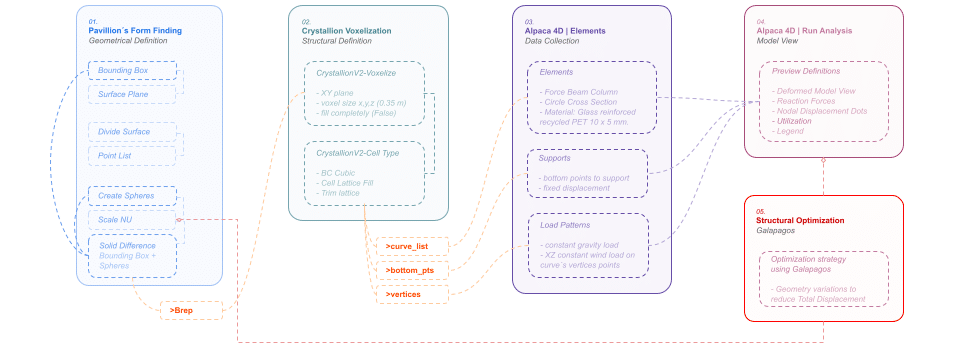
To achieve a balance between the visual “void” and structural stability, the design process followed a rigorous, five-step computational workflow:
- Form Finding: The process began by defining the initial volume and using Boolean operations to carve out internal spaces, establishing the “ghost” geometry.
- Voxelization: We utilized Crystallon to convert the solid geometry into a structural lattice. A “BC Cubic” cell topology was selected specifically for its stability within a voxel grid.
- Definition & Data Collection: The lattice was trimmed to fit the pavilion’s specific bounding box. We then defined the structural elements, identified support nodes, and applied load patterns.
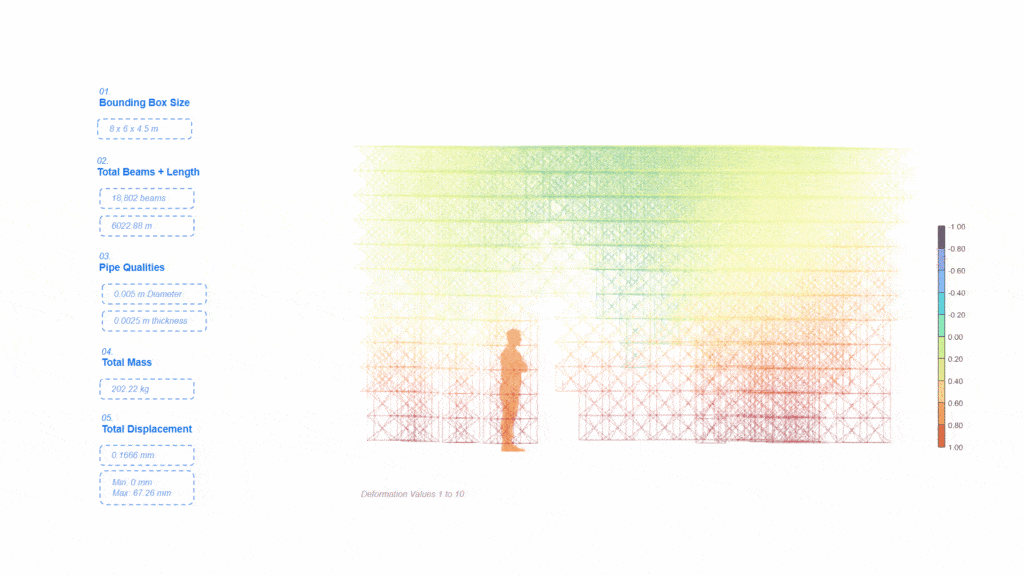
- FEA Analysis: We ran stress tests using Alpaca 4D to calculate the Deformed Model View and material utilization.
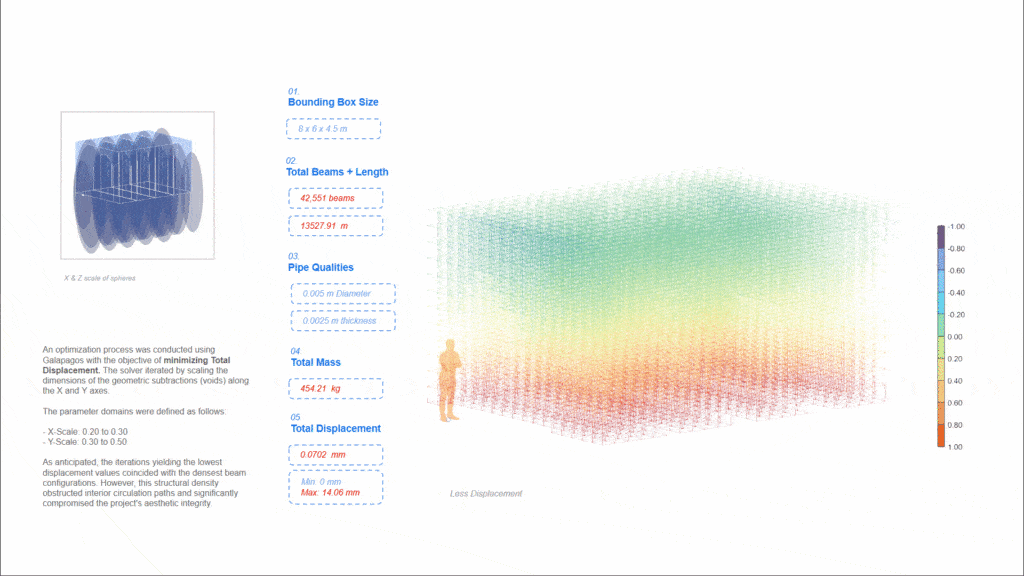
- Optimization: Finally, we employed Galapagos (an evolutionary solver) to refine the geometry and minimize displacement.

Materiality and Structural Elements
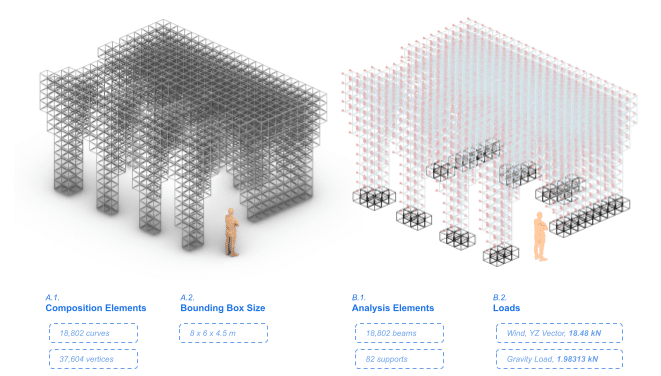
The structural analysis decomposed the complex geometry into a primary element model consisting of:
- 18,000+ Curves (Beams)
- 37,000+ Intersection Vertices (Nodes)
The Material Strategy To maintain the ethereal quality of the pavilion, we selected Glass Reinforced Recycled PET (5mm pipes). This material choice offers a high strength-to-weight ratio, aligning with the project’s ecological and aesthetic goals.
Structural Analysis: The Data
The pavilion is substantial in volume but incredibly light in mass. The geometry fits within an 8 x 6 x 4.5-meter bounding box. Despite containing over 6 kilometers of linear beams, the total mass of the structure is a mere 202.22 kg.
We subjected the model to combined forces:
- Gravity Loads: Derived from the structure’s self-weight.
- Wind Loads: Lateral forces applied to the lattice surface.
The Results The Finite Element Analysis (FEA) yielded promising results regarding the lattice’s rigidity.
- Global Displacement: The structure exhibited an exceptionally low total displacement of 0.16 mm.
- Peak Displacement: Under maximum load combinations, the maximum local displacement reached 67.26 mm.
Digital animations utilizing a color map (exaggerated by a scale factor of 10) allowed us to visualize exactly where forces were most intense, ensuring no specific node was pushed beyond its breaking point.
Optimization via Galapagos
The research did not end with the first successful test. We used Galapagos to run an evolutionary optimization process aimed at minimizing displacement by scaling the internal voids.
The Trade-off The optimization process highlighted a critical architectural trade-off:
- High Density: The densest lattice configurations were the strongest structurally.
- Spatial Quality: However, high density reduced interior circulation and blocked the transparency required for the “ghost” aesthetic.
The final design is a negotiated balance—sacrificing absolute maximum rigidity for the necessary visual lightness and interior habitability.
Conclusion
Materia Assente operates as a filter. It reconstructs the memory of architectural form without the burden of solid matter. Through advanced voxelization and evolutionary optimization, the lattice proves that a structure can be physically robust while remaining visually ephemeral.