Manja van de Worp
Director, YIP Structural Engineering | Faculty: MAA, MaCAD, MRAC
Manja van de Worp is a prominent structural engineer and the Director of YIP Structural Engineering London. With over 15 years of professional experience in the global construction industry, her work specializes in the synergy between structural geometry, advanced fabrication, and emergent technologies.
In 2013, she launched YIP, a consultancy bridging digital simulation and innovative fabrication through projects like FRP shells and modular steel roofs. Her leadership drives research into automated 3D-printed concrete, high-performance timber systems, and the structural integration of unconventional materials.
Manja spent significant time of her career at the Royal College of Art (RCA) in London, as a faculty in Structures and Technology and a Unit Lead for Technical Studies. During this tenure, she was focused on reshaping how structural design is integrated into the architectural curriculum. Her work at the RCA focused on bridging the gap between technical engineering requirements and creative studio design through an applied learning approach. By advocating for 1:1 physical prototyping and collaborative workshops, she enabled students to test structural logic and technical rigor directly within their architectural visions.
She is a core faculty member at IAAC across the MAA, MaCAD, and MRAC programs, Manja facilitates an applied learning approach that integrates technical rigor into creative studio projects. Her pedagogy emphasizes “Life Long” design strategies, focusing on circular construction for disassembly, 1:1 physical prototyping, and climate-responsive material research. Through these dual roles, she redefines the structural engineer as a vital collaborator at the forefront of sustainable architectural design and robotic fabrication.
Transcript of the guest lecture at IAAC on 21st April 2026 by Amaro Donoso, Leonard Elias Böker, and Subha Tahsin Saba.
In this insightful lecture, Manja van de Worp discusses her diverse background in architecture, structural engineering, and emergent technologies. She provides a comprehensive overview of her educational journey from technical universities in the Netherlands to computational design at the AA School of Architecture in London. Key topics explored include structural geometry and fabrication, the role of structural analysis tools, and the innovative application of advanced materials like 3D printed concrete and timber. Furthermore, she delves into leadership roles at prestigious institutions like Arup London and the Institute for Advanced Architecture of Catalonia (IAAC), highlighting a strong focus on sustainable and circular construction practices. Through detailed project examples, Van de Worp illustrates her commitment to redefining the traditional role of the structural engineer, pushing the technical and environmental boundaries of modern architecture. This thought-provoking presentation offers invaluable insights for aspiring professionals and established experts alike.
[Question 1] Assembly Tolerances in Design Process
“During the design and fabrication phases, when and how do you integrate assembly tolerances into the structure? At what point in the process do these tolerance considerations become part of your structural design – and how do you balance this with structural optimization?”
Manja van de Worp’s Response:
Assembly tolerances should be integrated as early as possible in the design process. It’s crucial to consult with contractors early on to identify key problems before they become issues on site. This early collaboration helps balance structural optimization with practical buildability.
[Question 2] Process Logic vs. Material Logic in Robotic Fabrication
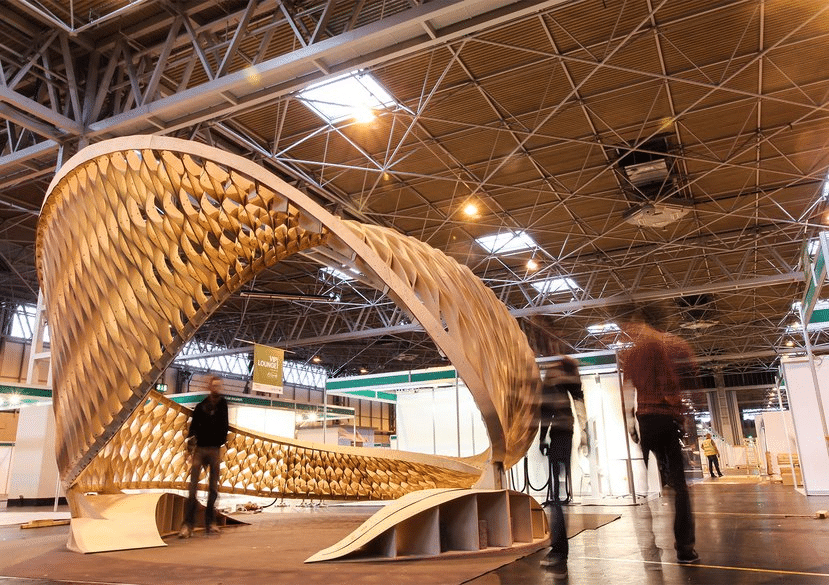
“You mentioned the example of robotic fabrication where full panels are cladded and windows are cut out afterward, versus using reclaimed smaller panels from the outside. How do you weigh the importance of different process logics – machine/time efficiency versus material efficiency versus human/building needs? Where should the priority lie in contemporary fabrication practice?”
Manja van de Worp’s Response:
For me, it’s about pushing the question: “What can the material do?” I want to explore the possibilities of reused materials – it’s an ideological push. Rather than defaulting to machine efficiency, we should be asking what’s possible with the materials we already have and designing our processes around material potential.
[Question 3]
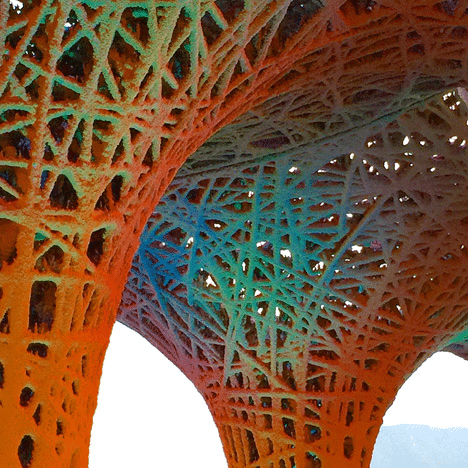
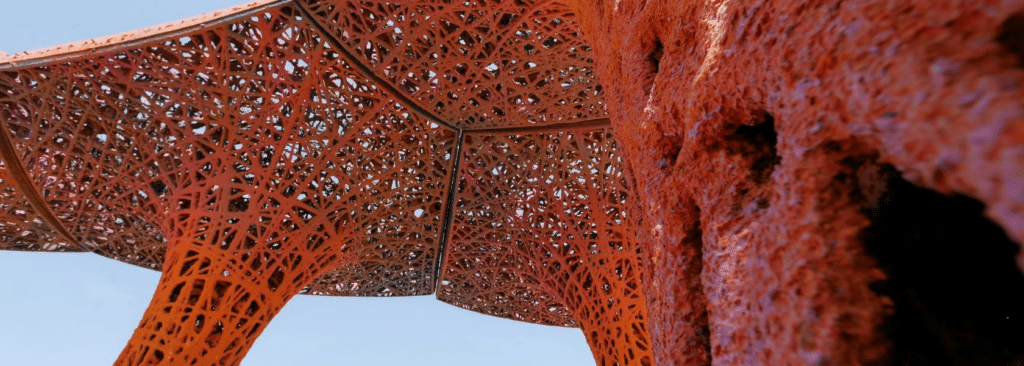
The Coachella project involved spraying strings with a mixture of paper pulp and other additives. How did you ensure the sprayed amount remained consistent, and were there specific parameters set for the accumulation of the mixture in certain areas?
Manja van de Worp’s Response: Maintaining consistency during the spraying process is quite challenging because, without visual aids like color-coding, it is nearly impossible to track exactly how many layers have been applied or the precise thickness at any given point. To address this uncertainty, we rely on structural testing after the fact to validate our assumptions. We check if the manual application methods actually meet the required performance standards. While spraying is less predictable, transitioning to a robotic printing process would be much more accurate. Printing allows for far greater control over the positioning, the exact amount of pulp applied, and the resulting thickness, directly linking material deposition to intended structural performance.
[Question 4]
Did the sprayed mixture compound function as a structural component once it was applied to the strings?
Manja van de Worp’s Response:
The mixture is designed to contribute to the structural behavior of the system by acting essentially as a shell, but its effectiveness depends entirely on the drying process. A major challenge with paper pulp is that it is difficult to dry if the application is too solid. The exterior often dries first and seals the moisture inside, which prevents the core from ever fully hardening.
In the Coachella project, the open nature of the string network allowed the pulp to dry more effectively than a solid wall would. To ensure it works as a structural component, the material must be applied in manageable layers to allow each to dry before adding the next, or used in a geometry that promotes airflow. Ultimately, the performance is a result of the relationship between the thickness of the “skin” and its ability to fully cure and harden.
[Question 5] In composite systems such as this paper-pulp and string pavilion, how can we determine the structural relevance of the pulp in relation to the textile reinforcement, and how do we define how much material is actually needed?
Manja van de Worp’s Response: Material quantity should not be defined intuitively, but through mechanical testing. To understand the structural contribution of the pulp, compression and bending tests are required in order to identify the load-bearing capacity of a given cross-section. These tests reveal how much load the system can withstand before failure and how it deforms under stress, establishing the relationship between load, stiffness, and deflection. Based on this data, it becomes possible to estimate the minimum thickness or volume required. At the same time, it is important to question whether spraying is truly the most appropriate fabrication method. Rather than assuming a process by default, alternative strategies: such as dipping, dripping, or pre-impregnated textile fabrication should be explored to determine which best suits the material behavior and construction context.