lux.ai
Lux.Ai: a specialized toolset built for the IFCore platform. Our mission is simple: to transform static BIM models into active solar energy assets by automating compliance and yield auditing
The MAA is a visionary master program with an innovative and open structure, mixing diverse disciplines, shaping professionals capable of producing theoretical & practical solutions towards responsive cities, architecture & technology.
Lux.Ai: a specialized toolset built for the IFCore platform. Our mission is simple: to transform static BIM models into active solar energy assets by automating compliance and yield auditing
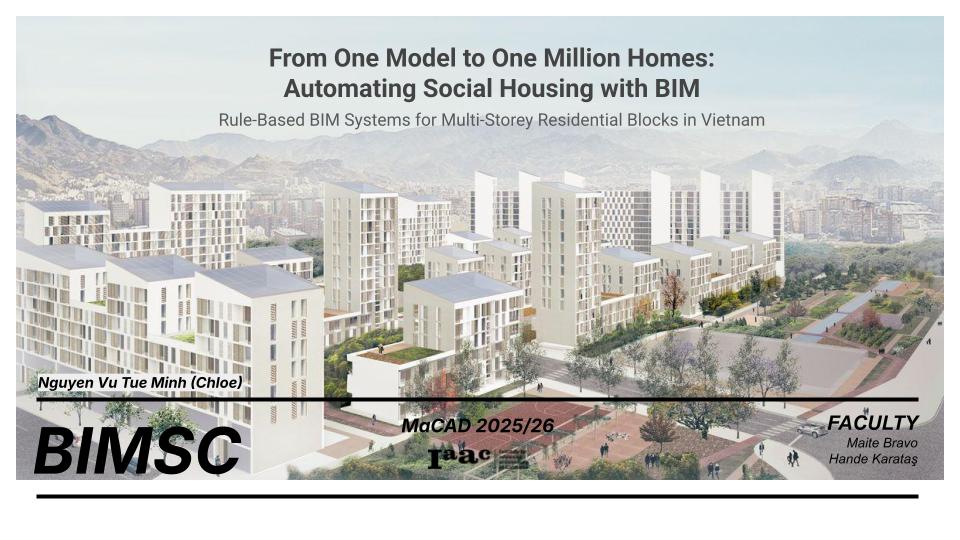
Rule-Based BIM Systems for Multi-Storey Residential Blocks in Vietnam Using rule-based BIM master models to automate repetitive social housing design in Vietnam, while addressing real-world challenges of coordination, adoption, and collaboration across large-scale public projects. //CONTEXT Vietnam currently has an ambitious national target to build one million social housing units by 2030. However, progress … Read more
AI Theory – IAAC | Group Project by Jinesh, Rafik, Chun Chun, and Vimal The construction industry is responsible for a massive chunk of global carbon emissions, material extraction, and waste. But here’s the thing: even as sustainability becomes more important, demolition is still the go-to solution for most projects, often without anyone really asking … Read more
Introduction Urban traffic congestion is more than just an inconvenience—it’s a global challenge tied to pollution, stress, and wasted time. While cities are turning to AI-driven systems to ease the gridlock, the question remains: Do these technologies actually perform better than traditional methods?Flow – SIGHT is a comparative research project that investigates traffic systems across … Read more
ABSTRACT; Decoding Urban Mobility: This project evaluates the impact of AI-driven traffic management versus conventional fixed-timing methods on urban congestion. It analyzes real-time and historical data—including traffic patterns, weather, demographics, and incident reports—from cities like London, Barcelona, and Los Angeles and compares machine learning models (e.g., LSTM, GRU, XGBoost) with traditional techniques. The study identifies … Read more
Abstract Digital twins are transforming architecture, urban planning, and infrastructure management by creating intelligent, data-driven replicas of physical assets. These virtual models integrate real-time sensor data, predictive analytics, and AI to optimize performance, streamline decision-making, and enhance sustainability. In this podcast, we explore the evolution of digital twins with guest Karla Saldano, an expert in … Read more
Located in the quiet community of Sant Adria De Besos lies the Besos Power Station. This waste to energy power plant is responsible for providing power to over 10 municipalities of Spain and takes care of nearly half of the waste that comes into Barcelona. While this factory proves to be highly effective, several negative … Read more
Introduction: Transforming Urban Junctions for a Sustainable Future Urbanization has drastically increased impervious surfaces in cities, leading to environmental challenges such as urban heat islands, stormwater runoff, and reduced access to green spaces. Junctions and intersections, often overlooked, are some of the most impervious and environmentally stressed areas in urban landscapes. This project aims to … Read more
1.0 Concept In the evolving landscape of urban development, property rates are influenced by numerous factors, including geographical, socio-economic, and infrastructural elements. Our project, “Urban Insights: Leveraging Open Data for Smart Property Rate Predictions,” aims to create an intelligent, data-driven model to forecast property rates. This model utilizes features such as wards, property types, and … Read more
The whole AEC industry is challenged by the high CO2 footprint caused by the increasing population and construction. Introducing regulations to the construction industry is a solution to reduce CO2 footprint. The workflow behind Leed mini consultant goes as follows: starting with gathering the regulation in a dataset and setting it up, training a rag … Read more
Project goal For our graph Machine Learning project we chose to work with the city of Copenhagen. Our goal was to predict the Road Noise in the city. Dataset and data preparation From the KOBENHAVNS OPEN DATASET, we obtained a dataset detailing road noise levels across Copenhagen. To fill in the gaps where data was … Read more