
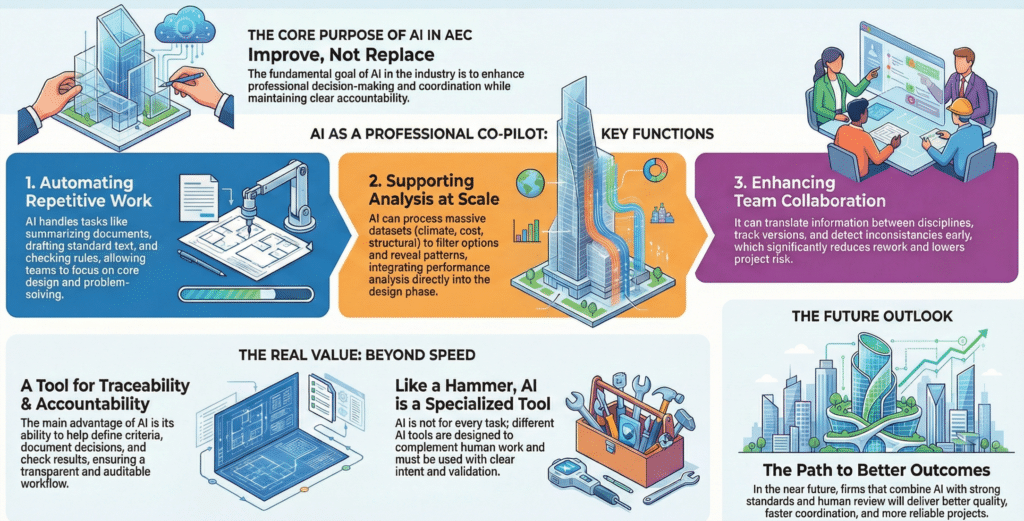
In AEC, the purpose of AI is not to replace architects or engineers. The purpose is to improve decision-making and coordination, while keeping clear responsibility.
In AEC, the purpose of AI is not to replace architects or engineers. The purpose is to improve decision-making and coordination, while keeping clear responsibility.AI can be seen as a professional co-pilot.
First, it helps with repetitive work: summarizing documents, drafting standard text, checking rules, and organizing information. This saves time so teams can focus on design intent and problem solving.
Second, AI supports analysis at scale. Projects generate large amounts of data: climate files, daylight and comfort studies, structural outputs, costs, and constraints. AI can filter options and highlight patterns, so performance is used during design, not only at the end.
Third, AI supports collaboration in a multi-agent industry. It can help translate between disciplines, track versions, and detect inconsistencies earlier. This reduces rework and lowers project risk.
The main change after this course and conversations with AI professionals is that AI is not only about speed. It is about traceability and accountability: defining criteria, documenting decisions, checking results, and using AI ethically. Like a hammer, AI is not for every task; different AI tools complement human work when they are used with clear intent and validation.
In the near future, firms that combine AI with strong standards and human review will deliver better quality, faster coordination, and more reliable outcomes.
In the near future, firms that combine AI with strong standards and human review will deliver better quality, faster coordination, and more reliable outcomes.
