

The project Reviving Bab Al-Louq explores the relationship between historical urban fabric and contemporary architectural intervention through the notion of contrast. Rather than replicating or mimicking the existing historical language, the proposal aims to create a clear spatial and material distinction that enhances the perception of the existing structure while introducing a new architectural layer.
Upon entering the building from the historically rich street, the design intends to create an immediate sense of spatial transition. This is achieved by positioning commercial units along the long edges of the building, which defines a large multifunctional open space at the center. This central space is conceived as a flexible public interior.

In its contextual reading, the project emphasizes the deliberate contrast between the historic building and the contemporary lattice structure. Rather than overpowering the existing fabric, the intervention sits lightly upon it, reactivating the building through spatial continuity, vertical movement, and material contrast. In this way, Reviving Bab Al-Louq proposes a strategy for architectural transformation that respects history while enabling new forms of urban life.

Aerial View, enhanced with AI.
Form Finding: Panelisation & Kangoroo & Scale

The existing structural system of the building is preserved as a primary architectural element. Alongside it, a new architectural axis is introduced to generate a contemporary spatial narrative. At the base of the newly generated roof surface, a hexagonal cellular system is applied in order to reinforce the contrast between old and new. These hexagonal units are parametrically scaled using an attractor curve, allowing the pattern to respond dynamically to spatial conditions. The resulting geometry is then projected onto the surface using a map-to-surface method, forming a continuous panelized system.
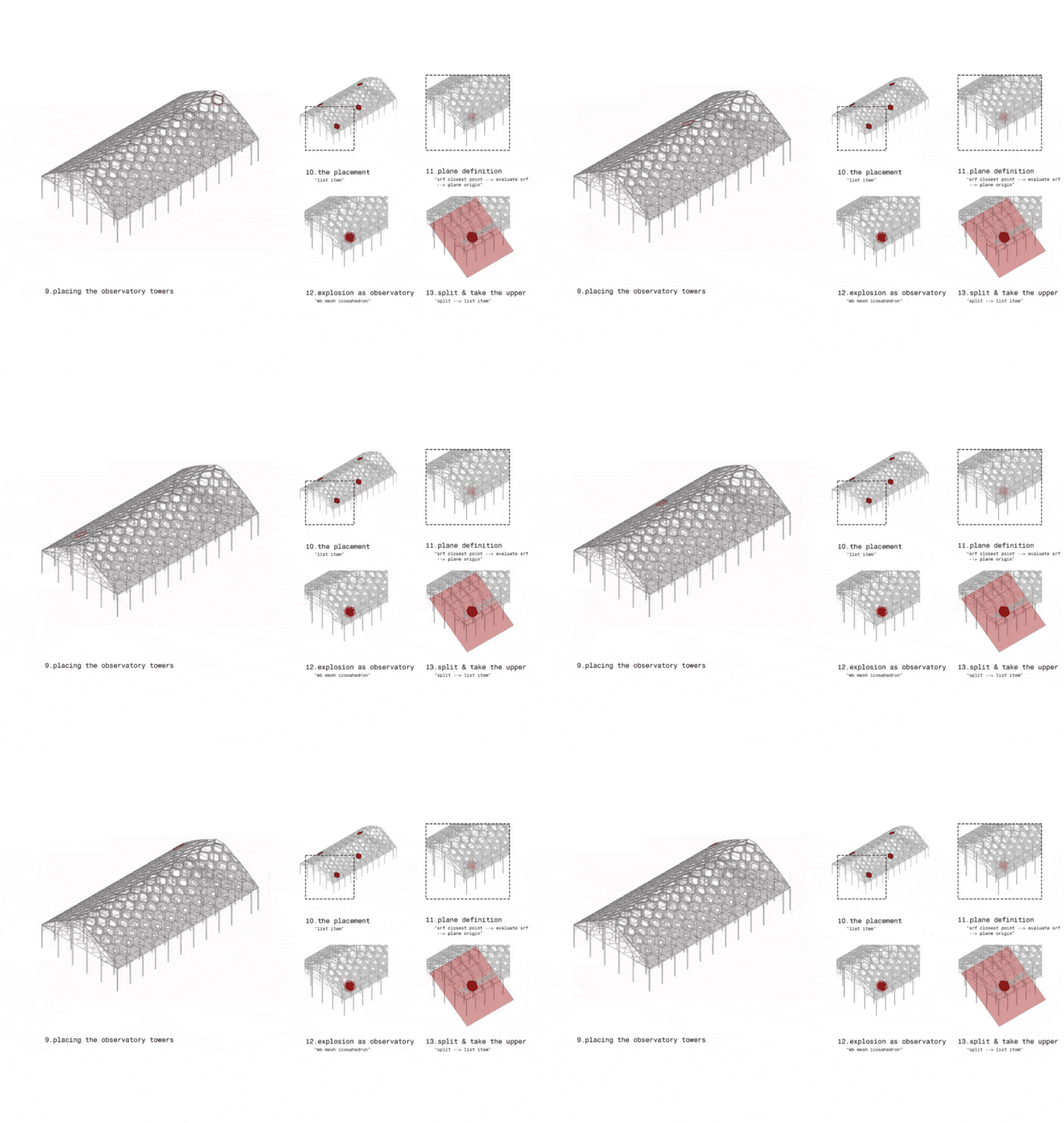
A key design objective of the project is to extend circulation vertically from the interior of the building up to the roof level. To ensure continuity, specific vertical connection points are defined within the structure. At these points, observatory towers are introduced as architectural elements that guide movement while acting as spatial landmarks. These towers transform selected surface panels into volumetric forms, establishing visual and physical connections between different levels of the building.
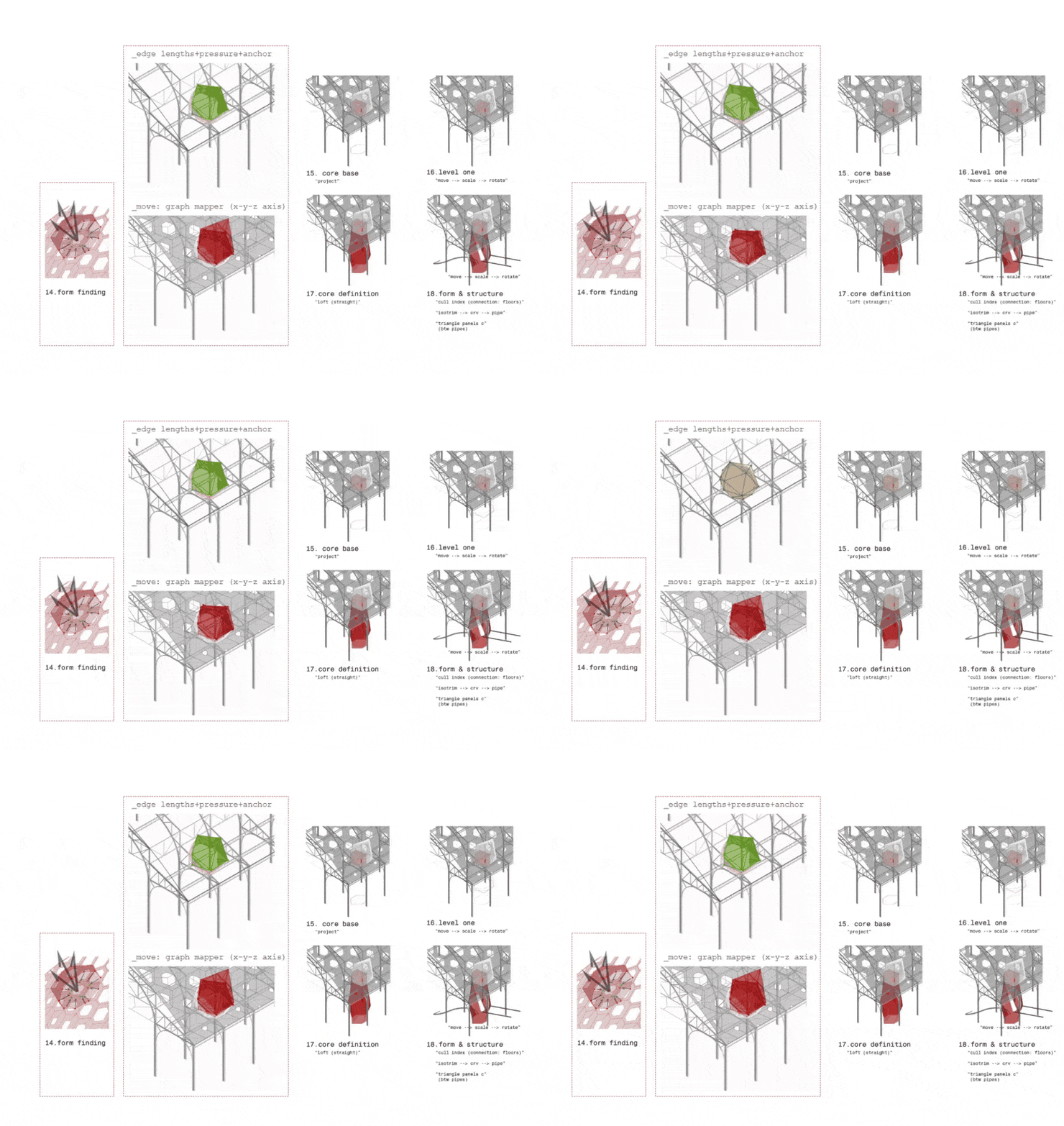
The form of the observatory towers is generated through a computational form-finding process. Using a Weaverbird mesh icosahedron, the upper parts of the geometry are extracted and further manipulated through Kangaroo physics simulation. Pressure, edge length, and anchor constraints are applied as primary goals. In this system, naked mesh points function as anchors, while the hexagonal cell points act as target positions. Following the simulation, the geometries are refined through controlled scaling and directional movement to enhance spatial orientation and visual emphasis.

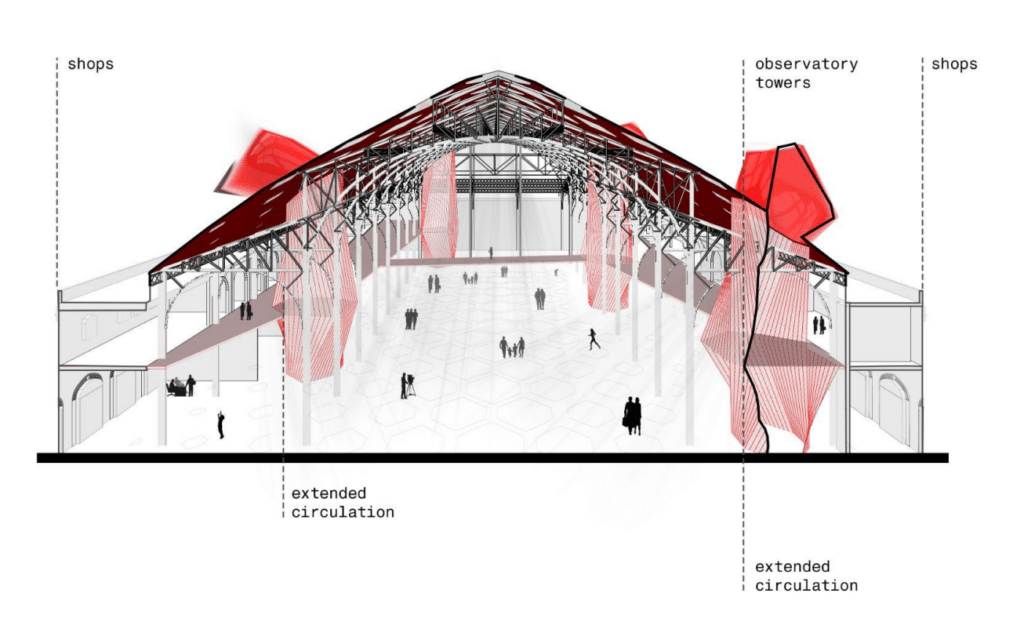

Structurally, the new intervention establishes a clear yet respectful relationship with the existing building. Additional diagonal bracing is introduced between the original structure and the new panel system to ensure stability. The panels are conceived as recycled fiberglass, while transparent elements are designed as glass panels. The primary load-bearing system is a steel structure, which enables both structural efficiency and visual lightness.

Natural light plays a significant role in shaping the interior atmosphere. Openings within the panelized roof system allow daylight to penetrate deep into the space, creating dynamic lighting conditions that evolve throughout the day. The vertical circulation cores, conceived as transparent and self-standing structures rising toward the observatory towers, introduce an additional spatial layer within the interior. This interaction between light, structure, and circulation enhances the overall experiential quality of the space.
