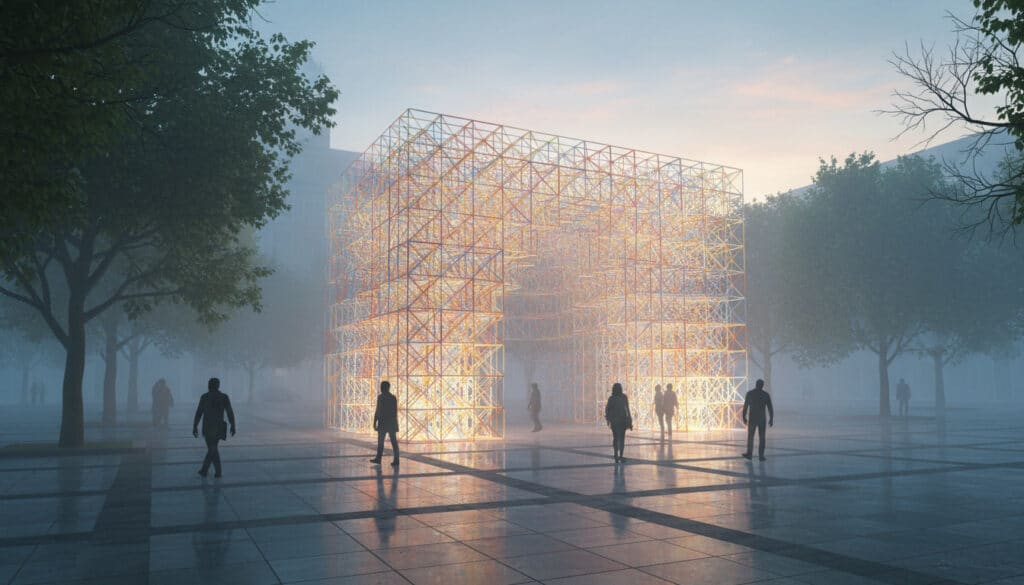
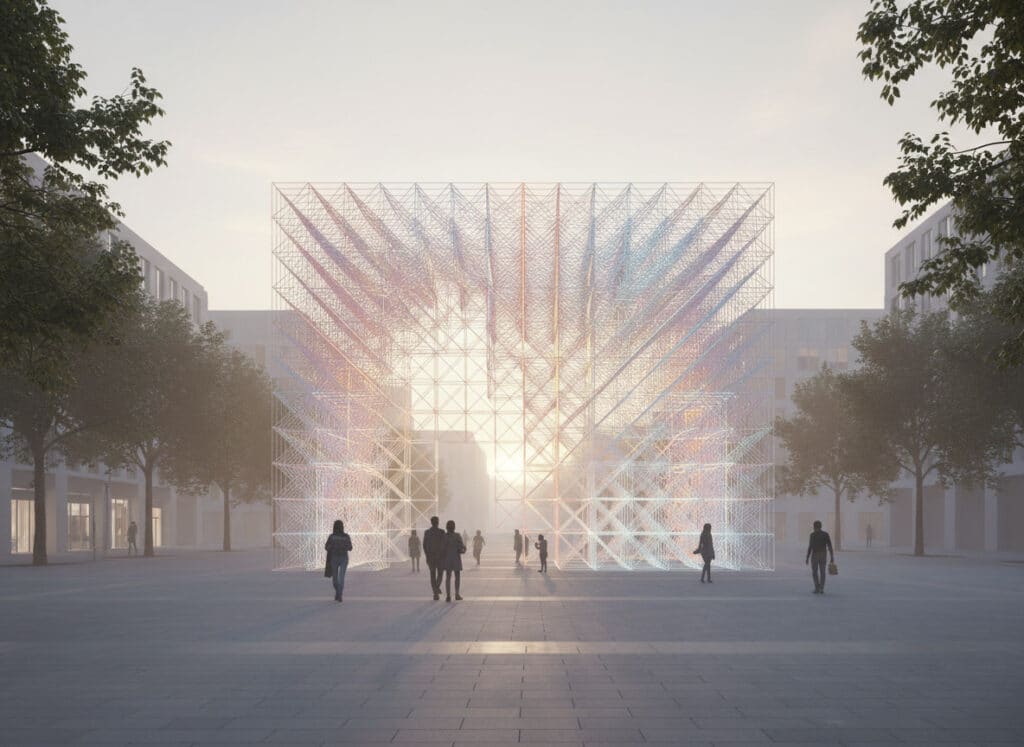
Glass fibre 3D printed temporary pavilion
A structural and topological investigation into voxelised lattice systems, combining catenary form-finding with performance-driven optimisation to explore emergent spatial order and material efficiency.
The Idea
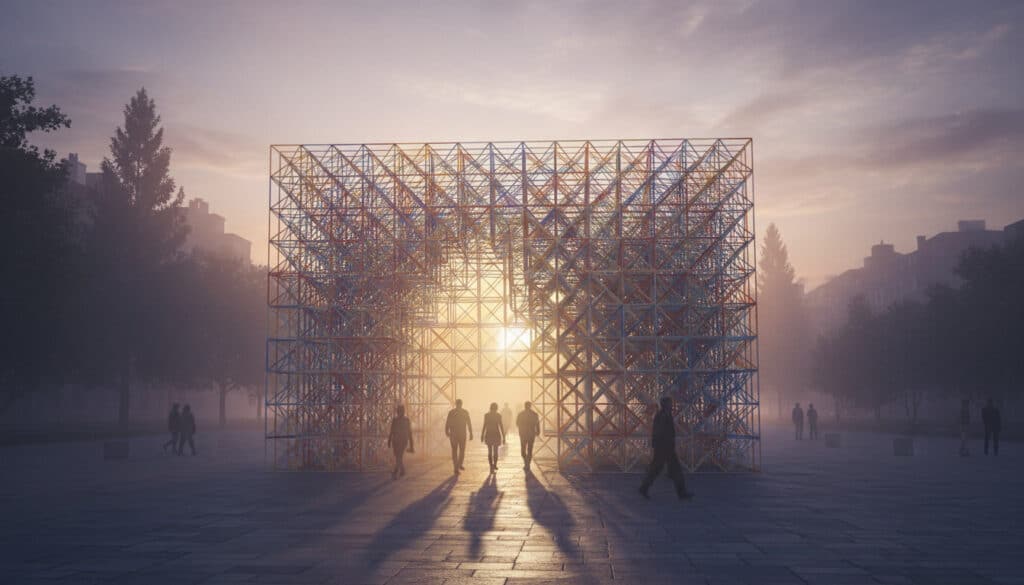
This project explores how a rigid, modular voxel system can define and enclose a pavilion, while an internally generated catenary geometry shapes circulation and spatial experience. The contrast between the repetitive, modular structure and the soft, irregular interior creates a clear tension between external order and an immersive, labyrinth-like space.
Computational workflow
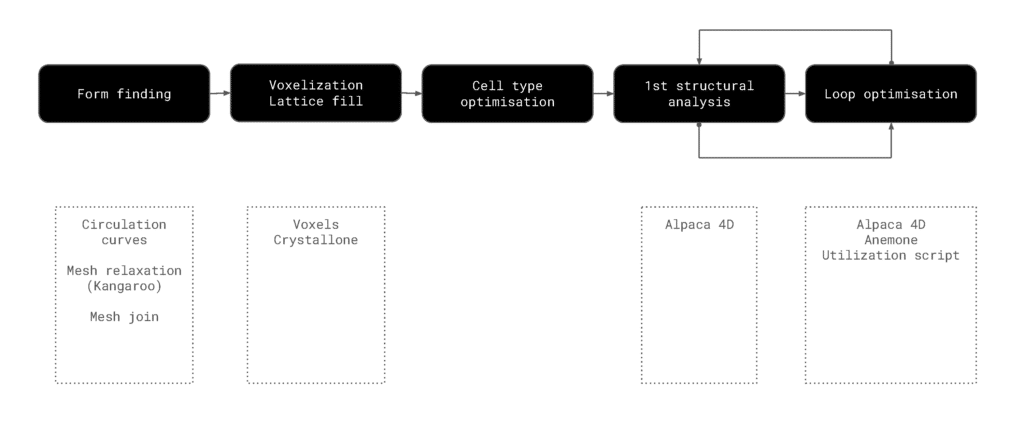
The computational workflow was based on 5 steps which are:
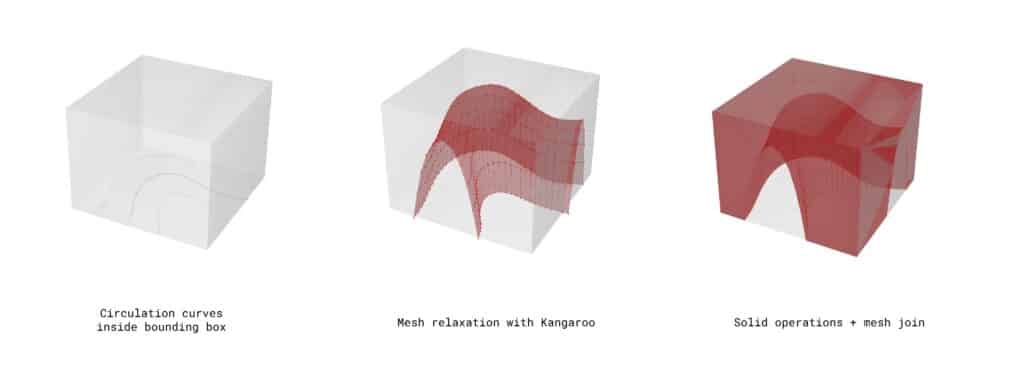
- Form Finding: The pavilion form is derived through catenary-informed mesh relaxation using Kangaroo plugin in Grasshopper, which articulates internal circulation paths, defines the internal void and the geometry of the arches.
- Voxelization: The resulting pavilion geometry is voxelised into a rigid modular grid and prepared for structural evaluation using Voxels and Crystallone plugins.
- Structural Analysis: To determine the best lattice unit, the entire pavilion is analysed as a single structural system in Alpaca 4D.
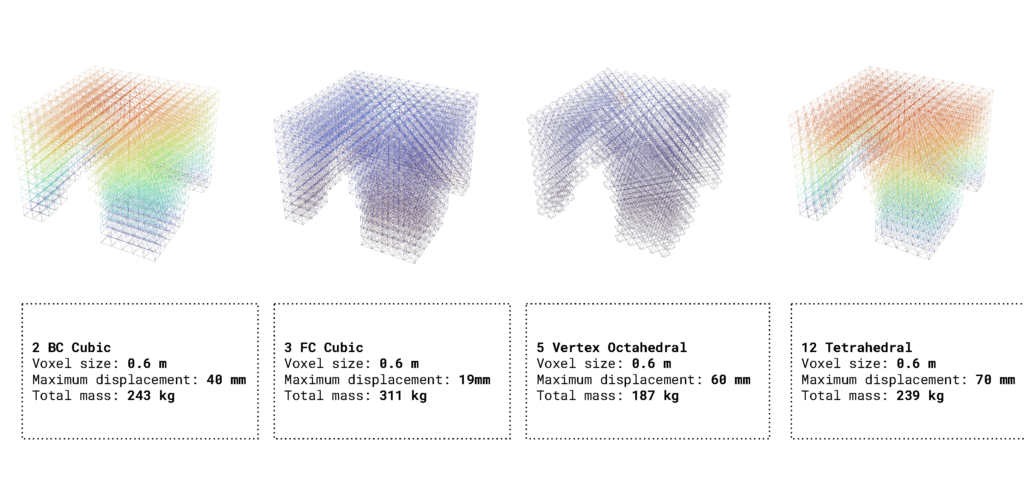
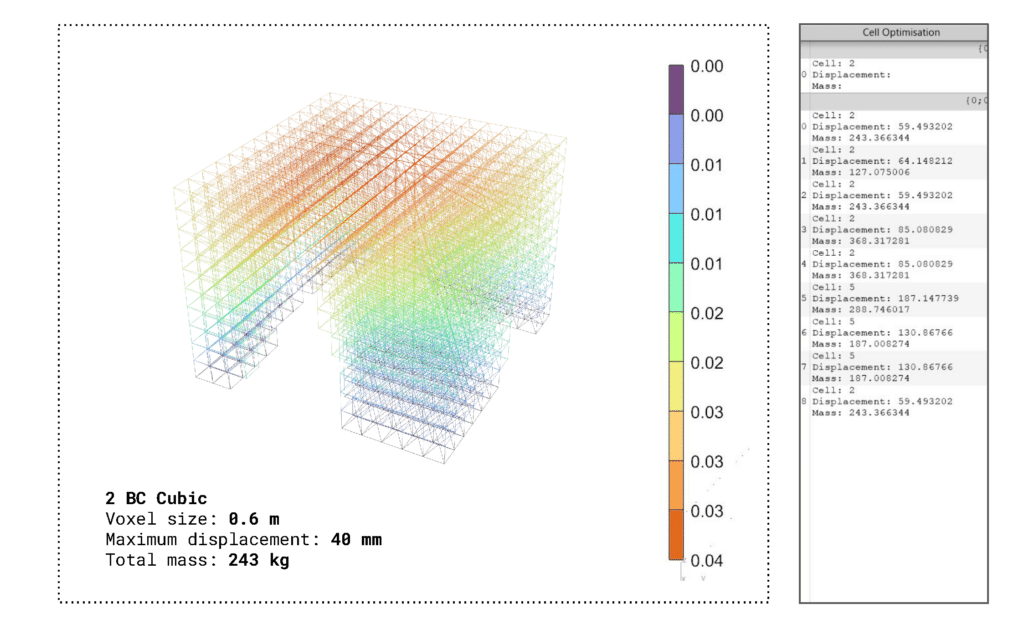
- Cell Unit Analysis: A comparative analysis of voxel cell types using Crystallon informs the selection of the optimal unit based on mass and displacement performance, extracted from the structural analysis. The Body Centered Cubic cell type was selected.
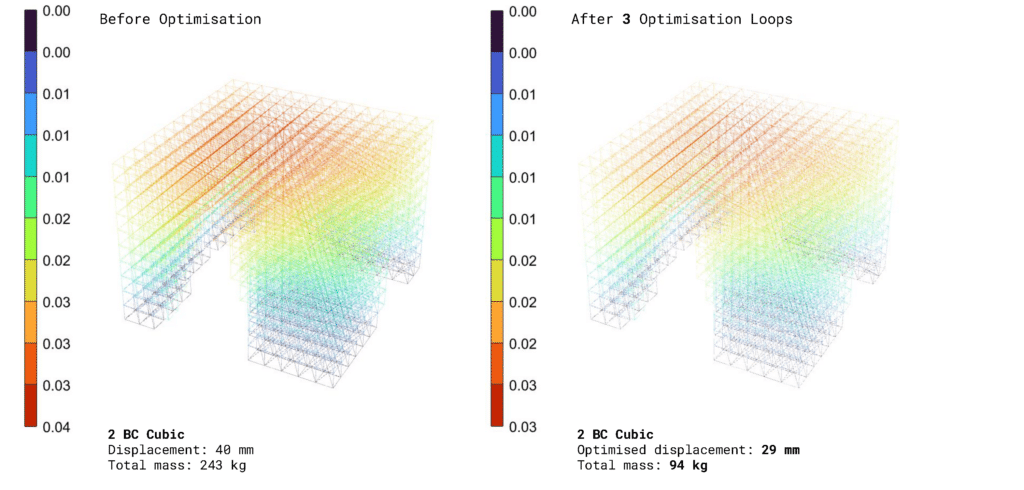
- Optimisation: After the unit is chosen, the structural analysis is run with the best unit and fed into an Anemone loop which automates iterative optimisation, adjusting beam cross-sections to maximise structural performance while minimising material use.
Form finding
Voxelization
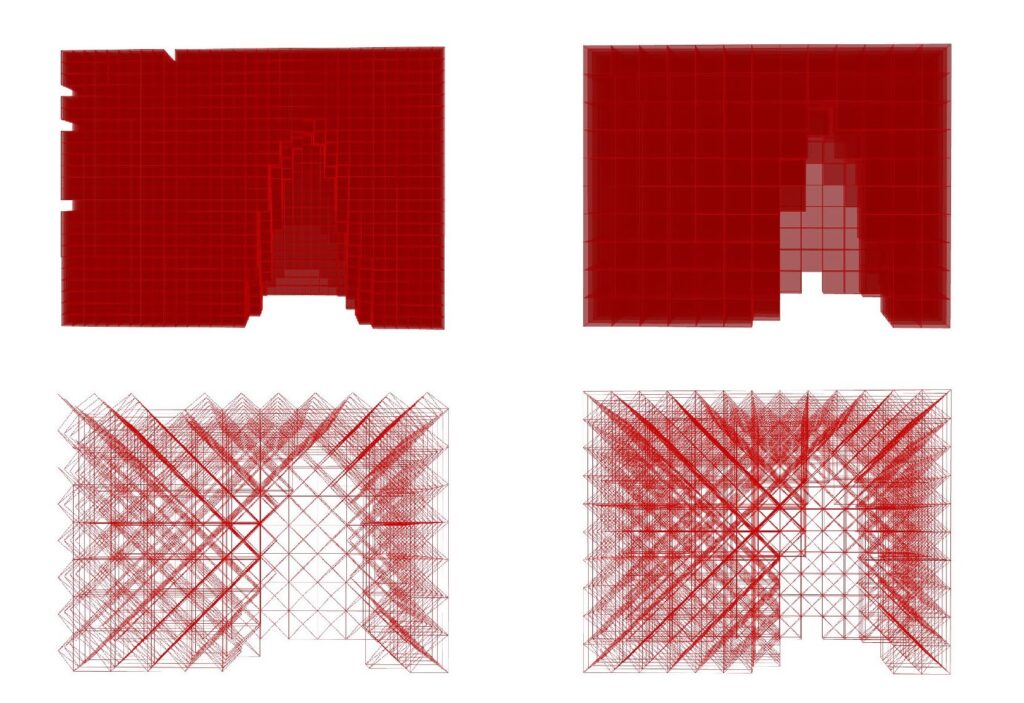
Once the pavilion form is defined, it is translated into a rigid voxel grid, filling the entire bounding volume, 8 x 8 x 6 m. The geometry was first voxelised with Crystallon, which accurately followed the interior catenary shapes but created structural issues, with some voxel parts missing and inconsistent valence. A second voxelisation using the Voxel tools plugin was less precise geometrically but produced a coherent, stable lattice that was structurally preferrable.
Structural Analysis
Inputs into Alpaca 4D structural analysis for beams / columns analysis are as follows:
Constant Gravity Load + Wind Load 0.08 kN/m2 XZ plane
Material: Glass reinforced recycled PET (Young Modulus 9.47e+6 kN/m²; Density 1710 kg/m³)
Total of: 13253 beams; 181 supports; 2822 point loads.
Cell Unit Analysis
Different voxel cell types are compared using Crystallon, evaluating mass and displacement performance. This identifies the most efficient cell for the pavilion’s modular grid before full structural evaluation.
Optimisation
Once the unit is chosen, a custom utilisation script is introduced to measure each beam’s efficiency. This reveals which elements are over or under utilised, providing a basis for targeted optimisation. Finally, an Anemone loop automates iterative adjustment of beam cross-sections, improving material efficiency and reducing mass while keeping displacements within limits. The result is a lightweight, expressive pavilion that balances structure and spatial experience.
Results
The iterative optimisation significantly improved the pavilion’s structural performance. Through repeated Anemone loops, the mass of the structure was reduced by 62%, from 243 kg to 94 kg, while the maximum displacement was limited to 29 mm. The final pavilion is lightweight yet expressive, balancing the rigid, voxelised exterior with the soft, labyrinth-like interior. The workflow demonstrates how computational design, structural analysis, and topology-based optimisation can be integrated to achieve both material efficiency and spatial quality.