
Computational design can feel like a field you need permission to enter, a space guarded by complex software, specialized knowledge, and a career path that isn’t clearly written anywhere. But after sitting down separately with Aaron Porterfield, developer of the open-source Grasshopper plugin Crystallon, and Aman Agrawal, founder of Cademy and computational design specialist at Apple, what struck me most was how neither of them had a map either. Aaron began building his own tools at Fathom Manufacturing because clients needed lattice structures, the kind that could replace foam padding or reinforce protective components in technical gear, and the available software in 2014 simply wasn’t good enough, so he looked at Grasshopper and figured he could probably do it himself. Aman started because he wanted to learn Open Frameworks, hit a wall with C++ syntax, and ended up experimenting with Grasshopper geometries that he posted online with no particular agenda. In both cases, the entry point wasn’t a curriculum or a job title. It was a gap, and the instinct to fill it. If you’ve spent any time in industrial design, that sounds exactly like the work.
What made Aman’s path particularly resonant was that the experimentation wasn’t a phase he left behind. It became the work itself. He started sharing his Grasshopper experiments on social media, geometries and textures and computational concepts applied to product forms, and slowly the engagement grew. Design studios found him. Clients came from that visibility. As he put it, “I was doing the same thing but for a client. The transition was not that difficult because I could translate easily what I was experimenting as an artistic tool, but now to a client for a practical project.” This is something industrial design school teaches implicitly but rarely names: that curiosity, when pursued seriously and shared openly, is its own form of positioning. Aman eventually learned to read the market more deliberately too, understanding what studios actually need, whether that’s parametric textures, topology optimization, or automated workflows. He frames both approaches not as opposites but as things that work together. Do the work the market needs, and do the projects that make companies imagine something they haven’t tried yet.
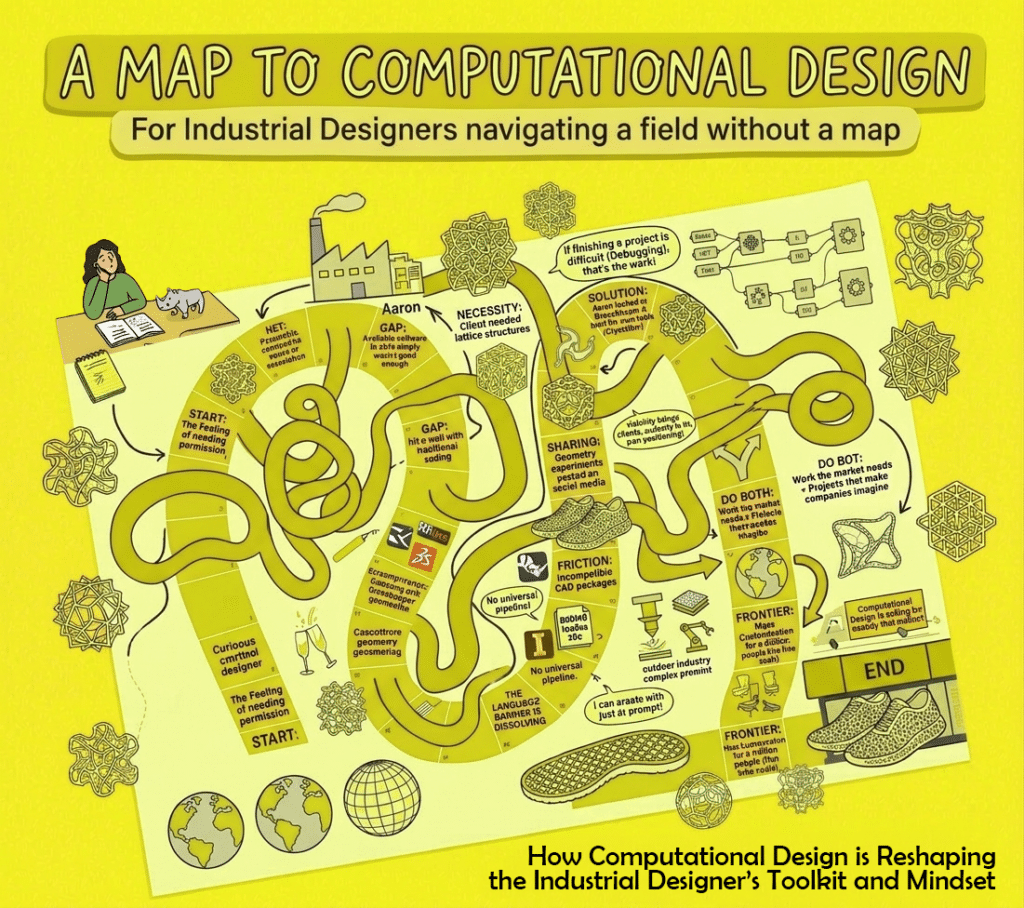
That is what gives me the most hope about entering this space, and part of that hope comes from where the tools themselves are heading. Aman’s entry into computational design began precisely because the language barrier of traditional coding, the C++ syntax wall he hit when trying to learn Open Frameworks, pushed him toward Grasshopper’s more visual and intuitive logic. Aaron sees that barrier continuing to fall. He talked about vibe coding, writing scripts through AI prompts without needing to know the language formally, and said that in five years you will likely be able to describe what you want a script to do and AI will write it correctly. “With a little knowledge I have of programming, I can actually create quite a lot just with AI.” He was careful to say it won’t replace designers who understand the logic underneath, but that the language barrier to coding is dissolving. Both Aaron and Aman point to a field that is present but not yet settled in product design. Aaron describes mass customization as the real frontier: “making a custom bike seat for a million people sounds impossible, but with computational design tools it is possible.” He also sees the outdoor and technical gear industry as held back more by cost and culture than by capability, not a closed door but an open one that hasn’t been walked through yet. Aman lists Samsung, Herman Miller, Apple, and automotive interiors as places actively hiring for computational design roles, while noting that most of the industry still has no established culture around it. That gap between what is technically possible and what is actually being practiced is uncomfortable if you need certainty, but it is exactly where industrial designers belong. We are trained to find the unmet need, to prototype before the answer is clear, and to build the solution and the process for building it at the same time. Computational design is still asking for exactly that. And honestly, that is exactly what someone like me needed to hear — that there is a place in this field for the same instinct that got me into industrial design in the first place, and that doing good work out of necessity is not a small thing. It is a way of being part of something bigger.
What neither interview romanticizes is the reality of the day-to-day. Aaron was candid in a way that felt genuinely useful: “It’s fun starting a project. It’s never fun finishing a project. Making something that works all the time is very difficult.” Ninety percent of his work, he said, is debugging, building processes that have to run correctly for every new customer, every new scan, every new body. Aman described a different but equally tedious friction: 800-megabyte files being emailed back and forth between incompatible CAD packages, clients working in SolidWorks or CATIA while he works in Rhino and Grasshopper, no universal pipeline, no clean handoff. In a product category like outdoor and technical gear, where a single item can involve multiple material types, ergonomic fit data, and performance testing across conditions, that pipeline complexity only multiplies. And yet neither conversation reads as discouraging. It reads as the texture of work that is still being figured out, which means the people doing it are still, in some real sense, inventing it.

How Computational Design Is Reshaping the Industrial Designer’s Toolkit and Mindset is a project of IAAC, Institute for Advanced Architecture of Catalonia developed in the Master in Advanced Com putation for Architecture and Design – 2025-2026 by the student Lakzhmy Mari Zaro during the course MaCAD 25/26 BIMSC Theory with faculty Maite Bravo and Hande Karataş.
