
This is part of the Integrative Modeling Seminar, within the Hyperbuilding studio, where three hyperbuildings were developed in parallel.
We are presenting Hyperbuilding 03 from the perspective of the Structure & Façade team, focusing on how integrative modeling was developed using Revit and Rhino Inside Revit.
In the studio, the work is organized into three teams: Structure & Façade, Program, and Data.
Our role is to develop the structural system and façade strategy, and integrate them into the overall design.
At the same time, we work closely with the other teams, creating a continuous feedback loop between design, data, and tools.
Plot Choice
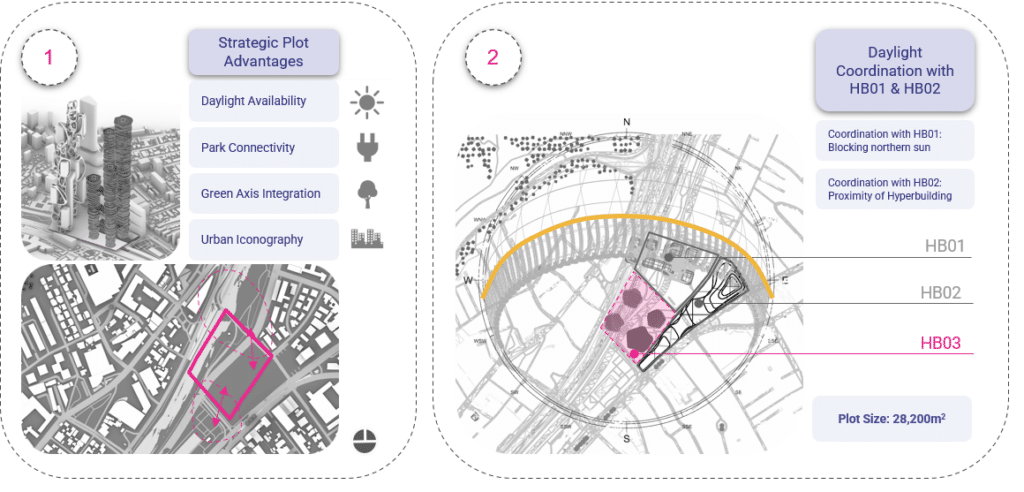
Hyperbuilding 03 is located on a plot of 28,200 square meters.
The site was selected for:
- High daylight availability,
- Connection to the park,
- And integration within the green axis.
The three hyperbuildings are also interdependent:
- HB01 blocks part of the northern sun,
- HB02 affects proximity and shading,
Massing Strategy
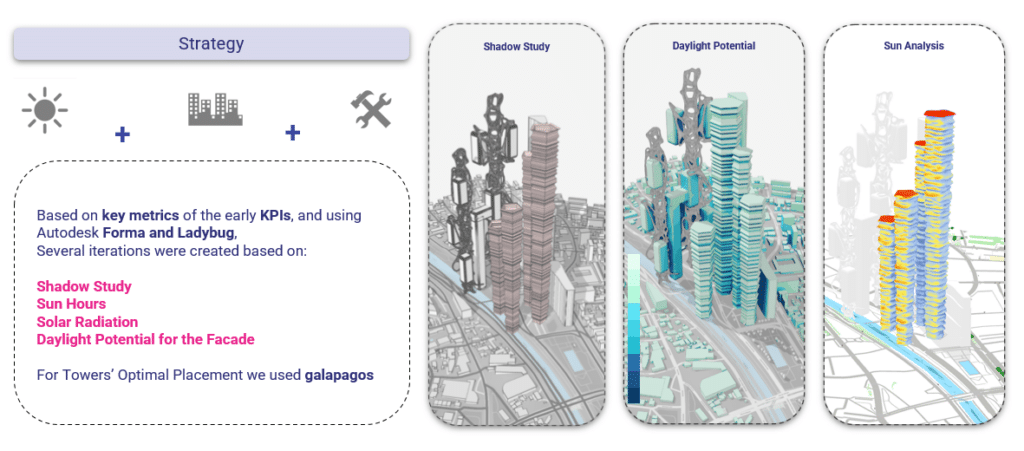
The massing was developed through environmental analysis.
Using Ladybug and Autodesk Forma, we evaluated:
- Shadow impact,
- Sun hours,
- Solar radiation,
- And daylight potential.
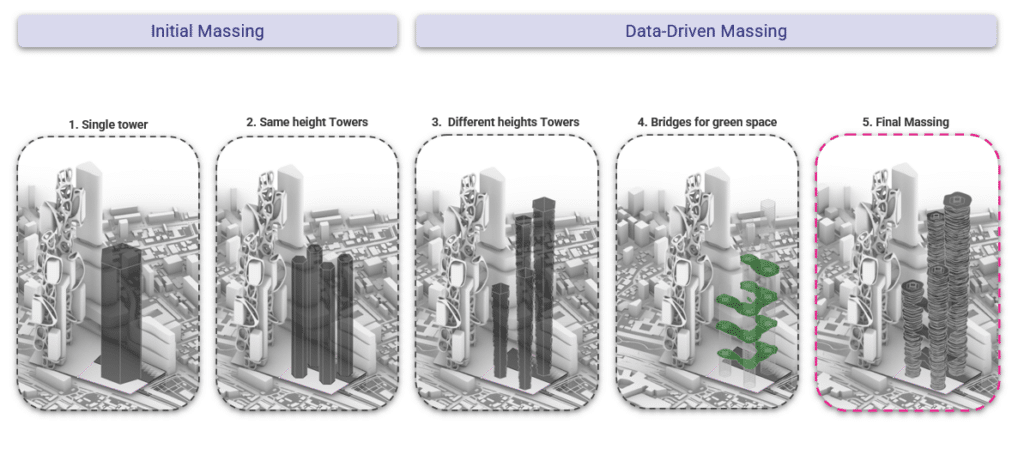
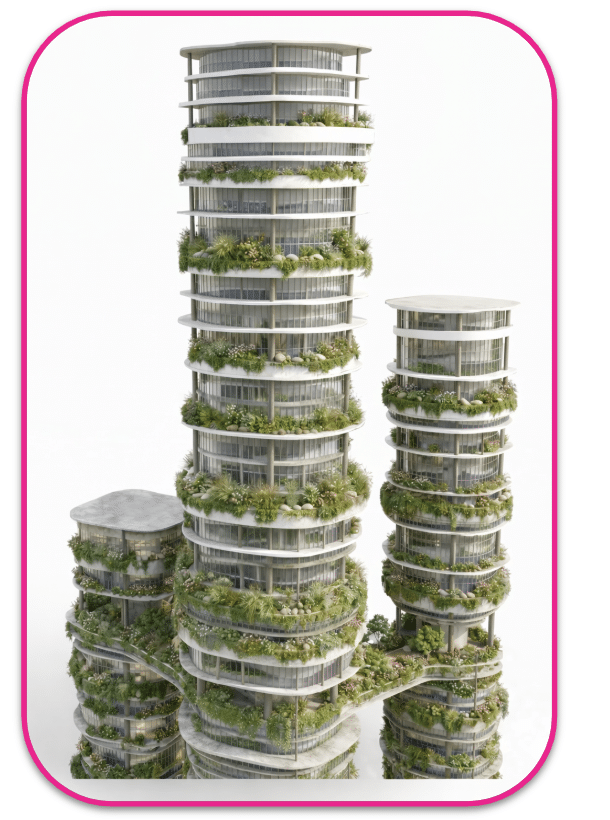
We tested different configurations, from a single tower to multiple towers, and finalized a system of four connected towers, balancing performance and spatial quality.
Concept
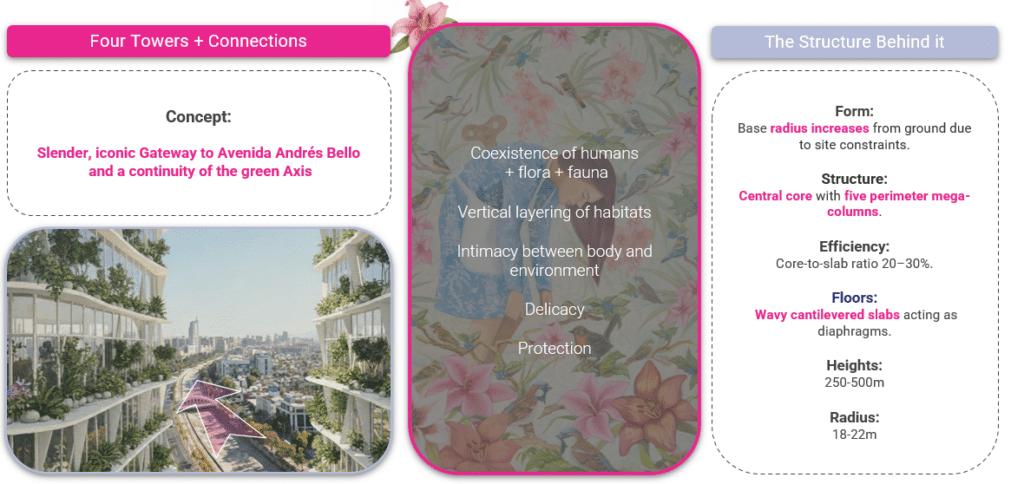
The concept positions the building as a slender gateway, extending the green axis vertically.
From our perspective, the focus is on:
- Coexistence of humans and connection with nature
- Vertical layering of habitats,
- And a strong relationship between structure and environment.
The connections between towers reinforce both structural continuity and ecological integration.
Structural Concept
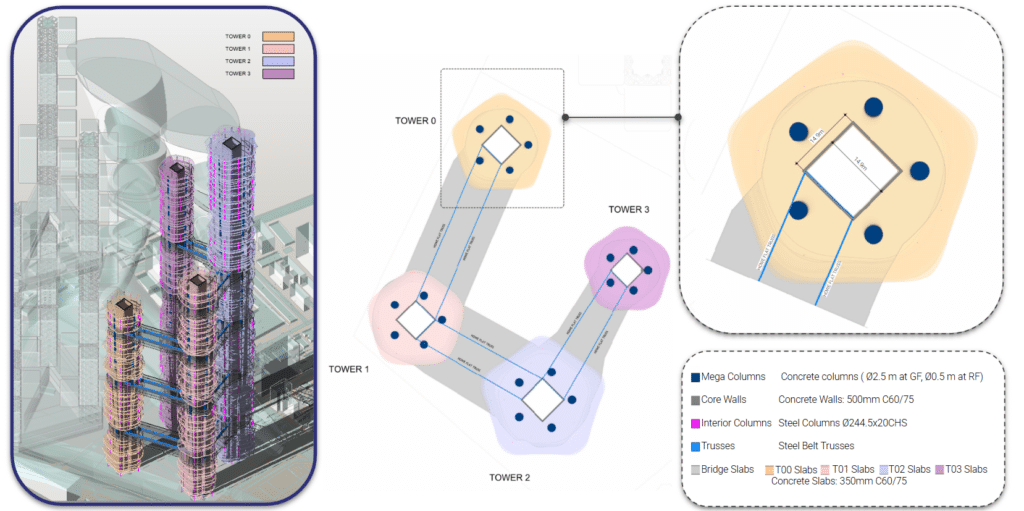
The structural system is based on:
- Central core,
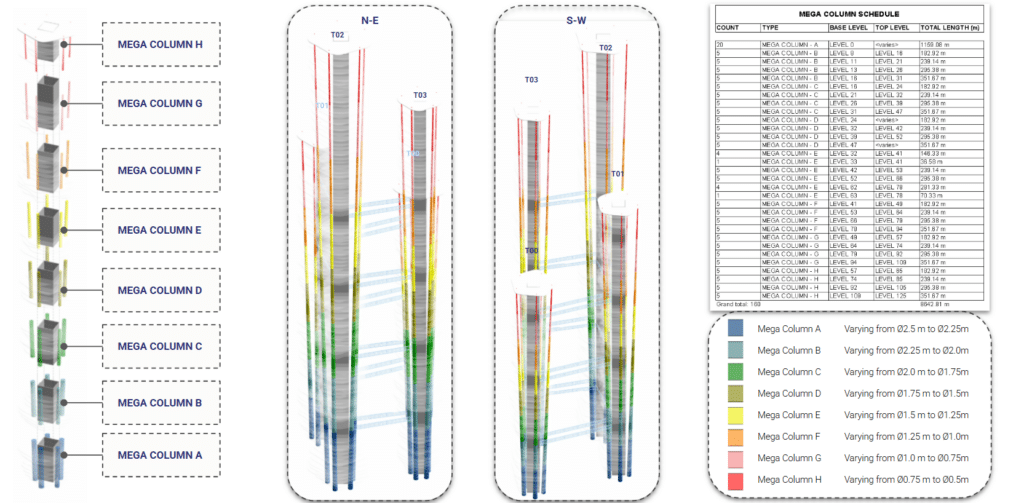
- Five perimeter mega-columns per tower that taper from 2.5m to 0.5m
- Wavy Slabs that act as diaphragm
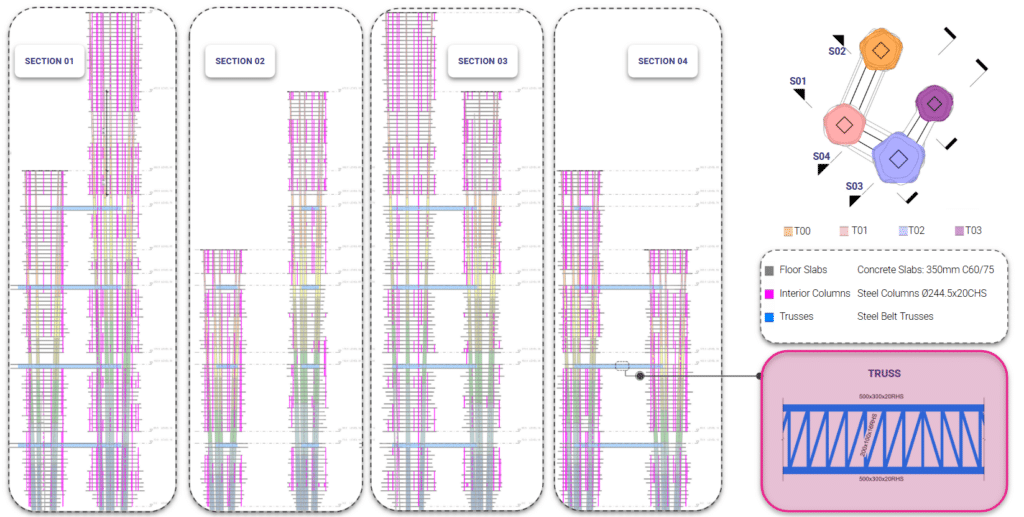
- and Bridges/Trusses that connect all towers
The towers reach heights between 250 and 500 meters,
with radius of 18 to 22 meters.
We achieve a core-to-slab ratio of 20–30%, ensuring efficiency.
Interior Columns & Trusses
Mega Columns
Our structural analysis shows peak compression at the base of the tower which justifies increasing the mega-column sections toward the bottom and reducing them towards the top.
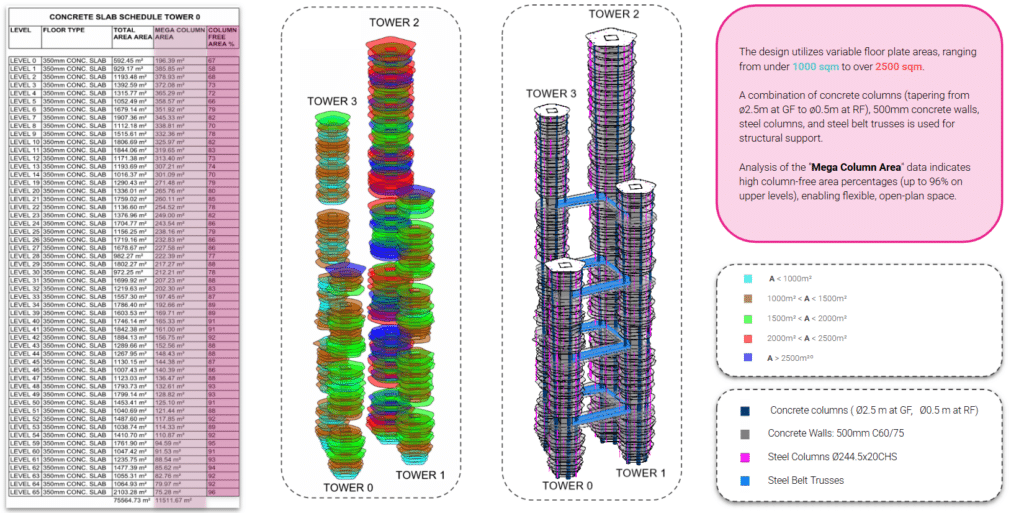
Wavy Slabs
The wavy slabs are both structural and spatial elements. Each floor acts as a structural diaphragm, distributing forces and ensuring geometric force closure.
They:
- Vary floor plate sizes from 1000 to over 2500 square meters,
- Improve load distribution,
- And create diverse interior spaces.
So structure is not only technical, but also drives spatial quality.
Façade Concept
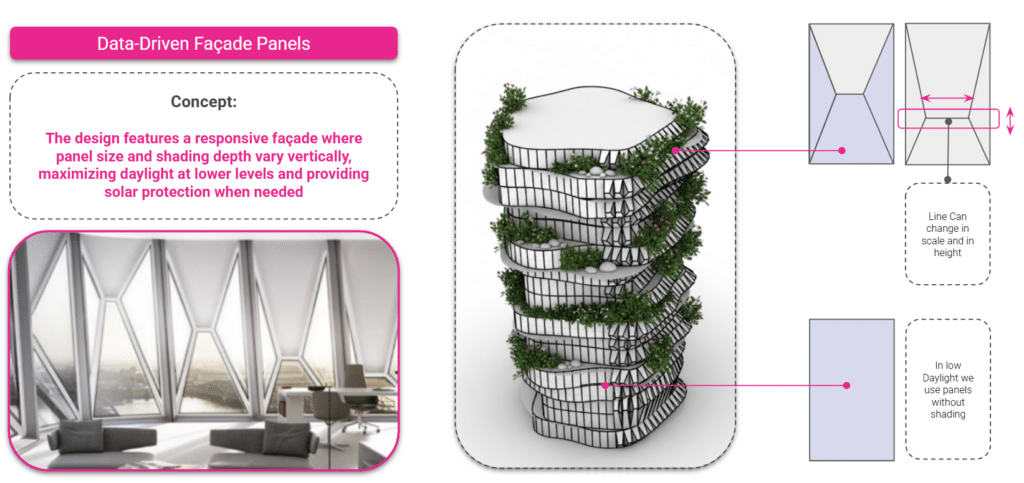
The façade is designed as a data-driven system.
Panel size and shading depth vary depending on environmental conditions:
- More open where daylight is low,
- More shaded where solar exposure is high.
This creates a façade that adapts vertically and improves both comfort and performance.
Façade
Through solar radiation analysis, we evaluated performance across orientations.
Radiation ranges from 170 to over 1025 kWh/m² per year.
The façade consists of over 24,000 panels, grouped into 10 categories per tower, allowing precise control.
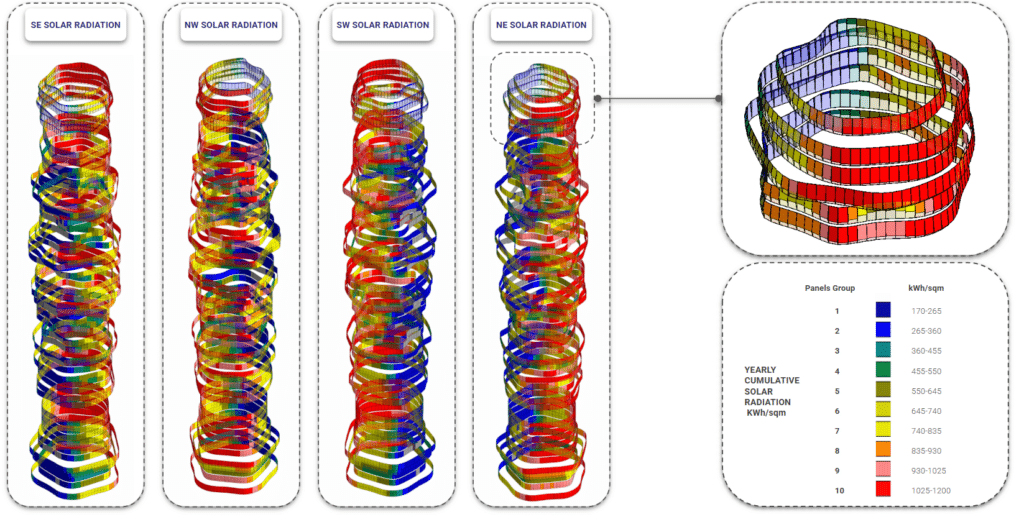
High-radiation areas require deeper shading and vegetation, while lower-radiation areas remain more open. This shows how façade design is directly driven by environmental data.
Conclusion
As the Structure & Façade team, our work demonstrates how integrative modeling allows us to:
Connect structure, façade, and performance,
Work between Rhino and Revit,
And collaborate with the team
Hyperbuilding 03 becomes a coordinated system, where design and data evolve together
