INTRODUCTION
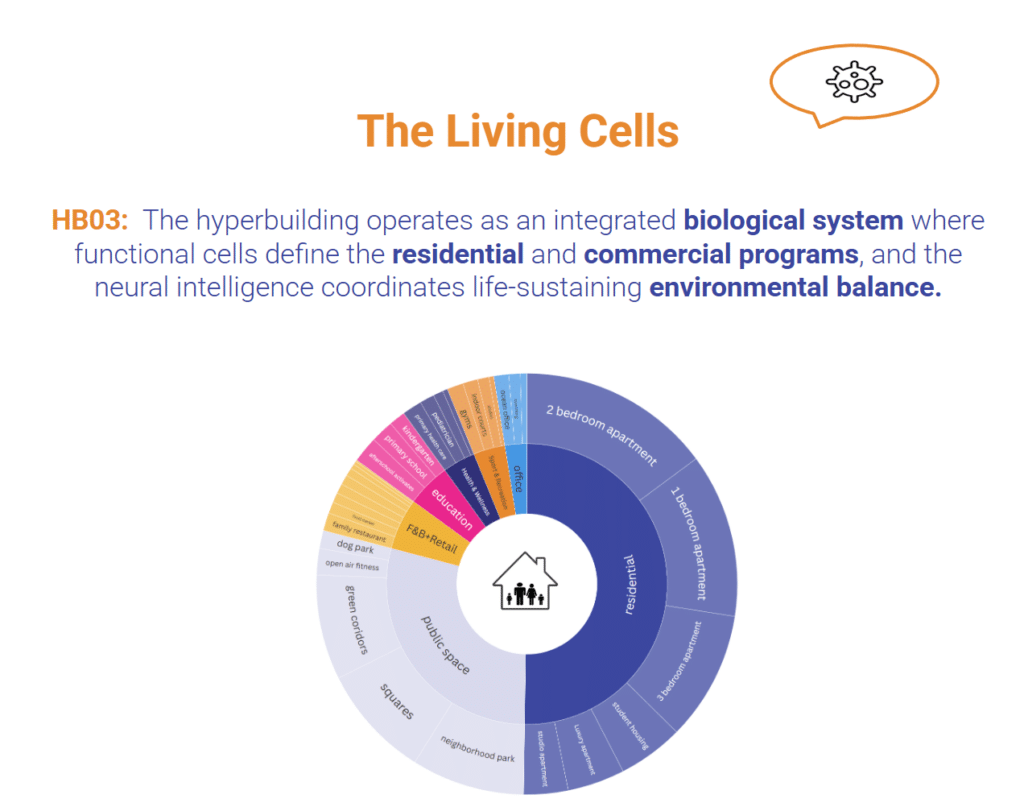
As the program team our role is to define the overall program strategy, which we call The Living Cells, with the goal to create a livable neighborhood that supports daily life beyond residential use. This means integrating a range of supporting functions — public and green spaces, schools, retail, and community amenities — so that every part of the neighborhood is active, inclusive, and self-sufficient.
PROGRAM UTILIZATION
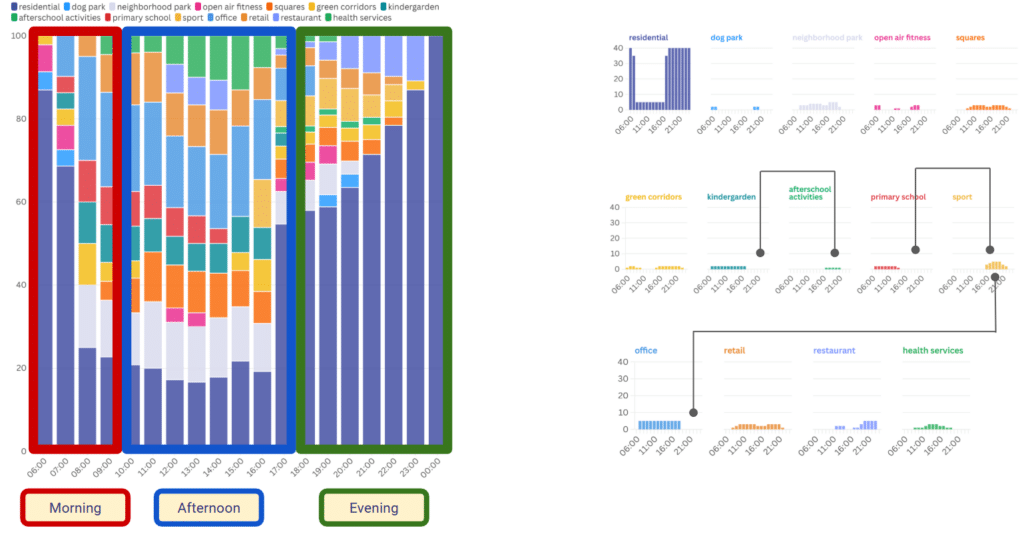
We conducted an occupancy study to understand how the use of different programs shifts throughout the day, comparing morning, afternoon, and evening patterns. This analysis highlights peak activity periods across residential, commercial, educational, and public functions, revealing how spaces are activated over time. These insights help inform more efficient program distribution and support better spatial and operational performance within the building.
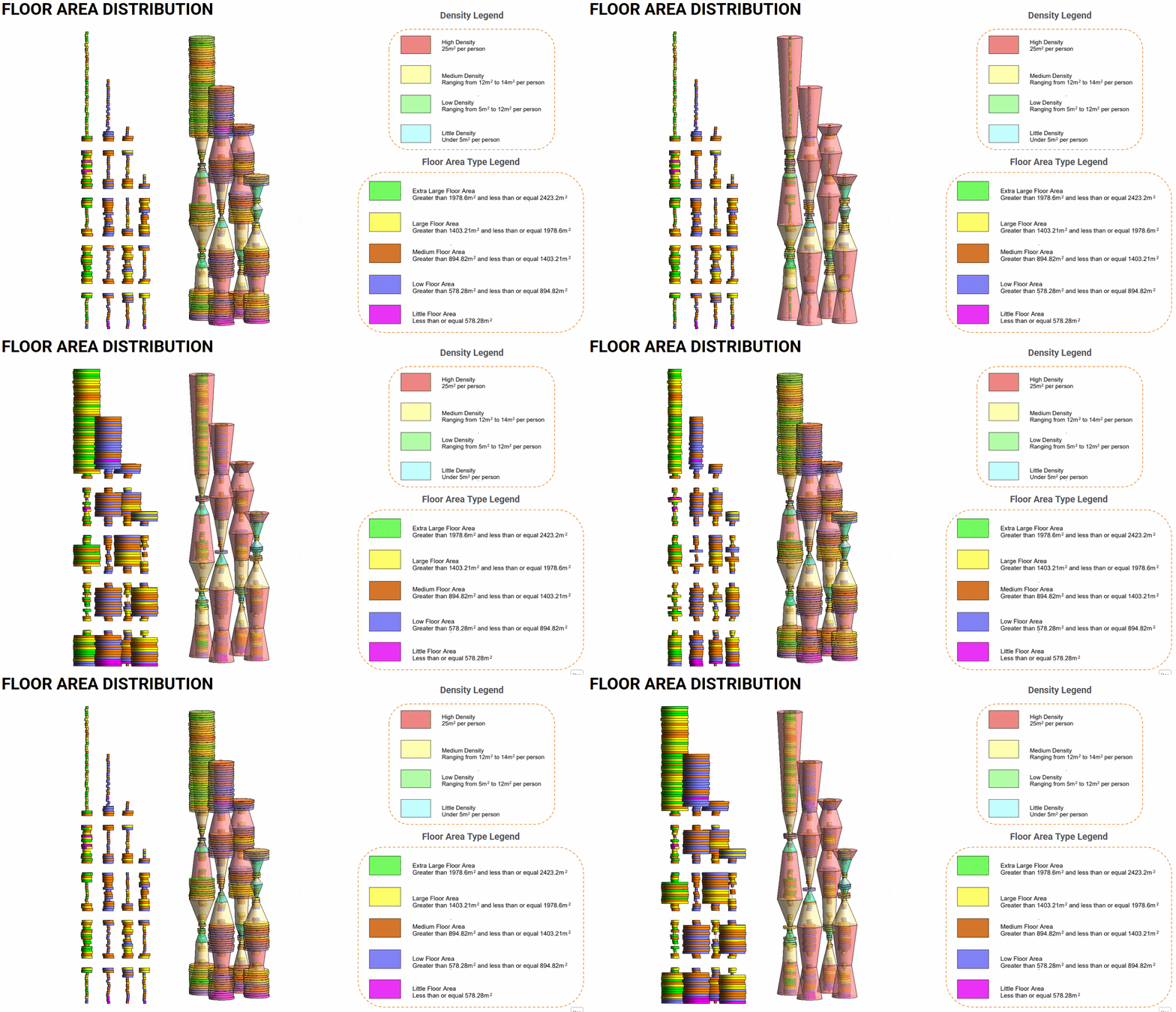
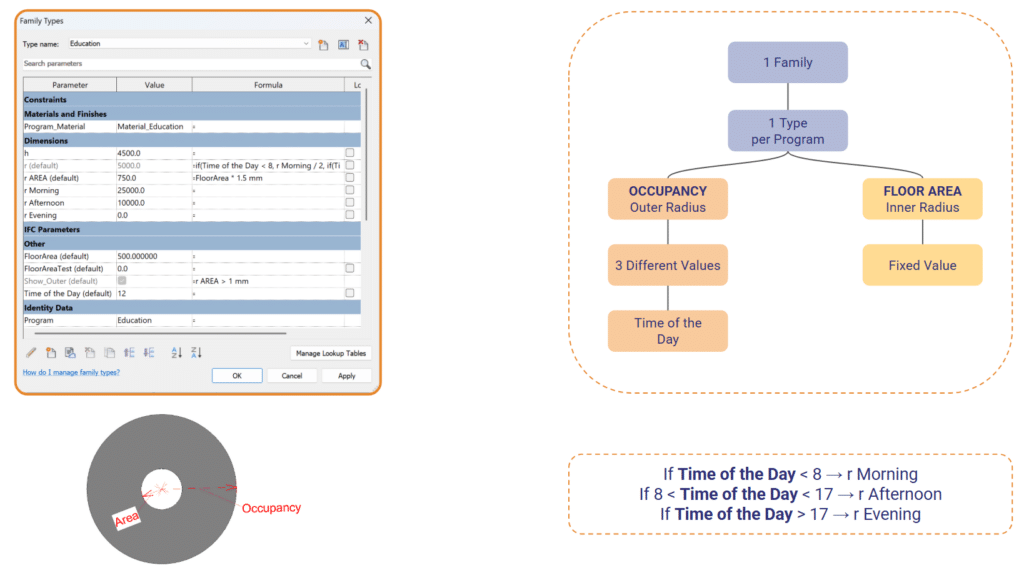
To represent all this data in a schematic way, we modeled a Revit family in the shape of a cylinder, and defined one type per program. The family has two key geometric parameters. The outer radius represents occupancy. It changes dynamically depending on the time of day, which we set as a global parameter. The inner radius, on the other hand, represents the floor area. This is modeled as a nested family and it holds a fixed value for each different floor. Another condition is set to visualize only the inner cylinder if the occupancy is zero.
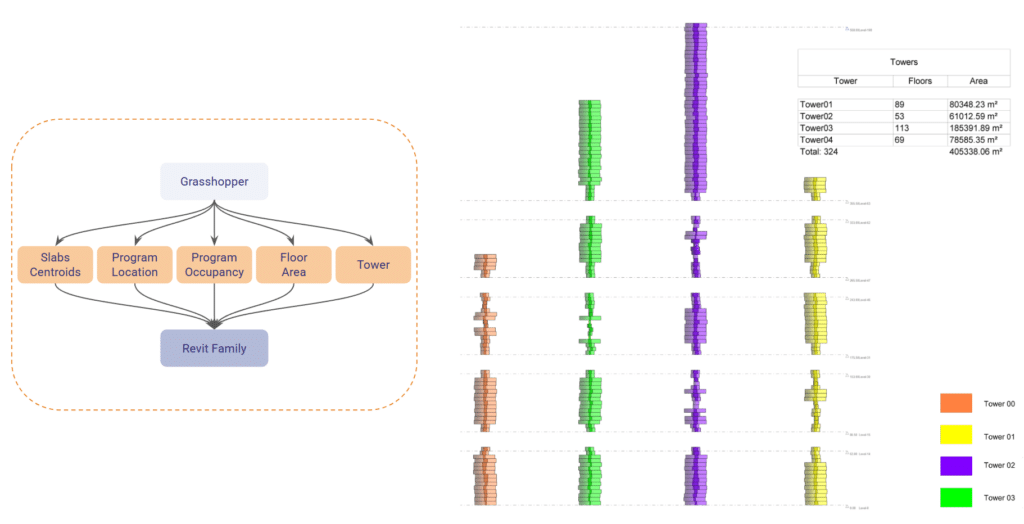
Through Rhino.Inisde.Revit we sent five key inputs to the revit family: the slab centroids, which define where each floor element is located in space; the program location, which tells us what type of use is assigned to each floor; the program occupancy, carrying the time-based utilization data we analyzed earlier; and the floor area, which sets the inner radius of each family instance and the corresponding tower number.
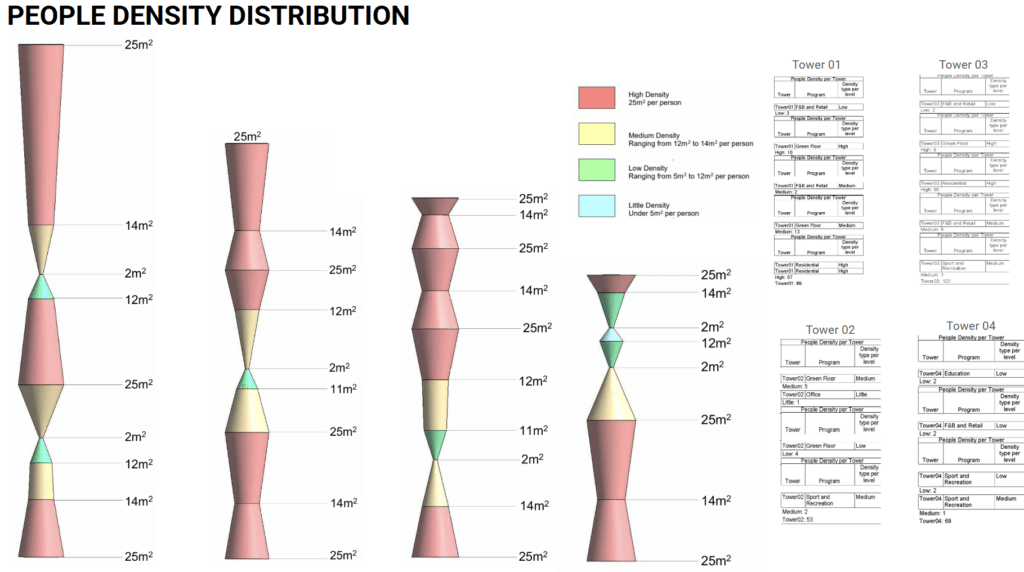
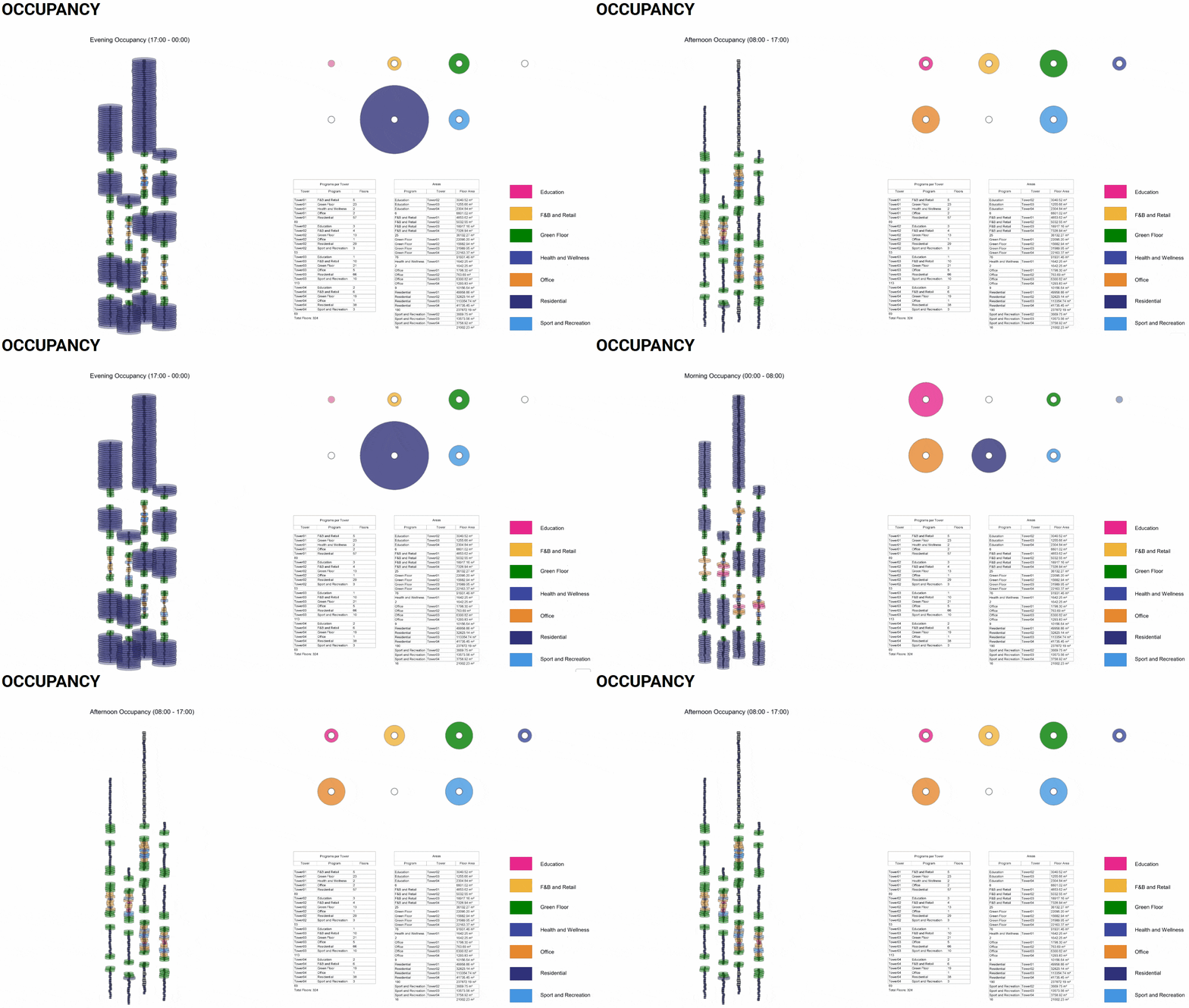
The model is filtered by program and the cylinder visually expands or contracts to reflect how many people are expected to occupy the space at any given moment. It demonstrates how the model can be queried at any hour to reveal the living rhythm of the neighborhood. The model encodes both the static footprint of the program and its variable occupancy over time.
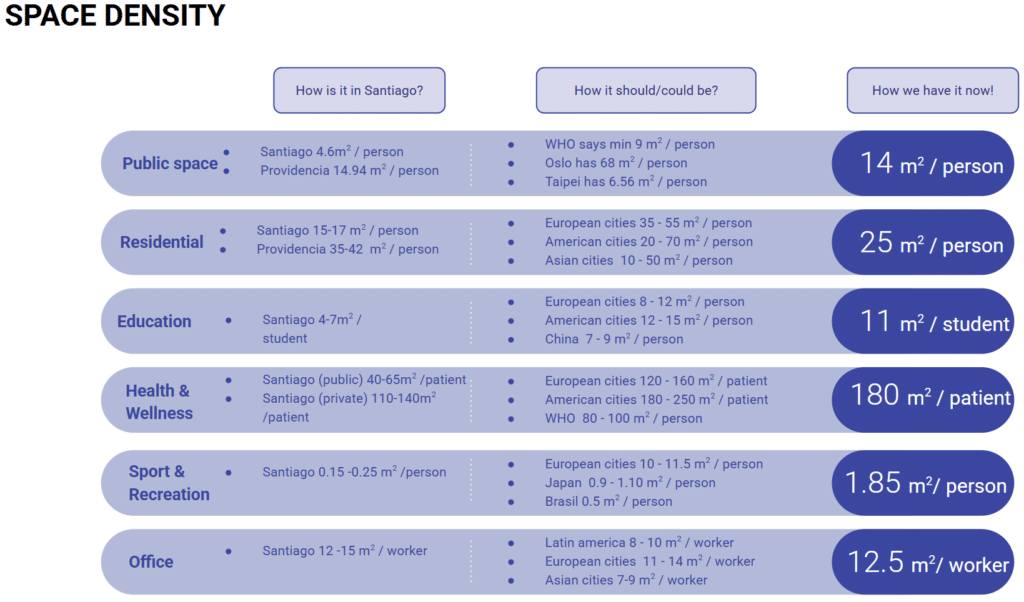
SPACE DENSITY RESEARCH