
In the traditional architectural workflow, parametric models are often “trapped” inside heavy desktop software like Rhino and Grasshopper. My latest project, the Parametric Brick Pavilion, aims to bridge this gap by moving high-level structural computation directly into a web-based interface.
The Challenge: Accessibility in Complexity
Parametric design is a powerful tool for iteration, but it usually requires a steep learning curve and expensive hardware. For this assignment, part of the IAAC-MACAD curriculum, I wanted to create a tool where a designer—or even a client—could manipulate complex architectural metrics through a simple, intuitive dashboard without ever opening a CAD program.
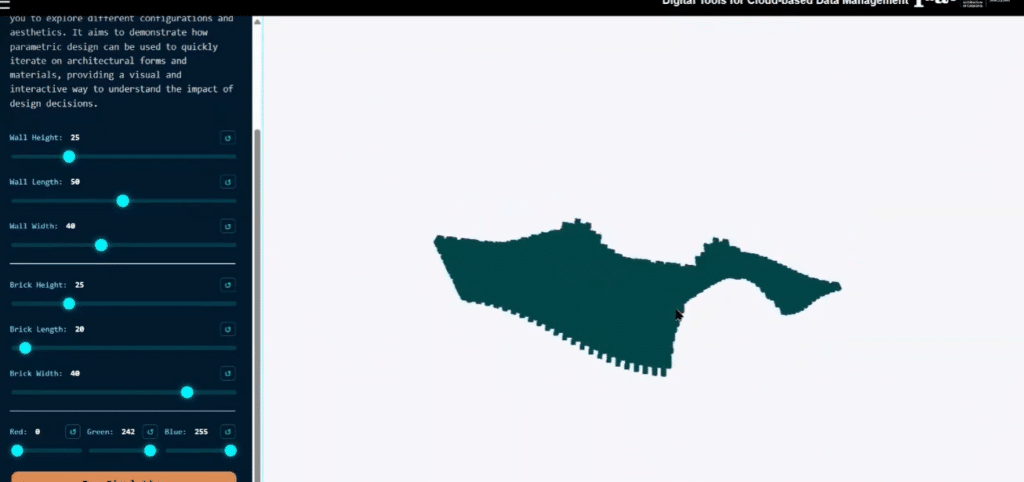
The Tech Stack: Rhino Compute + Vue.js + Three.js
To achieve a seamless “Vertical Machine” workflow, the project utilizes a modern decoupled architecture:
- The Engine: A Grasshopper definition running on Rhino Compute. It handles the heavy lifting—calculating brick positions, wall curvatures, and structural logic.
- The Interface: Built with Vue.js, the frontend manages a series of reactive parameters.
- The Viewport: Using Three.js, the app renders the resulting geometry with high-fidelity shadows and materials, providing an immersive 3D experience.
Design Logic & Instant Feedback
The pavilion is defined by a series of “Wall” and “Brick” parameters. One of the technical highlights of this project is the Dual-Stream Update Logic:
- Geometric Solving: When structural dimensions (like Wall Height or Length) change, the app sends a request to the server to re-solve the entire form.
- Instant Visual Styling: To keep the UI feeling “snappy,” I implemented an RGB Watcher. This allows users to change the color and material properties of the bricks in real-time within the browser, bypassing the server entirely for aesthetic tweaks.
Why it Matters
This project isn’t just about a brick wall; it’s about Operational Resilience in design. By translating BIM (Building Information Modeling) data into a web-friendly format, we democratize the design process. It allows for “Spatial Versatility” where users can explore thousands of variations in seconds, leading to more informed and efficient architectural outcomes.
Final Thoughts
As we move toward more collaborative, data-driven design environments, the browser is becoming the new drafting table. The Parametric Brick Pavilion is a step toward a future where complex architectural intelligence is accessible to everyone, everywhere.
